

Written by: Ali-Reza Adl-Tabatabai, Founder and CEO, Gitar
Key Takeaways for Java Developers
- Free AI Java code generators like ChatGPT and GitHub Copilot speed up prototyping but often output code that needs manual fixes, with under 44% accepted without changes.
- Gitar ranks first with a 9.8/10 score and a 14-day free trial for AI code review, auto-fixing CI failures, and Java support across Maven and Gradle projects.
- IDE integration varies by tool: Codeium works well in Eclipse and IntelliJ, Copilot shines in VS Code and IntelliJ, while ChatGPT relies on copy-paste workflows.
- Common issues include compilation errors, dependency hallucinations, and missing CI validation, which can slow teams despite high productivity expectations.
- Pair free generators with Gitar’s 14-day free trial to automatically fix issues and ship production-ready Java code.
How We Tested These Java AI Code Tools
We evaluated each tool with five Java prompts: “Create a REST API with Spring Boot for user management,” “Generate a Java servlet for file uploads,” “Build an Eclipse plugin class for syntax highlighting,” “Create a Maven project structure,” and “Generate JUnit tests for a calculator class.”
We scored tools on free tier limits, Java code quality, IDE integration with Eclipse and IntelliJ, generation speed, and percentage of runnable output. SWE-Bench 2026 rankings show Java reaching 86% accuracy across top models, although free tiers often trail behind paid versions.
Side-by-Side Comparison of Free Java AI Generators
|
Tool |
Free Limits |
Java Support |
IDE Integration |
Test Score/10 |
|
Gitar |
14-day Team Plan trial |
AI code review and auto-fix for Java (Python, Go, JavaScript, TypeScript, Java, Rust, and more) |
GitHub, GitLab, CI systems (GitHub Actions, GitLab CI, CircleCI, Buildkite) |
9.8 |
|
ChatGPT |
Generous free tier |
Basic Spring Boot |
Copy-paste workflow |
7.0 |
|
GitHub Copilot |
2,000 completions/month |
Strong Spring and Maven |
VS Code, IntelliJ |
8.0 |
|
Codeium |
180k completions/month for individuals |
70+ languages |
JetBrains, Eclipse |
7.5 |
1. Gitar – Auto-Fix Java Code for Green Builds
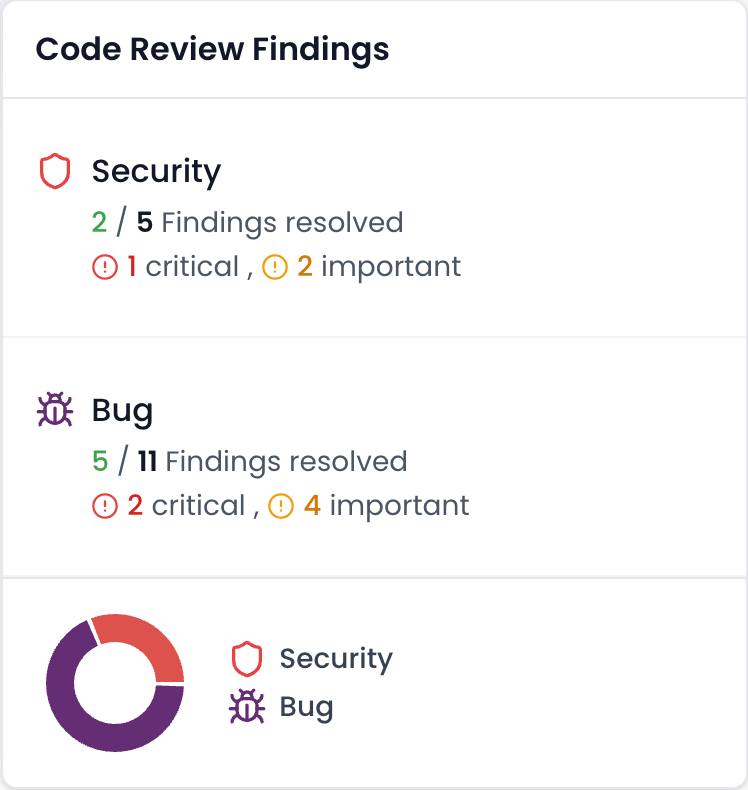
Gitar focuses on turning failing Java builds into green builds by automatically fixing code when CI fails. The 14-day free Team Plan trial includes full PR analysis, security scanning, bug detection, performance review, and auto-fix for Java and other languages, with integration to GitHub, GitLab, and CI systems such as GitHub Actions, GitLab CI, CircleCI, and Buildkite. See Gitar documentation.
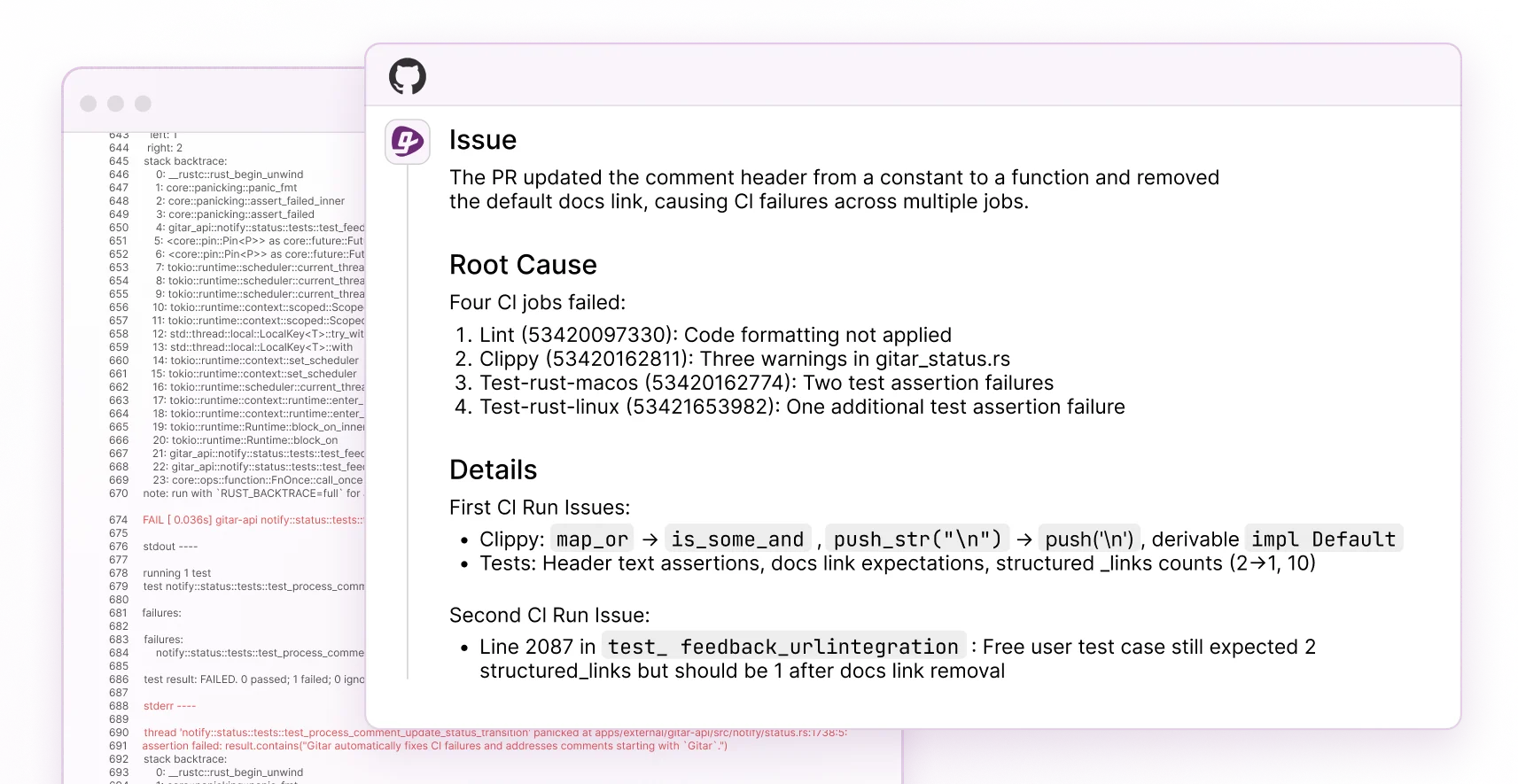
Pros: Automatically resolves lint errors, test failures, and build breaks, uses a single dashboard comment to cut notification noise, validates fixes in your actual CI environment, and supports Java projects using Maven and Gradle.
Cons: Requires repository integration and limits the full-featured trial to 14 days.
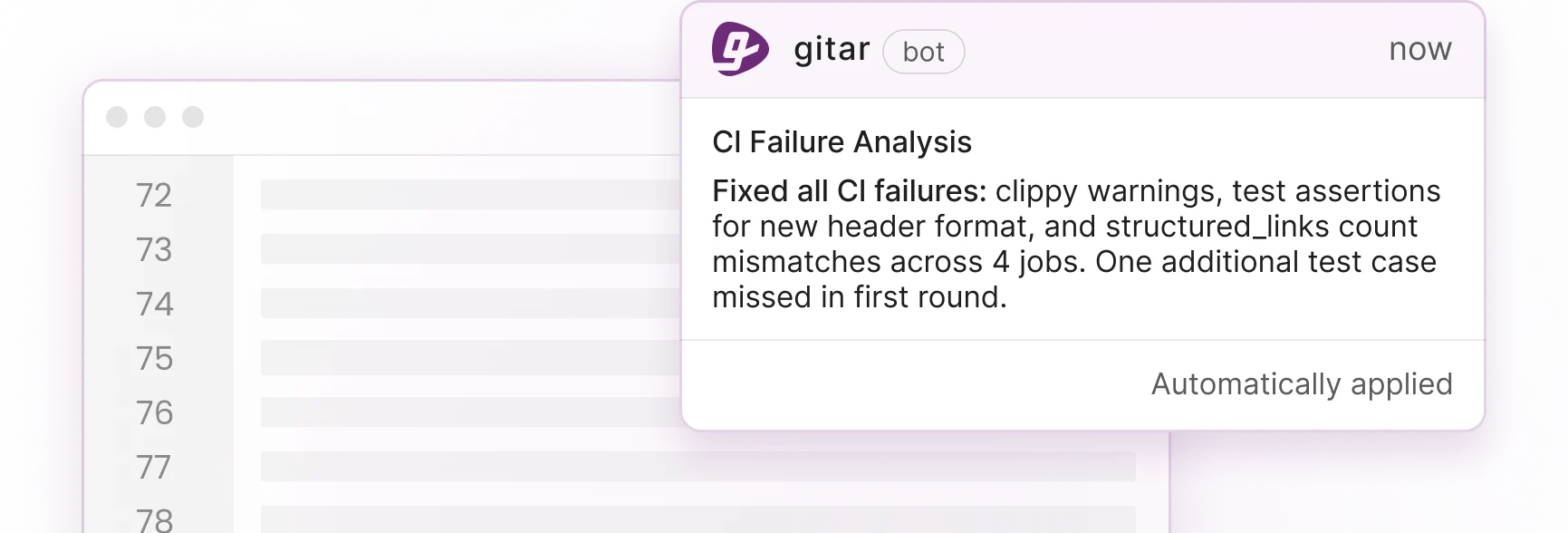
CI Auto-Fix Example: When a Java PR fails CI, such as a Spring Boot REST controller with a broken test, Gitar analyzes the failure, generates a fix, validates it in CI, and then commits the working change.
@RestController @RequestMapping(“/api/users”) public class UserController { @Autowired private UserService userService; @GetMapping public List<User> getAllUsers() { return userService.findAll(); } @PostMapping public User createUser(@RequestBody User user) { return userService.save(user); } }
Setup: Install the Gitar GitHub App or GitLab integration, connect your repository, and let Gitar analyze PRs and post a single dashboard comment. It works with any IDE, including Eclipse, through CI integration. See documentation for setup instructions.
Best For: Teams that want production-ready Java code and automatic CI failure resolution. Try Gitar’s 14-day free trial.
2. ChatGPT – Browser-Based Java Generation Without Signup
ChatGPT runs in the browser and provides generous Java code generation on its free tier. It works well for Spring Boot boilerplate and for explaining Java concepts, although the generated code often needs manual debugging before it compiles cleanly.
Pros: No API key required, generous usage, strong explanations of Java patterns, detailed Spring Boot applications, and solid handling of complex prompts.
Cons: No IDE integration, copy-paste workflow, frequent compilation errors, and no CI context or automatic fixing.
Java Example: Prompt: “Create a Java servlet for handling file uploads.”
@WebServlet(“/upload”) @MultipartConfig public class FileUploadServlet extends HttpServlet { protected void doPost(HttpServletRequest request, HttpServletResponse response) throws IOException { Part filePart = request.getPart(“file”); String fileName = filePart.getSubmittedFileName(); filePart.write(“/uploads/” + fileName); response.getWriter().println(“File uploaded: ” + fileName); } }
IDE Setup: Create a new Java class in Eclipse, paste the generated code, and then add imports and dependencies manually.
Best For: Developers learning Java or grabbing quick snippets without dealing with API setup.
3. GitHub Copilot Free – Java Help for Students and Individuals
GitHub Copilot Free offers 2,000 code completions and 50 chat messages each month. GitHub Copilot excels in Java for Spring Boot, Hibernate, Jakarta EE, Maven, and Gradle, which makes it strong for enterprise-style Java work.
Pros: Deep Java framework knowledge, tight IDE integration, context-aware suggestions, Maven and Gradle support, and solid unit test generation.
Cons: Monthly limits on the free tier, GitHub account requirement, and suggestions that sometimes fail to compile without edits.
Java Example: In IntelliJ, typing a comment such as “// Create a JUnit test for calculator” can generate:
@Test public void testAddition() { Calculator calc = new Calculator(); assertEquals(5, calc.add(2, 3)); } @Test public void testDivisionByZero() { Calculator calc = new Calculator(); assertThrows(ArithmeticException.class, () -> calc.divide(10, 0)); }
IDE Setup: Install the GitHub Copilot extension in IntelliJ IDEA or VS Code, sign in with your GitHub account, and enable suggestions for Java files.
Best For: Students and individual developers building Java projects with heavy framework usage. Fix AI Java bugs automatically with Gitar’s 14-day trial.
4. Codeium – High-Volume Free Java Completions
Codeium provides a generous free tier for core completion features and supports Java among 70+ languages, with JetBrains IDE integration. This makes it attractive for Java developers watching costs.
Pros: Up to 180k completions per month for individuals, support for 70+ languages including Java, Eclipse and IntelliJ integration, advanced context awareness, and SOC2 compliance.
Cons: Monthly completion caps and no CI integration.
Java Example: Typing “public class” in Eclipse triggers suggestions for common Java patterns such as singleton, builder, or data classes.
IDE Setup: Install the Codeium extension in Eclipse or IntelliJ IDEA, create a free account, and enable Java language support in settings.
Best For: Individual developers who need many completions across several languages, including Java.
5. Tabnine Free – Basic Java Completion Preview
Tabnine offers a free Dev Preview tier for individuals with basic code completions. This tier lets Java developers experiment with AI assistance before upgrading.
Pros: Fast completions for common Java patterns, JetBrains IDE integration, on-premises deployment option, and support for typical enterprise Java styles.
Cons: Limited features in the free tier and a paid subscription requirement for full capabilities.
Best For: Individuals or teams testing AI code completion for Java before committing to a paid plan.
6. Amazon Q Developer – Java Generation for AWS Workloads
Amazon Q Developer includes a free tier alongside a Pro plan at $19 per user per month. It generates Java code with strong AWS integration and broader development support.
Pros: Deep AWS service integration, free tier for individuals, strong Lambda and Spring Boot generation, full IDE integrations, and understanding of AWS SDK patterns.
Cons: AWS account requirement and a focus that favors AWS-centric rather than fully cloud-agnostic projects.
Java Example: Generates AWS Lambda handlers with correct annotations and error handling for serverless Java applications.
Best For: Java developers building AWS-native or cloud-heavy applications.
7. Open Source Java Models – CodeT5 and Local LLMs
Open-source models such as CodeT5 and Llama 3.1 70B, which perform competitively on coding benchmarks, can handle Java tasks with local setups that keep code private.
Pros: Completely free usage, potential for fine-tuning on specific Java patterns, privacy from local execution, and some available IDE integrations.
Cons: Technical setup overhead, high compute requirements, and constraints from model licenses and usage policies.
Best For: Advanced developers who feel comfortable deploying models and want private Java code generation.
Eclipse Workflows for Free Java AI Code Generators
Eclipse users can combine plugins and browser tools to bring AI into their Java workflow. Codeium offers native Eclipse integration, while GitHub Copilot requires VS Code or IntelliJ, so Eclipse users often mix tools.
- Install the Codeium Eclipse plugin from the marketplace.
- Configure Java project settings to improve completion quality.
- Use the ChatGPT web interface for complex generation and paste results into Eclipse.
- Connect Gitar to your repository so CI failures from Eclipse builds get fixed automatically.
IntelliJ IDEA Setup for Free Java AI Assistants
IntelliJ IDEA delivers the smoothest experience for most free AI Java tools. JetBrains AI Assistant adds native completion, test generation, and project-aware features that complement other tools.
- Install the GitHub Copilot extension for rich Java framework support.
- Add the Codeium plugin for high-volume completions.
- Enable JetBrains AI Assistant for native IntelliJ features.
- Configure Gitar repository integration so CI auto-fixing closes the loop.
Limits of Free Java AI Tools and How Gitar Helps
Developers expect 24% productivity gains from AI but see 19% slowdowns in controlled tests. Free AI Java generators often struggle with several recurring problems.
- Dependency hallucination, where tools suggest Maven artifacts that do not exist.
- Compilation errors that require manual fixes.
- Weak context handling in large or complex Java projects.
- No validation against real build environments.
- Inconsistent quality across different Java frameworks.
Gitar reduces these issues by validating generated code in real CI environments and then applying fixes automatically. Generate Java code free, then heal it with Gitar’s 14-day trial.
Frequently Asked Questions About Free Java AI Generators
What is the best free AI code generator for Java without signing up?
ChatGPT’s web interface offers Java code generation without account creation or API keys. The output often needs manual debugging, but it works well for Spring Boot boilerplate and for explaining Java concepts. For production scenarios, pair it with tools that validate and fix code.
Can I use ChatGPT for Java development without API costs?
Yes. ChatGPT’s web interface provides Java code generation at no cost. You describe requirements in natural language, and it returns Java classes, methods, and even full applications. You still need to test and debug the code manually because it lacks automatic validation and IDE integration.
How do I set up free AI code generation in Eclipse?
Install the Codeium extension from Eclipse Marketplace to get native AI completions. You can also use ChatGPT in the browser, copy the generated Java code, and paste it into Eclipse projects. Create new Java classes, paste the content, add imports and dependencies, and configure Maven or Gradle build files with the required libraries.
What is the difference between Gitar and GitHub Copilot for Java?
GitHub Copilot generates Java suggestions and completions inside your IDE but does not validate or repair the code. Gitar acts as an AI code review platform that analyzes CI failures in Java PRs, generates fixes using full codebase context, validates them in your CI environment, and commits working changes to restore green builds.
Do free AI Java generators work with Spring Boot and Maven?
Most free AI tools understand Spring Boot patterns and can generate Maven project structures. GitHub Copilot performs especially well for Spring Boot applications, while ChatGPT can output detailed Maven configurations. Some generated dependencies may be outdated or incorrect, so tools like Gitar help by validating code against real build systems.
Conclusion: Use Free Java AI Tools, Then Let Gitar Finish the Job
Free AI Java code generators speed up prototyping but still leave gaps before production. 78% of global development teams now use AI code assistants, coding 40% faster and cutting debugging time by 35%, yet most tools stop at generation and never confirm that the code runs.
ChatGPT, GitHub Copilot, and Codeium give strong starting points for Java work, while Gitar closes the loop as an AI code review platform that automatically fixes generated Java code and restores green builds. Start your 14-day free Team Plan trial.