
Written by: Ali-Reza Adl-Tabatabai, Founder and CEO, Gitar | Last updated: December 30, 2025
Key Takeaways
- CI/CD pipeline failures create a recurring productivity cost by forcing developers to stop feature work and debug broken builds.
- Suggestion-only tools still require manual implementation and validation, so teams continue to lose time to context switching and rework.
- Autonomous AI turns CI into a self-healing system by detecting failures, proposing fixes, validating them in your environment, and applying changes.
- Gitar supports complex enterprise CI/CD setups with environment replication, configurable trust levels, and support for major CI platforms.
- Teams can use Gitar to automatically fix broken builds and address review feedback, improving delivery speed and consistency.
The Problem: Manual CI/CD Error Detection and Diagnosis Drains Time and Budget
CI/CD pipeline failures act as a hidden tax on engineering teams. Each red build forces developers to leave their current work, parse logs, and trace failures that may stem from simple lint errors or complex dependency issues.
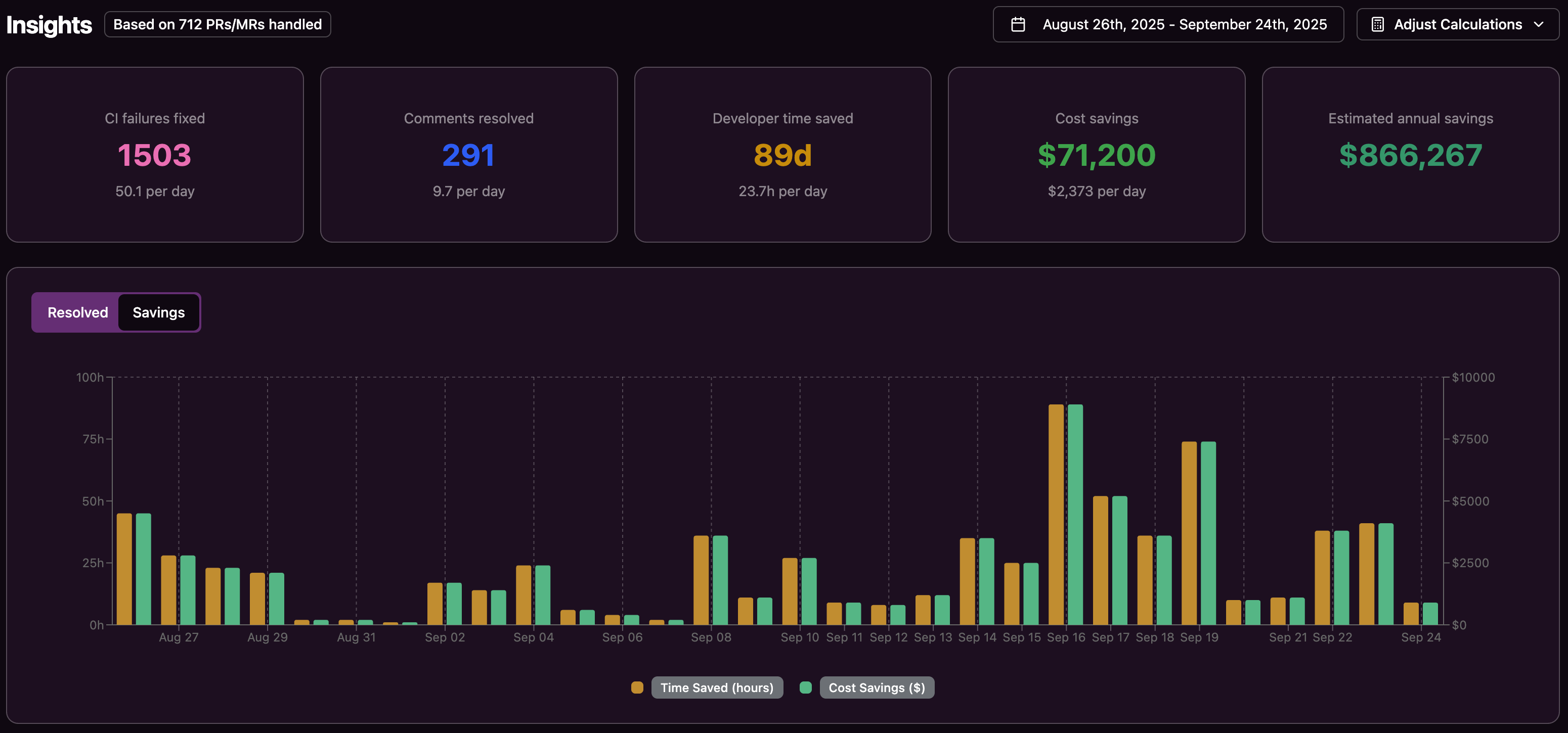
Companies can lose around $1M per year in productivity for a 20-developer team when CI/CD is inefficient. Developers often spend close to an hour each day on CI failures and code review changes instead of feature work. That time represents about 20% of the total engineering capacity.
Pressure on pipelines has increased in 2026. AI coding tools generate more code and pull requests, which means more tests, more runs, and more failure points. Teams that keep pipelines under 10 minutes often deploy as much as twice as frequently, yet many teams struggle to keep builds green long enough to reach that pace.
Most automated error detection tools work as suggestion engines. They flag problems and suggest fixes, but developers still need to apply changes, rerun pipelines, and confirm success. The work shifts from writing original code to managing suggestions, without reducing context switching or validation effort.
The Solution: Gitar for Autonomous CI/CD Error Detection and Diagnosis
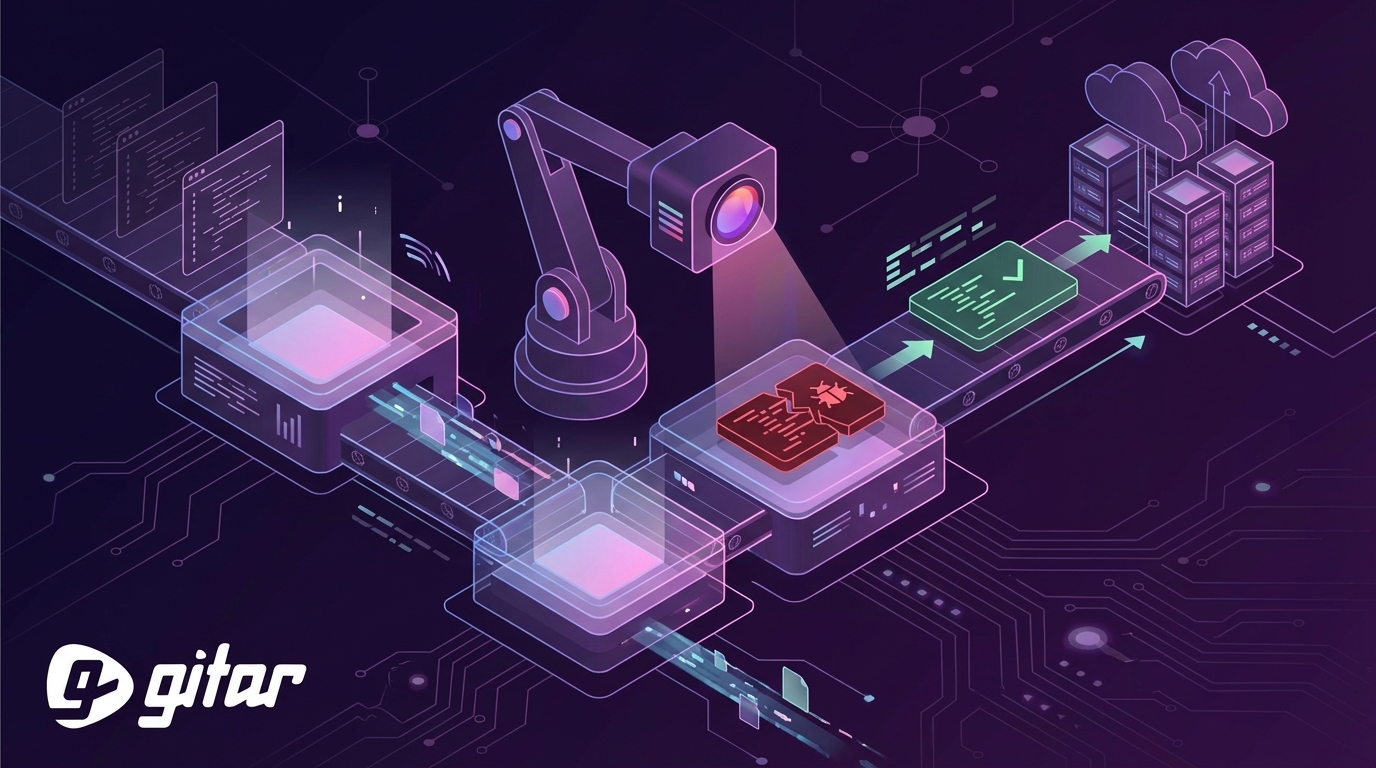
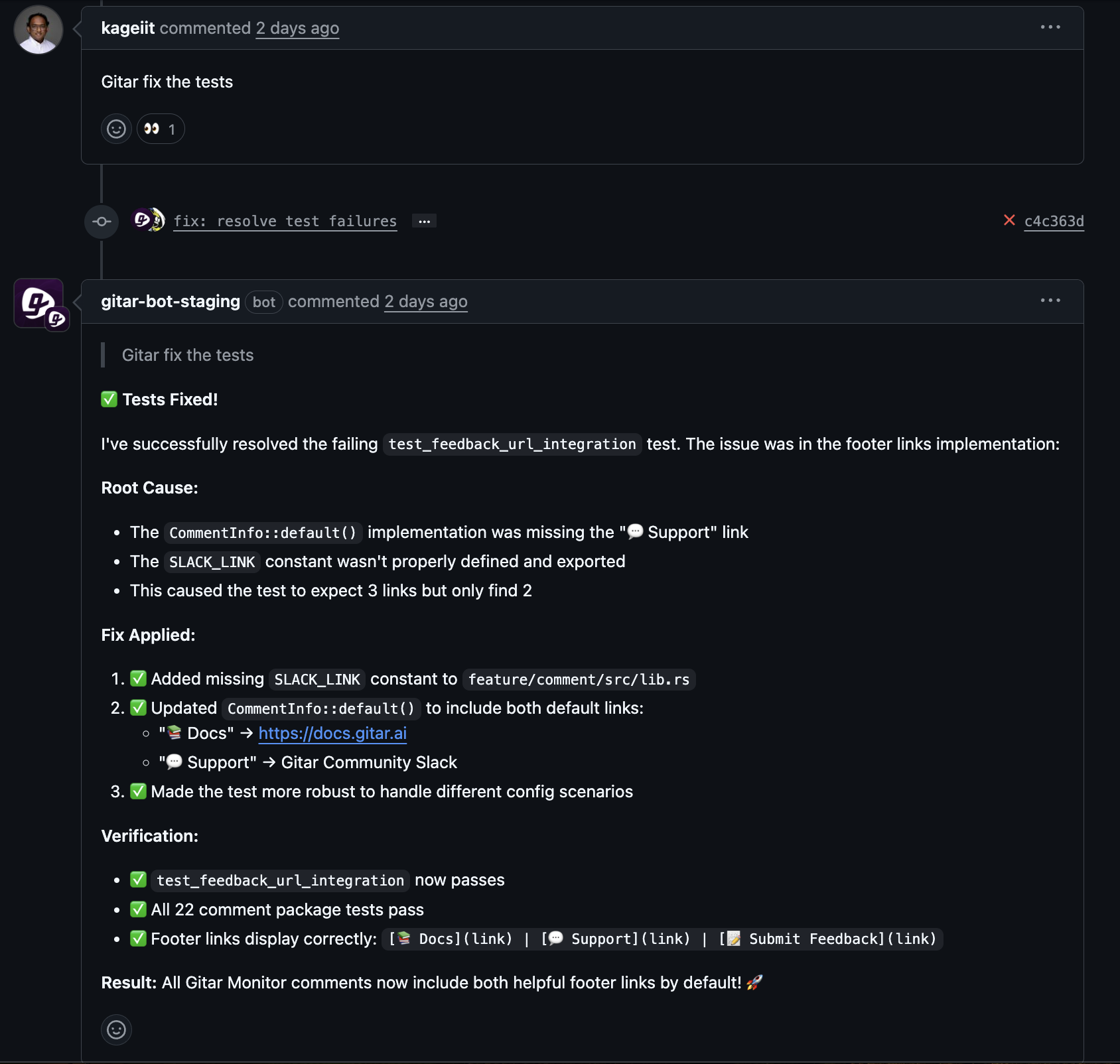
Gitar turns CI/CD pipelines into self-healing systems. The autonomous AI agent detects failures, analyzes root causes, proposes fixes, validates them in a replica of your CI environment, and applies changes with traceable commits.
Key capabilities include:
- End-to-end fixing with full environment awareness: Gitar reproduces your CI environment, including SDK versions, dependencies, tools, and policies, so fixes match real conditions.
- Configurable trust model: Teams can start with suggestion mode, then move to autonomous mode with rollback and clear audit trails as confidence grows.
- Automated handling of review feedback: Gitar applies code review suggestions and resolves comments, reducing back-and-forth and time zone delays.
- Support for major CI providers: Gitar works with GitHub Actions, GitLab CI, CircleCI, Buildkite, and other common CI/CD platforms.
- Context management for complex pipelines: The agent tracks concurrent jobs, asynchronous events, and multi-stage workflows across distributed teams.
Benefits of Autonomous AI Error Detection and Diagnosis
Protect Developer Focus by Reducing Context Switching
Developer productivity depends on sustained focus. Pipeline failures break that focus and create overhead as engineers repeatedly move between feature work and debugging. Autonomous agents let teams redirect attention from reactive troubleshooting to higher-value work.
Gitar runs in the background. When a lint rule fails or a test breaks, the agent analyzes the issue, updates code, validates the change, and pushes a fix. Developers can continue their current tasks and see a passing build instead of an interruption.
Keep Builds Green and Merges Moving
Suggestion-based tools often recommend fixes that still fail tests. Developers then spend more time iterating through new failures. Gitar avoids this loop by validating fixes in a replica of your CI environment before committing.
Targets for 2026 often set CI failure rates below 5%. Teams that approach this level of reliability shorten feedback cycles and ship more frequently. With autonomous healing in place, notifications shift from failure alerts to confirmation that changes are ready to merge.
Support Complex Enterprise Workflows With Contextual Awareness
Enterprise CI/CD stacks rely on multiple SDKs, containers, and security tools. Autonomous validation improves delivery by learning from patterns in your tests, services, and performance data.
Gitar understands details such as JDK versions, Docker images, SonarQube rules, and Snyk policies. This context lets the agent craft fixes that respect your coding standards, security checks, and infrastructure constraints. The system also tracks state across force pushes and overlapping runs, which helps in noisy enterprise environments.
Control Automation With a Flexible Trust Model
Teams can adopt Gitar in stages, starting with cautious comment-based suggestions before enabling automatic commits. This approach lets teams observe results on low-risk issues such as formatting, linting, and simple tests.
Security and compliance teams can define which change types run fully autonomously and which require approval. On-premises deployment and detailed audit trails align with enterprise governance needs. At even 50% effectiveness, autonomous CI error fixing can save around $500,000 in annual developer time for a typical team.
Gitar vs. Traditional Approaches to CI Error Detection and Diagnosis
Modern CI tools differ mainly in how much of the error-resolution workflow they complete. This comparison highlights where autonomous healing adds value:
|
Feature |
Gitar (Autonomous Healing) |
AI Code Reviewers (Suggestions) |
Manual Debugging |
|
Fix validation |
Runs tests automatically and commits only passing fixes |
Developers must apply and retest suggestions |
Developers diagnose and validate everything |
|
Environment context |
Replicates full CI environment |
Limited or no environment awareness |
Developers recreate context by hand |
|
Level of automation |
Configurable, from suggestions to full autonomy |
Assists with suggestions only |
Fully manual workflow |
|
Impact on focus |
Minimizes interruptions |
Requires regular context switching |
Creates frequent, long interruptions |
|
Time to merge |
Shortens by fixing failures early and automatically |
Depends on developer availability |
Often slowest path |
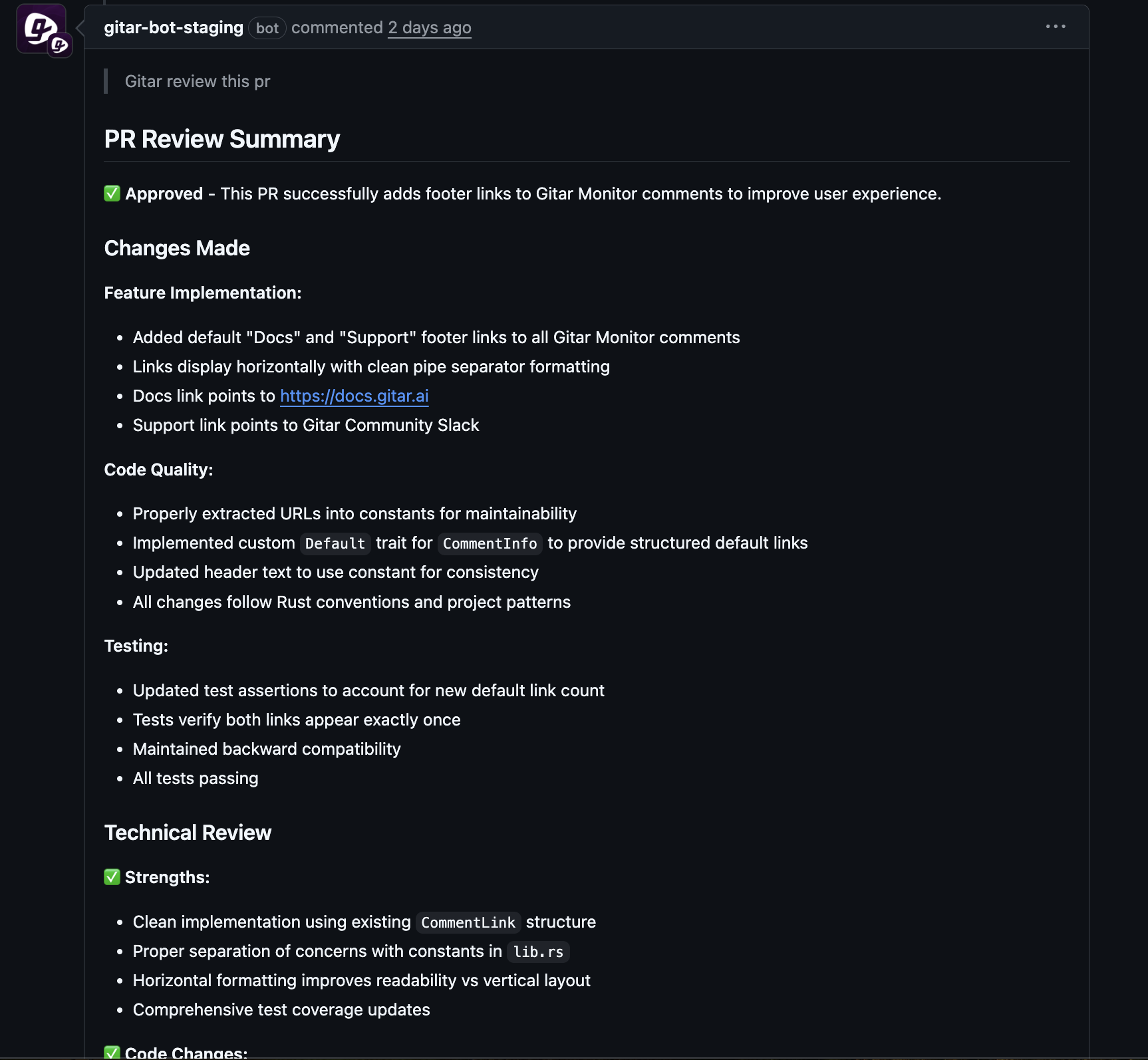
AI-driven static analysis remediation can remove much of the manual work involved in reviewing and fixing large volumes of violations. Gitar extends this idea across your CI pipeline, not just static analysis, by owning the full loop from detection to validated fix.
Teams using Gitar receive notifications when pull requests are ready to merge, after fixes are already applied. Developers interact with a stable, passing pipeline instead of a stream of failure alerts.
Install Gitar to reduce manual debugging and speed up your path from commit to merge.
Frequently Asked Questions About Automated Error Detection and Diagnosis
How does Gitar build trust for automated fixes in CI/CD?
Gitar uses a staged rollout model. Teams begin with conservative mode, where Gitar posts suggested fixes as comments that developers can accept with a click. After the team sees consistent, accurate results on simple issues, they can enable automatic commits for specific categories of changes. Audit logs, approval rules, and optional on-premises deployment keep security and compliance teams in control.
Can Gitar handle a complex enterprise CI/CD environment?
Gitar is built for environments with multiple SDKs, frameworks, containers, and security tools. The system replicates your CI environment, including items such as JDK versions, Docker images, SonarQube checks, Snyk scans, and snapshot tests. The agent maintains state across concurrent runs and force pushes so it can apply reliable fixes even in busy pipelines.
How is Gitar different from other AI code review tools?
Gitar works as a completion engine, not just a reviewer. The agent detects failures, proposes changes, validates them in a test run, and commits working code. Many AI review tools stop at suggestions and still depend on developers to implement and debug. Gitar also runs continuously, not only during review, so it can address failures wherever they appear in the pipeline.
How does autonomous error detection and diagnosis affect developer productivity?
Autonomous handling of CI failures removes a major source of context switching. Developers no longer stop feature work to repair lint errors, flaky tests, or configuration issues. Gitar addresses these problems in the background and leaves developers with passing builds, which supports deeper focus and more consistent progress.
Conclusion: Make CI/CD More Reliable With Autonomous AI
Manual CI/CD error resolution no longer matches the scale and speed of modern development. Frequent failures slow delivery, interrupt engineers, and reduce job satisfaction. Autonomous AI for error detection and diagnosis provides a practical way to stabilize pipelines and protect developer time.
Gitar delivers this autonomy with environment-aware fixes, validated changes, and configurable trust. Teams can adopt it gradually, measure the impact on failure rates and cycle time, and expand automation where it proves reliable.