

Last updated: March 10, 2026
Key Takeaways
- Qodo PR Agent detects bugs reliably with 75%+ recall and generates tests, but it does not auto-fix issues, so engineers still implement changes manually.
- Reddit reviewers rate Qodo 4.2/5 for analysis depth and only 3/5 for usability, citing clunky UI, $30/user/month pricing, and complex configuration.
- Competitors like CodeRabbit and Greptile also stop at suggestions, with no automatic fixes or deep CI integration across the current market.
- Gitar stands out with a healing engine that automatically fixes CI failures, supports GitHub and GitLab, and includes a 14-day full team trial.
- Teams report $750K per year in productivity gains, and Gitar’s free trial helps remove PR bottlenecks so you ship faster.

How Qodo PR Agent Evolved Into a Paid Platform
Qodo PR Agent grew from CodiumAI’s open-source pr-agent into a paid platform focused on code quality and test generation. The 2026 release introduces specialized agentic AI with dedicated agents for correctness, security, performance, observability, requirements validation, and standards compliance. The platform connects through a GitHub App and supports more than 20 programming languages, with IDE extensions for VS Code and JetBrains.
Qodo targets teams overwhelmed by PR volume, such as a 20-developer group producing 3 to 5 times more code with AI tools. The product delivers automated PR analysis, inline suggestions, security scans, and broad test suite generation. The open-source pr-agent holds 6.9k+ GitHub stars under the Apache 2.0 license, while the commercial version adds enterprise features and hosted infrastructure. A coordinator agent aggregates findings into a single review with severity ratings and deduplicated comments.
Qodo PR Agent Reviews: Strengths and Weak Spots
Qodo PR Agent feedback from Reddit and developer forums averages 4.2/5 for analysis depth and 3/5 for usability. Here is the detailed breakdown:
|
Aspect |
Pros |
Cons |
|
Bug Detection |
75%+ logic bug recall, broad security vulnerability scanning |
Shallow suggestions in 25% of cases, generic commentary without careful configuration |
|
Privacy/Deployment |
Open-source core, self-hosted options, data sovereignty for regulated industries |
Needs GPU infrastructure for local models, 30+ documented prompt-injection vulnerabilities |
|
User Experience |
Deep context analysis, effective on large PRs, IDE integration |
Clunky interface, noisy notifications, no auto-fixes so teams must apply changes manually |
Developers highlight Qodo’s automated test generation and code integrity checks, especially for legacy systems that lack coverage. Many teams struggle with the learning curve for test customization and want deeper static analysis similar to specialized security or linting tools. Qodo performs well for behavior verification during refactors but often feels heavy to configure and expensive to run because of ongoing LLM API usage.
Qodo Pricing, Value, and When It Makes Sense
Qodo offers three pricing tiers: Free (30 PRs per month, 75 IDE credits), Teams ($30/user/month with a 21% annual discount), and Enterprise (custom pricing). The Free tier rarely covers even a solo developer’s workload, and the Teams plan sits at the top of the market’s price range.
A 10-developer team pays $300 per month, which aligns with the high end of the $240 to $300 industry range. Total cost of ownership also includes LLM API spending for self-hosted setups and any GPU infrastructure you manage. Enterprise customers gain multi-repo context, SSO, advanced controls, and air-gapped deployment options. Teams that lose close to $1M per year to PR delays often accept this cost when they value deep analysis more than automation.
Qodo Setup, Real-World Use Cases, and Benchmarks
Qodo plugs into GitHub PR workflows through a one-click installation, then enforces architectural, security, and quality checks. Setup includes installing the GitHub App, defining repository rules, and tuning agent behavior through AGENTS.md files.
Teams rely on Qodo for CI failure analysis, broad test generation for new features, security checks in authentication flows, and consistent standards across large organizations. The platform scales to hundreds of repositories with persistent context and organization-wide rules. Benchmarks show strong recall for logic bugs and security issues, especially on high-risk PRs with clear configuration.
DevOps teams use Qodo to automate workflows across more than 15 predefined scenarios. Engineering leaders value risk scoring and compliance reports that summarize repository health. The tradeoff comes from heavy YAML configuration and ongoing maintenance, which feel demanding compared to simpler plug-and-play tools.
Qodo vs CodeRabbit vs Greptile: Where They All Fall Short
The AI code review market still lacks robust auto-fix features across major platforms.
|
Feature |
Qodo |
CodeRabbit |
Greptile |
|
Pricing |
$30/user |
$15-30/user |
$30/user |
|
Auto-Fix |
No |
No |
No |
|
CI Context |
Limited |
No |
Context-only |
Most competitors rely on commands like /review and /improve to generate summaries and suggestions, without applying fixes. Greptile and CodeRabbit handle cross-file reasoning and repository context well, yet they still lack the CI depth that modern pipelines expect. Across all of these tools, developers must read the comments, implement changes, and re-run checks, which keeps the manual workload high.
Why Gitar Beats Qodo PR Agent for Busy Teams
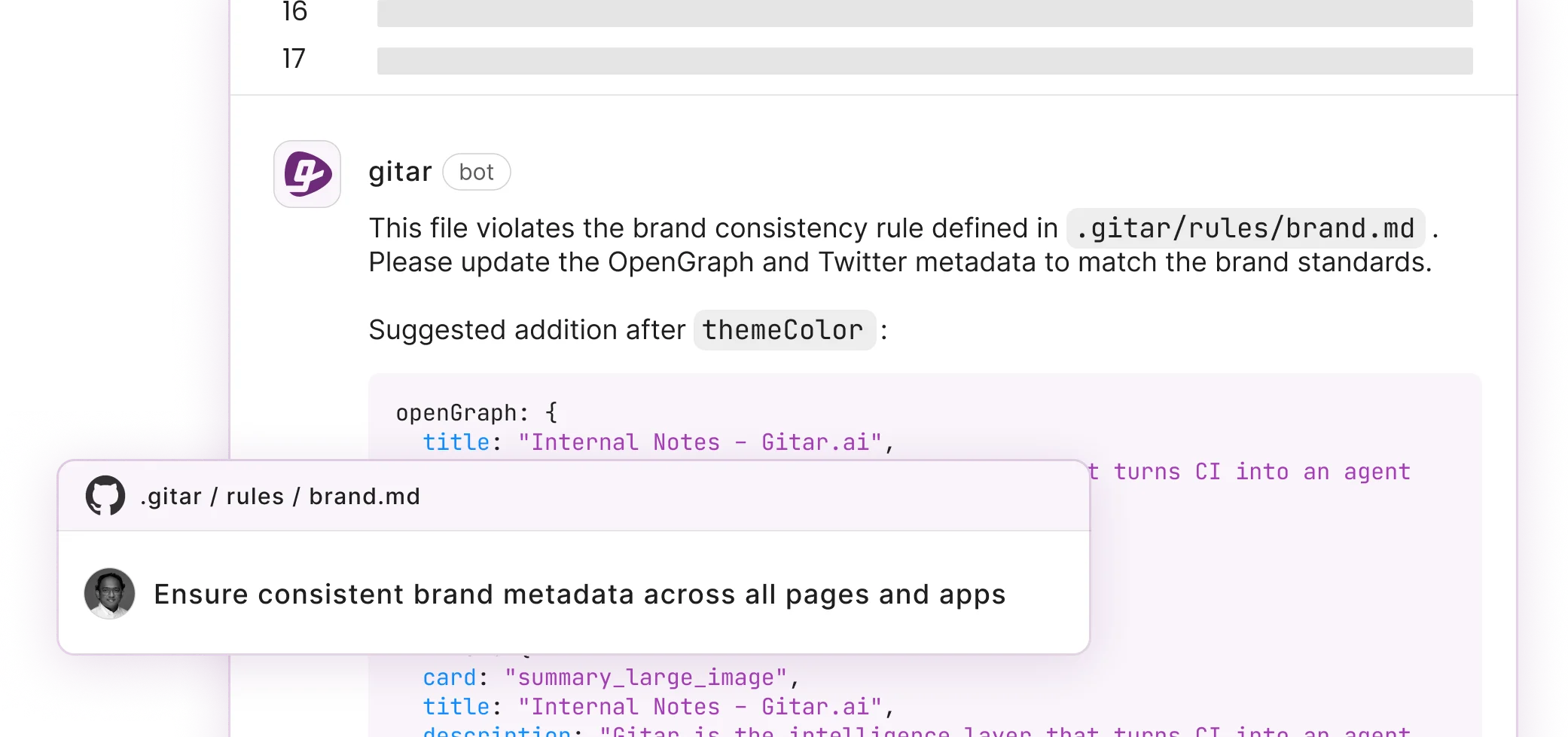
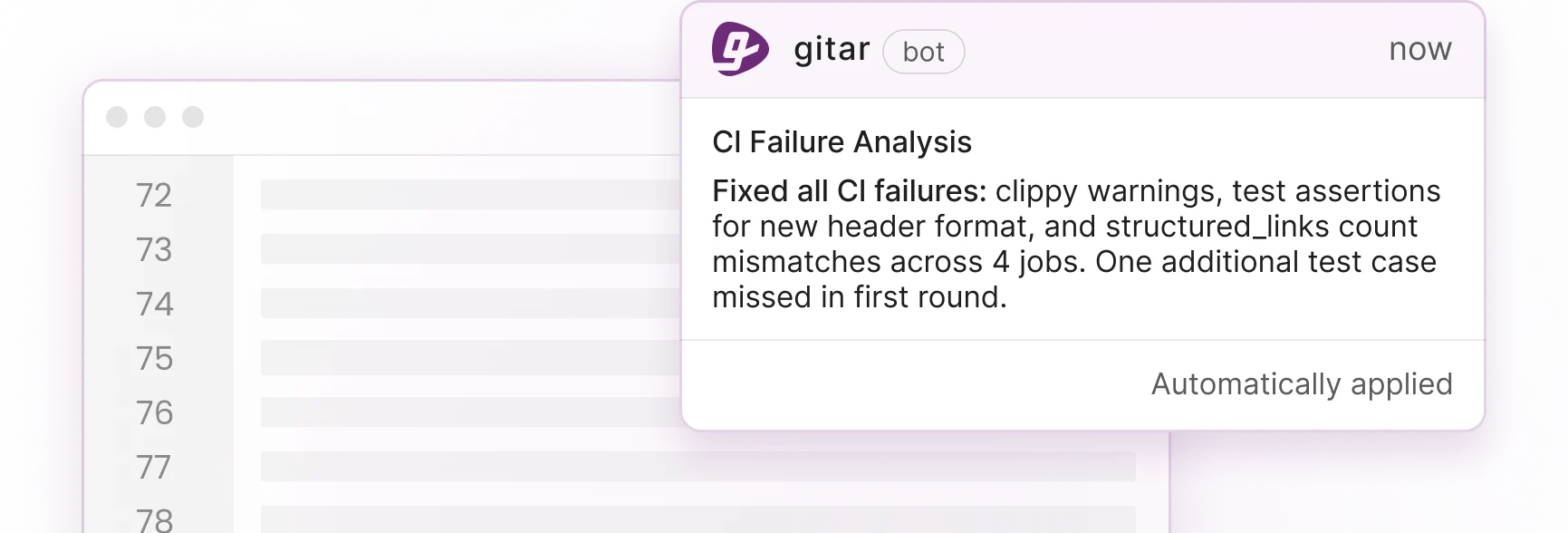
Gitar wins on auto-fix capabilities and deep CI integration. Qodo and similar tools charge premium prices for suggestion engines, while Gitar delivers a healing engine that inspects failures, proposes fixes, validates them, and commits the changes automatically. You can review the full feature set in the Gitar documentation:
|
Feature |
Qodo |
Gitar (14-Day Trial) |
|
Auto-Apply Fixes |
No |
Yes |
|
CI Auto-Fix |
No |
Yes |
|
Trial Access |
Limited Free Tier |
Full Team Plan |
Gitar’s 14-day Team Plan trial gives unlimited users access to auto-fix features and CI failure repair. The projected ROI reaches $750K per year for a 20-developer team by cutting context switching and automatically resolving lint errors, test failures, and broken builds. Gitar supports GitHub, GitLab, CircleCI, and Buildkite with natural language workflow automation, so teams can describe the outcome they want and let the system handle the details.
Start your 14-day trial now and see the difference between suggestions and real fixes.
Qodo vs Gitar: A Simple Decision Framework
The decision framework stays clear: choose Qodo for rich suggestions and test generation, and choose Gitar for autonomous fixes and consistently green builds. Reddit feedback supports Qodo’s deep analysis but repeatedly calls out the manual effort that Gitar removes with its healing engine.
Teams already paying $15 to $30 per seat for suggestion-only tools quickly see the productivity gap once they try Gitar. Engineering leaders summarize the experience this way: “Gitar’s trial proves fixes ship code, while suggestions only describe problems.”
Install Gitar now, automatically fix broken builds, and ship higher quality software faster.
FAQ
Is Qodo any good?
Qodo performs well for deep bug detection with 75%+ recall and strong test generation. Reddit reviewers often praise its security scanning and code integrity checks. The product still focuses on suggestions rather than auto-fixes, so engineers must apply every recommendation manually. Teams that value thorough analysis more than automation see benefits, although the $30/user/month price feels high compared to tools that also fix code.
Is Qodo PR Agent free?
Qodo includes a limited free tier with 30 PRs per month and 75 IDE credits, which rarely covers typical team usage. The open-source pr-agent remains available under the Apache 2.0 license for self-hosting, but teams must pay for external LLM APIs and manage their own infrastructure. The commercial Teams plan at $30/user/month unlocks advanced test generation, CI integration, and enterprise-grade security scanning.
How does Qodo PR Agent integrate with GitHub?
Qodo connects to GitHub through a one-click app installation and builds on an open-source repository with 6.9k+ stars. The platform supports GitHub Actions, automated PR analysis, and inline comments on code changes. Enterprise customers can run self-hosted deployments for data sovereignty while still using GitHub APIs for PR management, status checks, and workflow automation across many repositories.
Is Qodo open source?
The core pr-agent remains open source under the Apache 2.0 license, which allows self-hosted deployments and custom changes. The commercial Qodo platform layers proprietary capabilities on top, including advanced test generation, enterprise security controls, multi-repo context, and hosted infrastructure. Teams choose between the open-source version with manual setup and the paid platform with managed services and extended features.