
Written by: Ali-Reza Adl-Tabatabai, Founder and CEO, Gitar
Key Takeaways
- AI coding tools have increased code volume 3-5x, so teams now need natural language AI code review that handles PR floods and CI failures.
- Gitar leads with full conversational queries, hierarchical repository context, and auto-fix capabilities that guarantee green builds.
- Competitors like CodeRabbit offer strong PR analysis but require manual fix implementation, while Greptile excels in codebase knowledge graphs without CI validation.
- Automated fixes deliver stronger ROI, with teams reporting $750K annual savings versus manual suggestion workflows.
- Teams ready to automate CI healing and ship faster can install Gitar now with a 14-day free Team Plan trial.
How We Evaluated Natural Language AI Code Review Tools
Our 2026 evaluation criteria focus on natural language precision, repository-wide context understanding, automated fix validation, and comprehensive CI/CD integrations. We analyzed tools based on their ability to handle GitHub Actions, GitLab CI, CircleCI, and Buildkite pipelines, plus integrations with Jira, Slack, and Linear. Sources include vendor documentation, DORA 2025 Report findings, and developer community feedback from Reddit and DEV.to discussions.
Natural Language AI Code Review Tool Comparison Table 2026
|
Tool |
Natural Language Support |
Repository Context |
Auto-Fix & Validate |
|
Gitar |
Full conversational queries |
Hierarchical + CI healing |
Yes, green build guarantee |
|
CodeRabbit |
Inline comments only |
Diff-based with repo awareness |
One-click suggestions |
|
Greptile |
Codebase queries |
Full knowledge graph |
Suggestions only |
|
BugBot |
Intent-aware analysis |
PR diff focused |
One-click fixes |
|
Tool |
Pricing (per dev/month) |
Key Integrations |
Fix Success Rate |
|
Gitar |
14-day free Team Plan trial |
All major CI/CD + Jira/Slack |
Not specified |
|
CodeRabbit |
$15-30 |
GitHub-focused |
46% |
|
Greptile |
$30 |
Limited CI integration |
60% |
|
BugBot |
$20-25 |
GitHub, basic CI |
50% |
Snapshot of Leading Natural Language Review Platforms
Gitar auto-fixes CI failures and review feedback with full repository context and offers this through a comprehensive 14-day trial. CodeRabbit provides codebase-aware reviews with line-by-line comments and PR summaries for GitHub-centric workflows. Greptile excels in deep context via codebase knowledge graphs, analyzing ripples across entire repositories beyond PR diffs. BugBot maintains high precision in critical bug detection with low false-positive rates. Augment focuses on enterprise security scanning, and Bito offers multi-language support with basic automation features.
Detailed Reviews of Each AI Code Review Tool
Gitar: Healing Engine for High-Volume PR Streams
Gitar solves the main problem facing AI-accelerated development teams by shifting effort from manual review and CI validation to automated healing. Suggestion engines leave comments that still require manual implementation, while Gitar’s healing engine analyzes CI failures, generates validated fixes, and commits them directly to pull requests. See the Gitar documentation for details.
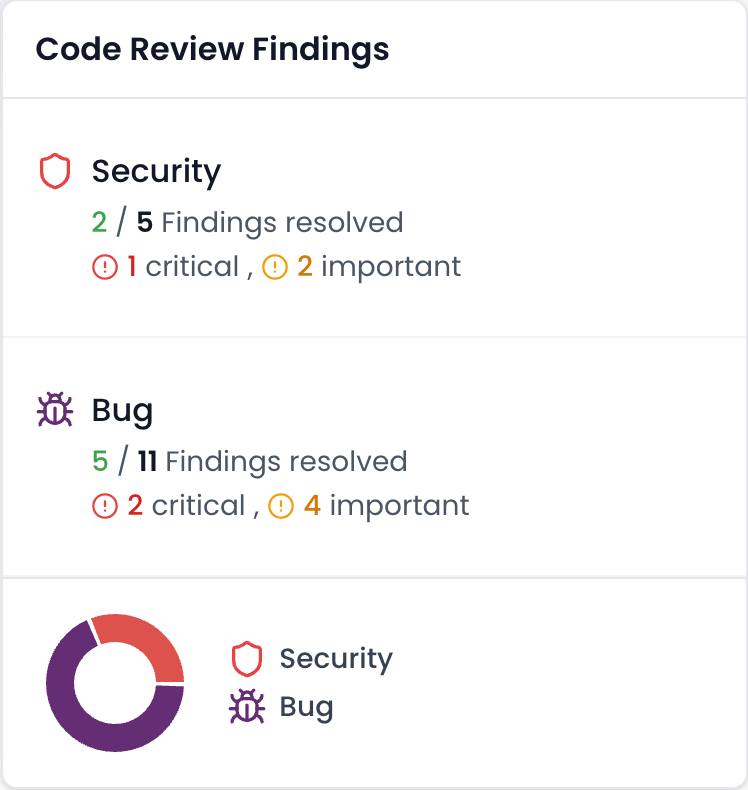
Key features include natural language repository rules stored in .gitar/rules/*.md files, which replace complex YAML configurations. When CI fails because of lint errors, test failures, or build breaks, Gitar analyzes failure logs, generates context-aware fixes, validates them against the full CI pipeline, and commits working solutions. The platform consolidates all findings into a single updating dashboard comment, which reduces notification spam compared to competitors that rely on scattered inline comments.
Gitar integrates with GitHub Actions, GitLab CI, CircleCI, Buildkite, Jira, Slack, and Linear for a cross-platform context. The 14-day free Team Plan trial provides full access to auto-fix capabilities, custom rules, and all integrations without seat limits.
Ideal for: Engineering teams facing PR volume spikes from AI coding tools, platform teams managing complex CI pipelines, and organizations seeking ROI from automated fixes instead of manual suggestion implementation.
CodeRabbit: Codebase-Aware PR Analysis
CodeRabbit offers codebase-aware reviews with one-click AI fixes and agentic workflows for tests and documentation. The platform reads full PRs, provides line-by-line comments, summaries, and diagrams, and adapts via thumbs up or down feedback to learn team styles.
CodeRabbit integrates with more than 40 linters, SAST tools, and security scanners, and supports GitHub, GitLab, and Bitbucket. Pre-merge checks include custom quality gates and unit test generation. Fixes remain suggestions that require manual implementation and validation.
Pricing ranges from $15-30 per developer monthly. CodeRabbit achieves 46% accuracy in detecting real-world runtime bugs through multi-layered analysis that includes AST and SAST scanning.
Ideal for: GitHub-centric teams that want comprehensive PR analysis, organizations that prioritize security scanning integration, and teams comfortable with suggestion-based workflows.
Greptile: Deep Repository and Architecture Insight
Greptile builds comprehensive knowledge graphs of entire repositories, indexing functions, dependencies, and history for analysis beyond PR diffs. The platform excels in large legacy codebases for architectural issues, helps new team members understand system interactions, and flags subtle issues that diff-based tools miss.
Greptile supports customization, private models, on-premises deployment, and SOC 2 compliance. The platform builds structural maps via syntax trees and call graphs, which enables reviews that understand change ripples across systems. The tool provides suggestions only and does not apply fixes or validate them in CI.
Pricing starts at $30 per developer monthly. The platform offers API access for custom tooling such as debugging assistants, but does not provide comprehensive CI pipeline integration.
Ideal for: Complex monorepos that need full-system impact analysis, teams managing large legacy codebases, and organizations that require on-premises deployment with custom model support.
Teams feel the difference between suggestions and actual fixes. Install Gitar now, automatically fix broken builds, and start shipping higher quality software faster with validated CI healing.
Free vs Paid Natural Language AI Code Review in 2026
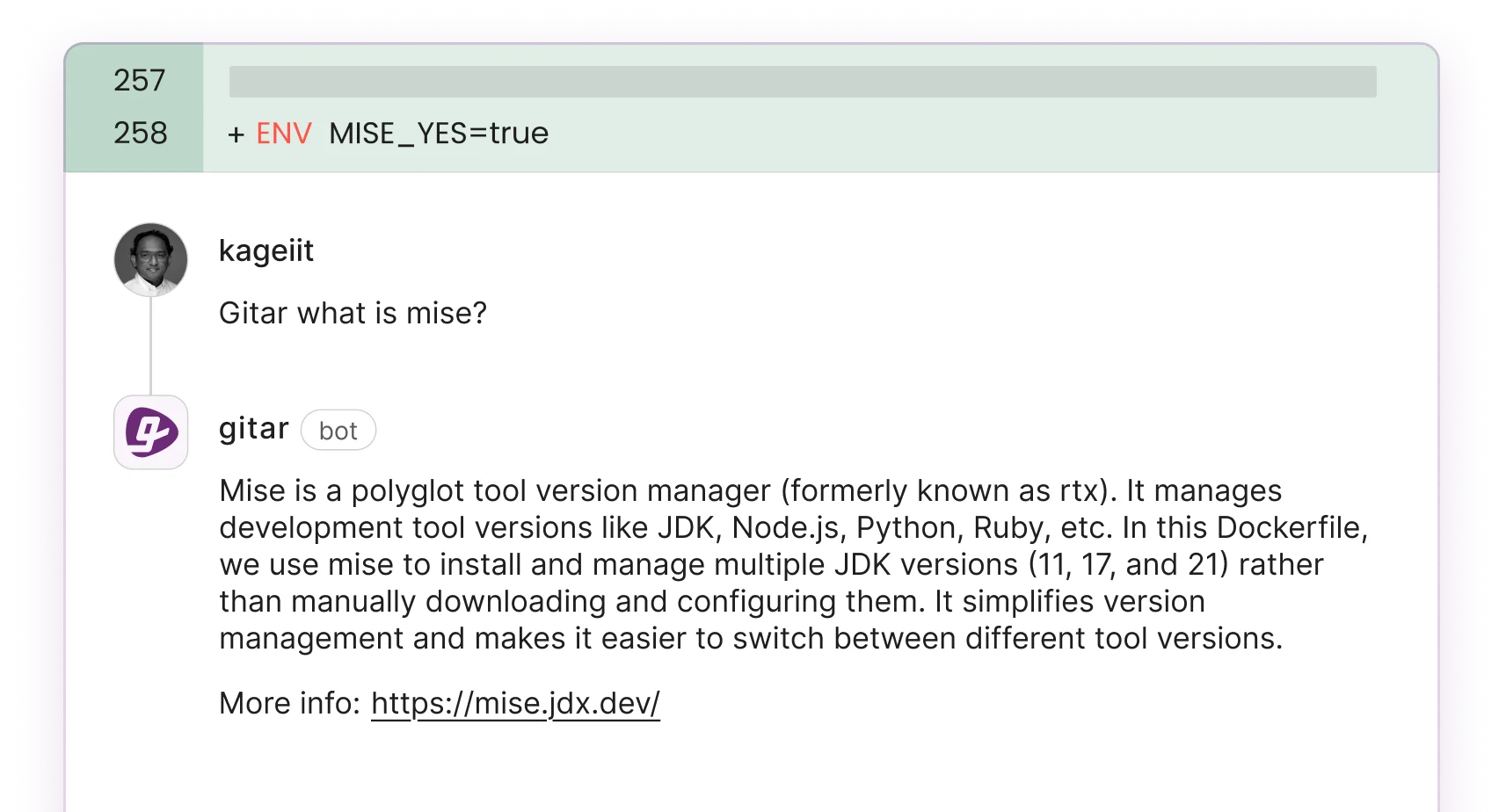
The free tier landscape shows clear capability gaps. Most platforms offer basic PR summaries and inline comments in free tiers, while automated fix application and CI integration remain premium features. Gitar’s 14-day free Team Plan trial provides full access to healing engine capabilities, custom rules, and all integrations without restrictions.
ROI calculations for a 20-developer team highlight major differences. Traditional suggestion tools costing $450-900 monthly still require manual implementation time. Teams report $750K annual savings from automated fix validation compared to the productivity loss from manual suggestion implementation cycles.
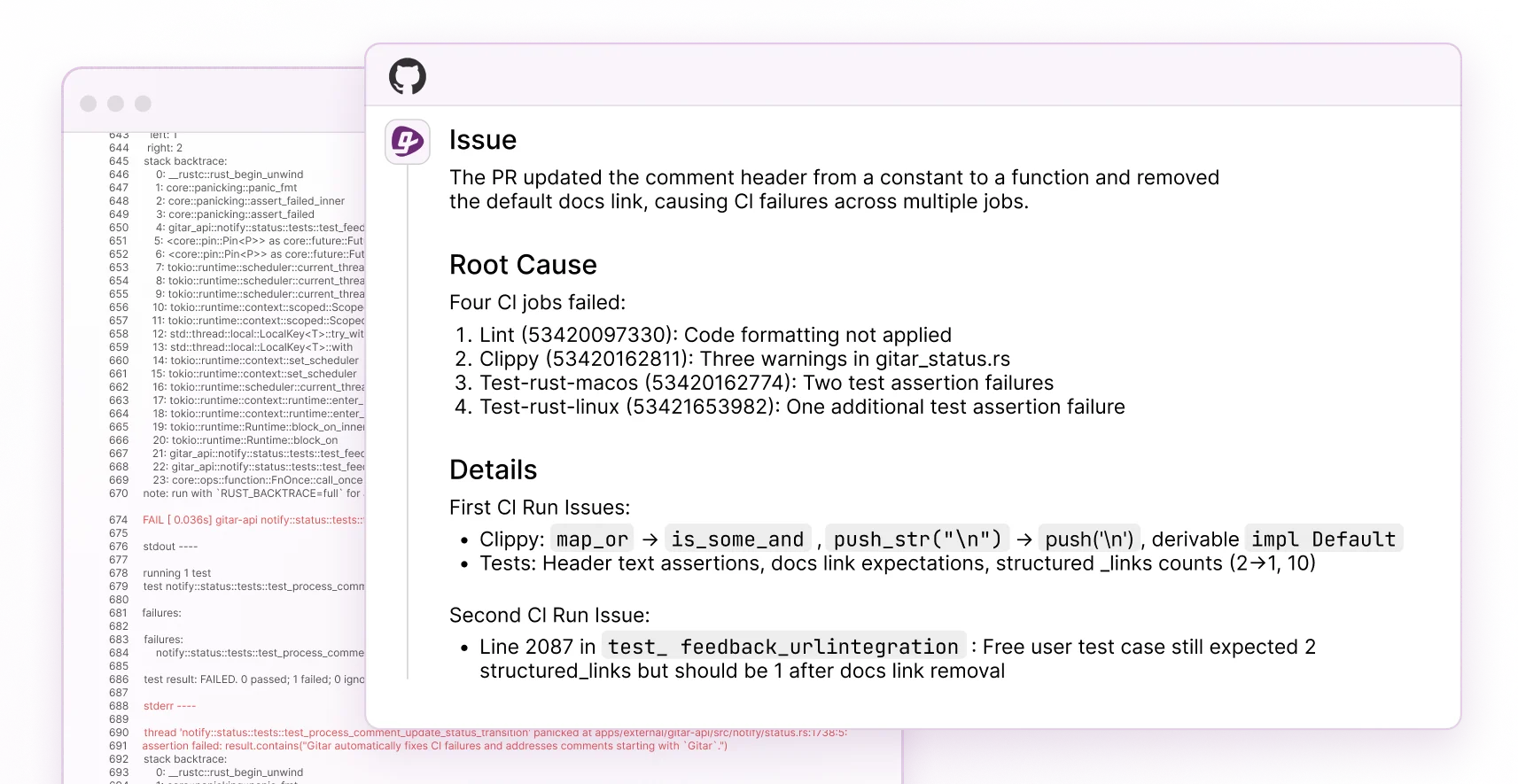
Architectural choices also affect outcomes. Gitar’s agent-based approach runs within CI pipelines with full context access, while competitors typically operate as external services that analyze diffs without build environment awareness.
Key Buying Considerations and Tradeoffs
Small teams gain the most from Gitar’s free trial approach because it removes upfront costs and proves ROI through real fix automation. Enterprise teams need in-CI deployment for security and context access, and Gitar’s Enterprise tier runs agents within existing pipelines with full secrets and cache access.
Teams can address trust concerns around automated commits through configurable approval workflows. They can start in suggestion mode, build confidence with specific failure types, and then enable auto-commit for validated fix categories. Fix validation remains the main differentiator, since tools that suggest without CI validation provide hope instead of automation.
User Stories and Performance Benchmarks
Pinterest engineering reported significant PR cycle time reductions after adopting automated CI healing for lint and test failures. Tigris team noted that Gitar’s PR summaries are “more concise than Greptile/Bugbot” because of the single updating comment approach instead of notification spam.
Collate’s engineering lead highlighted “unrelated PR failure detection” capabilities, which identify infrastructure flakiness versus code bugs, a distinction that traditional code reviewers without CI context cannot make. Teams using AI-assisted code review report 35% higher quality improvements, but only when tools provide validated fixes instead of suggestions.
Frequently Asked Questions
Best Free Natural Language AI Code Review Option
Gitar offers the most comprehensive free trial with 14 days of full Team Plan access, including automated CI healing, custom repository rules, and all integrations without seat limits. Competing free tiers usually limit features, while Gitar’s trial exposes complete platform functionality so teams can measure ROI through real fix automation instead of suggestion-only workflows.
Comparison Between CodeRabbit and Gitar
CodeRabbit delivers strong PR analysis and inline suggestions but requires manual implementation of all fixes. Gitar automatically applies, validates, and commits fixes directly to pull requests with green build guarantees. CodeRabbit costs $15-30 per developer monthly for suggestion workflows, while Gitar’s trial proves value through automation before any payment commitment.
How to Measure ROI from AI Code Review
Teams can calculate ROI by measuring developer time saved from automated fix application versus manual suggestion implementation. A 20-developer team that spends 1 hour daily on CI and review issues faces a $1M annual productivity cost. Tools that provide validated automated fixes can cut this to 15 minutes daily, which saves $750K annually.
Teams should also factor in reduced context switching, faster PR cycles, and improved sprint velocity for a complete ROI assessment.
Essential Integrations for Natural Language AI Code Review
Critical integrations include your version control system such as GitHub or GitLab, CI platforms such as GitHub Actions, GitLab CI, CircleCI, or Buildkite, and project management tools such as Jira, Linear, and Slack. Gitar provides native integration across all major platforms with single-comment consolidation, while competitors often focus on GitHub-only workflows with scattered notification approaches.
How to Switch from Existing Code Review Tools
Teams can start with Gitar’s 14-day trial running in parallel with existing tools for direct comparison. They configure approval workflows first, then gradually enable auto-commit for validated fix types as trust builds. The transition usually takes one or two sprints and reveals velocity improvements and ROI that justify replacing suggestion-only tools with automated healing engines.
Conclusion and Next Steps for Your Team
The natural language AI code review landscape in 2026 clearly separates suggestion engines from healing platforms. Traditional tools charge premium prices for comments that still require manual implementation, while Gitar’s approach of automated fix validation and CI integration targets the main bottleneck facing AI-accelerated development teams.
Your next step involves testing automated healing capabilities on real PRs and CI failures so you can measure velocity improvements and ROI. Start measuring the difference today. Install Gitar now, automatically fix broken builds, and start shipping higher quality software faster with a comprehensive 14-day Team Plan trial.