
Getting a pull request (PR) merged quickly can be a challenge with CI failures and lengthy review cycles. A clear PR description helps speed up the process, and tools like Gitar, an AI-powered assistant, can tackle technical issues to move your code from commit to deployment efficiently. Let’s explore how to improve your PRs and leverage AI for better results.
Why Pull Requests Often Face Delays in Review
Delays in PR merges frustrate many developers. You submit a PR, expecting a smooth process, only to face failing builds, broken tests, or style errors. This starts a cycle of debugging logs, making fixes, and waiting for CI pipelines to rerun, consuming valuable time.
On average, developers spend an hour daily addressing CI issues and review feedback. For a team of 20, this can equate to $1 million annually in lost productivity when considering costs and project delays.
Context switching adds to the problem. Returning to a PR after moving to another task disrupts focus, often costing more time than the fix itself. For distributed teams, time zone differences can stretch simple reviews across days.
Even with AI coding tools increasing code output, more PRs and tests mean more chances for delays. Clear descriptions help, but they can’t fix technical blockers on their own.
Install Gitar to automatically resolve build issues and ship quality code faster
How to Write Clear Pull Request Descriptions for Quick Reviews
A well-written PR description sets the stage for efficient reviews. It guides reviewers and provides context, making feedback easier to give and act on. Here’s how to craft one that works.
Keep PR Titles Short and Descriptive
Your PR title should clearly state the change. Avoid generic phrases like “Fix bug” and opt for specifics, such as “Fix login button issue on Safari.” Specific titles help reviewers understand the purpose instantly.
Use imperative language, like “Remove outdated API method,” to match typical commit styles. Include identifiers, such as ticket numbers (e.g., SLI-001), for easy tracking. This adds context and connects the PR to larger projects.
Lead with a Brief Summary of Changes
Start your description with a short overview, one or two lines, explaining the change and its impact. This snapshot helps reviewers grasp the scope quickly.
Before submitting, review your PR from a reviewer’s perspective to spot areas needing clarification. Addressing potential questions upfront saves time in the review process.
Explain Changes in Detail for Clarity
Build on your commit messages to create a detailed changes section in the PR description. Clear commit notes provide a solid base for this section.
Use bullet points to list what was changed, why, and how. This format makes it easy for reviewers to follow your reasoning. Structured lists help explain decisions that code alone might not convey.
Include Context with Links and Visuals
Provide background by linking to related issues, documentation, or other PRs. For UI updates, add screenshots or GIFs to show the impact. Such context helps reviewers see the bigger picture.
Note dependencies on other PRs and consider future team involvement. Anticipating long-term needs prevents confusion down the line.
Guide Reviewers with Testing Steps
Outline exact steps for testing, including commands or pages to check. Clear instructions save reviewers from guessing how to validate your work. Specific steps ensure accurate feedback without delays.
Also, mention any out-of-scope items to set expectations. Clarifying scope prevents unnecessary back-and-forth during review.
Use Templates for Consistent PR Descriptions
PR templates ensure all key details, like testing steps or updates, are included. They act as a checklist for consistency across teams.
Set up templates in platforms like GitHub or GitLab to streamline the process. Standard formats reduce variation in quality. Defined sections ensure reviewers get complete information every time.
Why Even Great PR Descriptions Need AI Assistance
A polished PR description improves communication, but it can’t resolve CI errors or apply feedback on its own. Clear descriptions increase the likelihood of quick merges, yet technical issues still require intervention.
For example, a description won’t fix a lint error missed locally or update a test when dependencies shift. It also can’t act on feedback left during off-hours across time zones. Combining strong descriptions with AI tools addresses these gaps for faster outcomes.
Meet Gitar: AI That Speeds Up Pull Request Merges
Gitar is an AI tool designed to handle technical barriers in PR workflows. Unlike tools that only suggest fixes, Gitar applies solutions and verifies them, reducing manual effort and speeding up merges.

When a CI pipeline fails or feedback arrives, Gitar steps in. It identifies the issue, applies a fix, and updates the PR, turning hours of manual work into an automated process.
What Gitar Offers for Faster PR Merges
Here are the key ways Gitar supports your workflow:
- Automatic Fixes: Gitar resolves CI issues like lint errors or test failures by applying and validating solutions directly in your PR branch.
- Environment Awareness: It adapts to complex setups, considering specific versions and dependencies for accurate fixes.
- Feedback Implementation: Reviewers can instruct Gitar to make changes via comments, enabling near-real-time updates across time zones.
- Customizable Automation: Choose between reviewing suggested fixes or allowing direct commits, with rollback options for added control.
See Gitar in action and shorten PR merge times with a demo
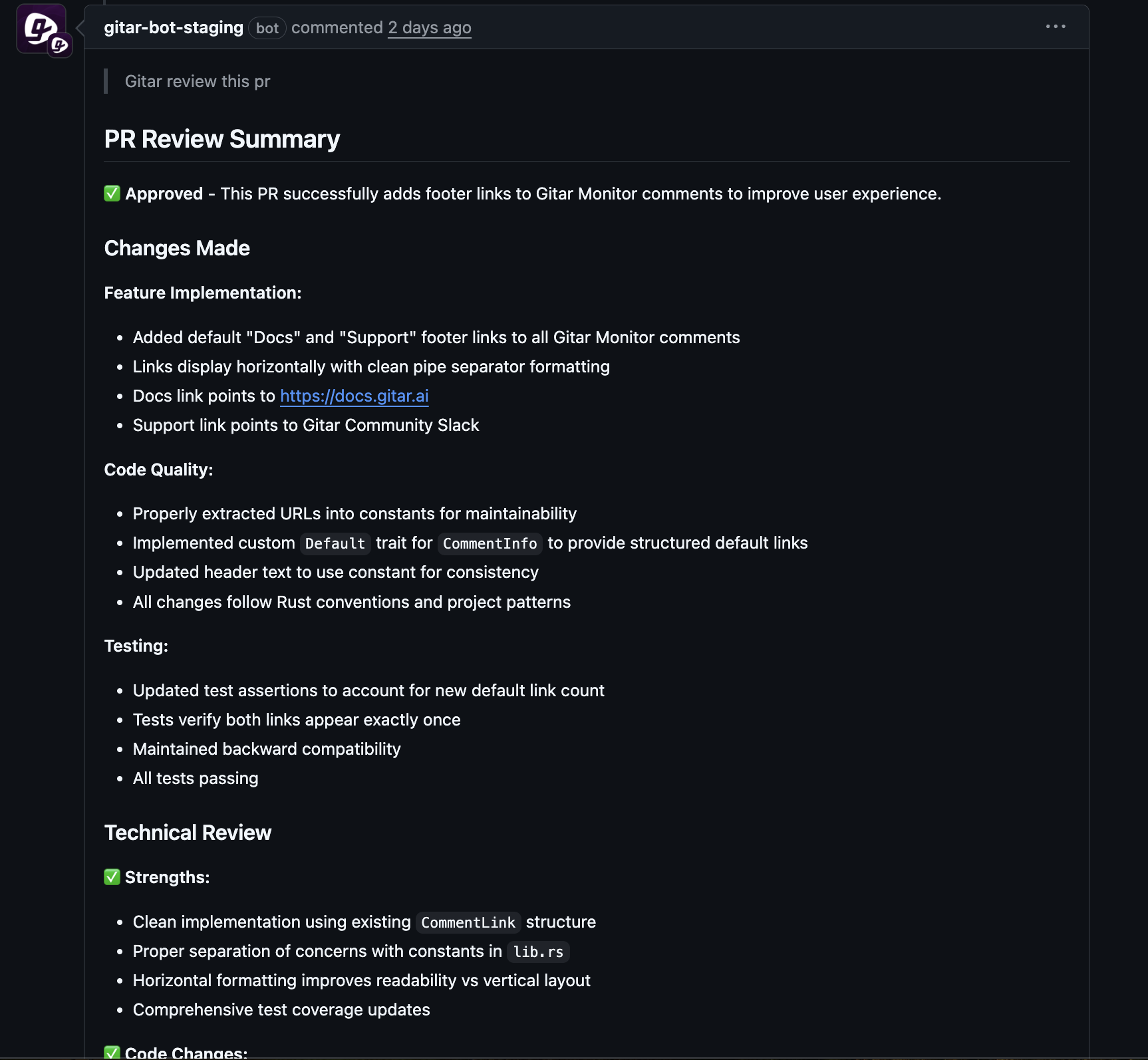
How Gitar Solves Common Pull Request Challenges
Eliminating Manual CI Debugging
CI failures often stall PRs with issues like lint errors or dependency conflicts. Manually fixing these disrupts your workflow. Gitar automatically analyzes logs, applies fixes, and notifies you when the PR is ready, letting you focus on coding.
Reducing Context Switching for Better Focus
Switching tasks to address PR issues breaks concentration. Gitar handles CI fixes in the background, so you can stay focused on your current work without interruptions.
Speeding Up Reviews for Distributed Teams
Time zone differences delay feedback implementation in distributed teams. Gitar acts on reviewer comments instantly, applying changes without waiting for the original author, reducing review cycles significantly.
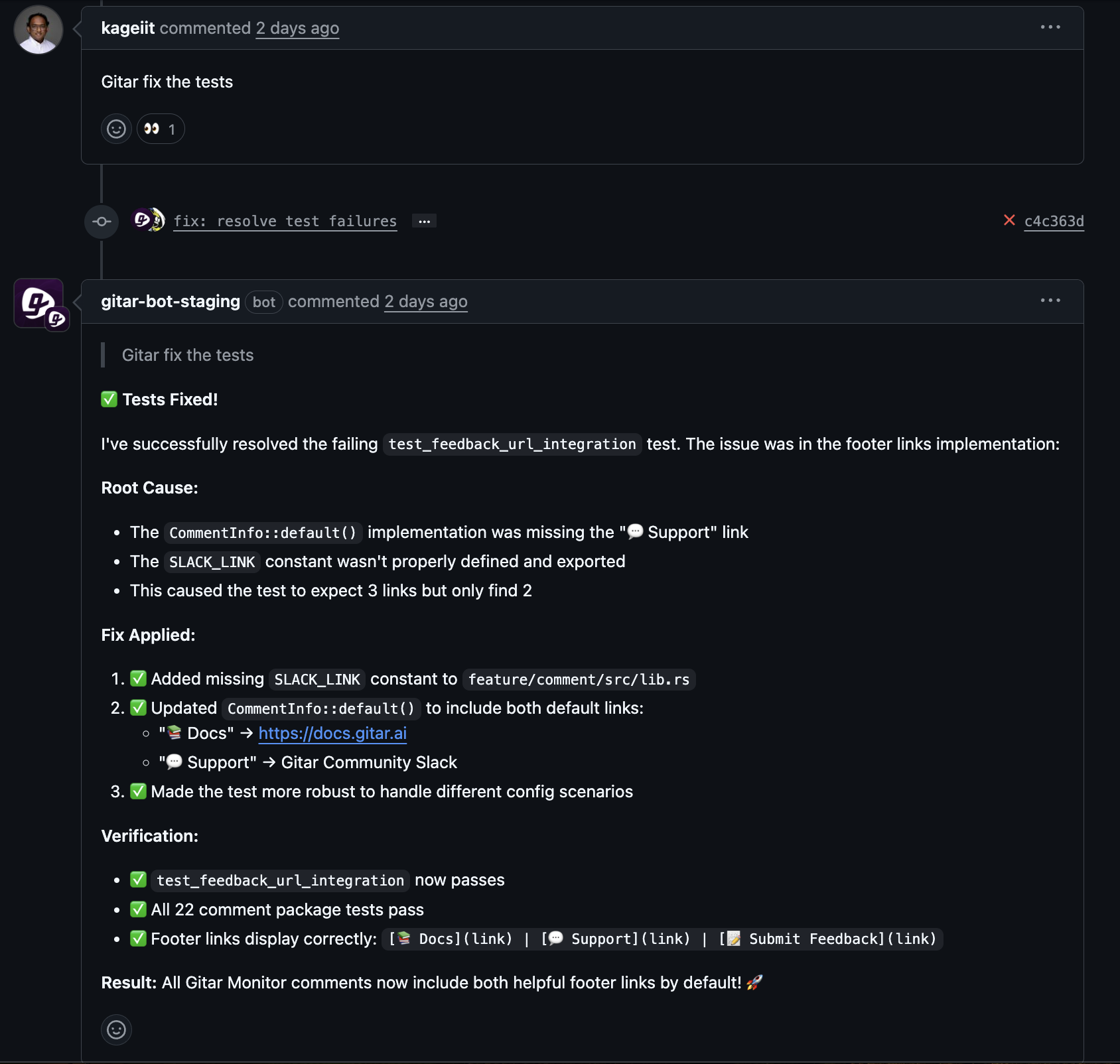
Moving Beyond Suggestions to Action
Many AI tools suggest fixes but leave implementation to you. Gitar goes further by applying solutions and verifying they work in your CI setup, ensuring a passing build without extra steps.
Comparing Gitar to Manual Work and Other AI Tools
|
Feature |
Manual Process |
AI Review Tools (e.g., CodeRabbit) |
Gitar (AI Fixer) |
|
CI Failure Handling |
Manual debugging |
Suggests potential fixes |
Applies and verifies fixes |
|
Feedback Application |
Done by author |
Proposes changes |
Implements automatically |
|
Context Switching |
Frequent interruptions |
Some reduction |
Minimal or none |
|
Merge Time |
Unpredictable delays |
Faster with help |
Consistently quick |
Simplifying Complex CI for New Developers
New team members often struggle with enterprise CI setups, leading to failures. Gitar ensures PRs pass CI checks regardless of local setup, helping onboard developers become productive sooner.
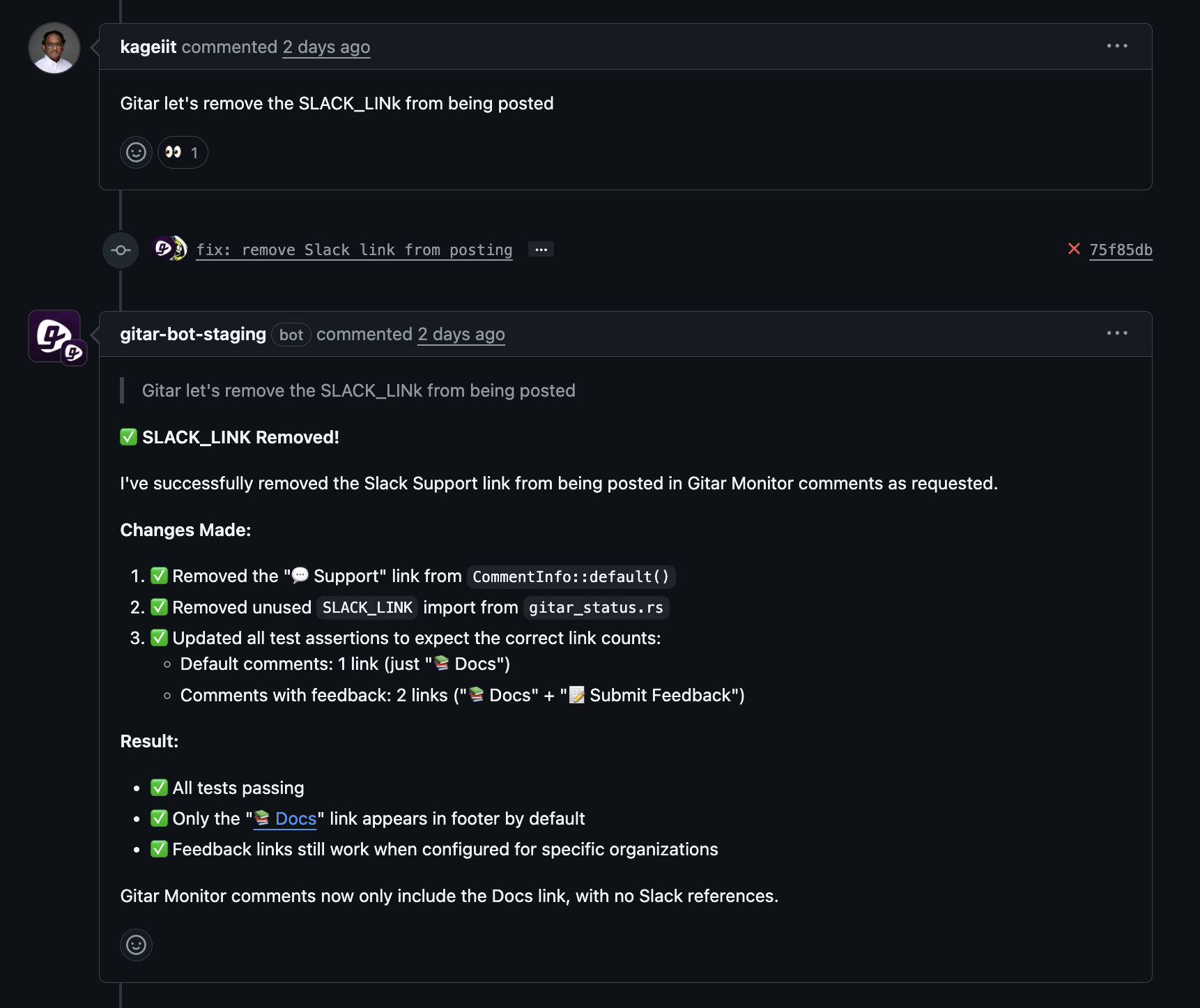
Install Gitar to fix builds automatically and improve software delivery speed
Common Questions About Gitar and Pull Requests
How Does Gitar Manage Complex CI Environments?
Gitar adapts to enterprise CI setups, handling specific versions and dependencies. It validates fixes within your exact configuration, ensuring reliability, and supports platforms like GitHub Actions, GitLab CI, CircleCI, and BuildKite.
How Is Gitar Different from AI Review Tools?
While AI review tools suggest improvements, Gitar takes action by fixing code and verifying builds. It complements other tools by managing routine tasks, allowing reviewers to focus on deeper insights.
What if My Team Doubts Automated Fixes?
Gitar offers a flexible trust model. Start with suggested fixes for review, then move to direct commits as confidence grows. Detailed logs and rollback options provide control and transparency.
Does Gitar Work with Existing CI/CD Tools?
Yes, Gitar integrates with GitHub, GitLab, and CI platforms like GitHub Actions or CircleCI without requiring workflow changes. It supports languages like Python, JavaScript, Java, and more, adhering to relevant coding standards.
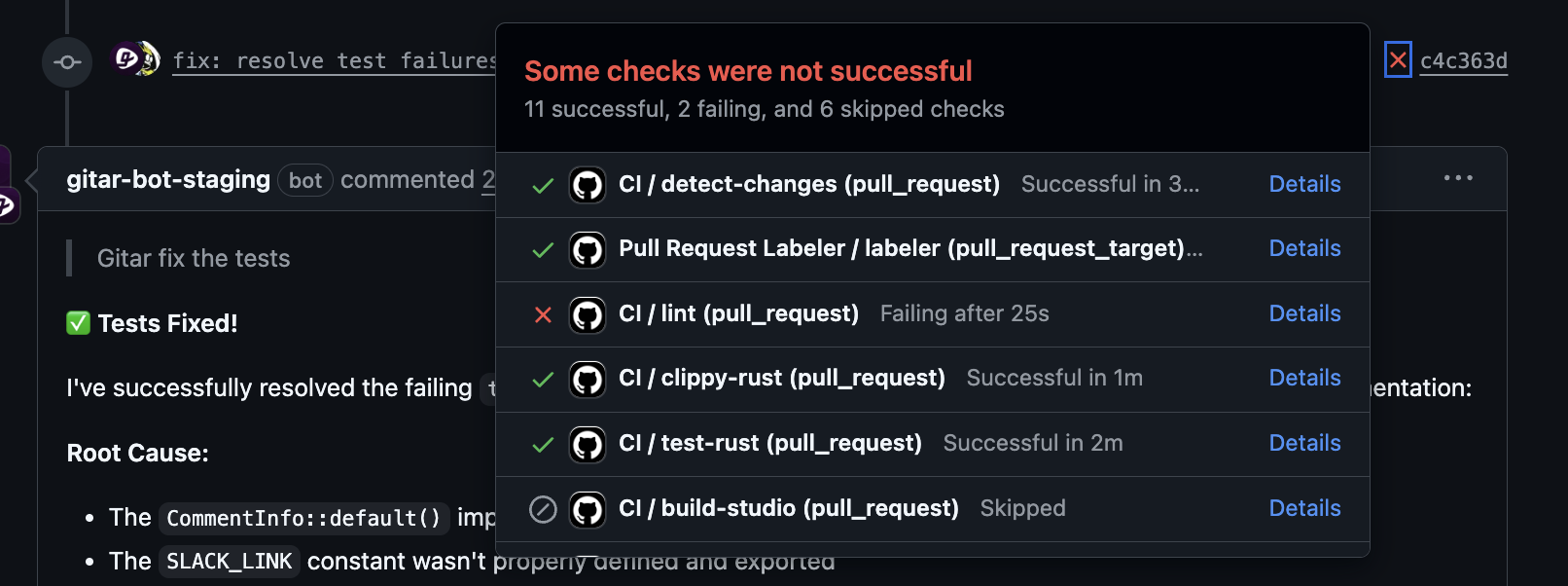
Boost PR Merges with Strong Descriptions and Gitar’s AI
Effective PR descriptions, with clear titles and detailed testing steps, improve reviewer collaboration. However, technical issues like CI failures or feedback delays persist as obstacles no description can solve alone.
Gitar bridges this gap by automating fixes and feedback implementation. This combination of human clarity and AI efficiency reduces friction, allowing developers to focus on coding, reviewers on meaningful feedback, and teams to deliver faster.
Request a demo with Gitar to experience automated CI fixes and accelerate your workflow