
Written by: Ali-Reza Adl-Tabatabai, Founder and CEO, Gitar
Key Takeaways
- AI coding tools generate code 3-5x faster, but CI/CD pipelines now face more test failures and manual fixes.
- Gitar ranks #1 as a free AI tool that analyzes CI logs, generates validated fixes, and commits them for guaranteed green builds.
- Competitors like CodeRabbit and Greptile charge $15-30 per user for suggestions that still require manual work, while Gitar offers free core functionality with broad CI support.
- Key evaluation criteria include auto-fix validation, free tiers, GitHub integration, and ROI from reduced debugging time, and Gitar excels across all.
- Teams can eliminate CI failures and ship faster by installing Gitar today for true automation beyond suggestions.
How We Ranked the Top Self-Healing CI Test Tools
Our evaluation focuses on auto-fix validation against CI systems, free tier availability, GitHub integration, measurable ROI, enterprise scalability, and integrations with Jira and Slack. We analyzed 2026 benchmarks from vendor documentation, GitHub star counts, user feedback across SERP tools, and validated Gitar performance data. Sources include DORA 2025 metrics showing high-performing teams achieve low failure rates and JetBrains surveys highlighting YAML configuration pain points and pipeline delays.
Top 9 AI Tools That Automatically Fix or Reduce Failing CI Tests
1. Gitar (#1): Free healing engine that analyzes CI logs, validates fixes, and commits solutions for guaranteed green builds.
2. Testim: Self-healing UI test locators with automatic element identification.
3. GitLab Duo: AI-powered root cause analysis with suggested fixes in merge requests.
4. Repairnator: Academic tool for automatic repair commits in Java projects.
5. Datadog Bits AI: Flaky test detection with automated PR draft generation.
6. CodeRabbit: Inline code suggestions and PR summaries.
7. Greptile: Codebase context analysis with review comments.
8. Dagger: Programmable CI/CD pipeline agents.
9. autofix.ci: GitHub-focused styling and formatting fixes.
Teams that want to eliminate CI failures can install Gitar now and experience true automation beyond suggestions.
Gitar
Gitar is an AI code review platform with a healing engine that automatically fixes CI failures such as lint errors, test failures, build breaks, and dependency issues. Gitar analyzes CI failure logs, generates context-aware fixes, validates them, and commits working solutions directly to pull requests.
Key features include single-comment PR summaries that update in place, natural language workflow rules stored in .gitar/rules/*.md files, and hierarchical memory that learns team patterns over time. The platform supports GitHub Actions, GitLab CI, CircleCI, and Buildkite. Gitar documentation provides detailed integration guides for all supported CI platforms.
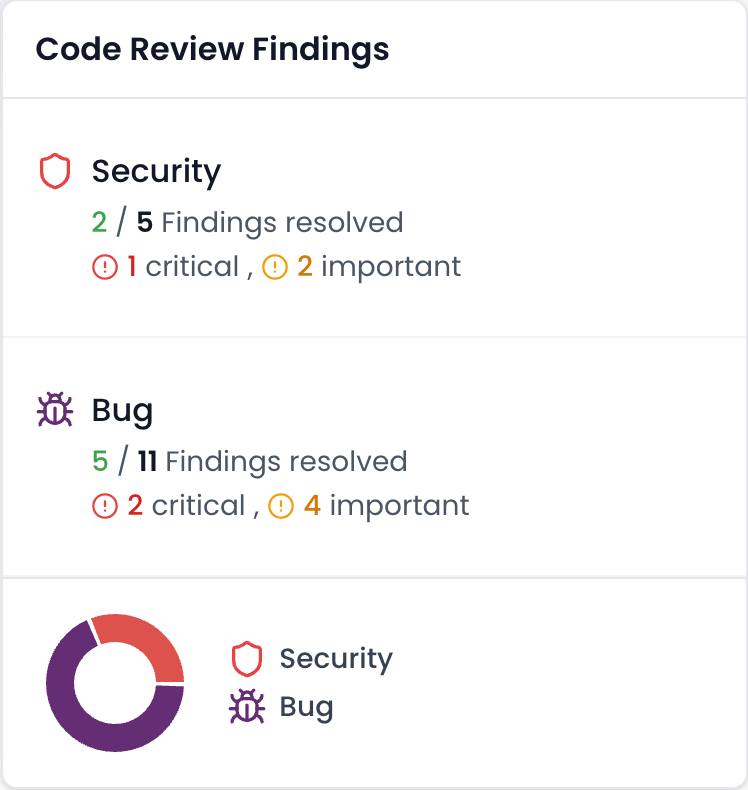
Setup takes about 30 seconds through the GitHub App installation. A 20-developer team typically saves about $750K annually by cutting CI debugging time from 1 hour to 15 minutes per developer per day.

Pricing: Free code review with unlimited repositories and users. Auto-fix features include a 14-day free trial, then team plans start at competitive rates. Enterprise deployments run agents within your own CI infrastructure for maximum security and context.
Pros: Completely free core functionality, cross-platform CI support, context memory system, guaranteed fix validation, and enterprise scalability proven at 50M+ lines of code.
Testim
Testim focuses on self-healing UI test automation and uses AI to identify alternative element locators when original selectors fail. The platform records user actions and automatically fixes flaky tests by adapting to UI changes in real time.
Core use cases involve web application testing where DOM elements change frequently. The tool maintains test stability across application updates without manual locator updates and offers CI/CD integrations for broader debugging.
Pricing starts at $450 per month for teams. Setup involves browser extension installation and test recording workflows.
Limitations: Primarily UI-focused for web, mobile, and Salesforce apps, with limited coverage of backend test failures or build issues.
GitLab Duo
GitLab Duo provides AI-powered root cause analysis for CI pipeline failures within the GitLab DevOps platform. The tool analyzes failure logs and suggests potential fixes through merge request comments.
Key features include pipeline failure summaries, suggested code changes, and integration with GitLab security scanning tools. The AI assistant identifies common failure patterns and recommends solutions based on historical data.
Pricing: Included with GitLab Premium at $29 per user per month and with custom pricing for Ultimate tiers.
Limitations: GitLab-only platform, suggestion-based approach instead of automatic fixes, and manual implementation of recommended changes.
Teams that want solutions instead of suggestions can try Gitar’s auto-fix engine with guaranteed CI validation.
Repairnator
Repairnator is an academic project in automatic program repair that targets Java projects with failing test suites. The tool attempts to generate patches that make tests pass through several repair strategies.
Primary use cases involve Java-based projects with strong test coverage. Repairnator works best on projects with clear test failure patterns and well-defined expected behaviors.
Pricing: Open source and free to use.
Limitations: Java-only support, research-focused design, limited CI platform integration, and significant setup and configuration requirements.
Datadog Bits AI
Datadog Bits AI supports developers across monitoring, APM, test improvement, code security, and related workflows inside the Datadog ecosystem. The tool identifies unreliable tests and can generate PR drafts with suggested fixes for common flakiness patterns.
Features include test reliability scoring, flaky test identification across CI runs, and integration with Datadog observability for correlating test failures with infrastructure issues.
Pricing: Part of Datadog CI Visibility, starting at $5 per month per committer.
Limitations: Requires adoption of the Datadog ecosystem, produces drafts instead of automatic fixes, and treats test flakiness as one focus area among many.
CodeRabbit
CodeRabbit provides AI-powered code review through PR analysis and inline suggestions. The platform covers security vulnerabilities, performance issues, and code quality improvements.
Use cases include automated code review for teams that want to scale review capacity. CodeRabbit analyzes pull requests and provides detailed feedback through inline comments and PR summaries.
Pricing: $15 per developer per month for the Pro plan and $30 per developer per month for Enterprise.
Limitations: Suggestion-only model that requires manual implementation, no CI failure analysis or auto-fix capabilities, and potential notification overload from many inline comments.
Greptile
Greptile specializes in codebase understanding and context-aware code review. The platform builds knowledge graphs of codebases to provide intelligent review comments and suggestions.
Key features include deep codebase analysis, context-aware suggestions, and integration with existing review workflows. Greptile works well for complex codebases that need rich contextual feedback.
Pricing: $30 per developer per month with enterprise options available.
Limitations: High cost for suggestion-only functionality, no automatic fix application, limited CI integration, and manual implementation of all recommendations.
Dagger
Dagger offers programmable CI/CD pipelines through code instead of YAML configuration. The platform itself is not an AI tool, but its programmable model supports integration with AI-powered debugging and fixing tools.
Use cases involve teams that want to replace complex YAML configurations with code-based pipeline definitions. Dagger supports multiple programming languages and CI platforms with portable integrations.
Pricing: Open source core with enterprise support options.
Limitations: No native AI capabilities and a focus on pipeline definition rather than failure resolution.
autofix.ci
autofix.ci provides automated fixes for code style, formatting, and some code quality issues in GitHub repositories. The tool focuses on consistent code formatting and common linting errors.
Primary use cases include automated code formatting, import sorting, and basic linting fixes. The tool helps teams maintain code style consistency.
Pricing: Free for open source projects with paid plans for private repositories.
Limitations: Primarily formatting and style fixes, no handling of test failures or build errors, and GitHub-only support.
Side-by-Side Comparison of AI CI Failure Tools
| Tool | Auto-Fix Validation | Free Tier | CI Support | Pricing |
|---|---|---|---|---|
| Gitar | Yes | Full Review | GitHub, GitLab, CircleCI, Buildkite | $0 (Free) |
| CodeRabbit | No | Limited | GitHub, GitLab | $15-30/user |
| Greptile | No | Trial Only | GitHub | $30/user |
| GitLab Duo | Partial | No | GitLab Only | $29/user (Premium), custom (Ultimate) |
This comparison shows Gitar as the only tool with true auto-fix validation, a comprehensive free tier, and broad platform support. While CodeRabbit and Greptile provide suggestions that require manual work, Gitar delivers working solutions validated against the actual CI environment.
Best AI Tools for Flaky Tests and CI Auto Fix on GitHub
Gitar setup for GitHub Actions takes about 30 seconds through the GitHub App installation. The platform automatically detects unrelated failures such as infrastructure issues versus code bugs, improving flaky test reliability and CI/CD pipeline stability. Gitar ML analysis separates environmental flakiness from genuine code problems and saves significant debugging time.
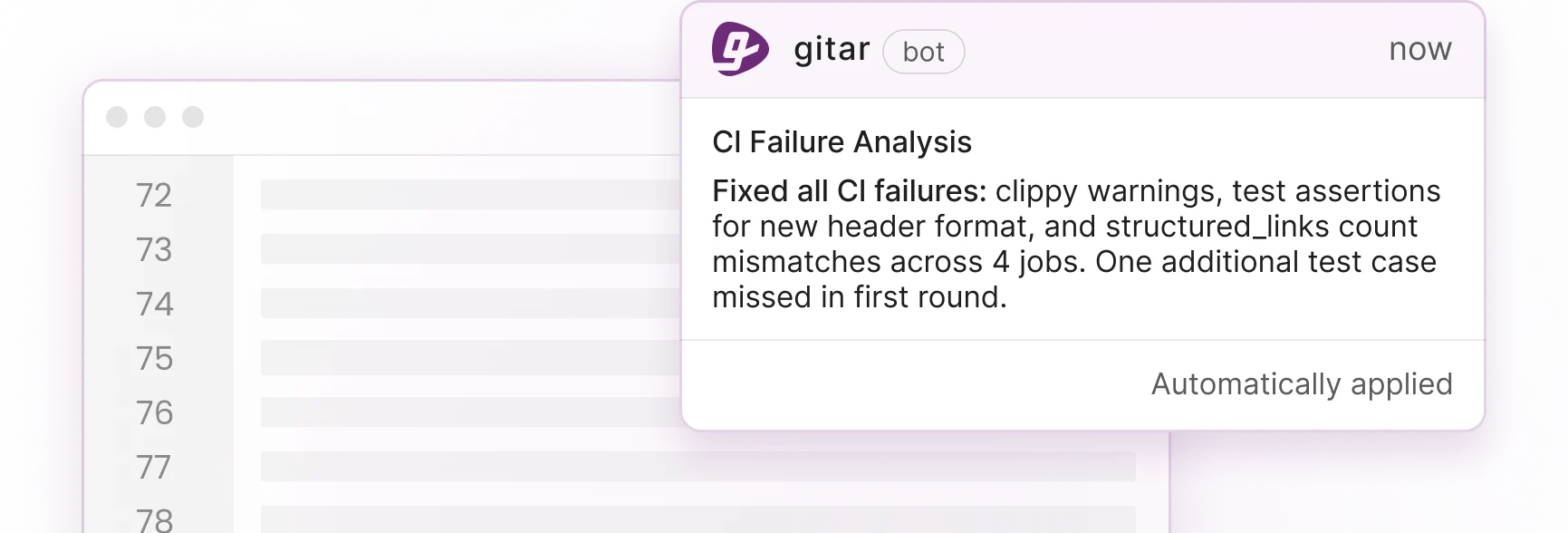
The log-to-fix workflow runs automatically when CI fails. Gitar analyzes failure logs, generates context-aware fixes using full codebase knowledge, validates solutions against the CI environment, and commits working fixes directly to the pull request. This workflow supports common “autofix ci pull requests” scenarios where teams need immediate resolution without manual intervention.
Self-healing automation testing ranks as a top trend for 2026, with AI and ML identifying alternate elements at runtime for continued testing success. Gitar extends this concept beyond UI testing and covers CI failure resolution across many failure types.
Teams can stop debugging CI failures manually. They can install Gitar and let AI handle the fixes while they focus on feature development.
Key Buying Considerations and FAQs for AI CI Tools
Teams should weigh free solutions like Gitar for small to medium groups against enterprise-scale requirements. Organizations that integrate AI across the SDLC improve software development outcomes by 30-45%, with strong ROI from reduced manual debugging time. Security factors include data retention policies, where Gitar maintains zero retention, and deployment options such as cloud or on-premises agents.
Free vs Paid AI CI Tools
Free tools like Gitar provide comprehensive code review, PR analysis, and CI failure detection without direct cost. Paid alternatives like CodeRabbit at $15-30 per user and Greptile at $30 per user offer suggestion-only functionality that still requires manual implementation.
Gitar free tiers include unlimited repositories and users, and the auto-fix engine offers a 14-day free trial. The main difference is that Gitar fixes code instead of only suggesting changes, which delivers stronger ROI even at zero cost.
How GitHub Integration Works for AI CI Tools
GitHub integration usually involves installing a GitHub App that monitors pull requests and CI status checks. Gitar installation takes about 30 seconds and then begins analyzing pull requests with a single dashboard comment that updates in place.
The platform integrates with GitHub Actions, GitHub status checks, and the GitHub review system. Unlike competitors that scatter inline comments across diffs, Gitar consolidates findings in one clean interface.
Guarantees for CI Fixes from AI Tools
Most AI tools provide suggestions without validation and rely on manual verification. Gitar validates every fix against the actual CI environment before committing and guarantees that applied fixes produce green builds.
This validation process runs the fix through the complete CI pipeline and checks compatibility with configuration, dependencies, and the test suite.
Handling Flaky Tests with AI
Advanced AI tools use ML analysis to separate genuine code issues from environmental flakiness. Gitar unrelated failure detection identifies CI failures that come from infrastructure problems instead of code changes and avoids unnecessary debugging cycles.
The platform maintains historical context, recognizes flaky test patterns, and applies strategies such as retry logic and environmental stability checks.
Switching from CodeRabbit or Other Review Tools to Gitar
Switching to Gitar removes monthly per-developer costs and upgrades teams from suggestion-based tools to automated fixes. The transition involves installing the Gitar GitHub App alongside or instead of existing tools.
Teams usually see immediate value from the consolidated comment approach compared with notification overload from many inline comments. The main benefit is moving from paying for suggestions to receiving free fixes that work.
Conclusion: Why Gitar Leads AI CI Failure Repair in 2026
Gitar stands out in 2026 as an AI tool that automatically fixes failing tests in CI and surpasses suggestion-only alternatives. Competitors charge premium prices for comments that still require manual work, while Gitar delivers free code review with validated auto-fixes that guarantee green builds.
The healing engine, broad CI support, and zero-cost entry point position Gitar as a clear choice for teams that want real automation instead of incremental improvements. Install Gitar now: https://gitar.ai/. Setup takes about 30 seconds, costs nothing for green builds, and delivers strong ROI for development teams.