

Key Takeaways
- Qodo PR Agent delivers deep code quality analysis but still requires manual fixes, which increases review workload.
- Bito offers quick setup and codebase-aware reviews but lacks auto-apply fixes and CI failure healing.
- Both tools charge $15-30 per seat monthly for suggestions only, which does not solve 2026 AI code review bottlenecks.
- Gitar provides free comprehensive PR reviews, automated CI failure healing, and real code fixes with proven enterprise scalability.
- Cut PR review time by up to 85% and remove most manual fixes, and install Gitar free today for unlimited repos with no card required.
Executive Summary: Qodo Depth vs Bito Speed Without Fixes
AI agents now touch 14.9% of PRs in 2026, according to recent research on AI code review adoption, and review queues keep growing. Qodo PR Agent focuses on deep code quality analysis for readability, complexity, and maintainability. Bito emphasizes quick setup and clear code explanations for busy teams. Both tools still share one critical flaw: they suggest changes but do not apply fixes.
Our evaluation criteria cover analysis depth, setup complexity, auto-fix capabilities, CI integration, pricing, platform support, and scalability. Neither Qodo nor Bito solves the core 2026 problem, because both add commentary without reducing manual work. Gitar stands apart by fixing code and CI failures automatically, and the Gitar documentation explains the implementation details.
Feature Comparison: Qodo PR Agent vs Bito vs Gitar
| Feature | Qodo PR Agent | Bito | Gitar |
|---|---|---|---|
| PR Analysis | Deep quality review | Advanced codebase-aware review | Comprehensive and free |
| Auto-Apply Fixes | No | No | Yes (14-day trial) |
| CI Failure Healing | No | No | Yes |
| Pricing | $15+/month | $15-30/seat | Free review, trial autofix |
Qodo PR Agent: Deep Analysis Without Automation
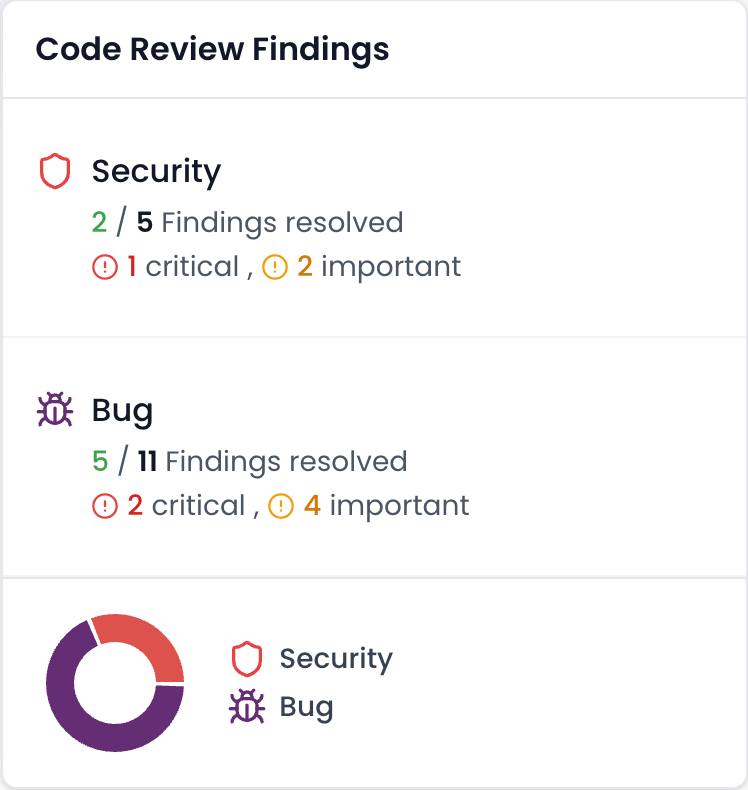
Qodo PR Agent excels at comprehensive code analysis and evaluates readability, complexity, and maintainability while integrating with CI/CD pipelines. The platform delivers detailed feedback on code quality issues and supports custom review commands. Teams value its analysis depth compared to simpler review tools.
Qodo struggles in 2026’s high-velocity development environment. The tool requires manual implementation of every suggestion and offers no CI failure resolution. It also charges premium pricing for what functions as sophisticated commenting. With 42% of committed code now AI-assisted, suggestion-only tools increase manual work instead of reducing it.
Bito AI Code Review: Fast Setup, Limited Review Power
Bito presents itself as a comprehensive AI coding assistant and handles tedious developer tasks by generating code, creating test cases, and writing comments. The platform claims to save developers more than an hour each day through quick setup and support for multiple AI providers.
Bito still falls short in real code review workflows when compared to specialized tools that deliver full automation. The tool creates notification noise across PRs and still requires manual implementation of every suggestion. At $15-30 per seat monthly, teams pay premium prices for commentary that continues to demand manual fixes.
Qodo vs Bito: Depth, Speed, and the Automation Gap
Qodo and Bito represent a trade-off between depth and speed. Qodo provides thorough analysis with a straightforward hosted setup. Bito focuses on faster deployment and codebase-aware reviews.
Both tools share the same core limitation in 2026. They act as suggestion engines during a period that demands automation. With AI-generated code requiring more review effort than human-written code, more suggestions without fixes only deepen the bottleneck. Neither product addresses CI failures, validates fixes against real build environments, or meaningfully reduces the manual work that slows development velocity.
Bito Downsides and the Gitar Fix
Bito’s main downsides include notification spam across PR diffs, lack of CI context for meaningful failure analysis, and pricing that does not match the limited automation. Teams report cognitive overload from scattered inline comments and frustration with suggestions that ignore build environment complexities.
Gitar removes these pain points through single-comment consolidation, full CI integration, and real fix implementation. Teams stop paying for suggestions and receive free review plus automated resolution instead.
Why Gitar Outperforms Qodo and Bito in 2026
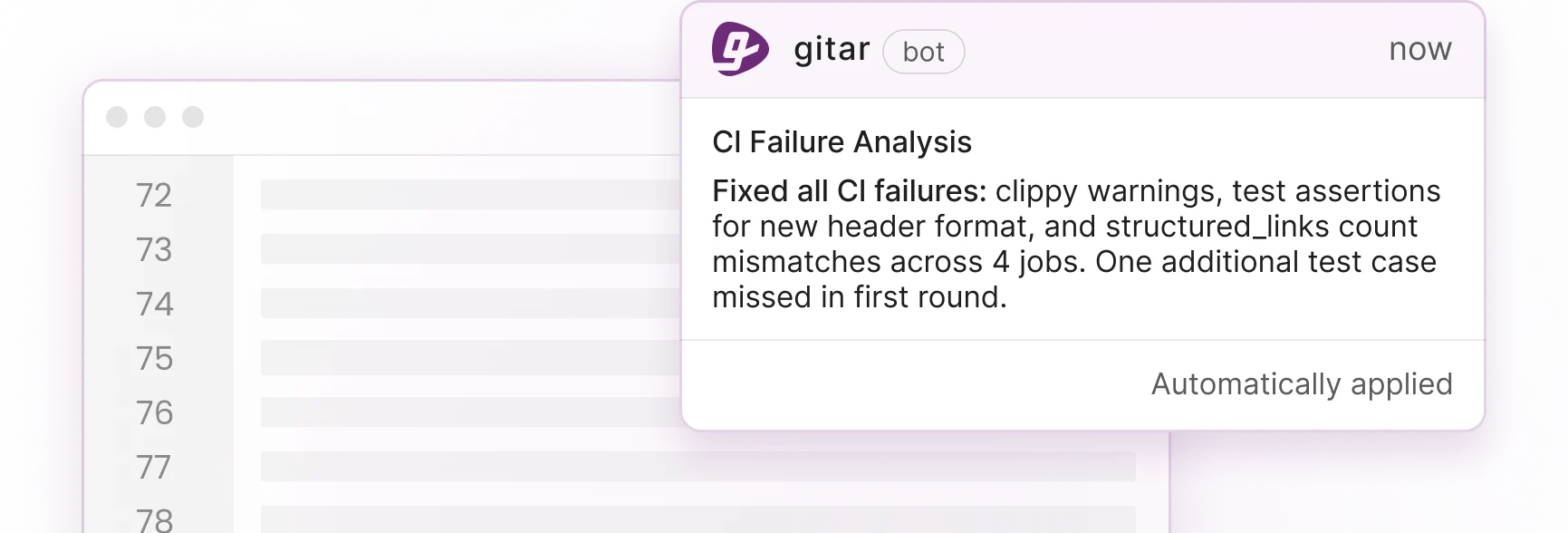
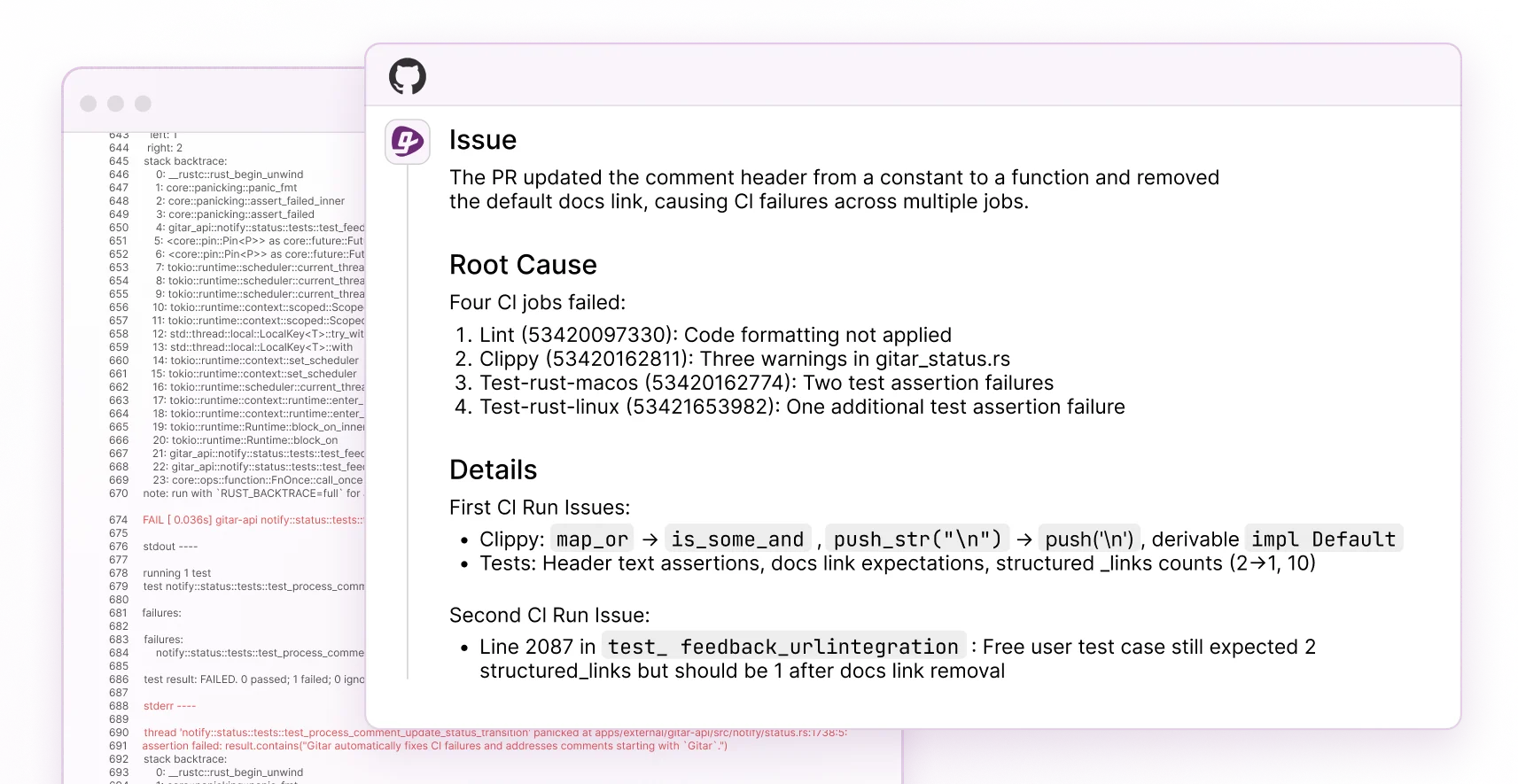
Gitar wins by solving the real problem, which is fixing code instead of only commenting on it. While competitors charge $15-30 per developer for suggestions, Gitar delivers free comprehensive review plus a 14-day autofix trial. The healing engine resolves CI failures automatically, including lint errors, test failures, and build breaks, as detailed in the Gitar documentation.
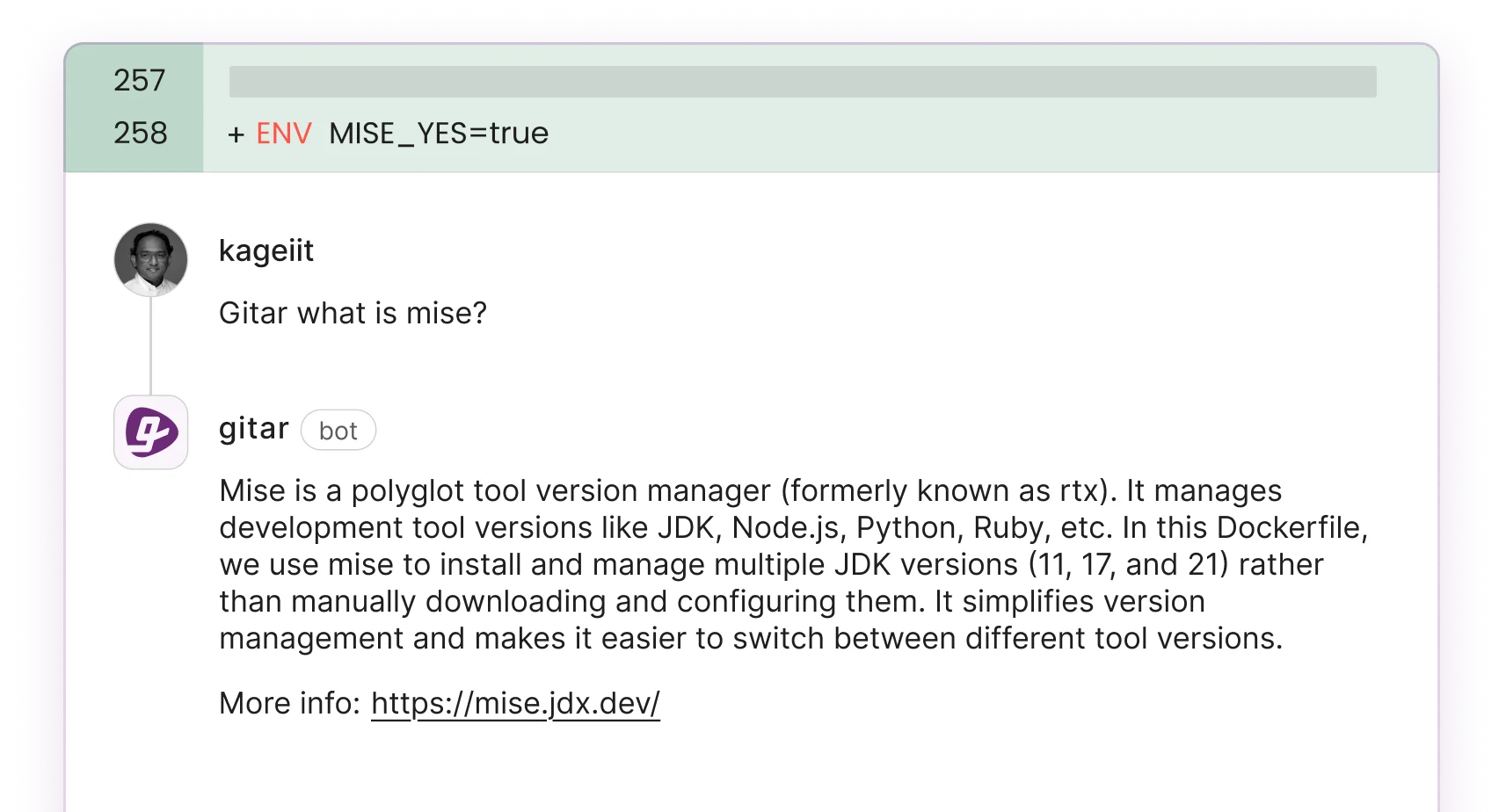
Customer results confirm this advantage. Pinterest runs Gitar across more than 50 million lines of code with thousands of daily PRs. Tigris reports that Gitar’s summaries are “more concise than Greptile/Bugbot.” Collate’s engineering team highlights Gitar’s “unrelated PR failure detection,” which saves significant debugging time. Install Gitar now and bring those benefits to your own repos.
Gitar ROI: Before and After Performance
| Metric | Before Gitar | After Gitar |
|---|---|---|
| Daily CI/Review Time | 1 hour per developer | 15 minutes per developer |
| Annual Productivity Cost | $1M (20-dev team) | $250K |
| Tool Spending | $450-900/month | $0 |
Qodo vs Bito Verdict and Better Alternatives
Qodo and Bito both fall short in the 2026 comparison and represent expensive answers to the wrong problem. Qodo offers depth without automation. Bito delivers speed with shallow analysis. Both charge premium prices for incomplete solutions.
Gitar emerges as the practical alternative with free comprehensive review, real code fixes, CI healing, and platform-level scalability. The decision stays simple. Teams that only need suggestions can use free tools, while teams that need fixes should choose Gitar.
Decision Framework: Why Gitar Fits 90% of Teams
Most teams benefit from treating paid suggestion engines as a misaligned investment. Code review should feel free and automated for developers. Gitar delivers both outcomes while competitors charge for neither.
Start with free review, then trial the autofix capabilities, and finally expand into full platform features as your workflows mature. This path keeps costs low while steadily increasing automation.
FAQ
What are the main downsides of Bito for AI code review?
Bito’s primary limitations include notification spam from scattered inline comments, shallow analysis that lacks CI context, and no automated fix implementation. Pricing also fails to match the limited automation. Teams report cognitive overload and frustration with suggestions that ignore build environment complexities.
What are the best alternatives to Bito and Qodo for AI code review in 2026?
Gitar stands as the leading alternative and offers free comprehensive code review, automated CI failure resolution, and real fix implementation instead of suggestions only. Unlike paid tools that charge $15-30 per developer for commentary, Gitar delivers stronger functionality at no cost, with optional premium features for advanced workflows.
Which AI code review tool is best for 2026?
Gitar leads the 2026 landscape by solving the core problem that other tools ignore, which is actually fixing code instead of only commenting on it. With free comprehensive review, automated CI healing, single-comment consolidation, and proven scalability across enterprise environments, Gitar delivers stronger ROI than suggestion-only alternatives.
What are Qodo PR Agent’s key features and limitations?
Qodo PR Agent provides deep code quality analysis for readability, complexity, and maintainability with CI/CD integration. It still operates as a suggestion-only tool that requires manual implementation of all recommendations. Qodo also offers no CI failure resolution and charges premium pricing for sophisticated commenting without automation.
How much do AI code review tools typically cost in 2026?
Traditional AI code review tools usually cost $15-30 per developer monthly, with Qodo starting at $15+ and Bito charging $15-30 per seat. These costs scale quickly, so a 30-person team pays $450-900 monthly for suggestion-only tools. Gitar disrupts this model by delivering stronger functionality completely free for code review, with optional premium features for advanced automation.
Conclusion: Reduce PR Friction and Install Gitar Free
The Qodo vs Bito comparison exposes a core market issue, because both tools act as expensive solutions to the wrong challenge. Suggestion engines do not solve the 2026 bottleneck created by AI-generated code flooding review pipelines. Gitar ends this suggestion trap by fixing code, healing CI failures, and automating the workflows that matter most.
Install Gitar now, automatically fix broken builds, and start shipping higher quality software faster. No credit card is required, and you can connect unlimited repositories.