
Written by: Ali-Reza Adl-Tabatabai, Founder and CEO, Gitar
Key Takeaways
- AI coding tools generate code 3-5x faster, yet CI failures and PR reviews still slow teams, even with 84% AI adoption in 2025.
- Suggestion tools like CodeRabbit and Greptile ($15-30 per developer monthly) still require manual fixes, which keeps debugging loops and notification overload in place.
- Gitar offers free unlimited code review plus a 14-day auto-fix trial, analyzing CI logs, validating fixes, and committing solutions across GitHub Actions, GitLab CI, CircleCI, and Buildkite.
- Teams cut merge times by 75% and save about $750K annually for a 20-developer team by reducing CI debug time from 1 hour to 15 minutes per day, backed by SOC 2 security and enterprise deployments.
- Transform your CI pipeline from reactive debugging to proactive healing by installing Gitar now for immediate productivity gains.
Why CI Auto-Fix Matters More Than Suggestions in 2026
Modern development teams face constant CI failures that traditional review tools cannot resolve end to end. Broken Access Control alerts increased 172% year-over-year, largely from misconfigured CI/CD permissions and AI-generated scaffolds that miss critical authentication checks. Test failures stack up on AI-generated pull requests and create repetitive debugging loops that drain developer focus.
Suggestion-based tools like CodeRabbit and Greptile stop at comments. These platforms analyze code, flag issues, and post feedback, then hand the work back to developers. Engineers still implement fixes, push commits, and wait for CI to validate changes. At $15-30 per developer monthly, teams pay for commentary while the manual bottleneck remains.
Self-healing CI replaces reactive suggestions with proactive fixes. Intelligent systems read failure logs, generate targeted changes, validate them in CI, and commit working solutions automatically. This approach matches AI-accelerated code generation with AI-accelerated validation and repair, which removes the core friction in modern pipelines.
Gitar: Automatic CI Failure Fixes With Free Code Review
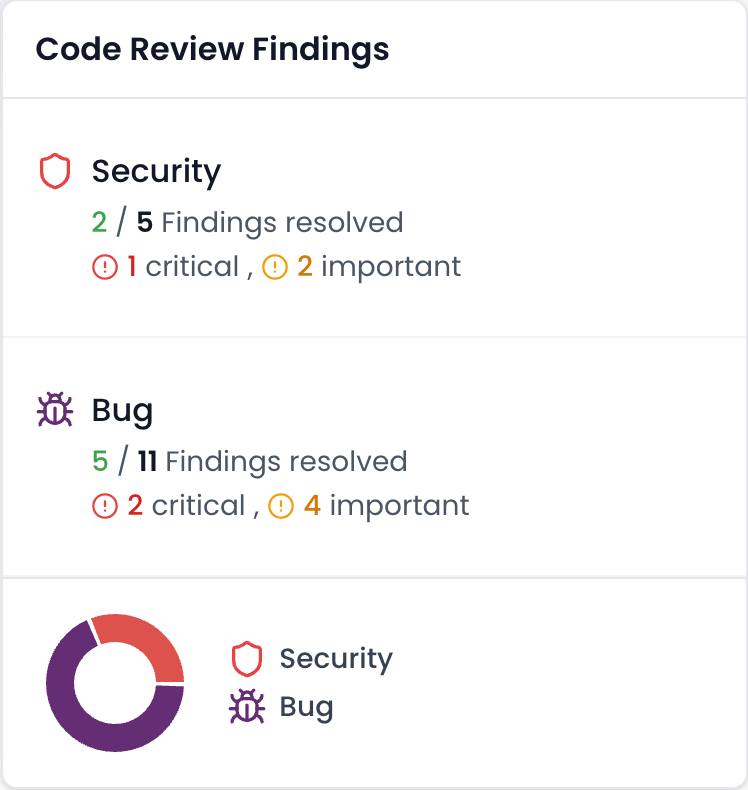
Gitar delivers automatic code review that actually fixes CI failures, not just comments on them. The platform offers comprehensive free code review with a 14-day auto-fix trial, so teams get unlimited PR analysis, security scanning, and bug detection at no cost. The healing engine then turns findings into working fixes instead of leaving them as to-do items. For detailed features, see the Gitar documentation.
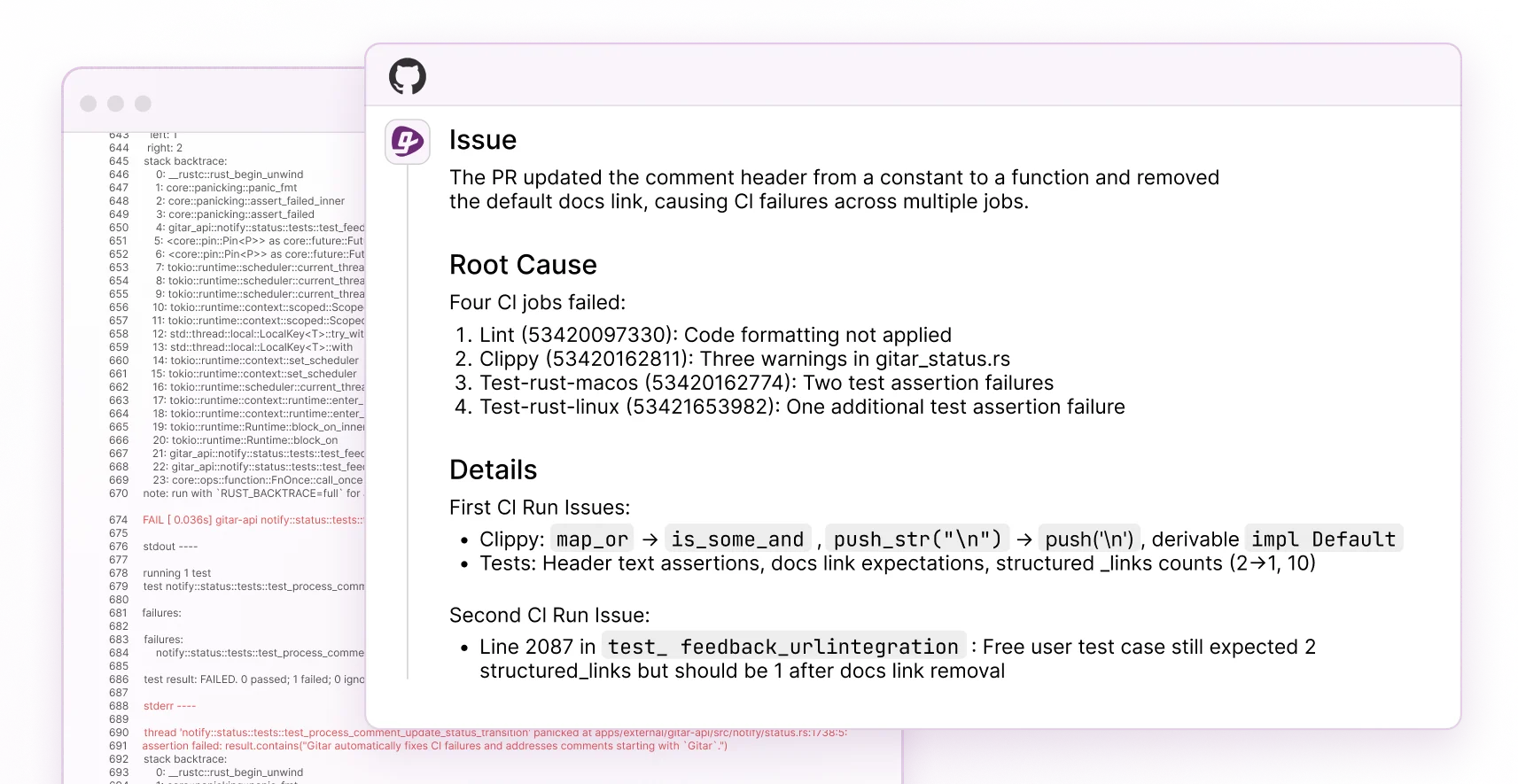
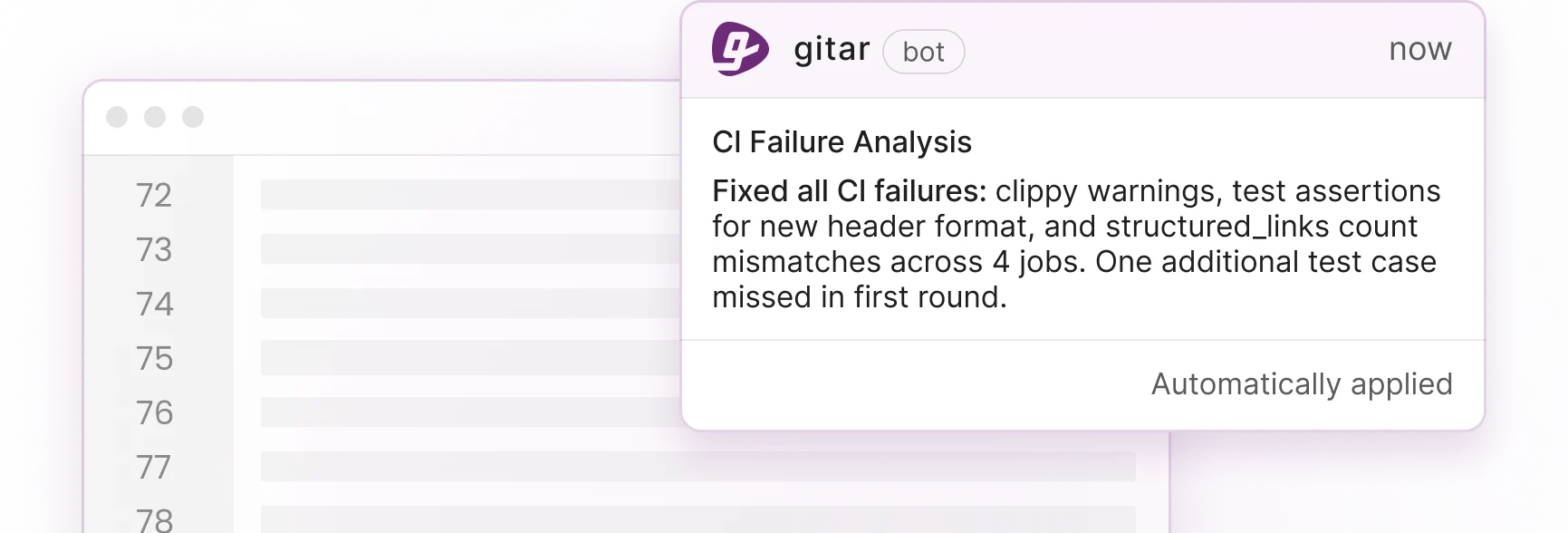
Gitar’s core value comes from its complete CI failure resolution workflow. When lint errors, test failures, or build breaks appear, Gitar analyzes failure logs to identify root causes. It then generates code changes with full repository context, validates those changes against your CI system, and commits verified fixes directly to the pull request. Results appear in a single dashboard-style comment that updates in place, which removes noisy comment threads and notification spam. Learn more in the documentation.
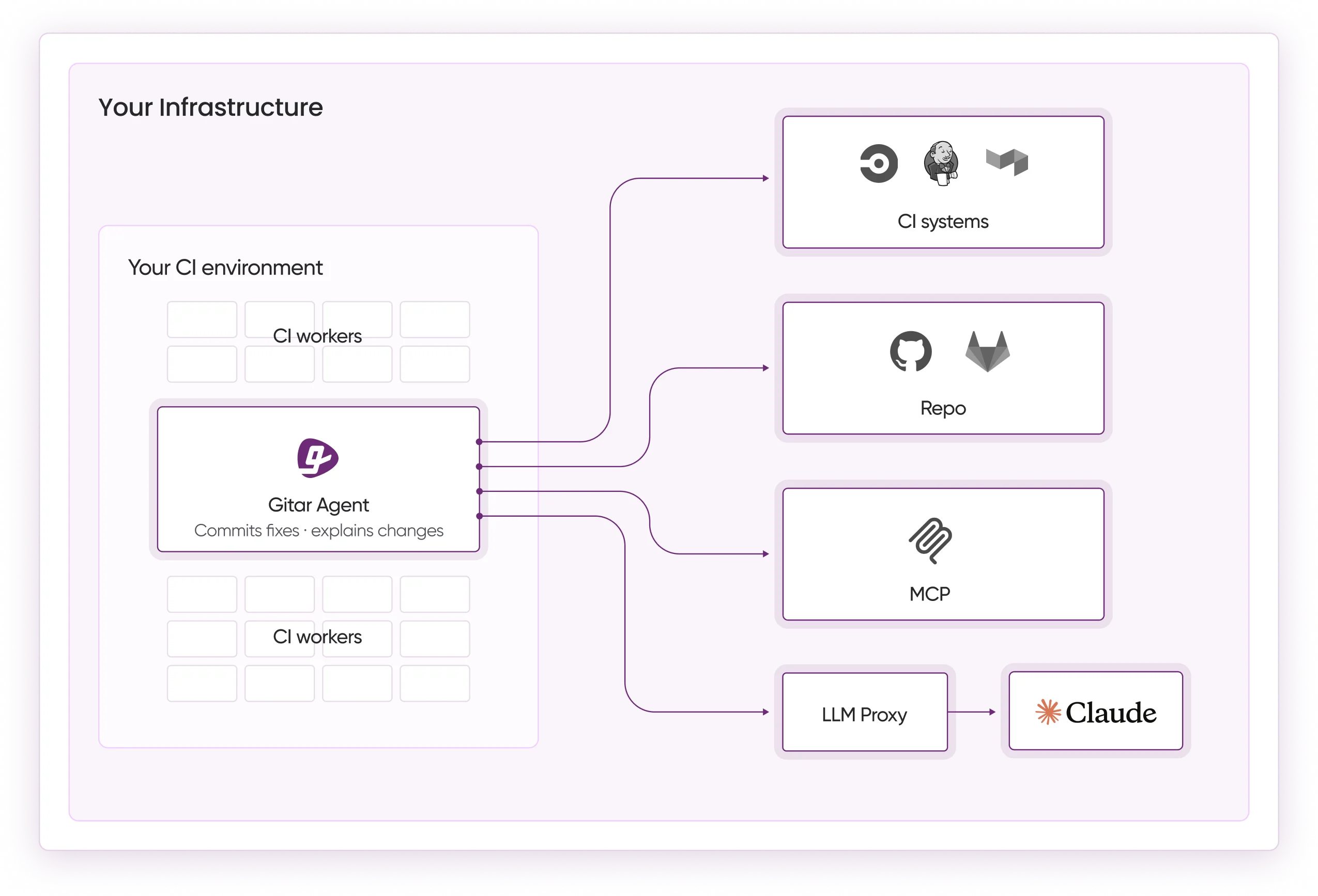
Gitar supports GitHub Actions, GitLab CI, CircleCI, and Buildkite, so teams can use one solution across multiple platforms. Natural language repository rules let teams automate workflows without complex YAML. Jira and Slack integrations keep stakeholders aligned, while hierarchical memory learns team patterns over time. Enterprise validation includes Pinterest’s rollout across more than 50 million lines of code, which proves reliability at production scale. Setup guides live in the Gitar docs.
ROI modeling for a 20-developer team shows strong savings when CI debug time drops from one hour per day to 15 minutes. Tigris reports “more concise summaries than Greptile/Bugbot,” and Collate’s engineering team highlights “unrelated PR failure detection” that separates infrastructure flakiness from real code bugs. Traditional reviewers rarely achieve this because they lack deep CI context.
Gitar’s security model includes SOC 2 Type II certification. Deployment options range from managed cloud to on-premises agents that run inside existing CI pipelines. Getting started takes a 30-second GitHub App installation with no credit card or account creation. Install Gitar now to shift your CI pipeline from reactive debugging to proactive healing.
Top AI CI Auto-Fix Tools Compared
The AI CI auto-fix market spans simple suggestion tools to full healing engines. The comparison below focuses on each tool’s ability to resolve CI failures with validation and commits, not just surface-level feedback.
| Tool | Pricing | Auto-Fix CI Level | Platforms/Strengths |
|---|---|---|---|
| Gitar | Free/14-day trial | Full (Validation/Commit) | GitHub/GitLab/CircleCI/Buildkite | Healing engine, ROI-proven |
| CodeRabbit | $15-30/dev | Suggestions/No | GitHub | Noisy comments, manual fixes required |
| Greptile | $30/dev | Suggestions/No | GitHub/GitLab | Context-aware but no commit capability |
| Autofix.ci | Paid | Linting/Partial | GitHub | Formatting only, limited scope |
GitHub Copilot integrates only with GitHub and offers diff-based reviews at $10-39 monthly. It misses deeper architectural issues and cannot commit fixes. BugBot requires a $40 subscription plus Cursor licensing, which narrows its audience while still providing only medium-depth analysis without CI integration.
Open-source tools such as gh-fix-ci offer partial GitHub Actions support with do-it-yourself Claude integration. They lack strong validation guarantees and enterprise backing. JetBrains AI Assistant ships with IntelliJ for static analysis suggestions but cannot commit fixes or plug directly into CI pipelines.
Validation and commit capability define the real gap. Suggestion tools still rely on manual implementation and hope that fixes pass CI. Gitar instead delivers end-to-end automation with CI validation guarantees. This architectural difference explains why teams report 75% faster merge times and large productivity gains after moving from suggestion engines to healing platforms. Install Gitar now, automatically fix broken builds to experience the shift from suggestions to solutions.
Self-Healing CI Results, Benchmarks, and ROI
Benchmarks show that self-healing CI systems outperform suggestion-based tools on both productivity and cost. Nx’s Self-Healing CI fixed 60-66% of broken PRs automatically in 2025, which removed context switching and helped teams ship at AI speed without manual triage.
ROI analysis for automatic CI failure fixing highlights clear financial gains across team sizes:
| Metric | Before | After Gitar | Annual Savings |
|---|---|---|---|
| CI Debug Time | 1 hour/day/dev | 15 min/day/dev | $750K (20-dev team) |
| Tool Costs | $450-900/month | $0 | $5,400-10,800 |
| Context Switching | Multiple/day | Near-zero | Productivity gains |
Independent research supports these outcomes. AI-powered self-healing systems reduced average system downtime by 60% compared to manual fault management, with root cause analysis correctly identifying issues in more than 90% of test cases.
Teams often worry about free models and automated commits. Configurable automation levels address those concerns. Gitar starts in suggestion mode so teams can review and approve fixes while they build trust. They can then enable auto-commit for specific failure types as confidence grows. The validation engine checks fixes in real CI environments, not just isolated tests, which reassures teams with complex pipelines.
Gitar Setup Guide and Key Adoption Steps
Teams can roll out Gitar’s automatic CI failure fixing in four phases that support gradual adoption. Phase 1 starts with installing the GitHub App or GitLab integration with no account or credit card. Gitar immediately posts dashboard comments on pull requests. Detailed installation steps appear in the Gitar documentation.
Phase 2 focuses on trust building through suggestion mode. Teams review proposed fixes and confirm that Gitar reliably resolves lint errors, test failures, and build breaks. Phase 3 enables auto-commit for trusted fix categories and introduces repository rules that automate workflows. Phase 4 adds analytics dashboards, natural language rules, and enterprise deployment options for larger organizations.
Different roles gain different benefits. Developers avoid constant context switching and see fewer notifications. Engineering leaders track clear ROI from automated fixes and simplified tooling. DevOps engineers gain self-healing CI that cuts reruns and eases onboarding through natural language rules instead of complex YAML. Security teams benefit from SOC 2 Type II certification and flexible deployment models, from managed cloud to on-premises agents. Refer to the docs for security and deployment details.
CodeRabbit vs Gitar for CI Fixes
FAQs
What is the best free automatic CI failure fixer available in 2026?
Gitar offers the most complete free automatic CI failure fixing solution in 2026. Teams get unlimited code review, PR analysis, and security scanning at no cost, plus a 14-day free trial of auto-fix features. Paid alternatives charge $15-30 per developer for suggestions only, while Gitar delivers validated fixes with commits, which makes it the strongest option for both cost and capability.
Does Gitar validate fixes against CI before committing them?
Gitar validates every fix against your actual CI environment before it commits changes. The healing engine reads failure logs, generates fixes with full repository context, and tests them against your CI configuration, including SDK versions and dependencies. It then commits only verified working solutions, which ensures that changes succeed in production environments, not just in isolated tests.
How does Gitar compare to CodeRabbit for CI failure resolution?
Execution capability separates Gitar from CodeRabbit. CodeRabbit charges $15-30 per developer monthly to leave suggestions in comments that engineers must implement manually. Gitar provides free code review plus automatic fix implementation with CI validation. CodeRabbit often creates notification overload with many inline comments, while Gitar consolidates updates into a single evolving dashboard comment.
Does Gitar support GitHub Actions and other CI platforms?
Gitar supports GitHub Actions, GitLab CI, CircleCI, and Buildkite with consistent auto-fix behavior. This broad coverage works well for teams that use multiple CI systems or expect to migrate in the future. The architecture adapts to each CI environment while preserving the same healing capabilities.
What ROI can teams expect from implementing automatic CI failure fixing?
A 20-developer team usually saves substantial value by cutting CI debugging time from one hour per day to 15 minutes per developer. Additional gains come from removing $450-900 in monthly tool costs, reducing context switching, and increasing overall delivery speed. Even if automation resolves only half of failures, the ROI still exceeds the cost of paid suggestion tools while offering deeper functionality.
What are the key trends in self-healing CI for 2026?
About 73% of enterprises are implementing AIOps for self-healing infrastructure, moving from manual intervention to autonomous pipelines that analyze telemetry and adjust automatically. Gitar fits this shift by delivering practical self-healing CI that removes the manual gap between AI code generation and deployment, which positions teams for autonomous development workflows.
Conclusion and Next Steps with Gitar
The automatic code review market now favors tools that fix problems, not just point them out. Gitar combines free, comprehensive code review with validated automatic fixes and cross-platform CI support. This mix makes it a strong choice for teams that want to remove CI failure bottlenecks instead of working around them. The healing engine, proven ROI, and enterprise-scale deployments show that teams gain more value from tools that resolve issues directly.
Getting started takes about 30 seconds and requires no financial commitment. Teams can begin in suggestion mode, build trust, then enable full automation when ready. Install Gitar now, automatically fix broken builds, and start shipping higher quality software faster.