
Key Takeaways
- AI coding tools have increased PR review times by 91% as code generation outpaces review capacity, so teams now need auto-fix solutions.
- Gitar leads as the free AI platform with CI auto-fixing, security scanning, and unlimited PR analysis, unlike CodeRabbit’s $24/month suggestions-only model.
- Alternatives like Qodo Merge, Greptile, and SonarQube provide strong reviews but lack Gitar’s automated fix implementation and green build guarantees.
- Teams using Gitar report $750K–$1M annual savings by cutting CI and review time from 1 hour to 15 minutes per developer daily.
- Teams that want to remove review bottlenecks can install Gitar now for free auto-fixes and faster shipping.
How We Ranked These CodeRabbit Alternatives
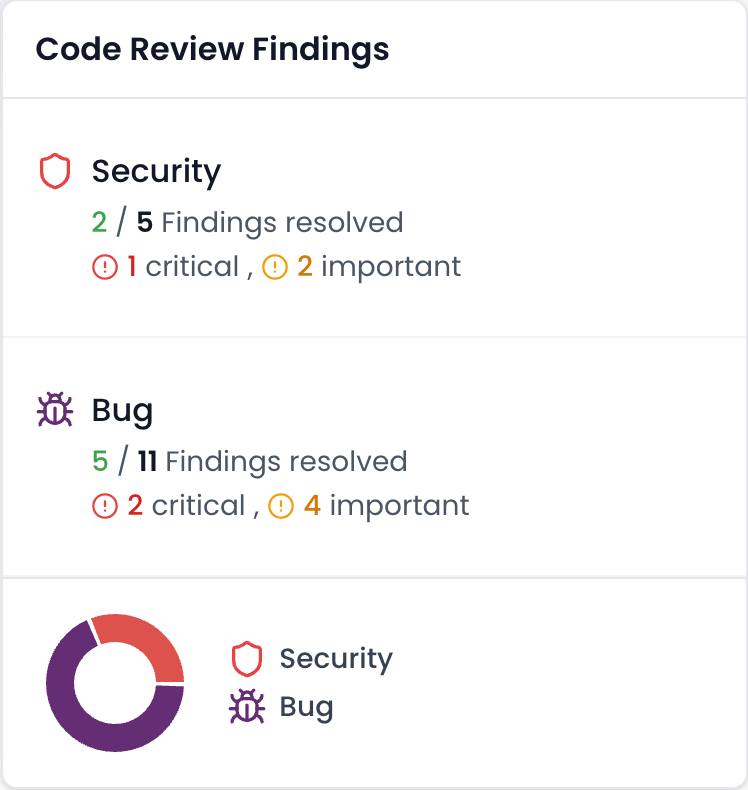
Our rankings focus on auto-fix capabilities as the main differentiator. We also evaluated pricing transparency, CI integration depth, scalability for high-volume environments, and noise reduction features. Our analysis uses vendor documentation and feature comparisons, hands-on testing with AI-generated PRs, and feedback from large engineering teams. We prioritized tools that address the 91% spike in PR review time caused by AI coding adoption.
Top 10 CodeRabbit Alternatives for AI Code Review in 2026
1. Gitar – Free AI Code Review with Auto-Fix Engine
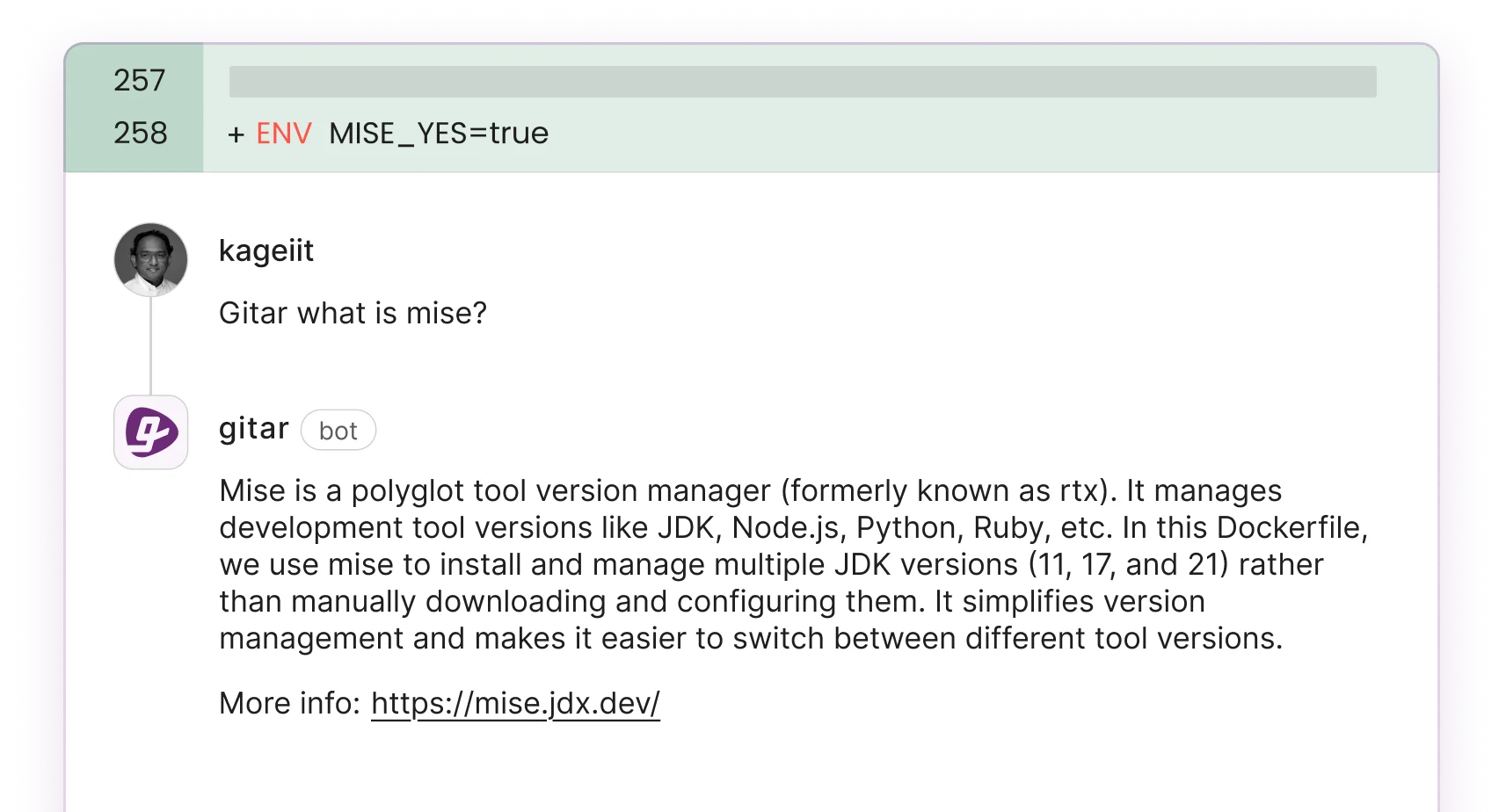
Gitar is the only free platform in this list that fixes code instead of only suggesting changes. While competitors charge $15–$30 per seat for comments, Gitar offers comprehensive PR analysis, security scanning, and bug detection at no cost. The 14-day auto-fix trial reshapes how teams handle CI failures.
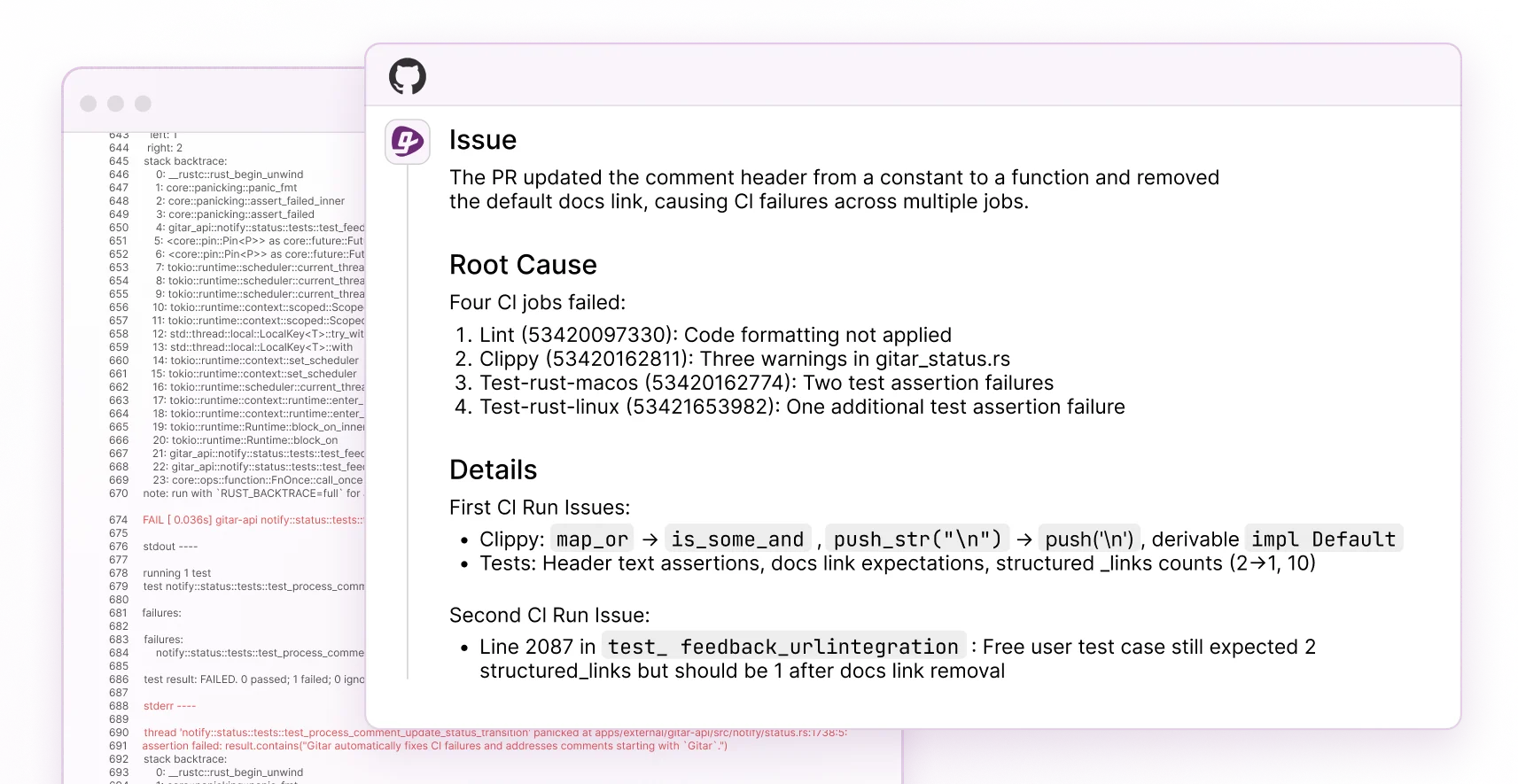
When CI breaks from lint errors, test failures, or build issues, Gitar analyzes failure logs, generates validated fixes, and commits them to your PR. This approach replaces guesswork with a healing engine that targets green builds. The single updating comment format reduces notification spam and keeps all findings in one clear thread.
Gitar supports enterprise scale, handling 50M+ lines of code and thousands of daily PRs. It integrates with GitHub, GitLab, CircleCI, and Buildkite and uses natural language workflow rules instead of complex YAML configuration. Teams report saving about $1M annually through reduced context switching and automated issue resolution.
| Feature | Gitar | CodeRabbit |
|---|---|---|
| Auto-Apply Fixes | Yes (14-day trial) | No |
| CI Auto-Fix | Yes | No |
| Pricing | Free | $24/month (annual) |
| Notification Style | Single comment | Multiple inline |
Teams can roll out Gitar in phases to build trust. They start with suggestions, enable auto-commit for specific failure types, then expand to full workflow automation. Install Gitar now, automatically fix broken builds, and ship higher quality software faster.
2. Qodo Merge – Auto-Merge and Compliance Focus
Qodo Merge offers AI-guided PR reviews and automated merging with context-aware analysis and compliance checks. It works well for sophisticated review workflows and governance-heavy teams. However, it does not match the depth of CI failure analysis and auto-fix functionality that high-volume AI codebases often require.
3. Greptile – Deep Codebase Context at a Premium
Greptile charges $30 per developer monthly for codebase-aware reviews with reinforcement learning. It focuses on context-rich suggestions but does not validate or apply fixes. Many teams report notification fatigue because of its verbose commenting style.
4. SonarQube – Static Analysis and Security Strength
SonarQube delivers strong static code analysis and security scanning across many languages. It flags issues thoroughly but does not implement fixes, which keeps developers in the loop for every change. This approach often recreates the same bottleneck that AI coding tools introduced.
5. Snyk – Security-First Code Review
Snyk focuses on security vulnerability detection and code quality analysis, including dead code and API misuse, with robust compliance features. Pricing starts at $25 per user monthly. Its primary strength is security scanning rather than broad CI failure handling.
6. Codacy – Quality Analysis Without Auto-Fix
Codacy offers code quality analysis at accessible pricing and highlights technical debt and style issues. It does not apply fixes automatically, so teams still spend time resolving each finding manually.
7. GitHub Copilot Code Review – Built-In Suggestions
GitHub’s native AI review comes bundled with existing subscriptions and adds suggestions directly in the PR. It fits naturally into GitHub workflows. It does not handle CI failures or validate and apply fixes, so teams still manage broken builds themselves.
8. Cursor Bugbot – Logic and Security Inside Cursor
Cursor Bugbot costs $40+ monthly and targets logic bugs and security vulnerabilities in AI-generated code. It supports one-click fixes but requires the full Cursor subscription and ecosystem, which may not suit teams that already standardized on other IDEs.
9. CodeAnt AI – Basic Reviews with Some Automation
CodeAnt AI ranges from $10–$24 per developer monthly and provides code quality reviews, security checks, and CI/CD integration. It offers automated fixes and advanced features but may not match the depth of specialized auto-fix engines for heavy AI-generated workloads.
10. PR-Agent – Open-Source AI Review Option
PR-Agent delivers open-source AI-assisted code review with self-hosting options. It is free to use but requires significant setup and ongoing maintenance. Many teams find it less polished than commercial tools.
Side-by-Side Comparison of Core Features
| Tool | Auto-Apply Fixes | CI Integration | Monthly Cost | Noise Level |
|---|---|---|---|---|
| Gitar | Yes (14-day trial) | Full CI healing | $0 | Single comment |
| CodeRabbit | No | Basic | $24 (annual) | Multiple inline |
| Greptile | No | Limited | $30 | Verbose |
| Qodo Merge | Merge & reviews | Basic | $25 | Moderate |
2026 Benchmarks and Real-World Results
Real-world testing shows clear performance gaps between tools. Gitar’s healing engine catches security vulnerabilities in Copilot-generated code that some competitors miss and presents more concise summaries. Teams using Gitar cut daily CI and review time from 1 hour to 15 minutes per developer, which equals about $750K in yearly savings for a 20-person team.
Adoption of coding review agents grew from 14.8% to 51.4% in 2025, but retention varies widely. Tools that only suggest fixes see higher churn because teams realize they pay for incremental gains instead of meaningful automation.
The ROI math stays simple. A team that spends 1 hour daily on CI failures and review cycles loses about $1M annually in productivity for 20 developers. Tools that fix issues instead of just flagging them deliver measurable gains in velocity and cost reduction.
What to Prioritize When Implementing a New Tool
Different roles care about different outcomes when they compare CodeRabbit alternatives. Developers want fewer context switches and faster resolution of blocking issues. Engineering leaders look for clear ROI metrics and visible improvements in team velocity. DevOps engineers focus on reliable CI integration and lower infrastructure costs from fewer failed builds.
A phased rollout works best for most teams. Start with a 30-second installation that needs no credit card, run in suggestion mode to build confidence, then enable auto-commit for specific failure types. Expand to full workflow automation after the team trusts the fixes. Address concerns about automated commits by highlighting configuration controls and gradual rollout paths.
Complex CI environments benefit from tools that emulate the full build context instead of running fixes in isolation. Enterprise deployments should evaluate on-premise options that access internal dependencies and secrets while still meeting security and compliance requirements.
Frequently Asked Questions
What is the best free alternative to CodeRabbit?
Gitar is the most comprehensive free alternative to CodeRabbit, with unlimited PR analysis, security scanning, and bug detection without seat limits or credit card requirements. CodeRabbit charges $24 monthly for suggestion-only features, while Gitar adds a 14-day auto-fix trial that resolves CI failures and implements review feedback automatically.
How does Qodo compare to CodeRabbit for AI code review?
Qodo and CodeRabbit both provide AI code reviews, and Qodo adds advanced merge automation and compliance features while CodeRabbit emphasizes broad coverage. Qodo supports implemented suggestions and chat-enabled improvements. Teams that need full automated fix implementation often choose Gitar, which combines free review capabilities with CI auto-fixing.
Can I migrate from CodeRabbit to a free alternative easily?
Migration to Gitar usually takes about 30 seconds through a GitHub App installation or GitLab integration. You do not need an account setup or credit card. Gitar starts posting dashboard comments on new PRs immediately, and you can run both tools in parallel to compare results before canceling your CodeRabbit subscription.
How do I measure ROI from AI code review tools?
Track time saved from fewer CI failures, faster review cycles, and reduced context switching. A typical 20-developer team that spends 1 hour daily on CI and review issues loses about $1M annually in productivity. Tools that automatically fix issues instead of only suggesting changes provide clear velocity gains. Monitor metrics like mean time to resolution, build success rates, and developer satisfaction scores.
Do these tools support GitLab and other platforms besides GitHub?
Most modern AI code review tools support several platforms. Gitar integrates with GitHub, GitLab, CircleCI, and Buildkite. CodeRabbit supports GitHub, GitLab, and Azure DevOps. When you compare alternatives, confirm that the tool supports your specific CI/CD pipeline and version control system to avoid integration issues.
Is automated code fixing safe for production environments?
Automated fixing is safe when teams use proper controls and a phased rollout. Start in suggestion mode and approve each fix manually, then enable auto-commit for low-risk changes such as lint errors and formatting. Expand to more complex fixes as confidence grows. Tools like Gitar offer configurable automation levels and validate changes against your full CI environment before applying them.
Conclusion: Why Auto-Fix AI Review Wins in 2026
The 2026 AI code review landscape now favors tools that resolve problems instead of only describing them. Traditional review tools charge premium prices for comments that still require manual work, while newer platforms focus on healing engines that deliver working fixes. Gitar leads this shift by pairing free, comprehensive review capabilities with automated fix implementation that competitors charge $15–$30 monthly just to suggest.
Teams overwhelmed by AI-generated PRs and CI failures face a clear decision. They can keep paying for incremental improvements or adopt tools that remove the bottleneck entirely. Install Gitar now, automatically fix broken builds, and start shipping higher quality software faster.