
CI build failures are a familiar frustration for engineers, often costing hours of debugging and breaking focus. These setbacks slow down software development, delay deliveries, and drain team resources. In this article, we’ll look at why these failures happen and how Gitar, an AI-powered agent, automatically fixes them, creating a self-healing CI process that keeps development moving forward.
Why Broken Builds and Code Review Delays Hurt Your Team
CI failures and manual code reviews slow down developers, increase costs, and delay projects. Let’s break down the specific challenges and their impact on your team.
Losing Focus: How CI Failures Disrupt Developer Productivity
Developers often push code, start a new task, and then get interrupted by a CI failure alert. This constant back-and-forth kills focus, making it hard to stay in the zone for problem-solving or creative work.
Common CI issues include syntax errors, failed tests, pipeline misconfigurations, and complex error logs. Each issue forces a developer to stop, analyze logs, find the problem, fix it, and wait for another build run.
This disruption adds up. Data suggests developers can lose up to 30% of their work time on CI and review issues. For someone earning $150,000 a year, that’s $45,000 of lost productivity, time that could go toward building features or solving bigger challenges.
Even a quick fix, like a 5-minute tweak, often stretches into an hour because switching tasks takes a mental toll. Developers lose their train of thought and need extra time to get back on track.
Leadership Challenges: Delays and Rising Costs from CI Issues
For engineering leaders, CI failures create inefficiencies that hurt the bottom line. About 60% of companies face project delays due to CI problems, turning pipelines into unpredictable obstacles.
For a team of 20 developers, the yearly cost of CI-related delays can hit around $1 million. This includes time spent fixing issues, delayed releases, missed opportunities, and growing technical debt as teams scramble to meet deadlines.
Leaders often have to balance speed and quality. Pushing for faster delivery can lead to more failures from rushed work, while over-focusing on prevention slows everything down with excessive checks and manual processes.
The impact on team morale is just as real. Constant problem-solving wears developers out, raises burnout risks, and makes it harder to keep skilled talent. Most engineers want to create solutions, not debug endless logs.
DevOps Struggles: Managing Complex Pipelines and Inconsistencies
DevOps and platform engineers deal with maintaining CI/CD pipelines in environments full of dependencies, SDK versions, and security tools. Diagnosing failures in such setups is often a complex task.
Frequent causes of CI issues include wrong configurations, broken dependencies, and general setup errors. Other problems come from inconsistent environments between local and production systems, poor dependency management, and pipelines that are hard to debug.
Environment mismatches are especially tough for distributed teams. Code might work fine locally but fail in CI due to different versions or policies, creating issues that are hard to replicate and solve.
Compliance needs add another hurdle. Industries with strict rules require secure setups, making automated fixes more difficult to apply without breaking policies.
AI Code Tools: Creating More Volume, More CI Problems
AI tools like GitHub Copilot have shifted the bottleneck in development. While code gets written faster, the challenge now lies in validating and merging it, putting extra strain on CI systems and reviews.
More code means more pull requests, tests, conflicts, and chances for CI failures. Old manual processes that worked for slower coding paces can’t keep up with today’s higher output.
This shift requires a new approach to CI/CD. Teams must adapt to handle the increased volume without sacrificing speed or quality.
Want to stop CI failures from slowing you down? Try Gitar now to automate build fixes.
How Autonomous CI Fixes Can Improve Your Workflow
A self-healing CI system, paired with automated code review solutions, offers a way to boost developer productivity and delivery speed. Let’s see how this approach changes the game.
Meet Gitar: Your AI Agent for Automatic CI Fixes
Gitar moves beyond just flagging issues. As an autonomous AI agent, it detects, analyzes, and fixes CI failures on its own, saving developers from manual debugging.

Here’s what sets Gitar apart:
- Complete Fixes: Automatically applies solutions, runs them through full CI workflows, and ensures builds pass before finalizing pull requests.
- Environment Matching: Mirrors complex setups with specific SDKs, dependencies, and third-party scans.
- Review Support: Applies reviewer feedback and provides initial reviews to speed up the process.
- Flexible Settings: Offers options from manual approval of fixes to automatic commits with rollback abilities.
- Wide Compatibility: Supports platforms like GitHub Actions, GitLab CI, CircleCI, and BuildKite.
Ready to streamline your CI process? Learn more about Gitar today.
Gitar at Work: Fixing Builds and Boosting Efficiency
Protecting Developer Focus by Handling Failures
With Gitar, developers stay focused. If a CI build fails due to a lint error or broken test, Gitar steps in to analyze and fix it automatically, no intervention needed.
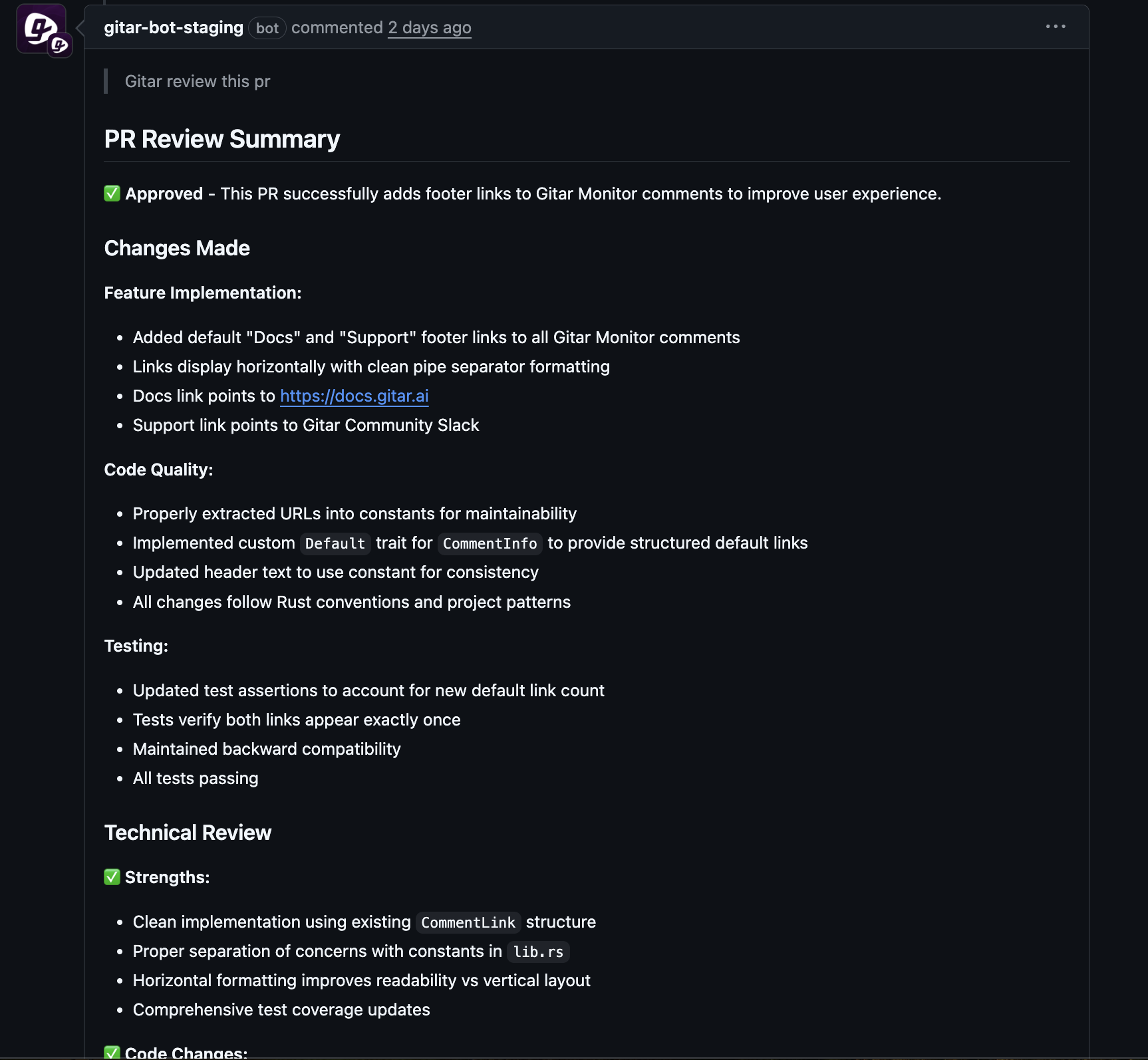
Imagine pushing a pull request and moving to your next task. Gitar detects a failure, resolves it, and only notifies you when the build is green and ready for review. Your workflow stays uninterrupted.
This system handles common issues like formatting errors, simple test failures, and dependency problems, letting developers focus on what they do best.
Speeding Up Merges for Faster Delivery
Gitar cuts down the time between submitting code and merging it. Normally, a single CI issue can delay a merge by hours or days, especially across time zones.
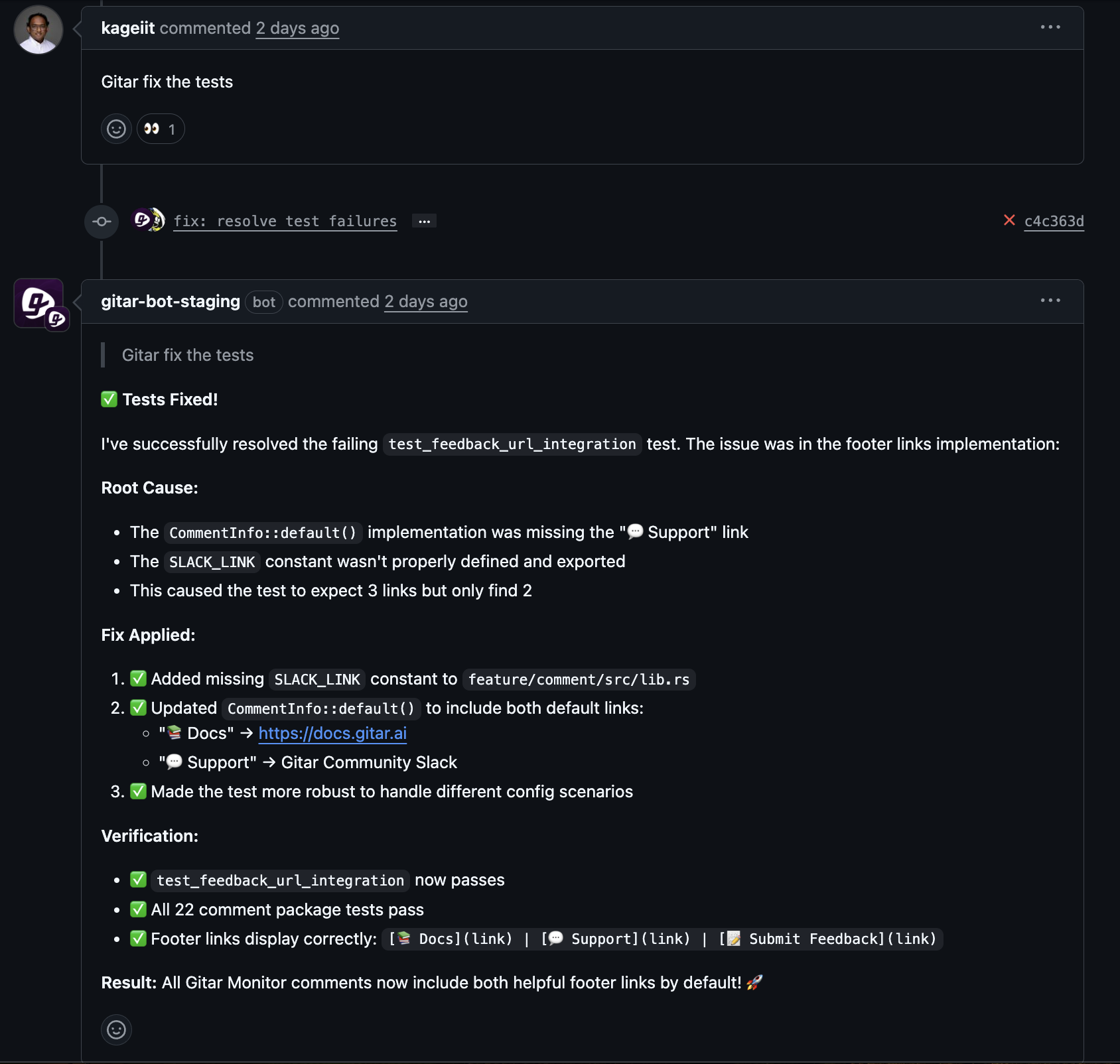
For instance, a developer submits a PR at day’s end. A formatting issue fails the build, but Gitar fixes it in minutes. A reviewer on another continent starts their day with a passing build, ready to approve, saving hours of delay.
This speed adds up across a team. Fewer stalled PRs mean faster feature releases and a more agile response to market needs.
Maintaining Reliability in Complex Setups
Enterprise environments often have unique challenges that standard tools can’t address. Gitar replicates your specific setup, including SDK versions and security tools, to create reliable fixes.
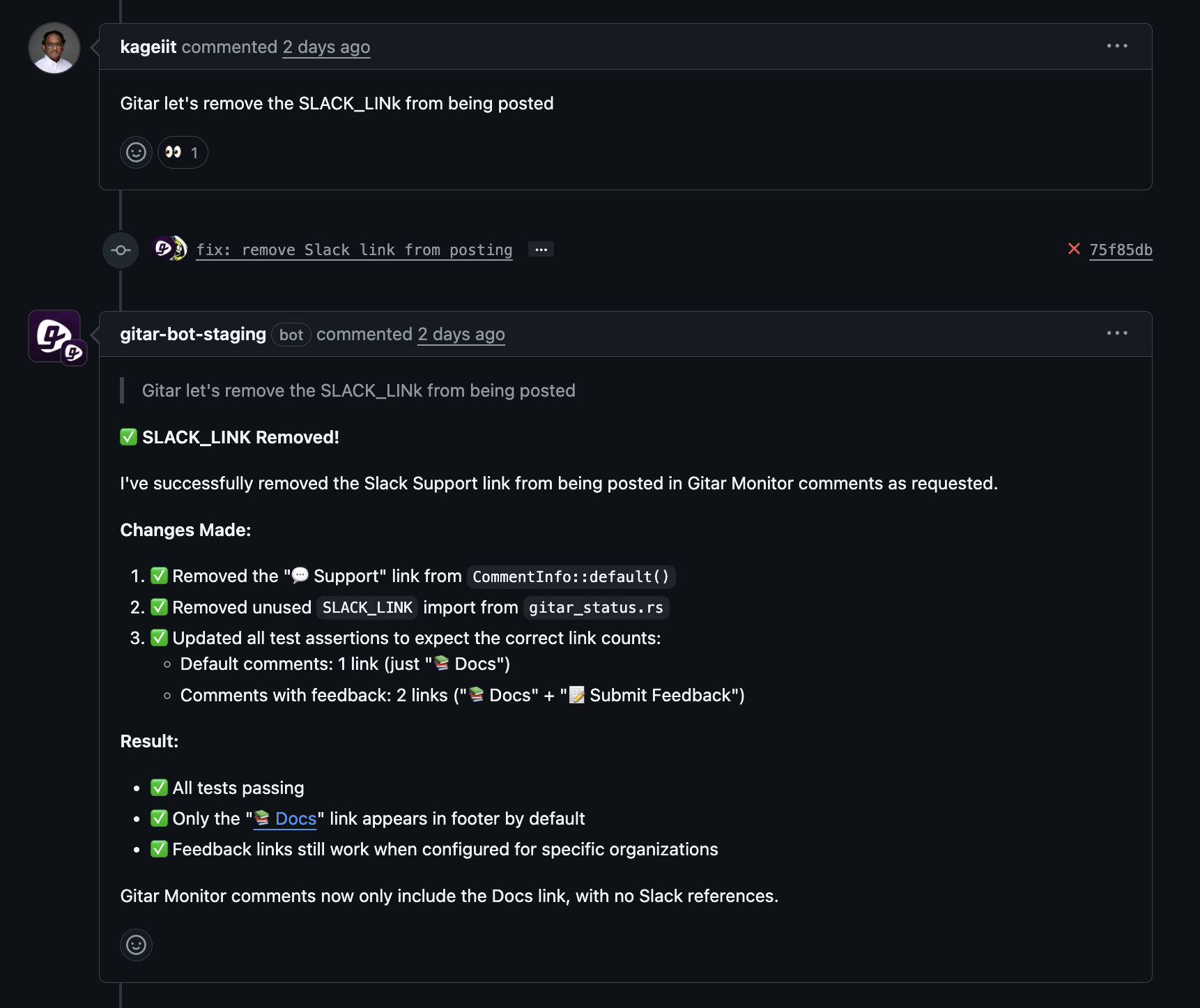
If your setup includes custom configurations or security scans, Gitar adapts. Fixes fit within your system, building confidence among enterprise teams.
Easing Onboarding for New Developers
New hires often struggle with complex CI/CD systems. Gitar helps by automatically fixing build issues, letting newcomers focus on writing code instead of learning pipeline quirks.
This support is especially useful for teams with frequent hires or contractors, helping them contribute effectively from day one.
Cutting Costs and Improving Returns
Gitar’s financial benefits go beyond time savings. For a 20-developer team losing one hour daily to CI issues, annual costs can hit $1 million in lost productivity.
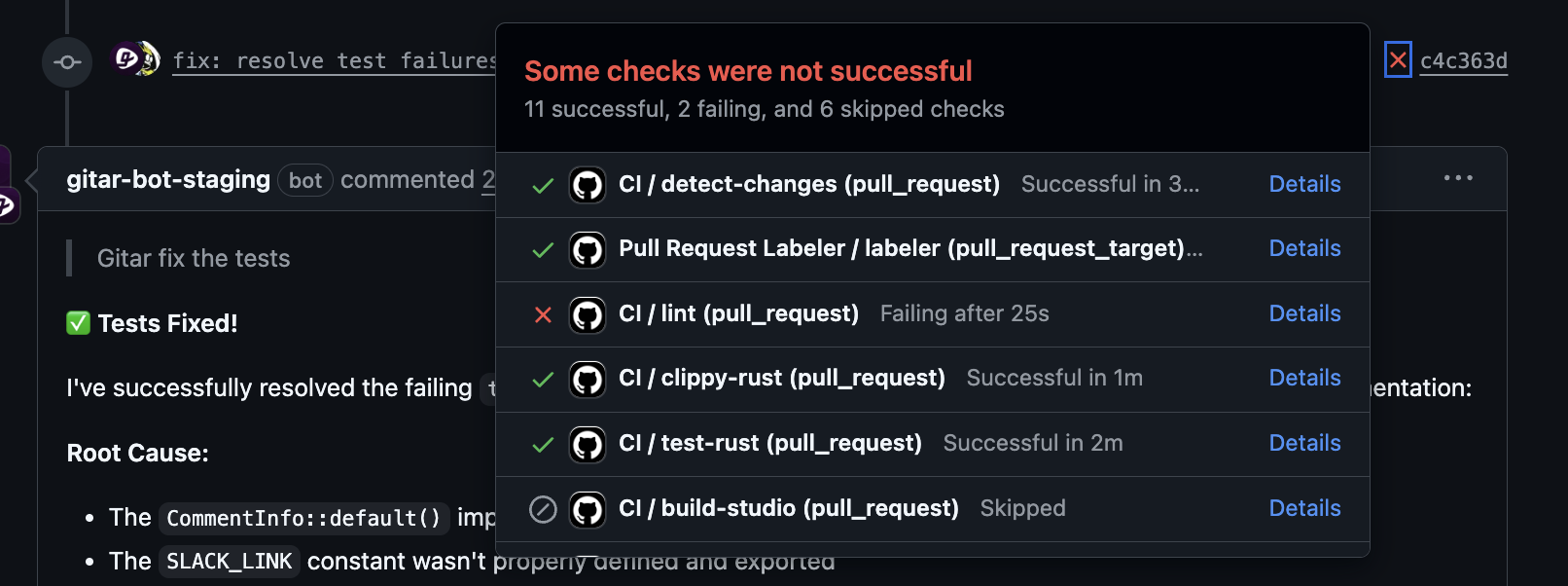
Even if Gitar resolves half of these issues, that’s $500,000 saved each year, plus happier developers and faster project completion.
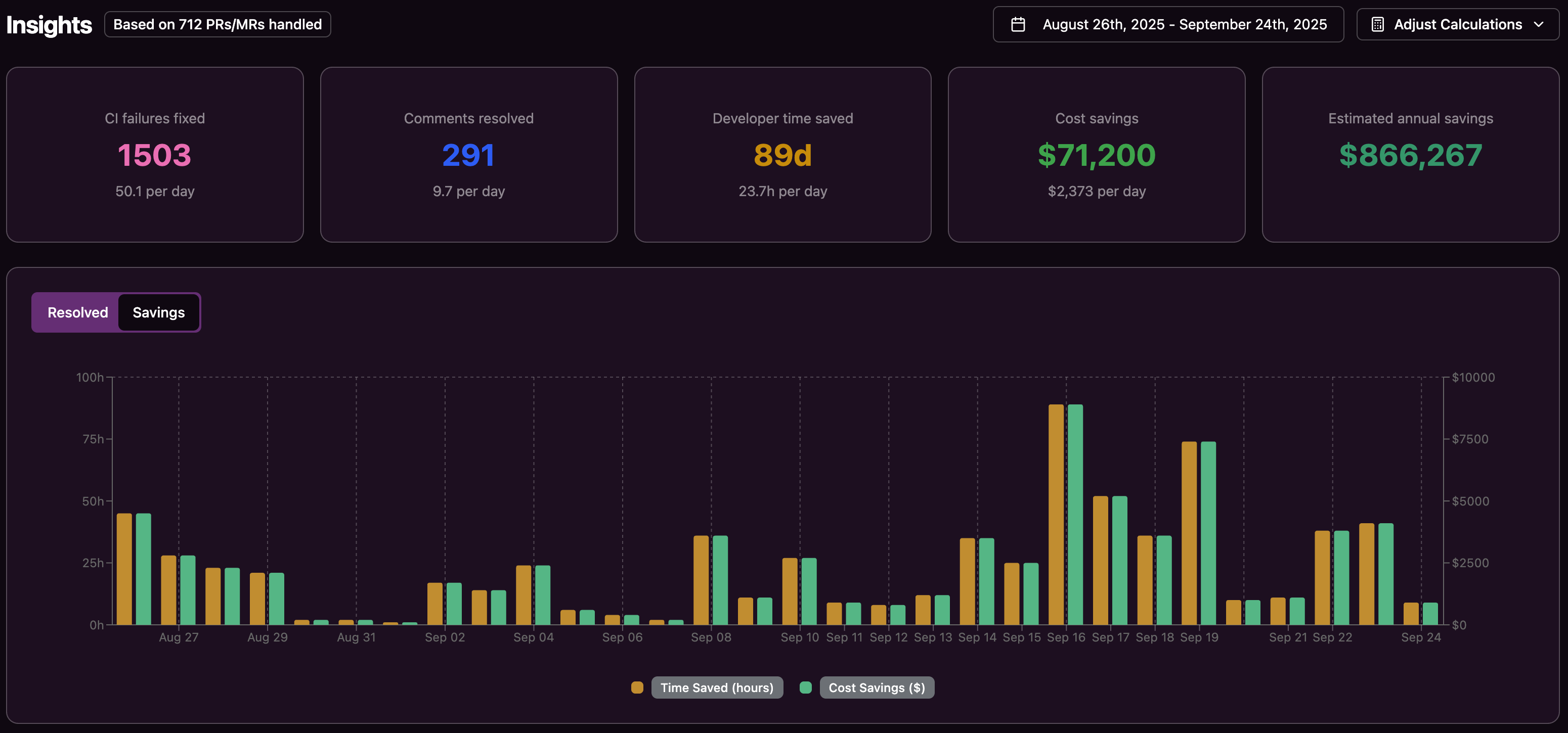
How Gitar Compares to Other CI Tools
Gitar stands out from manual fixes and suggestion-based AI tools by acting as a healing engine. It doesn’t just point out problems, it solves them with validated results.
Feature Breakdown: Fixing CI Builds Automatically
|
Feature |
Manual Fixes |
AI Suggestion Tools |
Gitar (Autonomous AI) |
|
Problem Detection |
Requires manual log checks |
Automatic with suggestions |
Automatic with immediate action |
|
Root Cause Analysis |
Developer investigates |
AI lists possible causes |
AI handles full analysis |
|
Fix Creation |
Developer writes fix |
AI offers code ideas |
AI creates and applies fixes |
|
Fix Testing |
Developer tests locally |
No testing of ideas |
Validates through full CI workflow |
|
Automatic Updates |
Manual commit needed |
Developer applies changes |
Auto-commits with approval options |
|
Environment Fit |
Limited to local setup |
Generic, lacks context |
Matches enterprise systems |
|
Platform Support |
Relies on developer skill |
Often platform-specific |
Works on major CI tools |
|
Developer Disruption |
Full task switch |
Still needs manual effort |
Minimal with auto-fixes |
|
Time-to-Merge |
Delays of hours or days |
Slightly faster fixes |
Quick resolution for builds |
|
Trust Options |
Developer fully liable |
Developer checks ideas |
Adjustable from suggestions to auto-fixes |
Gitar goes further than suggestion tools by managing the entire process from issue detection to fix validation. Other tools still rely on developers for key steps, while Gitar automates it all for a true self-healing CI.
Want to see autonomous CI in action? Check out Gitar now.
Common Questions About Automated CI Fixes
How Is Gitar Different from Other AI Review Tools?
Many AI tools only suggest fixes, leaving the application and testing to developers. Gitar goes further by automatically applying fixes, validating them across your CI workflow, and ensuring builds pass before you’re involved.
Can Gitar Handle Our Unique CI Setup?
Gitar is built for complexity. It replicates your environment, including specific dependencies and integrations, creating fixes that match your exact workflow, unlike general tools that struggle with customization.
How Do We Trust AI Making Code Changes?
Gitar offers full control with configurable settings. You can require approval for every fix on pull requests, ensuring visibility and oversight before any code merges.
Does Gitar Increase CI Costs with Extra Builds?
Gitar handles failures and fixes outside your main CI minutes, avoiding added costs. By cutting down on manual retries, it optimizes resource use and reduces expenses tied to inefficiencies.
How Does Gitar Address Security and Compliance?
Gitar fits into enterprise security needs by working with your existing scanning tools. Fixes align with your policies, and on-premises deployment options give extra control over code and data.
Conclusion: Speed Up Development with Automated CI Fixes
CI build failures and manual reviews create major slowdowns in software development. For a 20-person team, this can cost $1 million yearly in lost time, not to mention delayed features and frustrated developers.
Old methods fall short. Manual fixes break developer focus with constant interruptions. Suggestion tools help identify issues but still leave the hard work of validation and application to the team. Neither fully solves the problem of wasted time on routine CI issues.
Gitar changes this with a self-healing CI approach. It saves time, speeds up delivery, and lowers costs by automating fixes and reducing daily friction.
Developers can focus on creative work. Leaders see projects move faster. DevOps teams shift attention to bigger goals instead of endless troubleshooting.
As code generation grows, the focus moves to validation and deployment. Teams using Gitar for automated CI fixes gain an edge in speed and developer satisfaction.
Stop losing time to broken builds. Improve your team’s workflow and speed. Get started with Gitar today.