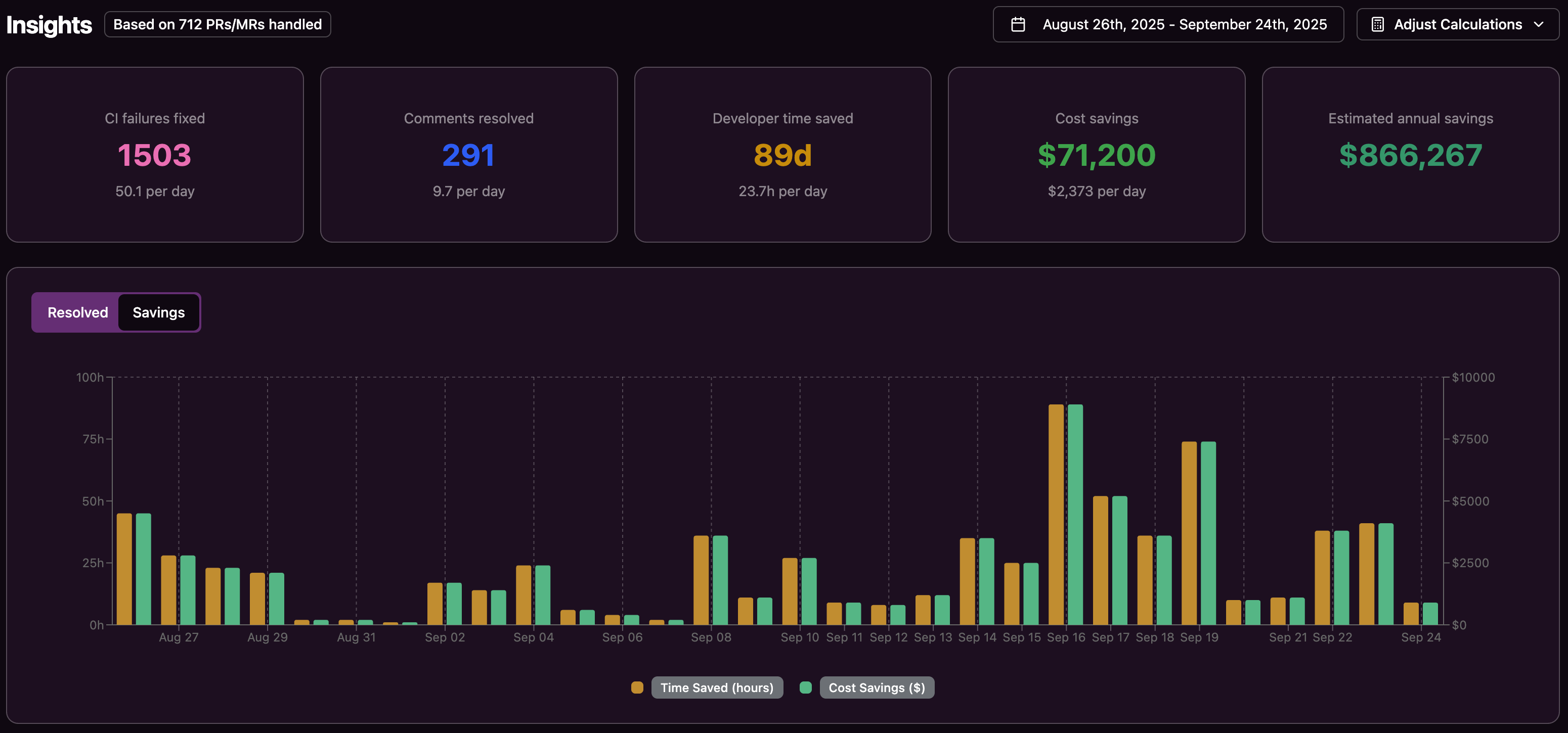
CI build failures drain engineering resources, waste time, and slow down development cycles. This article dives into how autonomous CI CD automation tools can tackle these issues, reduce manual work, and speed up merging code. Even with AI tools like GitHub Copilot boosting code creation, validation and merging remain a bottleneck. Developers often spend hours fixing builds instead of focusing on new features.
Why CI Build Failures Hurt Teams and Slow Progress
Every developer knows the frustration of pushing a pull request, only to face a flood of failed CI checks. Common issues like unstable tests, slow builds, and messy configurations often cause these failures. A quick check turns into a long delay as you dig through error logs, switch back to your local setup, apply a fix, and wait for the pipeline to rerun.
Switching between tasks comes at a high cost. A 30-minute fix for a simple lint error can easily eat up an hour of productive time due to the mental strain of refocusing. Slow builds and unreliable tests drag down morale and delay results.
For distributed teams, this gets worse. A developer in California might push a PR needing review from someone in India. Time zone differences turn a short exchange into days of waiting. Add CI failures to the mix, and project delays pile up, with 60% of companies facing setbacks due to pipeline issues.
AI coding tools have shifted the problem. While they speed up writing code, they create more pull requests and tests to handle, increasing the chance of CI failures. The focus now is on validating and merging code efficiently to keep development moving.
Want to stop wasting time on CI build failures? Install Gitar today to fix broken builds automatically and ship better software faster.
How Autonomous CI Fixing Saves Time and Effort
Older methods for handling CI failures, like suggestion tools or manual fixes, often fall short. They overlook a key point: CI issues are predictable and can be solved without human input most of the time.
Autonomous CI fixing changes the game by moving from reactive debugging to proactive solutions. These systems detect issues, apply fixes, validate them, and commit changes without involving developers. This cuts down on interruptions and speeds up the process.
Self-healing CI builds on the idea of running tests after every commit to spot problems fast. Automated testing after commits gives quick feedback on code issues. Autonomous fixing goes further by solving these problems directly.
By handling routine failures in the background, this approach frees developers to focus on meaningful work. CI pipelines stop being a hurdle and become a reliable part of the workflow that operates without constant oversight.
Meet Gitar: Your AI Agent for Automatic CI Fixes
Gitar is a cutting-edge CI CD automation tool built to save developers hours on CI tasks. Unlike tools that only suggest fixes, Gitar acts as an independent AI agent. It analyzes failures, creates fixes, updates pull requests, and ensures builds pass without needing your input.

Here’s what sets Gitar apart:
- Complete Automation: Gitar applies fixes, runs full CI workflows, and ensures builds pass for issues like lint errors and test failures. It doesn’t just suggest, it resolves.
- Accurate Environment Matching: Gitar mirrors complex CI setups, including specific SDKs, dependencies, and security scans like SonarQube. Fixes fit your unique context.
- Customizable Control: Start with suggestion-only mode for caution, or switch to auto-commit for faster workflows. You decide the level of automation.
- Support for Distributed Teams: Gitar fixes issues instantly, bridging time zone gaps. Feedback from one region is actioned before the other starts their day.
- Wide CI Compatibility: Gitar works with GitHub Actions, GitLab CI, CircleCI, BuildKite, and more, fitting into varied setups without hassle.
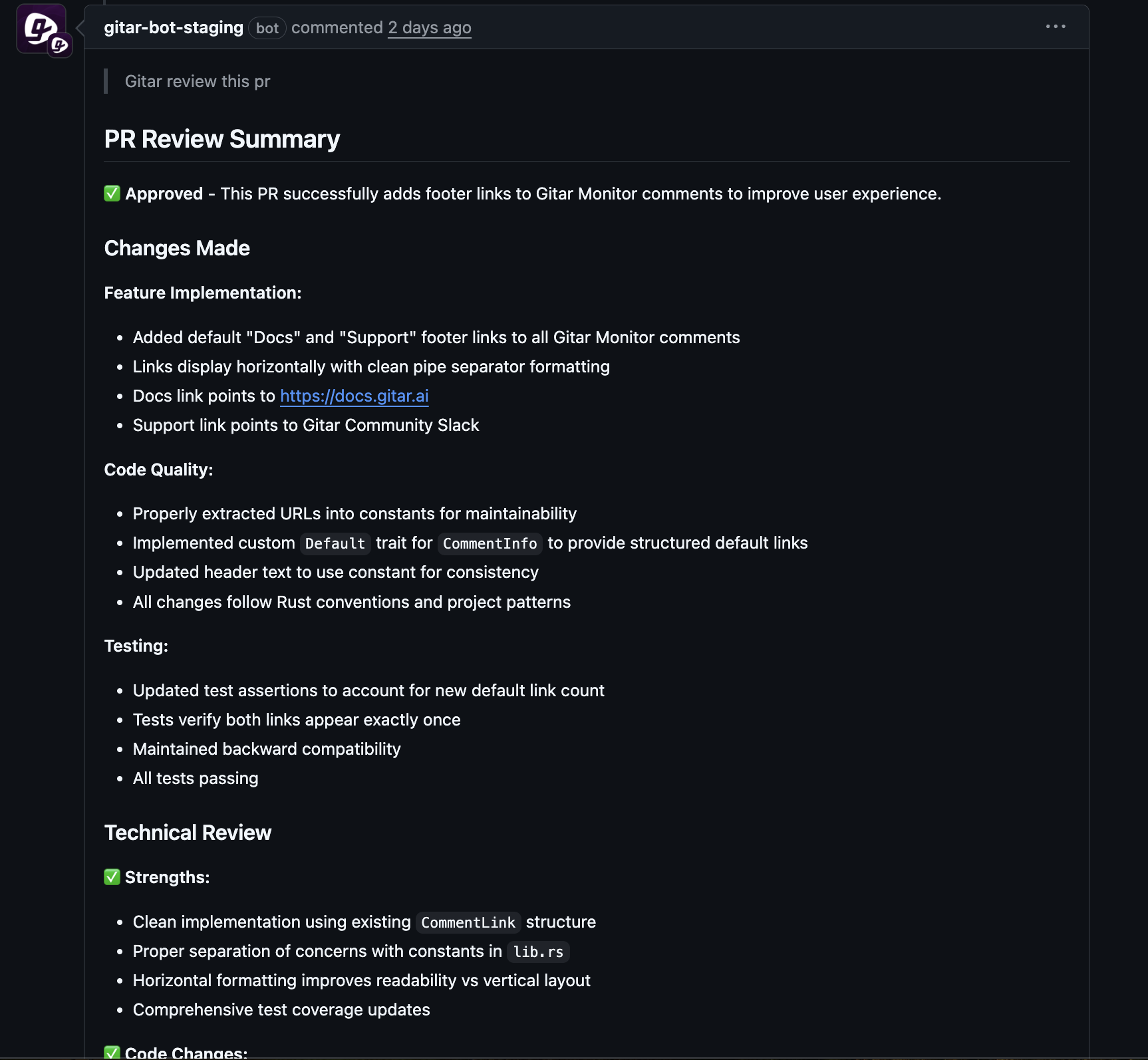
Teams often realize Gitar’s value when it fixes a CI failure before they even notice the issue. What used to be a frustrating interruption now happens quietly in the background.
Ready to see the difference? Request a demo of Gitar and watch CI fixes happen automatically.
How Gitar Boosts Speed by Solving CI Issues
Fixing Pipeline Failures Without Delay
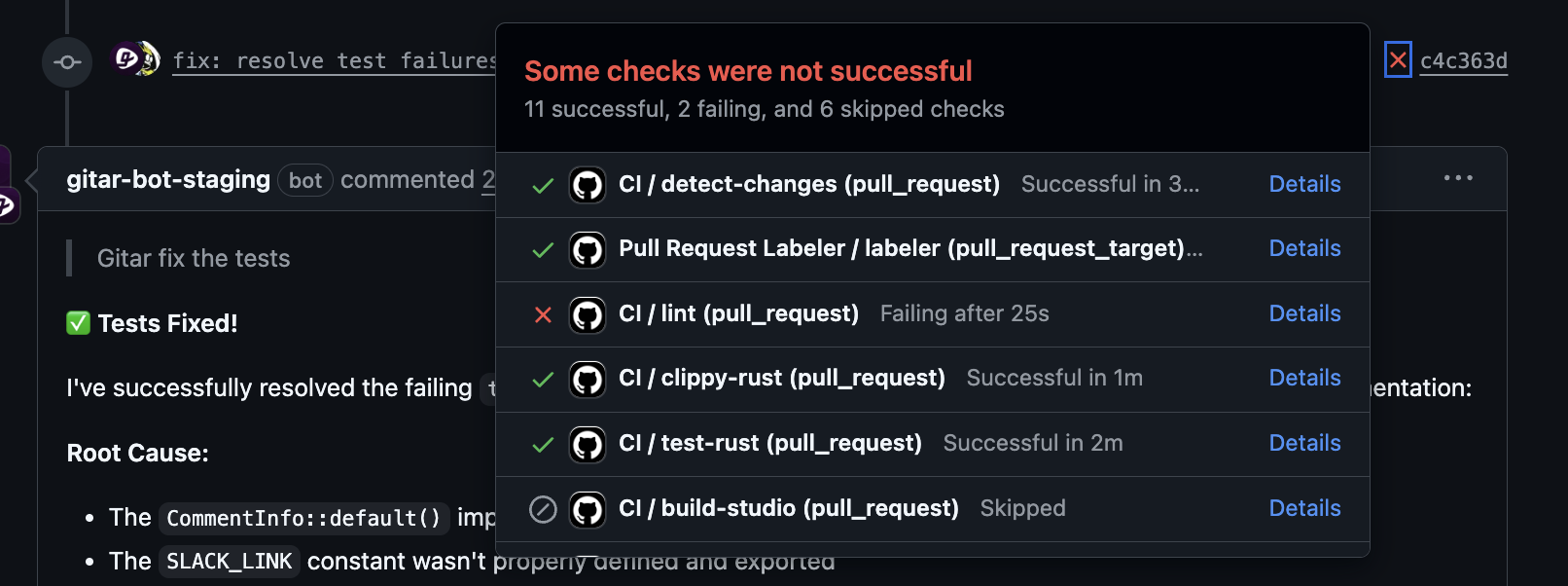
Gitar tackles many CI problems, from linting errors to test failures and dependency issues. It reads logs, finds the root cause, and applies precise fixes that stick.
Its ability to replicate your exact CI environment ensures fixes work under the same conditions as the failure. This prevents recurring problems and addresses the issue right away.
Cutting Down Context Switching and Stress
Switching tasks costs more than just time. When a CI failure pulls you away from coding, the mental reset slows you down even further. Gitar handles these distractions, letting you stay focused on building features.
For routine fixes, the impact is clear. Tasks that took manual effort now happen automatically. Submit a pull request, and trust Gitar to solve many CI issues while you work on bigger challenges.
If AI tools are increasing your code output, Gitar ensures CI problems don’t grow with it. Development speed improves without extra manual work.
Speeding Up Merges with Self-Healing CI
Gitar makes CI pipelines self-healing by not just spotting issues but fixing them too. This shortens the time from commit to merge significantly.
The cost savings add up. A team of 20 developers spending an hour daily on CI fixes loses about $1 million in productivity each year. Gitar shifts this by automating repetitive tasks, tightening feedback loops, and getting features out faster.
Gitar vs. Other Tools: Autonomous Fixes Beat Suggestions
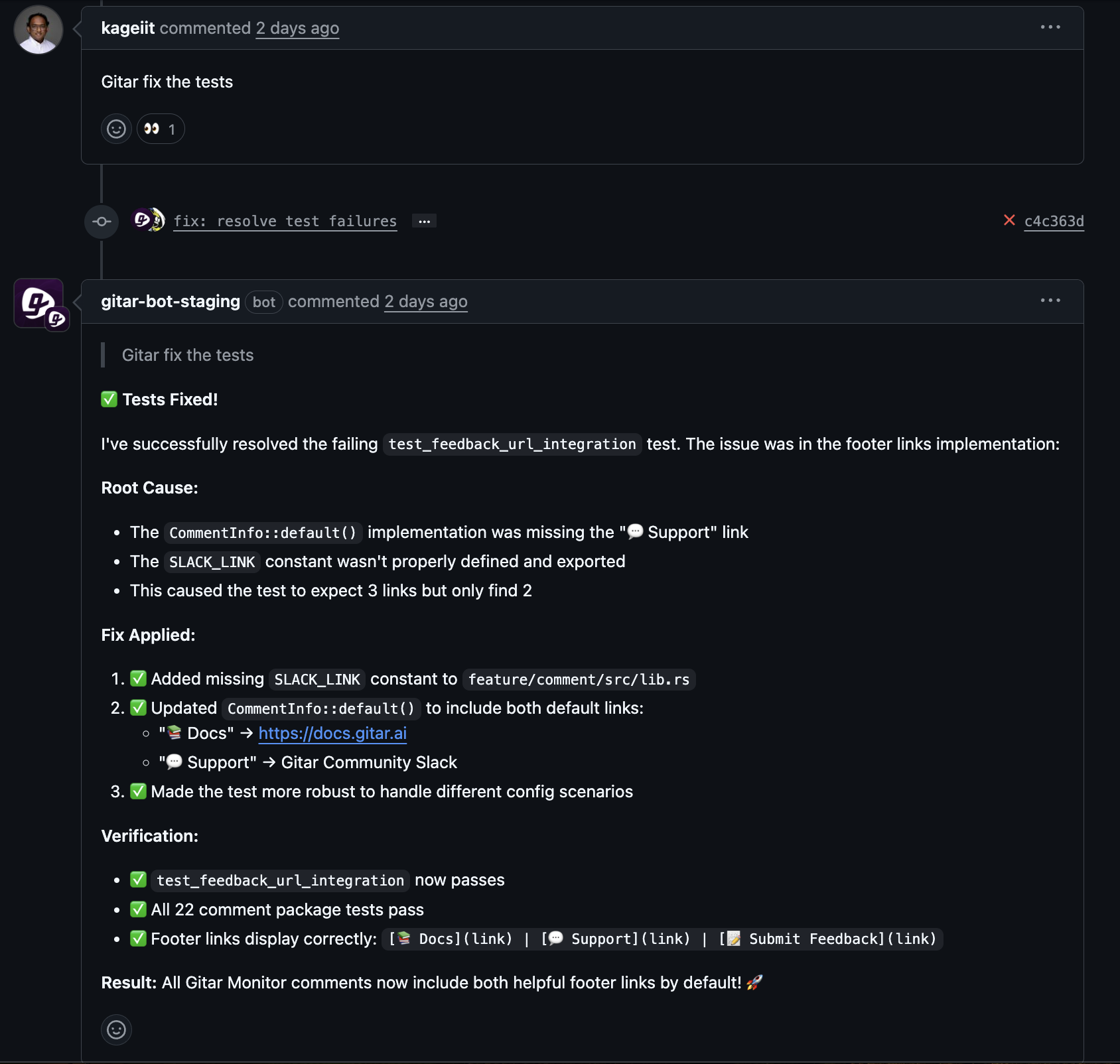
The difference between healing engines and suggestion tools matters when picking CI CD automation. Suggestion tools offer ideas for fixes that you still need to apply and check. Healing engines like Gitar handle everything, from fixing to validating, on their own.
|
Feature / Tool |
Manual Work (Status Quo) |
AI Code Reviewers (e.g., CodeRabbit) |
Gitar (Autonomous CI Agent) |
|
Issue Resolution |
Manual investigation & fix |
Suggests fixes |
Autonomous fix, validation, commit |
|
Context Switching |
High, frequent interruptions |
Lowers review burden, still needs manual fix validation |
Minimal, issues resolved in background |
|
Build Validation |
Manual re-run of CI |
None, developer validates |
Full CI run, guarantees green builds |
|
Environment Context |
Human expertise |
Limited |
Full environment replication |
|
Feature / Tool |
On-Demand AI Fixers (e.g., Claude CI) |
Gitar (Autonomous CI Agent) |
|
|
Cross-Platform CI |
GitHub only |
All major CI systems |
|
|
Dev Workflow Impact |
Specific task assistance |
Accelerates time-to-merge, maintains flow |
|
|
Automation Level |
Manual trigger, limited context |
Fully autono-mous, comprehensive context |
|
|
Resource Usage |
Consumes customer CI minutes |
Independent validation environment |
While other tools help with parts of the CI process, only Gitar offers a full, validated solution. Suggestion tools leave the final steps to developers, but Gitar manages the entire process from start to finish.
Ready for real automation? Install Gitar now to resolve build failures and boost your team’s speed.
Common Questions About Autonomous CI Fixing
How does Gitar differ from AI reviewers like CodeRabbit for CI failures?
AI reviewers like CodeRabbit offer useful feedback on code quality, but you still need to apply and test their suggestions. Gitar goes further by autonomously fixing issues, running full CI checks, and ensuring builds pass. Use CodeRabbit for insights on code style and Gitar for automatic CI resolutions.
Can we trust autonomous fixes without reviewing them?
Gitar builds trust with a flexible setup. Start in a cautious mode where fixes need a quick approval. As confidence grows with successful results, move to full automation, with rollback options always available.
Will Gitar work with our complex CI environment?
Gitar shines in complicated setups. It mirrors your exact CI conditions, including SDK versions, dependencies, and security tools like SonarQube. Fixes are tailored to your specific environment for reliable results.
What CI failures can Gitar handle on its own?
Gitar fixes common issues like linting errors, formatting problems, basic test failures, and build issues from dependencies or scripts.
How does Gitar fit into our current workflow?
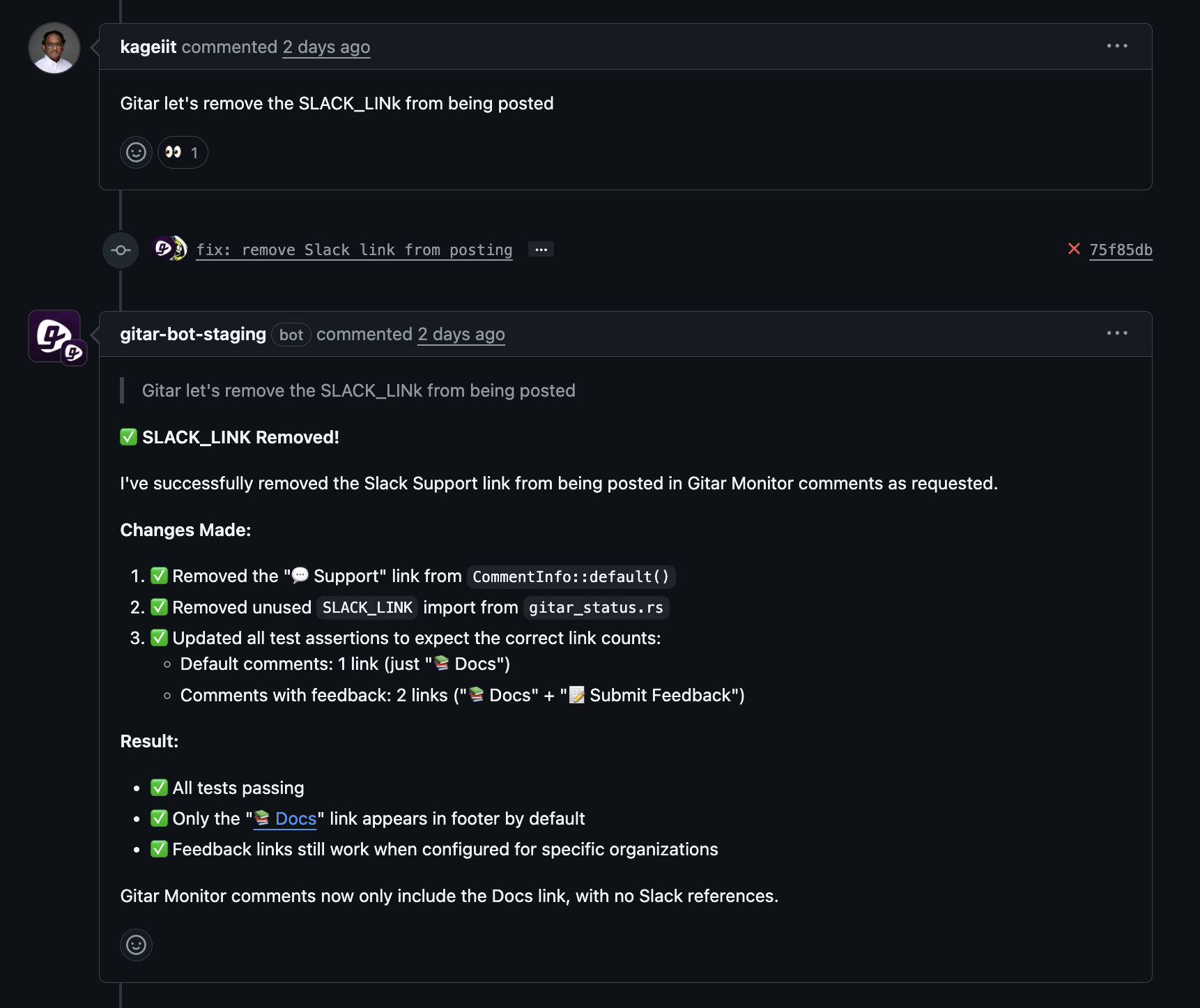
Gitar integrates as a GitHub or GitLab app, watching your repositories and CI pipelines. It posts updates on pull requests and works with systems like GitHub Actions and CircleCI without setup changes. Team members can interact via comments, and Gitar explains every step it takes.
Wrap-Up: Boost Productivity with Autonomous CI Tools
CI build failures cost teams millions each year in lost time and delayed work. Manual fixes and suggestion tools don’t solve the core problem: developers shouldn’t lose focus on creative tasks to debug routine issues.
Tools like Gitar mark the future of development workflows, turning CI pipelines into self-fixing systems. By handling detection, fixes, and validation automatically, Gitar cuts out repetitive work that slows teams down.
The benefits go beyond saving time. Developers stay in a focused state, avoid burnout from tedious tasks, and merge code faster. For distributed teams, Gitar removes delays from time zones, supporting round-the-clock progress.
As AI speeds up coding, merging and validating code efficiently becomes the priority. Adopting autonomous CI fixing now helps teams scale output without extra workload.
Ready to ditch CI build frustrations? Install Gitar today to speed up merges and empower your team with cutting-edge automation.