
Written by: Ali-Reza Adl-Tabatabai, Founder and CEO, Gitar
Why These 10 Code Review Tools Matter in 2026
- AI code generation has increased PR volume by 98% and review times by 91%, creating a serious post-AI code review bottleneck.
- Gitar leads as the top free tool with unlimited code review and auto-fix for CI failures, lint errors, and test breaks.
- Free tiers vary widely: Gitar offers unlimited access, while Qodo and SonarQube limit usage through individual or self-hosted models without full automation.
- Tools like Snyk and Codacy excel in security and analysis but lack broad auto-fixing, so teams still handle many fixes manually.
- Teams using Gitar cut CI and review time from 60 minutes to 15 minutes per developer daily, unlocking large productivity gains.
How These Workflow Automation Tools Were Evaluated
Each tool was evaluated across five criteria with clear weights. Automation depth carried 40% and covered auto-fix and CI healing capabilities. Free tier generosity carried 20% and focused on usage limits and feature access. Integration breadth carried 15% and included GitHub, GitLab, and CI systems. Setup simplicity and noise reduction carried 15%. Enterprise scalability carried 10%. Sources included 2026 developer surveys, hands-on testing, and production case studies from teams handling thousands of PRs daily.
#1 Gitar: Free Healing Engine for CI and Code Review
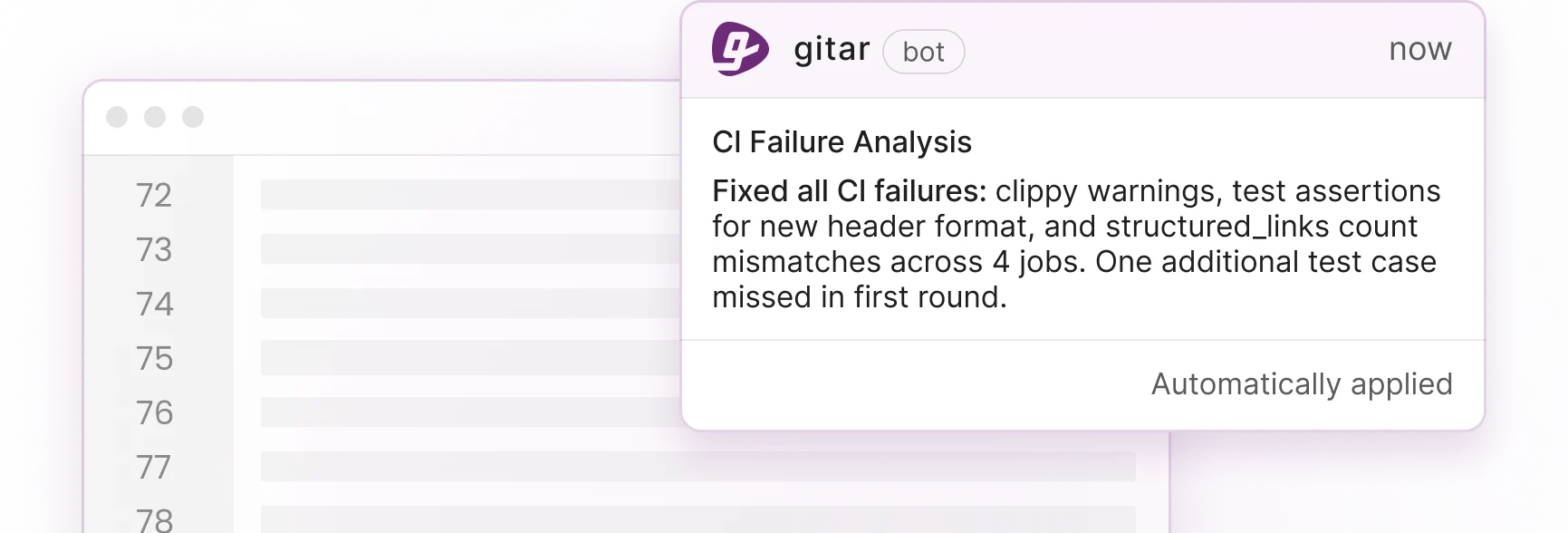
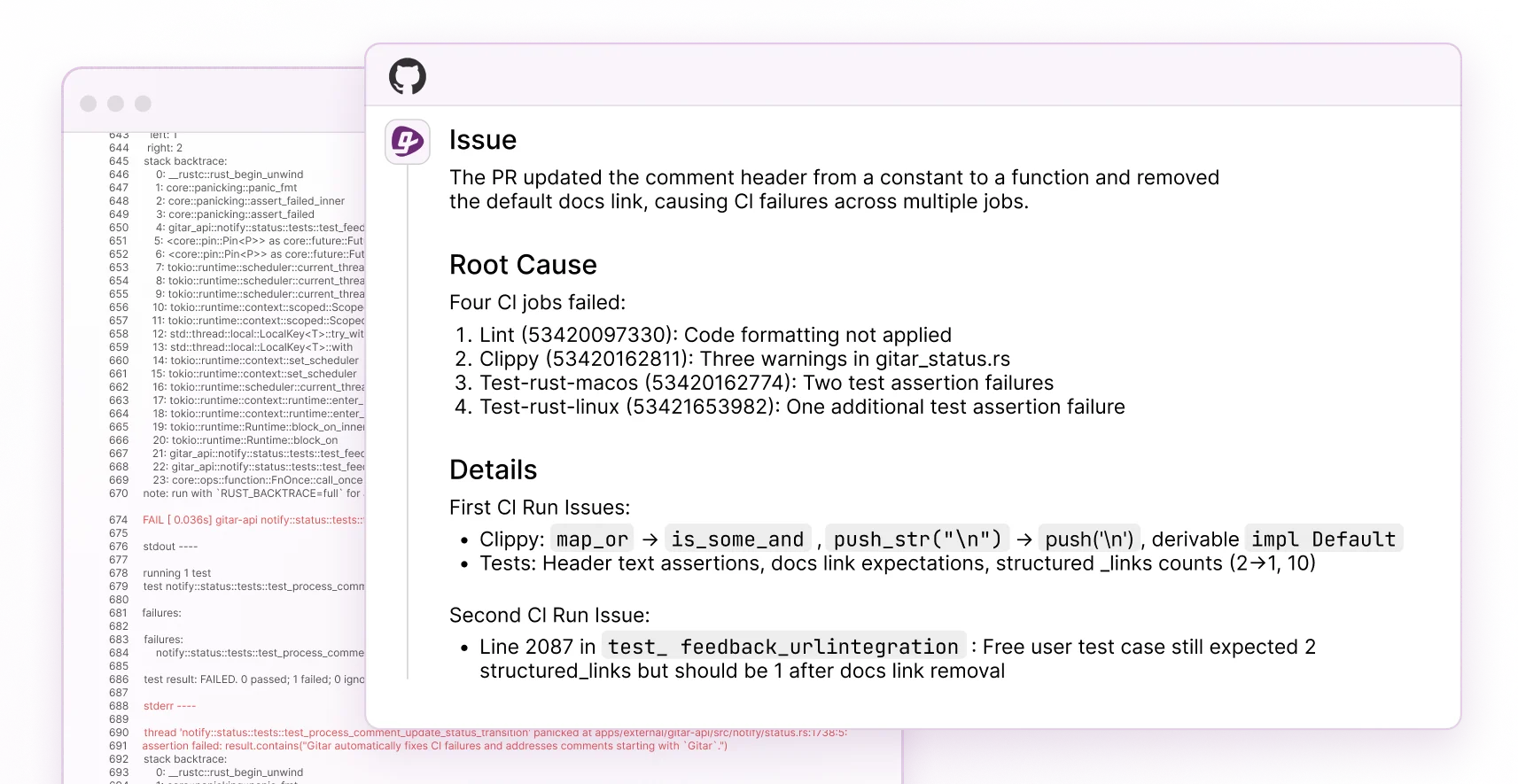
Gitar focuses on fixing code instead of only suggesting changes. When CI fails because of lint errors, test failures, or build breaks, Gitar analyzes failure logs, generates validated fixes, and commits them automatically. This healing engine model aims for consistently green builds rather than hoping manual fixes work.
The platform consolidates findings into a single dashboard comment that updates in place, which reduces notification spam. Teams report that this approach significantly reduces cognitive load from PR review bottlenecks compared to tools that scatter many inline comments across diffs.
Key Features:
- Unlimited free code review for public and private repositories
- 14-day free trial of auto-fix capabilities
- CI failure analysis with automatic resolution
- Integration with GitHub Actions, GitLab Pipelines, CircleCI, and Buildkite
- Natural language workflow rules in .gitar/rules/*.md
- Jira, Slack, and Linear integration for cross-platform context
Setup: Install the GitHub App or GitLab integration in about 30 seconds. No account or credit card is required.
Strengths: Production-validated at Pinterest scale with more than 50 million lines of code, catches security vulnerabilities that Copilot can miss, and detects unrelated PR failures that save significant debugging time.
ROI Impact: Teams report cutting CI and review time from one hour per developer daily to 15 minutes. For a 20-developer team, this can translate to more than $375,000 in annual savings even at 50% effectiveness.
#2 Qodo (formerly CodiumAI) for AI-Assisted Reviews
Qodo delivers AI-powered code review with static analysis, team history learning, and auto-fix support through agents and commands like /implement. The platform provides contextual suggestions and keeps a free tier for individual developers.
Key Features:
- Free tier for individual developers
- GitHub and GitLab integration
- Learning from team feedback patterns
- Static analysis enriched with LLM insights
- Auto-fix agents and CI integration
Limitations: Free tier scope for teams is limited and full automation may require extra configuration.
#3 SonarQube Community Edition for Static Analysis
SonarQube Community Edition offers comprehensive static analysis with quality gates and security scanning. It works well for enforcing code quality standards but behaves like a traditional analysis tool without AI-driven automation or auto-fix features.
Key Features:
- Fully open-source and free
- Multi-language static analysis
- CI and CD pipeline integration
- Quality gates and security rules
Limitations: No AI-powered suggestions, self-hosting requirements, manual fix implementation, and a relatively steep learning curve.
Install Gitar now, automatically fix broken builds, start shipping higher quality software, faster
|
Tool |
Free Tier |
Auto-Fix CI |
Integrations |
Noise Level |
|
Gitar |
Unlimited |
Yes (14-day trial) |
GitHub/GitLab/CircleCI/Jira |
Single comment |
|
Qodo |
Individual |
No |
GitHub/GitLab |
Low |
|
SonarQube |
OSS self-host |
No |
CI/CD |
Medium |
|
Others |
Limited |
No |
Partial |
High |
#4 Codacy for AI-Enhanced Static Checks
Codacy offers automated code review with AI Reviewer, Guardrails for real-time fixes, and GitHub integration. The free tier supports open-source projects and helps maintain consistent quality across contributions.
Key Features:
- Free for open-source projects
- GitHub and Bitbucket integration
- AI-powered static analysis and fix suggestions
- Pull request decoration for clear feedback
Limitations: Free access for private repositories is limited and some teams experience high noise levels.
#5 Snyk Open Source for Security-Focused Fixes
Snyk centers on security vulnerability detection and creates automated fix PRs. The free tier covers 30 private repositories monthly. It integrates with CI and CD pipelines and supports license compliance workflows.
Key Features:
- 30 private repositories monthly on the free plan
- Security vulnerability scanning with auto-fix PRs
- GitHub integration and CI/CD support
- Dependency and license analysis
Limitations: Focus stays on security and licensing, free usage is limited, and it does not provide general-purpose code review.
#6 PR-Agent for Self-Hosted AI Reviews
PR-Agent delivers AI-assisted self-hosted code reviews with strong data sovereignty, which appeals to teams that require on-premises deployment. This control comes with higher setup and maintenance overhead than managed solutions.
Key Features:
- Open-source and self-hosted
- Data sovereignty for sensitive codebases
- GitHub integration
- Customizable review rules
Limitations: Complex self-hosting, no managed option, shallow automation depth, and ongoing maintenance work.
#7 DeepSWE for Autonomous Bug Fixing
DeepSWE functions as a fully open-source autonomous coding agent for bug fixing and refactoring, fine-tuned on large codebases. Teams gain strong automation but need technical expertise for deployment and tuning.
Key Features:
- Fully open-source project
- Autonomous bug fixing capabilities
- Training on large codebases
- Project-aware suggestions
Limitations: Complex setup, limited documentation, need for ML expertise, and no managed service option.
#8 GitClear for Development Analytics
GitClear focuses on development analytics and basic code review insights. It emphasizes productivity metrics more than active workflow automation. The free tier offers limited functionality that suits small teams exploring analytics.
Key Features:
- Basic free tier
- Development analytics dashboards
- Git repository insights
- Team productivity metrics
Limitations: Analytics-first design, minimal automation, limited free features, and no auto-fix capabilities.
#9 Bugdar for Secure PR Reviews
Bugdar brings AI-augmented secure code reviews directly into GitHub pull requests with multi-language support, contextual vulnerability detection, and CI/CD integration.
Key Features:
- Free and open-source
- Multi-language support
- Security-focused reviews
- GitHub and CI/CD integration
Limitations: Security-only focus and manual fix work for non-security issues.
#10 Graphite for Stacked Diffs and AI PR Summaries
Graphite provides a free tier with stacked diffs, AI-driven PR summaries, and Graphite Agent for automated reviews and fixes. It targets teams that want advanced Git workflows along with AI-supported code review automation.
Key Features:
- Free tier available
- Stacked diffs and merge queue
- AI PR summaries and Graphite Agent fixes
- Advanced Git and review workflows
Limitations: Often requires adoption of a stacked PR workflow and does not provide unlimited free auto-fix across all features.
Real Developer Pain Points With AI Code Review
Engineering teams consistently report that PR reviews create the biggest development bottleneck. Slow reviews trigger context switching, focus loss, and cognitive fatigue. About 45% of developers say debugging AI-generated code takes longer than writing it manually, and 66% struggle with AI outputs that are almost correct but still flawed.
Gitar targets these pain points with its healing engine approach, which resolves issues before developers see them and consolidates feedback into concise, actionable summaries with minimal noise.
Install Gitar now, automatically fix broken builds, start shipping higher quality software, faster
Key Tradeoffs When Choosing Automation Tools
Teams should prioritize platforms that fix code instead of only suggesting changes. Companies that implement real automation often save 25% to 50% of throughput costs, but only when tools remove manual work rather than add extra steps.
Free unlimited tiers usually outperform freemium models that rely on strict limits. Auto-fix capabilities drive measurable ROI. Teams using Gitar report cutting daily CI and review time from 60 minutes to 15 minutes per developer, which creates substantial productivity gains without subscription fees.
Frequently Asked Questions About Free AI Code Review
Which tool offers the strongest free tier for GitHub PR automation?
Gitar provides the most complete free tier with unlimited code review for public and private repositories and a 14-day free trial of auto-fix. Competing tools often charge $15 to $30 per developer monthly for suggestion-only features. Gitar’s free tier includes full PR analysis, security scanning, bug detection, and performance review.
How do auto-fix tools avoid creating trust issues?
Modern auto-fix platforms such as Gitar support configurable automation levels. Teams usually start in suggestion mode and approve each fix manually. After they build trust through consistent results, they enable auto-commit for specific failure types like lint errors or test fixes. The system validates all fixes against CI before committing, which ensures that changes actually work.
What is the difference between Gitar and paid tools like CodeRabbit?
CodeRabbit charges $15 to $30 per developer monthly for suggestion-only reviews that still require manual implementation. Gitar offers free code review plus auto-fix capabilities that resolve issues automatically. The core difference is simple: commenting on problems versus directly solving them.
Which tools integrate best with existing CI pipelines?
Gitar offers broad CI integration that includes GitHub Actions, GitLab CI, CircleCI, and Buildkite. The platform runs agents within your CI environment for full context access. Many competitors focus only on GitHub and have limited awareness of the wider CI pipeline.
How can teams measure ROI from automated code review tools?
Teams can calculate ROI by measuring time saved from shorter CI and review cycles and multiplying that by developer hourly costs. Teams using comprehensive automation often cut daily review and CI time from 60 minutes to 15 minutes per developer. For a 20-developer team at a loaded cost of $100 per hour, this can reach $375,000 in annual savings, which far exceeds typical tool costs.
Conclusion: Move From Suggestions to Automatic Fixes
The modern code review bottleneck requires tools that fix code, not tools that only comment on it. Gitar leads this space by offering free, unlimited code review with real auto-fix capabilities that many competitors charge premium prices for without matching outcomes.
Install Gitar now, automatically fix broken builds, start shipping higher quality software, faster