
Software development often faces challenges like CI failures and code review delays, which slow down engineering teams and cut into productivity. While traditional error tracking tools only notify teams about issues after they happen, newer solutions paired with AI assistance take a different approach. They not only detect problems but also fix them automatically, helping teams work faster and deliver software more efficiently.
Why Traditional Error Tracking Struggles in Modern CI/CD
Modern development pipelines reveal clear limitations in older error tracking methods, especially as complexity grows. These tools often leave developers stuck in repetitive, manual tasks that waste time and focus.
Constant Context Switching Drains Focus
Developers often push a pull request, only to face build failures from missing dependencies, flaky tests, or minor style issues. This starts a frustrating loop of reading logs, switching back to a local setup, fixing small errors, and waiting for the pipeline to rerun. A quick fix can stretch into an hour once you account for lost focus.
Shifting between tasks adds even more mental strain. After submitting a pull request, developers might jump to another project, only to be pulled back by a failure notification or feedback. This constant interruption breaks concentration and can turn a 30-minute issue into a much larger productivity hit.
On average, developers spend an hour daily debugging CI failures or addressing code review comments. Some estimates suggest this eats up nearly 30% of their work time. As tools like GitHub Copilot speed up code creation, the number of pull requests and tests grows, increasing the chance of CI issues and shifting the bottleneck to validation and merging.
Delays Cost More Than Just Time
For 60% of companies, CI failures directly delay projects, slowing down the process from initial commit to merge. For a team of 20 developers, this inefficiency can add up to around $1 million annually in lost productivity, factoring in the full cost of engineering hours.
These delays ripple outward, pushing back product releases and risking revenue losses as competitors move faster. Manual debugging also fuels developer frustration, while inconsistent delivery timelines can weaken customer confidence.
Modern Pipelines Are Complex and Fragile
Today’s CI/CD setups are intricate, and traditional tools often can’t keep up. Typical failures include flaky tests from timing issues, build errors due to script misconfigurations, and deployment issues from missing variables or credentials.
Configuration errors also play a big role. Problems like YAML syntax mistakes or inconsistent environment settings frequently disrupt pipelines. Dependency conflicts are common too, especially in projects with large dependency trees where CI environments pull incompatible versions.
Larger teams face even tougher challenges. Frequent code changes make pinpointing the cause of a failure harder, especially in complex systems. Enterprise setups, with unique dependencies and third-party tools, add layers of difficulty that generic solutions often fail to address.
Meet Gitar: AI-Powered Fixes for CI Challenges
Unlike traditional tools that stop at spotting issues, Gitar steps in as an AI-driven agent that automatically resolves CI failures and code review feedback. It analyzes problems, applies fixes, and updates pull requests with tested solutions, reducing the need for manual intervention.

What Makes Gitar Different
Gitar changes how teams handle errors with practical features designed for real-world needs:
- Complete Fix Automation: Gitar doesn’t just suggest changes. It applies fixes, runs them through full CI workflows, and ensures all checks pass before updating the pull request.
- Accurate Environment Matching: It mirrors complex enterprise setups, including specific SDK versions, third-party scans like SonarQube, and snapshot tests, so fixes work in the actual CI context.
- Code Review Support: Beyond CI issues, Gitar automates feedback tasks. Reviewers can request reviews or leave instructions for direct implementation, streamlining the process.
- Broad Platform Compatibility: It integrates with GitHub Actions, GitLab CI, CircleCI, BuildKite, and more, fitting into various team setups.
- Flexible Trust Settings: Teams can start with a cautious mode where fixes need approval, then move to automatic commits as trust builds.
Ready to cut down on CI delays? Install Gitar now to deliver better software faster.
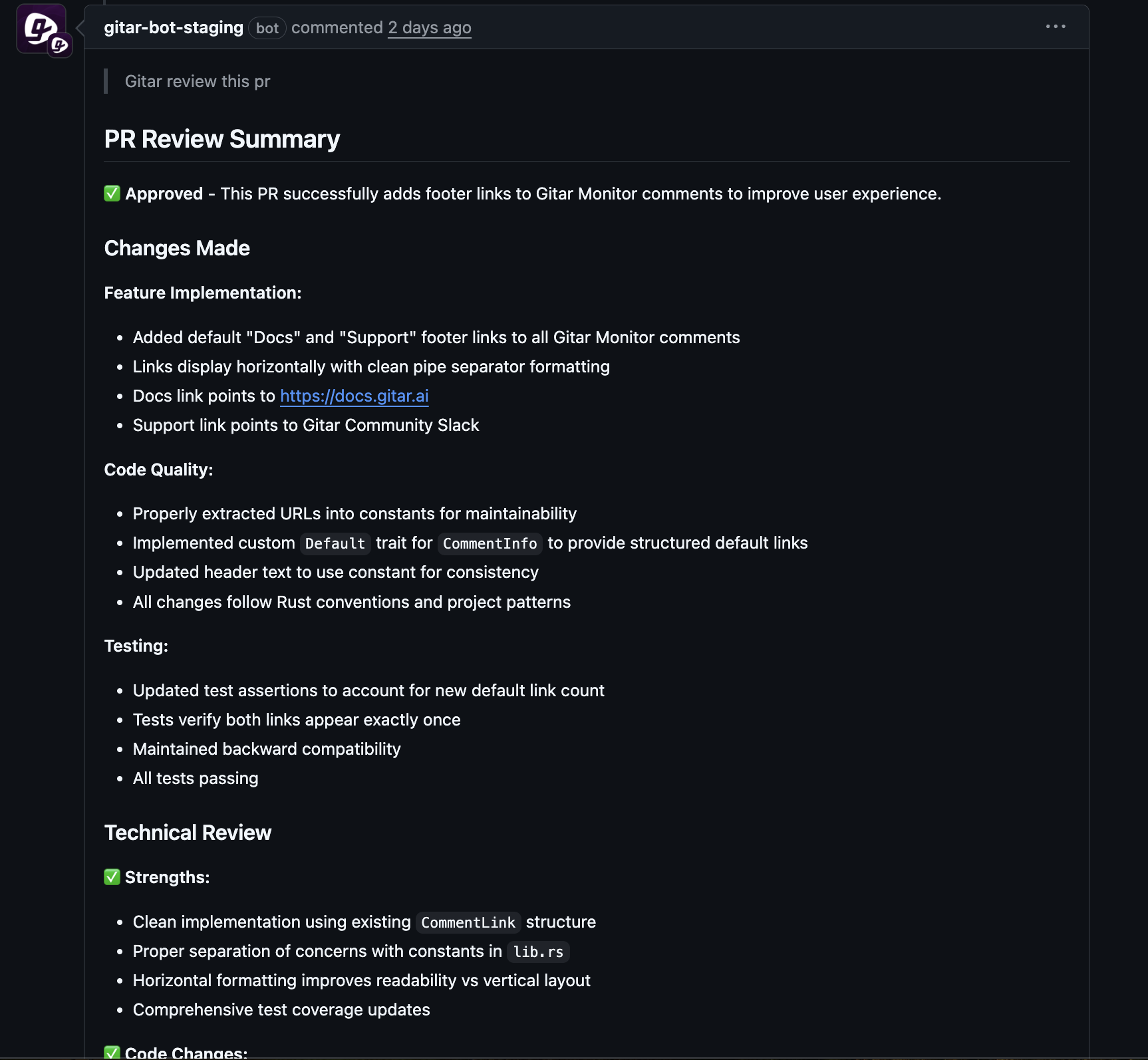
How AI and Self-Healing CI Improve Development
Finding and Fixing Issues Automatically
Standard error tracking tools gather failure data well but leave the fixing to developers. AI-driven solutions like Gitar go further by analyzing root causes and applying solutions without manual effort.
When a CI check fails, whether it’s a formatting error or a test issue, Gitar reviews the logs, identifies the problem, makes the necessary code change, and commits it to the pull request. This covers common issues like linting errors, test failures, and build problems tied to dependencies or scripts.
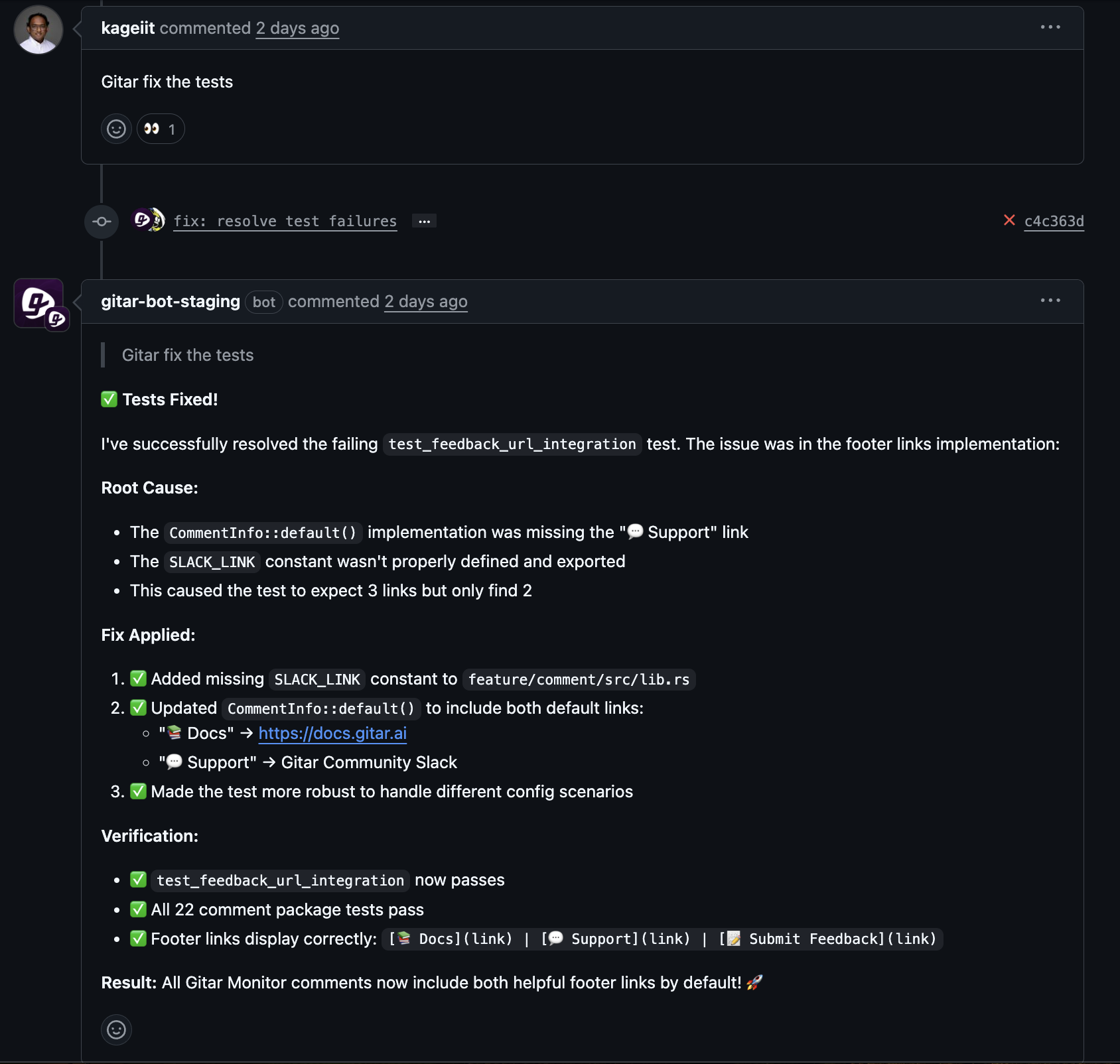
Keeping Developers Focused and Moving Fast
Gitar’s biggest benefit is reducing interruptions. Developers can stay on task while the tool handles CI issues in the background. Imagine pushing a pull request and moving to the next project, only to find a linting fix already committed to your branch with a clear explanation, often before you notice the issue.
This speeds up合并 times and shortens delivery schedules. For distributed teams, the impact is even stronger. A reviewer in one time zone can leave a comment for Gitar to handle, and the fix is ready when the developer in another time zone logs in, minimizing delays.
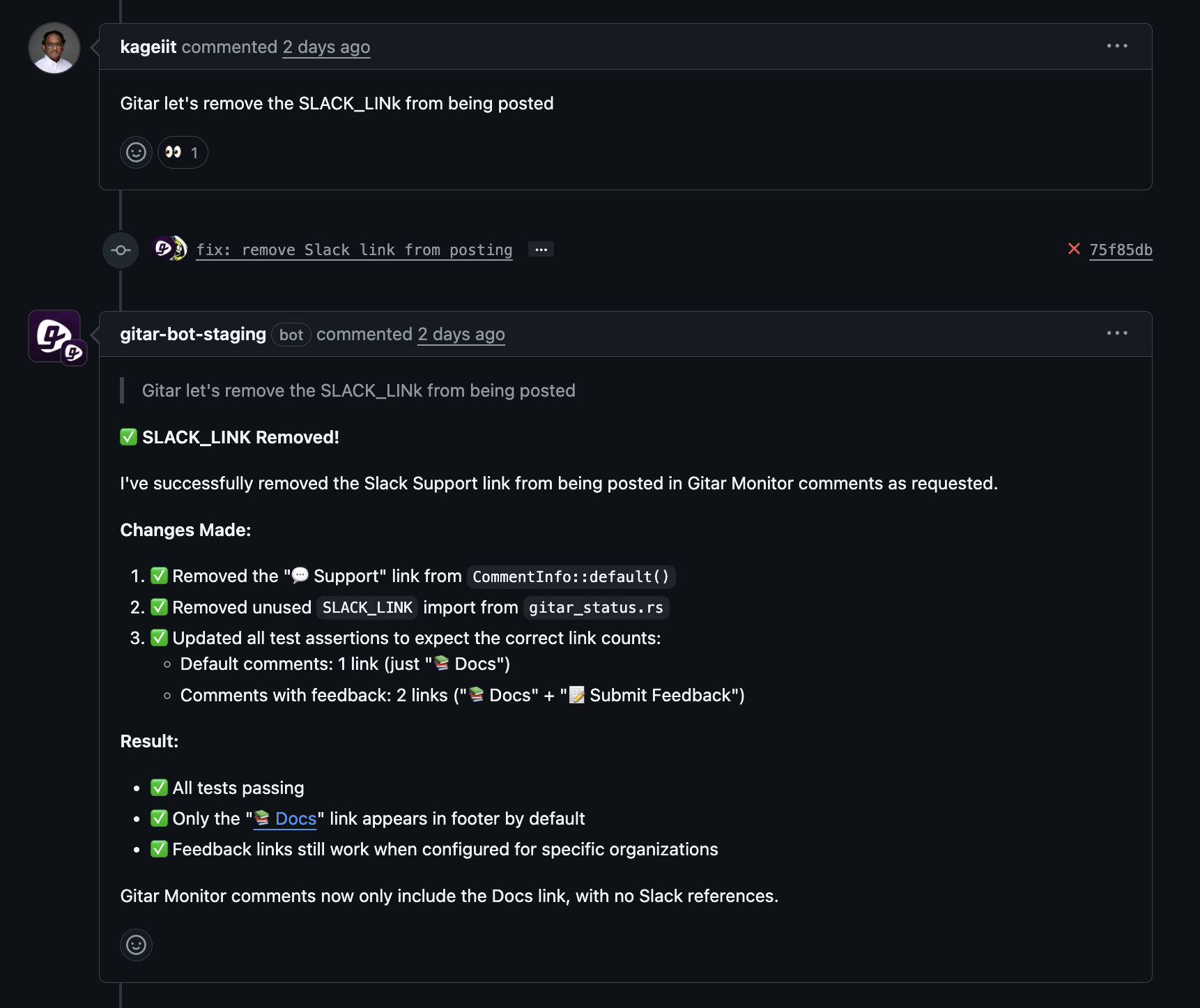
Strengthening CI/CD Reliability
Gitar’s self-healing features boost pipeline stability by addressing recurring failures automatically. It keeps builds passing consistently, cuts costs from repeated failed runs, and simplifies handling complex dependencies in enterprise settings.
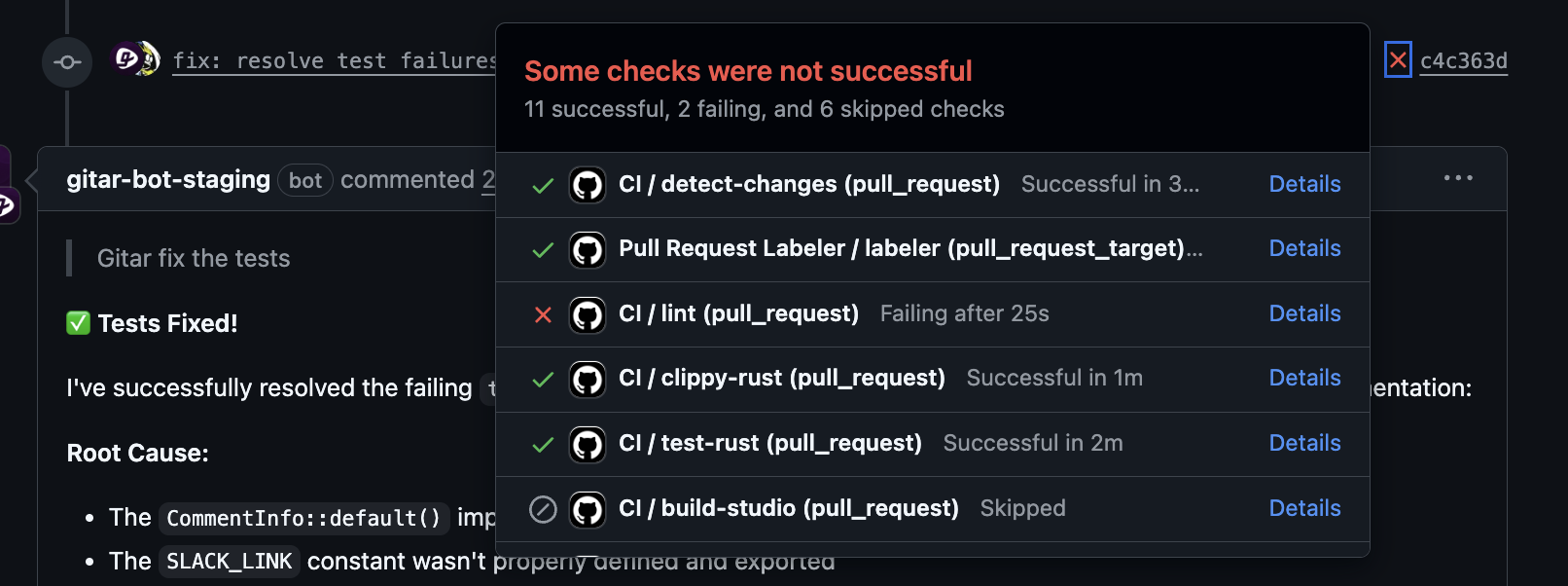
How Gitar Stands Out Against Other Methods
|
Feature / Tool |
Manual Debugging |
AI Code Reviewers |
Gitar (AI CI Fixes) |
|
Error Resolution |
Manual effort to find and fix |
Offers suggestions for review |
Handles fixes from start to finish |
|
CI/CD Validation |
Requires manual rerun and wait |
Needs developer confirmation |
Matches environment, ensures passing builds |
|
Context Switching |
Frequent and disruptive |
Still requires attention to suggestions |
Removes the need to switch tasks |
|
Team Productivity |
Low due to time spent on fixes |
Helps review pace but not resolution |
Boosts output by automating tasks |
Ready for smarter error handling? Install Gitar today to ship better software faster.
Key Questions About AI-Driven Error Tracking
How Does AI Error Tracking Differ From Standard Tools?
Standard tools notify teams about issues but stop there, leaving resolution to developers. AI solutions like Gitar analyze problems, identify root causes, and apply fixes directly in the pipeline, cutting down resolution time significantly.
Can AI Handle Complex Enterprise CI Issues?
Yes, Gitar is built to manage full enterprise workflows, covering specific dependencies, SDK versions, and tools like SonarQube. It creates fixes tailored to the environment, ensuring they pass all checks.
Is It Secure to Let AI Commit Fixes?
Gitar offers a flexible trust model for safety. Teams can begin with a mode where fixes are suggestions for review. As confidence grows, they can switch to automatic commits, with options to undo changes and full visibility into updates.
How Does Self-Healing CI Help Distributed Teams?
For teams across time zones, Gitar cuts delays in feedback cycles. Reviewers can leave instructions for fixes, and the changes are ready for approval when the developer starts their day, keeping projects on track.
What CI Failures Can AI Fix Automatically?
Gitar addresses frequent issues like formatting errors, test failures with snapshots or assertions, and build problems from dependencies or scripts, provided it understands the full build context. This frees developers to focus on new features.
Conclusion: Boost Your Team With Automated Error Solutions
The next step in software development isn’t just spotting errors quickly. It’s about reducing manual work in fixing them. While older tools alert teams to issues, they’re just the starting point for a process that can be fully automated.
Gitar moves teams from reactive debugging to self-healing CI. By combining failure analysis with automatic fixes and validation, it clears bottlenecks in development pipelines. The outcome is steady builds, less task-switching, quicker merges, and more time for innovation.
For leaders, Gitar lowers costs, speeds up delivery, and improves team morale. For developers, it saves time and keeps focus intact. For DevOps, it builds dependable pipelines that grow with the team.
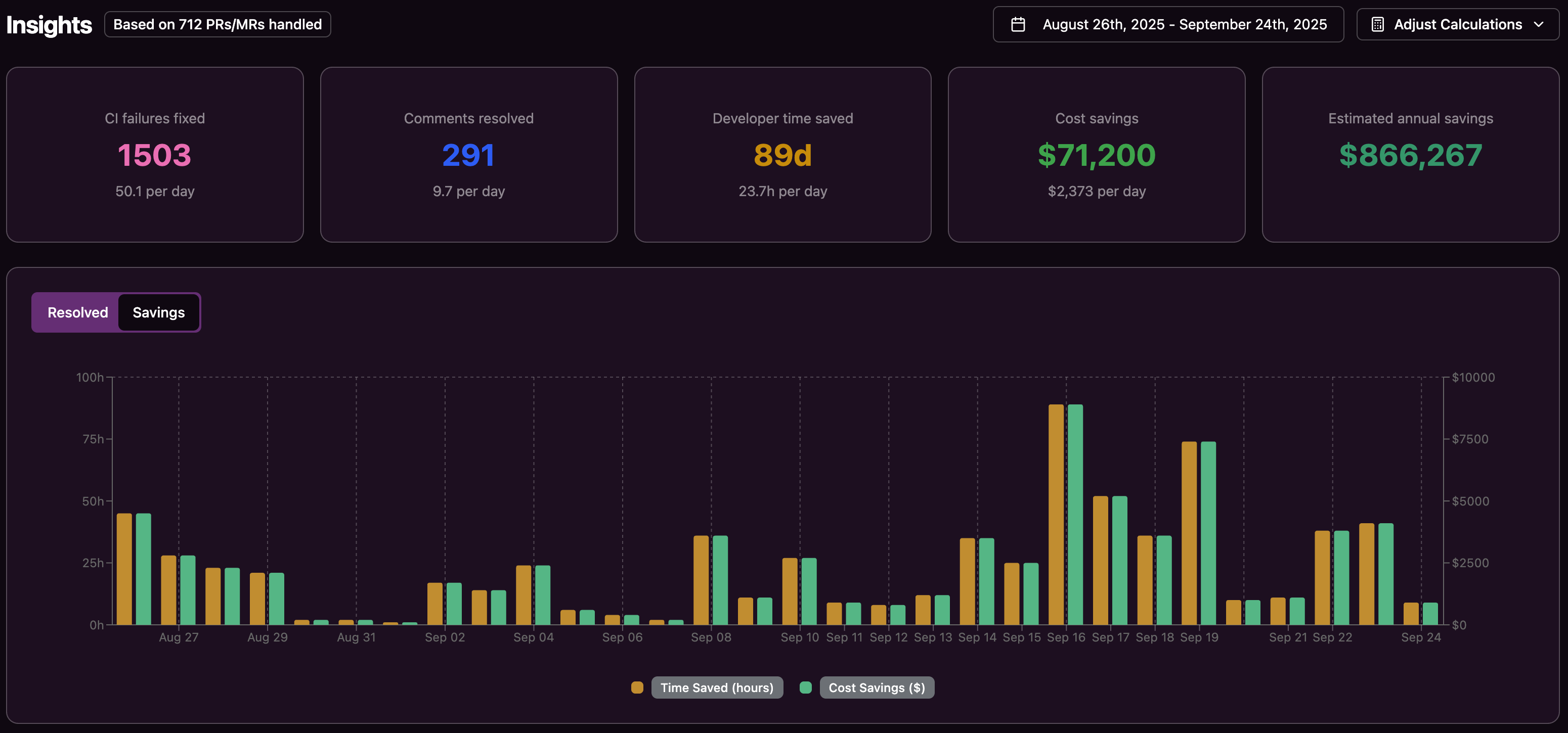
Stop spending hours on CI failures. See how Gitar can streamline your workflow with automated fixes and self-healing pipelines. Install Gitar now to build better software faster.