
Written by: Ali-Reza Adl-Tabatabai, Founder and CEO, Gitar
Slow code merges drain productivity in engineering teams every day. Developers submit pull requests hoping for a quick merge, only to face failing CI pipelines and lengthy review cycles. These delays disrupt focus and stall progress. Pre-merge failures outnumber post-merge issues by a 5:3 ratio, often due to coding standard violations that automation could address. This isn’t just a minor annoyance, it’s a costly bottleneck for businesses, leading to millions in lost time and delayed releases. Tools like Gitar offer a practical fix by automatically resolving CI failures and review feedback, cutting down hours of manual debugging to streamline the merge process.
Why Slow Merges and CI Failures Hurt Your Team
Developers Lose Focus Fixing CI Issues
Every developer knows the frustration of a pull request failing CI checks. A missed lint error, a test passing locally but failing in CI, or a dependency issue can turn a quick merge into a long troubleshooting session. This pulls you away from your main work and breaks your concentration.
Context switching adds a hidden cost. Switching tasks to fix past code issues slows down merges and raises expenses. Imagine coding a complex feature, only to stop and fix a formatting error from an earlier PR. That interruption can waste far more time than the fix itself.
Studies suggest developers lose up to 30% of their workday on CI failures and review tasks, roughly an hour daily on issues automation could solve. A quick 5-minute fix can stretch into an hour when you account for refocusing afterward. For many, this constant disruption feels unavoidable, but it doesn’t have to be.
Leaders Face Delays and Rising Costs
While developers deal with daily CI headaches, engineering leaders see the bigger picture. Pipeline delays extend release timelines and reduce team output. These setbacks ripple through product plans and market strategies.
The financial hit is significant. For a 20-developer team losing one hour daily to CI and review issues, annual productivity losses can hit $1 million, assuming a $200 hourly rate per developer over 250 workdays. Costs often climb higher with senior engineers and complex setups.
About 60% of companies cite CI failures as a key reason for delayed projects, affecting time-to-market and customer trust. When releases lag due to merge delays, competitors can gain ground, and revenue opportunities slip away.
Distributed teams face added challenges. A developer in San Francisco waiting for feedback from a teammate in Tokyo could see delays stretch across days due to time zone differences. Each review round, like fixing a lint error or tweaking a test, adds another cycle of waiting.
Root Issue: Coding Standards and Inefficient Checks
The core problem isn’t poor coding, it’s the systems meant to enforce quality. CI failures often stem from misconfigured scripts, outdated tools, syntax errors, or flawed merge practices. Tools like linters catch issues but can flag false positives or problems fixable by automation.
A developer might spend 20 minutes on a security alert that’s irrelevant or fix a style issue an AI could handle instantly. Manual enforcement slows the pre-merge phase as developers wait for feedback. Ironically, quality checks often hinder productivity more than they help.
In enterprise settings, complex dependencies and specific tool integrations make local fixes fail in CI, leading to repeated debugging cycles. As AI coding tools boost code creation, more PRs mean more chances for failures and validation delays.
How AI Can Fix CI Failures Automatically
Adding more detection tools or linters isn’t the answer. Autonomous AI agents that solve issues, not just flag them, make the difference. Unlike traditional CI tools that suggest fixes for manual action, AI-driven solutions apply corrections and validate them in the full CI workflow.
This change cuts out manual bottlenecks. Instead of pausing to fix a lint error, an AI identifies it, applies the solution, and confirms the pipeline passes, all in the background. A process that once took hours now happens without disrupting your workflow.
AI for CI redefines development by treating failures as routine tasks for automation, not interruptions for humans. Merges happen faster, context switching drops, and productivity rises.
Try Gitar to fix broken builds and deliver quality code faster
Meet Gitar: Your Solution for Quicker Code Merges
Gitar is an AI agent that automatically resolves CI failures and handles code review feedback, saving developers hours on routine checks. Unlike tools that only offer suggestions, Gitar acts as a problem-solver, applying fixes and speeding up merges.

Gitar stands out with these key features:
- Complete Fix Process: Gitar applies fixes and validates them across your CI workflow, ensuring PRs pass all checks without guesswork.
- Environment Matching: It mirrors complex enterprise setups, including specific SDKs and integrations like SonarQube, for accurate fixes.
- Adjustable Automation: Start with Conservative Mode for suggested fixes needing approval, then move to Aggressive Mode for full autonomy as trust builds.
- Wide CI Compatibility: Gitar supports GitHub Actions, GitLab CI, CircleCI, BuildKite, and more, fitting diverse setups.
- Review Support: It acts on reviewer feedback directly, cutting delays, especially for teams across time zones.
Gitar posts updates on your PRs, showing real-time fixes for CI issues or review comments. Seeing a lint error resolved with a clear commit message before you notice the problem highlights its value.
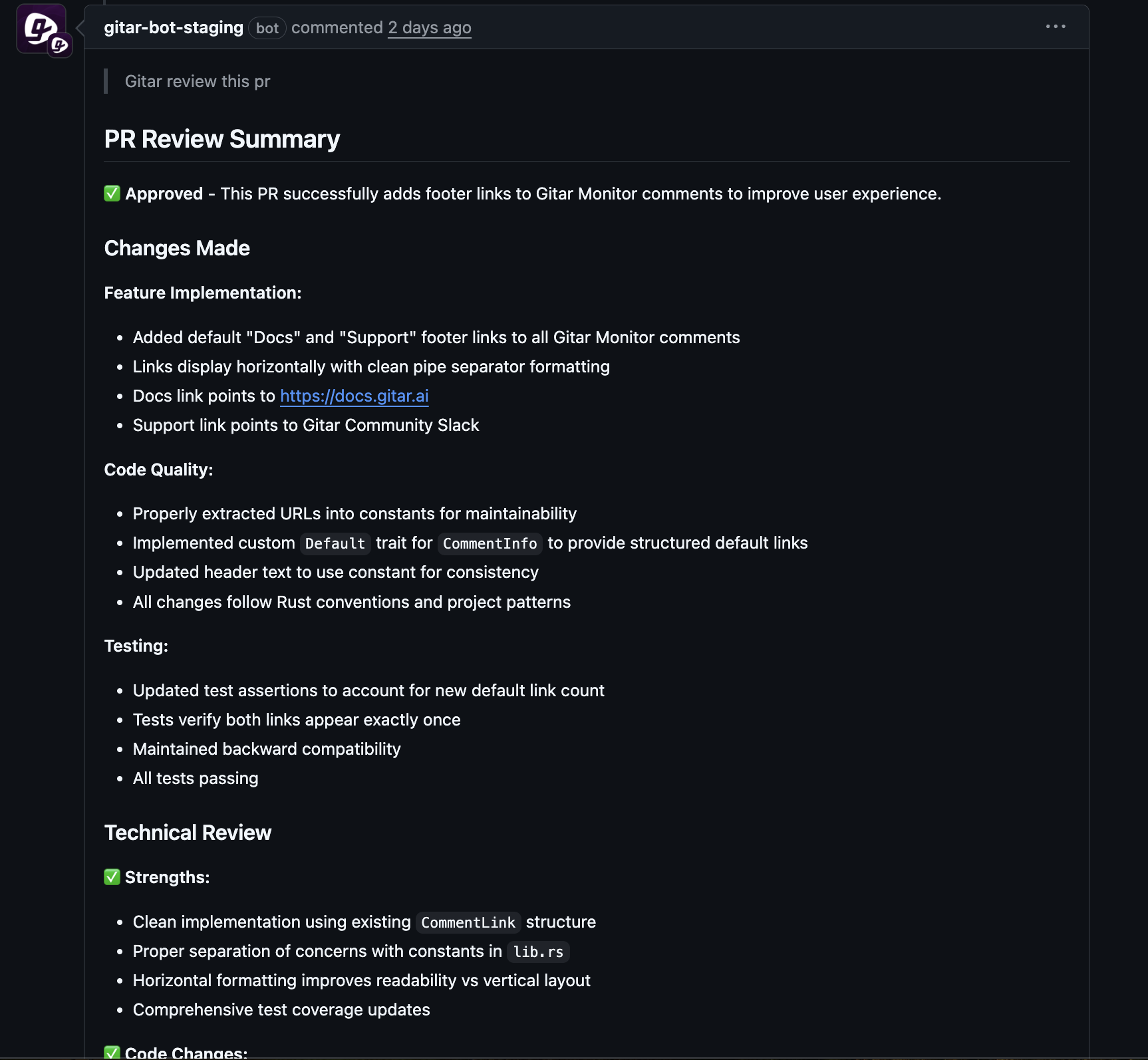
Book a demo with Gitar to see self-fixing CI in action
Gitar’s Impact on Merges and Code Quality
Clearing CI Obstacles with Automatic Fixes
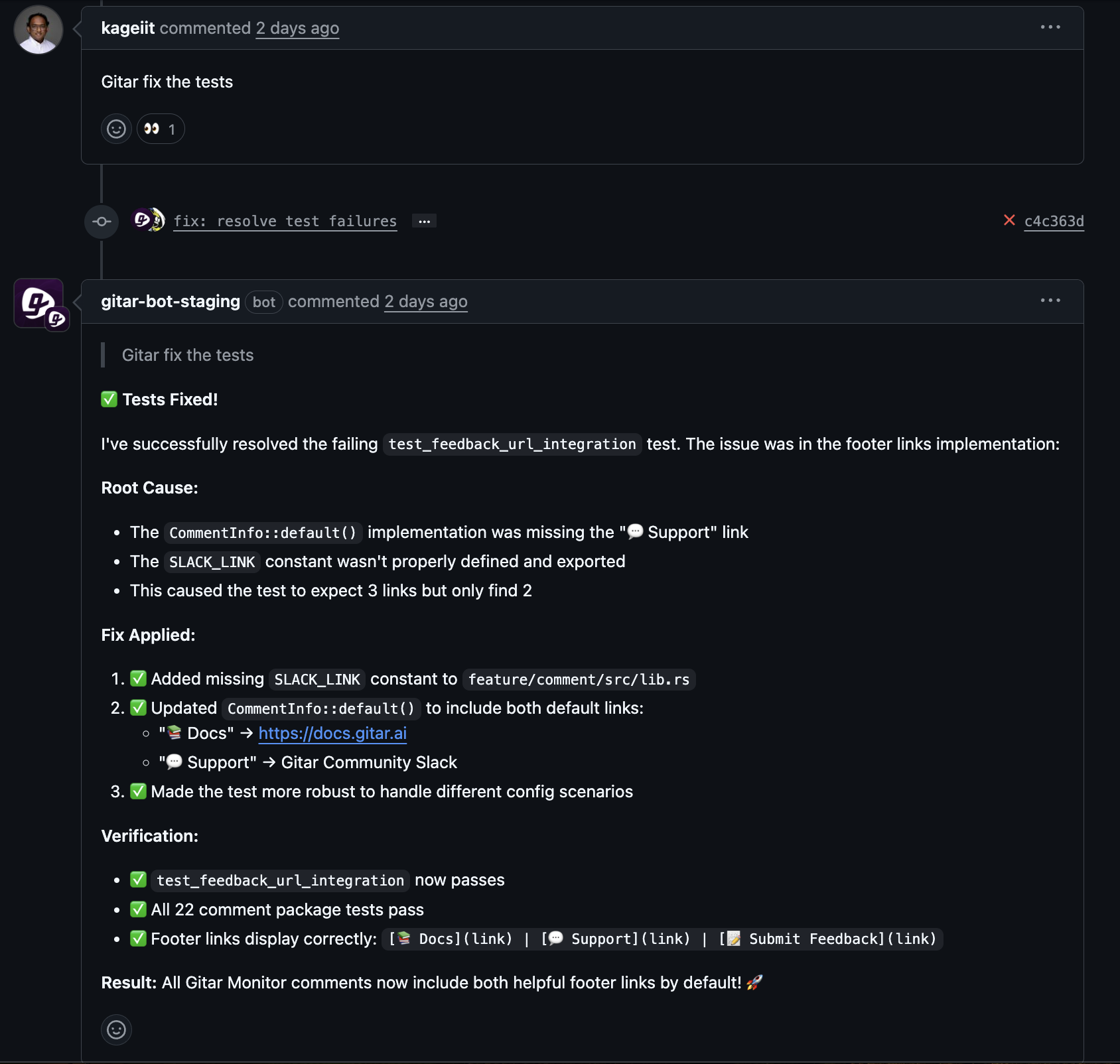
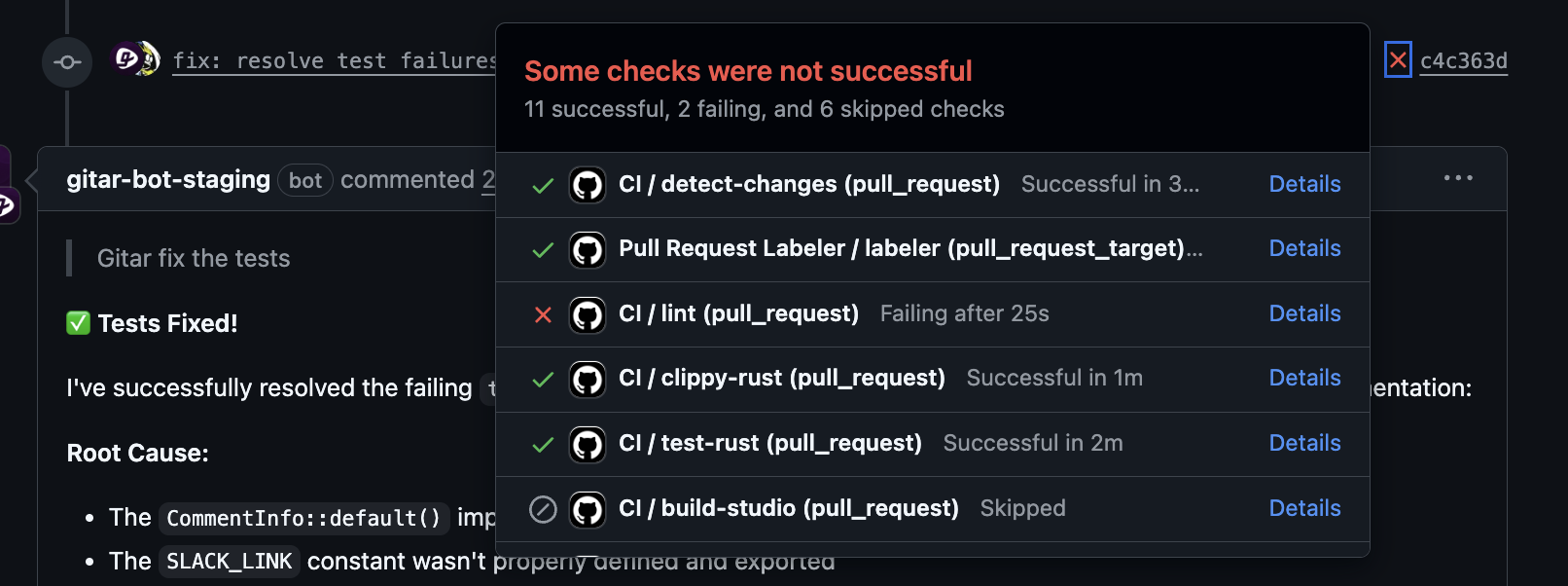
Gitar tackles common CI failures that often need manual effort. When a pipeline fails due to linting, tests, or build errors, Gitar analyzes logs, finds the cause, applies a fix, and commits it to your PR branch.
It covers frequent issues like:
- Formatting Errors: Adjusts style violations instantly.
- Test Problems: Fixes simple failures, like updating snapshots.
- Build Issues: Corrects dependency or script errors.
Gitar’s ability to replicate your exact CI environment, including SDK versions and dependencies, ensures fixes work in your setup. This shortens the push-to-green-build cycle, letting developers focus on coding, not troubleshooting.
Simplifying Reviews and Maintaining Standards
Code reviews slow down merges, especially for distributed teams. Unstable CI operations delay releases and lower efficiency. Manual feedback cycles add to the wait.
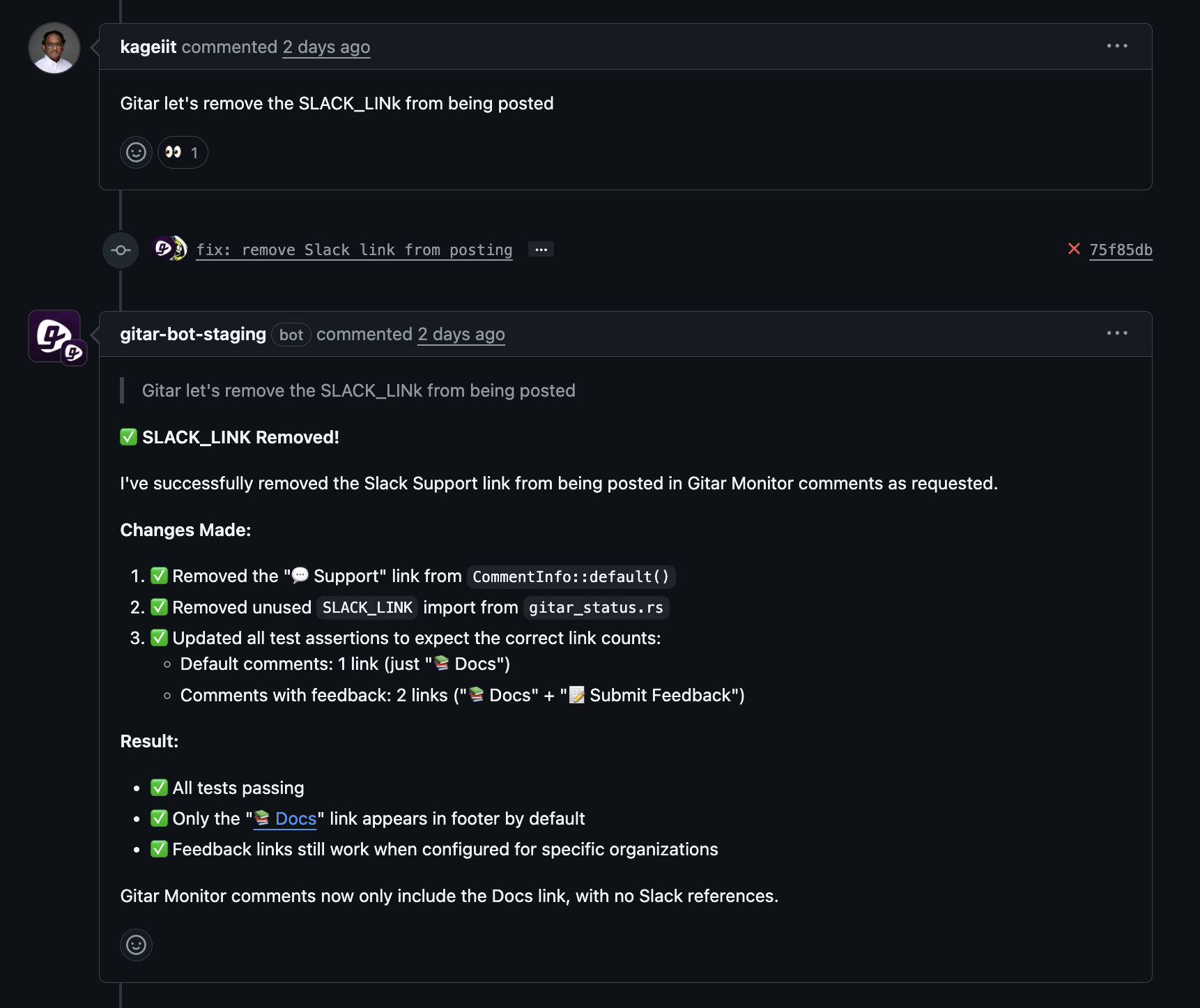
Gitar speeds things up by applying reviewer comments directly. A teammate in one time zone can comment, and Gitar implements changes before the original coder starts their day, reducing delays. It also offers initial PR analysis when tagged, helping reviewers focus on strategy over minor errors.
Real Savings: Productivity and Cost Benefits
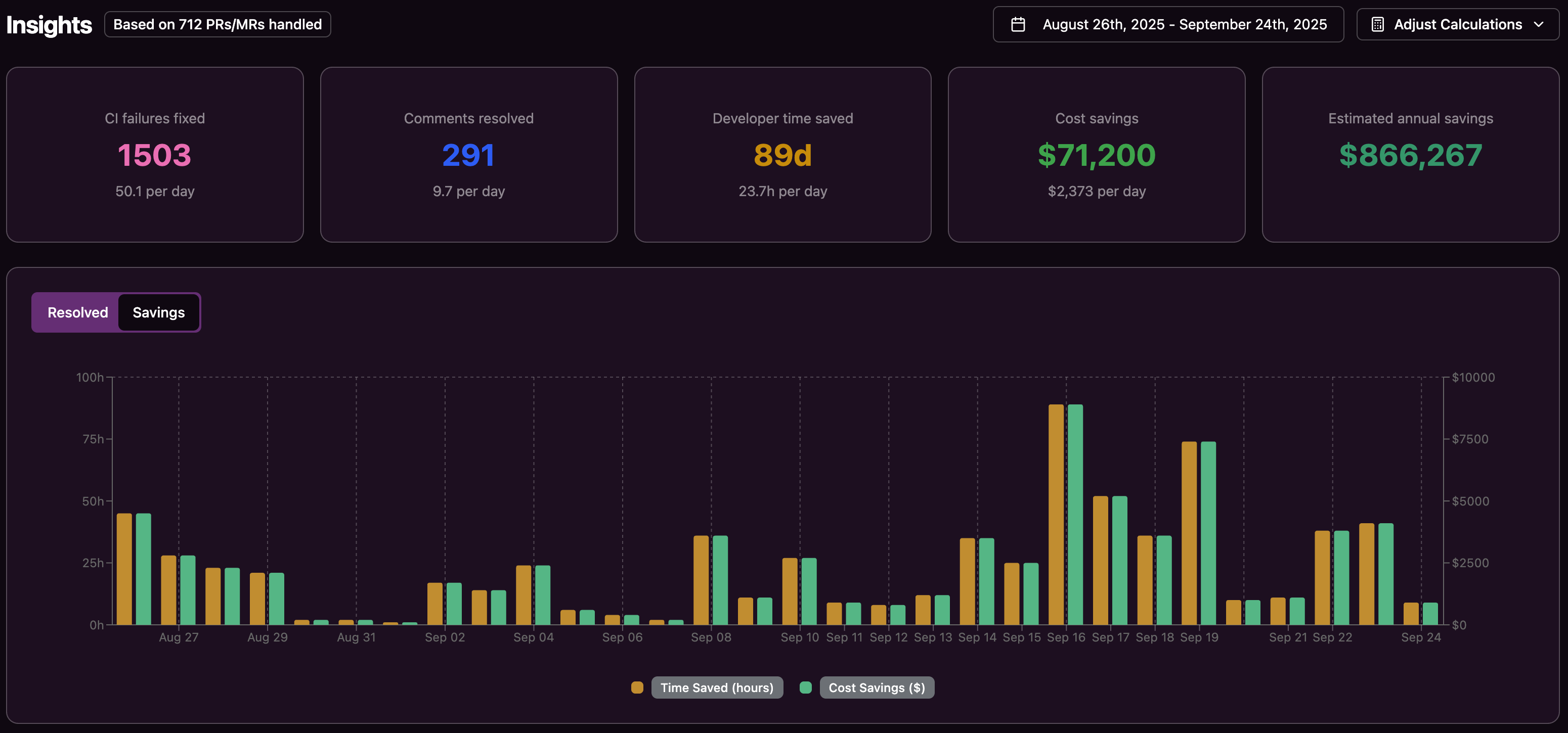
Gitar’s impact goes beyond time saved. For leaders, the financial case is clear. Take a 20-developer team losing one hour daily on CI and reviews:
- Annual Hours Lost: 20 developers x 1 hour x 250 days = 5,000 hours.
- Cost Impact: 5,000 hours x $200 per hour = $1 million yearly loss.
- Savings with Gitar: At 50% effectiveness, save $500,000 annually while boosting morale and speed.
Other gains add up. Reliable CI speeds up releases and market delivery. Fewer failed runs cut costs, new hires onboard faster, and reduced frustration lowers burnout.
Gitar vs. Other Tools: A Clear Comparison
|
Feature |
Gitar (Fixing Engine) |
AI Review Tools (Suggestions) |
Manual Process |
|
Handles CI Failures |
Fixes Automatically |
Suggests Only |
Manual Effort |
|
Applies Fixes |
Yes, Independently |
No |
Manual |
|
Validates Fixes |
Full CI Process |
No |
Manual |
|
Ensures Passing Builds |
Yes |
No |
Developer Task |
|
Environment Accuracy |
Full Match |
Basic, Generic |
Local Setup |
|
Developer Disruption |
Minimal |
Often |
High |
Gitar fixes issues directly, while other tools leave the work to you. This means less interruption and quicker results.
Install Gitar to automate fixes and ship code faster
Common Questions About Gitar
How Does Gitar Differ from Other AI Coding Tools?
Gitar works differently from tools like GitHub Copilot. While those assist with writing code, Gitar focuses on post-commit fixes, autonomously resolving CI issues and validating them. You don’t need to step in, saving time compared to implementing suggestions manually.
Does Gitar Work with Complex Enterprise Systems?
Yes, Gitar handles intricate enterprise CI setups. It mirrors specific SDKs and tool integrations, ensuring fixes fit your environment. Plus, it supports multiple platforms like GitLab CI and CircleCI, adapting to varied workflows.
What if My Team Hesitates to Trust Automated Fixes?
Gitar offers a flexible trust model. Start in Conservative Mode, where fixes are suggestions for approval. As confidence grows, switch to Aggressive Mode for automatic commits. Clear explanations and rollback options keep transparency high.
Can Gitar Cut CI Costs and Speed Up Merges?
Absolutely. Gitar reduces failed pipeline runs by fixing issues fast, lowering costs. It also cuts merge times by automating fixes and feedback, especially for distributed teams, leading to quicker releases and happier developers.
How Does Gitar Handle Security and Compliance?
Gitar fits into enterprise security needs. All changes are trackable with detailed commit notes for audits. It respects branch rules and can operate in suggestion mode for sensitive projects, balancing automation with oversight.
Boost Merges and Productivity with Gitar
Development teams lose time not from bad code, but from inefficient processes turning small tasks into big delays. CI failures and slow reviews disrupt focus, push back releases, and cost millions yearly.
Simply offering suggestions isn’t enough. Developers shouldn’t manually fix routine issues AI can handle. AI tools can detect and resolve CI failures while keeping human control where needed.
Gitar shifts development to true automation by fixing CI issues and review feedback. Merges speed up, interruptions fade, and teams focus on innovation over maintenance.
Want faster merges and a more efficient team? Request a demo with Gitar today and see how autonomous CI fixing changes the game for your developers and your business.