
Last updated: February 5, 2026
Key Takeaways
- AI coding tools speed up code generation 3-5x but increase PR review time by 91%, costing teams about $1M yearly in lost productivity.
- Traditional AI code review tools like CodeRabbit and Greptile charge $15-30 per developer each month for suggestions but provide no autofix, so teams still handle fixes manually.
- Gitar offers free, unlimited code review plus a 14-day autofix trial that fixes CI failures and reviewer feedback for consistently green builds.
- AI code healing engines analyze failures, generate validated fixes, and auto-commit changes, closing the loop that suggestion-only tools leave open.
- Teams using Gitar save more than $750K per year; install Gitar now to fix broken builds automatically and ship higher quality software faster.
1. Gitar: Free AI Code Healing That Fixes Your Builds
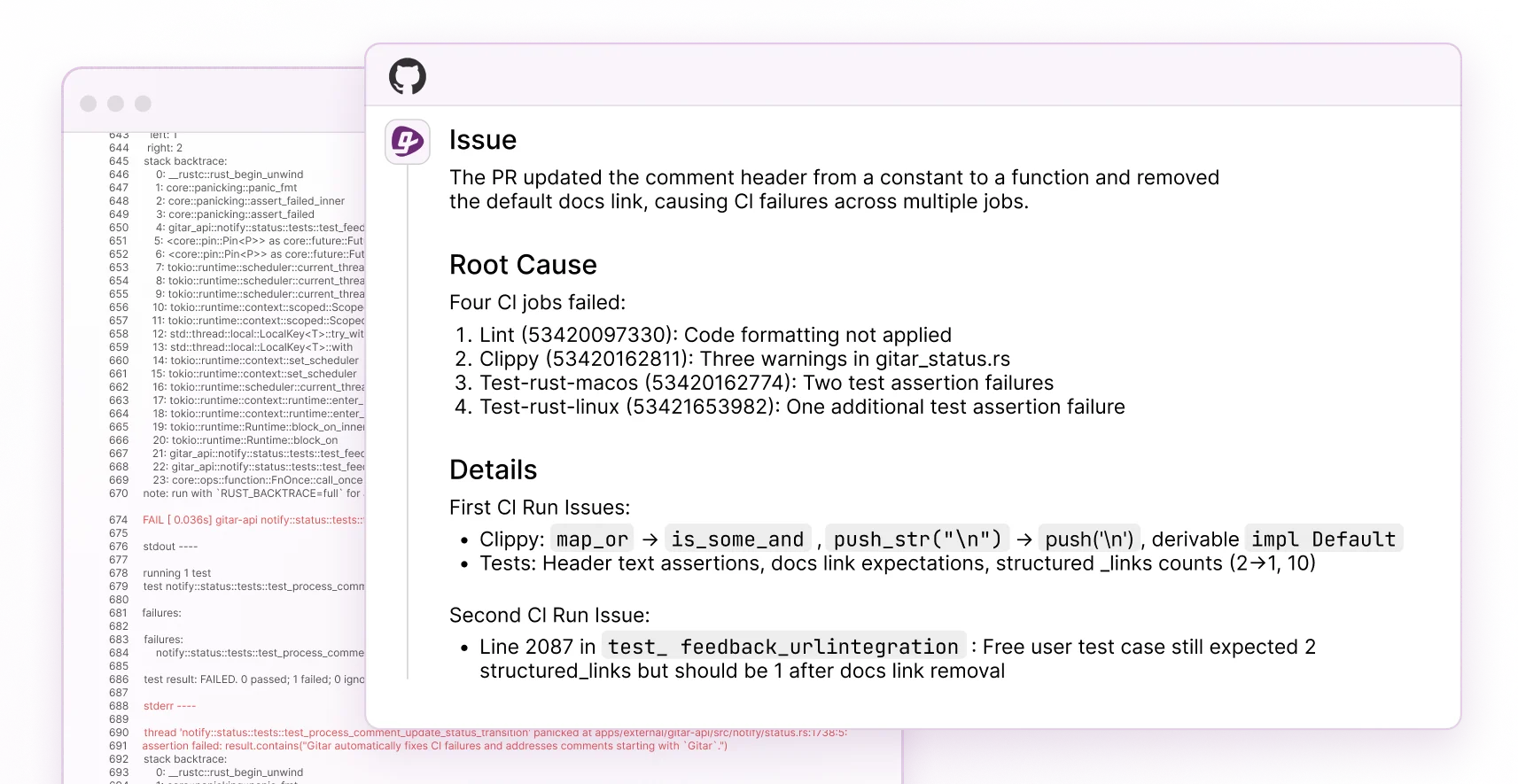
Gitar is the only free AI code review platform that fixes code instead of just suggesting changes. Competitors charge premium prices for basic commentary, while Gitar delivers full code review at no cost plus a 14-day free trial of autofix that keeps builds green.
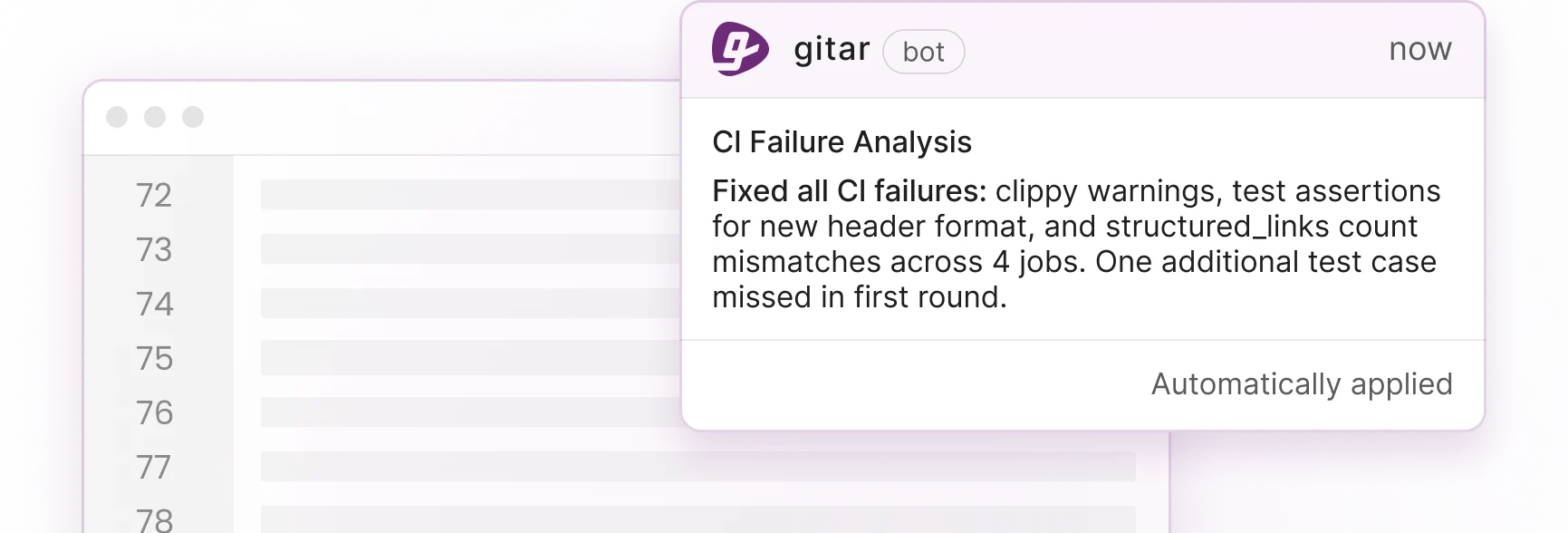
The healing engine analyzes CI failures, generates validated fixes, and commits them directly to pull requests. When reviewers leave feedback, Gitar applies the requested changes automatically. This is not a suggestion engine. It is an automation system that removes the manual work other tools still require.
| Feature | Description | Benefit |
|---|---|---|
| Auto-Apply Fixes | Validated CI failure resolution | Green builds guaranteed |
| CI Analysis | Full failure log parsing | No manual debugging |
| Single Comment | Consolidated PR dashboard | Reduced notification spam |
| Pricing | Free unlimited review | $1M+ annual ROI |
Gitar handles more than basic review and supports CI autofix for lint errors, test failures, and build breaks. It integrates natively with GitHub, GitLab, CircleCI, and Buildkite, and it keeps context aligned through Jira and Slack connections. Enterprise teams like Pinterest have validated that Gitar can manage more than 50 million lines of code and thousands of pull requests every day.
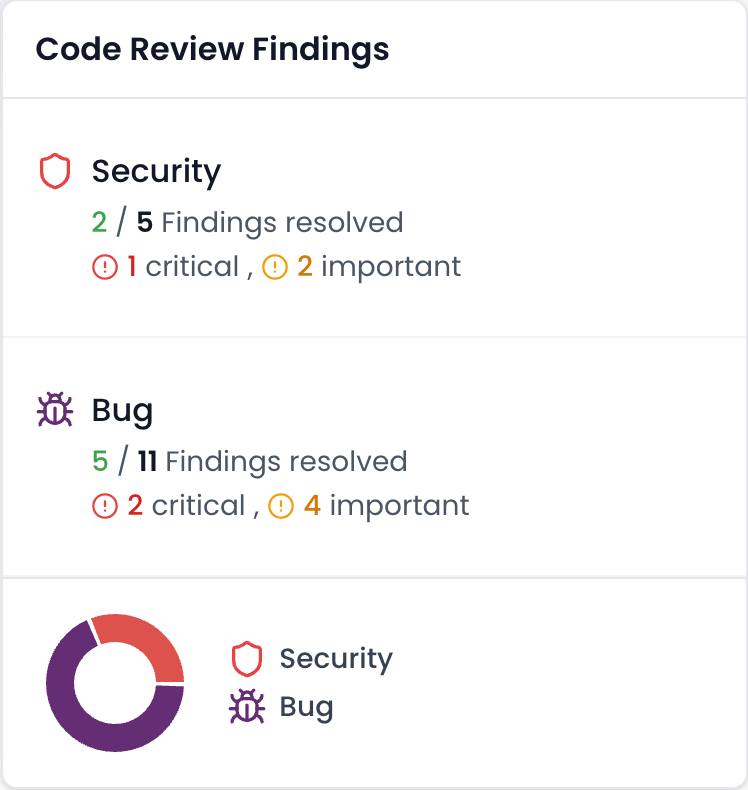
Security review features catch high-severity vulnerabilities in Copilot-generated code that the original AI missed. This proves the value of a dedicated review system instead of relying on the same models that produced the code.
Install Gitar now, automatically fix broken builds, start shipping higher quality software, faster
2. CodeRabbit: Paid AI Suggestions Without Autofix
CodeRabbit works as a traditional suggestion engine and charges $15-30 per developer each month for inline comments and pull request analysis. It offers detailed diff analysis and integrates with GitHub, GitLab, and Azure DevOps, but it lacks the autofix features that define true code healing.
The platform focuses on pull request analysis without CI context, so developers still perform the actual fixes. CodeRabbit reaches 46% accuracy in detecting runtime bugs, yet it provides no way to resolve those issues automatically.
3. Greptile: Deep Context, High Cost, No Autofix
Greptile positions itself as a premium option at $30 per developer each month and highlights deep codebase analysis through complete repository graphs. The platform catches more than 50% more bugs than CodeRabbit by tracking relationships and dependencies across the entire codebase.
Greptile still functions as a suggestion engine. Even with stronger bug detection, it offers no autofix and no CI integration. Teams pay higher prices for better analysis but still face the same manual implementation bottleneck that affects the rest of the category.
How AI Code Healing Engines Work
AI code healing engines move beyond traditional code review and deliver autonomous code correction. These systems run self-correcting loops that analyze failures, generate fixes, validate solutions in CI pipelines, and commit working code automatically.
The healing workflow follows a clear sequence. The engine detects failures and parses logs, generates contextual fixes using full codebase knowledge, validates those fixes through real CI runs, and then commits clean updates to the pull request. Companies like Elastic have shown this approach in practice by fixing 24 broken pull requests with 22 commits in the first month of use.
This model differs from traditional tools that only flag issues. Healing engines close the loop by confirming that fixes work in production-like environments and remove the guesswork of manual implementation.
Install Gitar now, automatically fix broken builds, start shipping higher quality software, faster
Gitar vs. CodeRabbit vs. Greptile: Direct Comparison
The AI review market splits between suggestion tools and true automation. Traditional tools focus on analysis and comments, while Gitar delivers end-to-end automation that removes manual fixing.
| Tool | Auto-Fix | Pricing | CI Integration |
|---|---|---|---|
| Gitar | Yes (14-day free trial) | Free review, trial autofix | Full Pipeline |
| CodeRabbit | No | $15-30/seat | Limited |
| Greptile | No | $30/seat | None |
The ROI math highlights Gitar’s impact. A 20-developer team that spends 1 hour each day on CI and review issues incurs about $1 million in yearly productivity costs. Gitar cuts this to about 15 minutes per day, saving roughly $750,000 per year while removing tool subscription costs.
Why Suggestion-Only AI Review Tools Fall Short
Existing AI code review tools fail because they stop at suggestions. Thirty-eight percent of developers say reviewing AI-generated code takes more effort than human-written code, which creates a verification bottleneck that cancels out speed gains.
These tools flood developers with notifications through scattered inline comments, ignore CI context that matters for real failures, and leave implementation to engineers. Teams receive slightly better analysis but face the same manual workload, which rarely justifies premium pricing.
How Teams Can Adopt AI Code Healing in 2026
Teams see the best results when they adopt AI code healing in phases. Initial installation takes less than 30 seconds and requires no account setup. Teams usually start in suggestion mode and watch how the system handles lint errors, test failures, and build breaks.
The trust-building phase matters because teams observe validated fixes that succeed in their own CI environment. Once confidence grows, they enable auto-commit for specific failure categories and then expand automation over time. More advanced options like natural language workflow rules and cross-platform integrations come later as teams mature their setup.
Most objections focus on cost and trust in automation. Gitar’s free model removes cost concerns, while configurable automation levels let teams keep the level of control they want. Unlike ChatGPT and other general AI tools that do not connect to CI, dedicated code healing engines provide the infrastructure and validation needed for production systems.
FAQs
How does AI code healing differ from traditional code review?
Traditional code review tools identify issues and suggest fixes, then hand the work to developers. AI code healing engines generate, validate, and commit working fixes automatically. The shift moves teams from pure analysis to automation and delivers green builds instead of hoping manual fixes succeed.
What makes Gitar the leading free AI code review tool in 2026?
Gitar offers full code review at no cost, including pull request analysis, security scanning, and bug detection across unlimited repositories. The 14-day autofix trial showcases healing engine capabilities that competitors charge $15-30 per month to approximate with suggestions. A single consolidated comment keeps context clear and reduces notification overload.
How does Gitar’s autofix workflow function in practice?
When CI fails, Gitar reads the failure logs, identifies the root cause, and generates fixes using full codebase context. It validates those fixes against the real CI environment and then commits working code automatically. Teams can start with suggestion-only mode and later enable auto-commit for fix types they trust.
What ROI can teams expect from AI code healing?
A 20-developer team typically saves about $750,000 per year by cutting CI and review time from 1 hour to 15 minutes per developer each day. They also remove $450-900 in monthly tool costs and gain faster deployments with shorter lead times. Even if effectiveness reaches only 50%, ROI still exceeds 300%.
Which platforms and integrations does Gitar support?
Gitar integrates directly with GitHub and GitLab for version control and with GitHub Actions, GitLab CI, CircleCI, and Buildkite for CI. It connects to Jira and Linear for project management and to Slack for communication. The platform supports major languages including Python, Go, JavaScript, TypeScript, Java, and Rust.
Conclusion: Move From Suggestions to Self-Healing Code
The AI code review market has reached a point where suggestion engines no longer justify premium pricing. Teams now need healing engines that fix code instead of tools that create more manual work. Gitar’s free code review and validated autofix features point to the future of development automation.
Install Gitar now, automatically fix broken builds, start shipping higher quality software, faster