
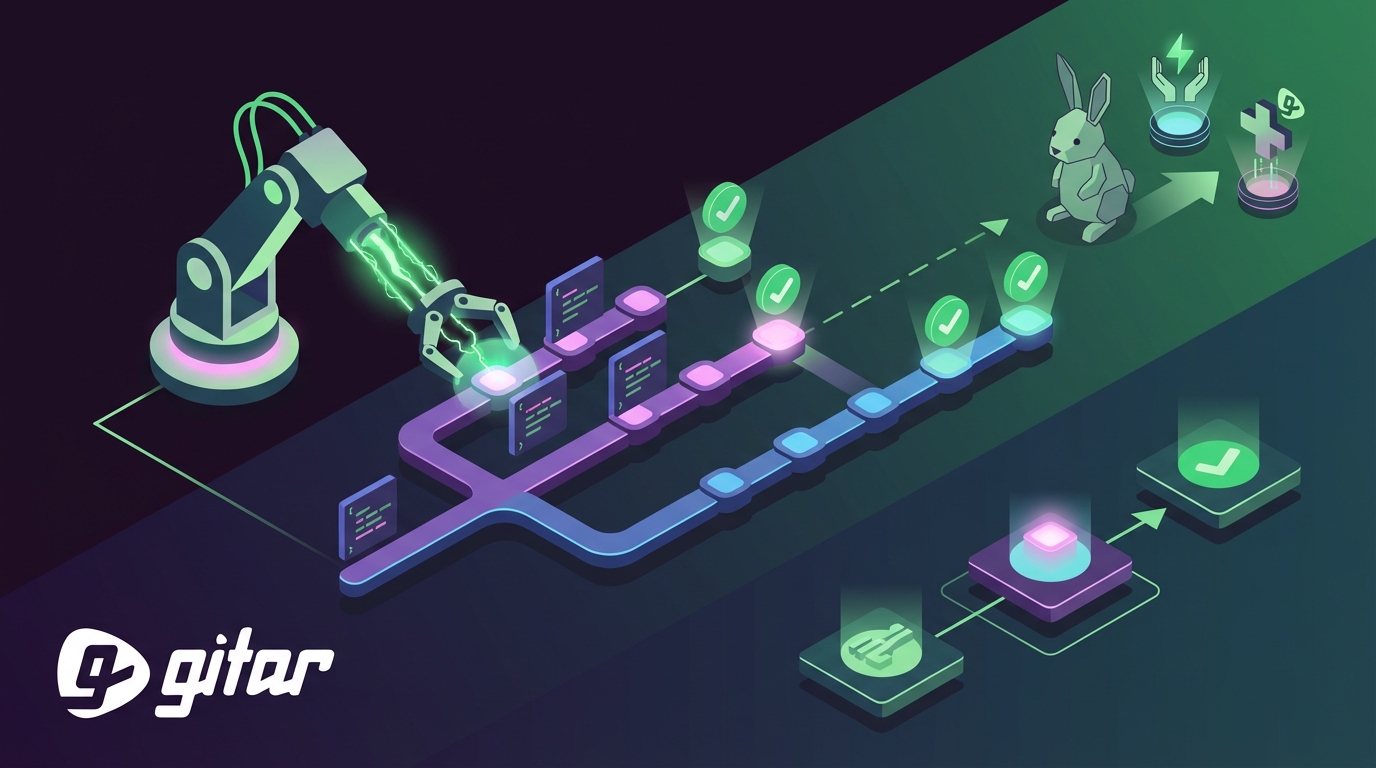
Key Takeaways for 2026 CodeRabbit Alternatives
- AI coding tools have increased PR volume by 20% YoY, raising incidents 23.5% and costing teams $1M annually in CI and review friction for 20 developers.
- Gitar ranks #1 as the free AI code review platform with validated auto-commits that fix CI failures and review feedback directly in PRs.
- Competitors like Qodo Merge, CodeAnt.ai, and Greptile offer analysis or partial fixes but lack Gitar’s free unlimited access and CI-validated auto-commits.
- Gitar integrates deeply with GitHub, GitLab, CircleCI, and Buildkite, enabling 5-minute setup and cutting daily CI and review time from 1 hour to 15 minutes per developer.
- Teams save $750K+ annually with Gitar’s zero-cost unlimited review and autofix trial—install Gitar now for guaranteed green builds.
How We Ranked Auto-Fix Power and VCS Integration
Our evaluation criteria prioritize tools that actually fix code rather than just suggest changes. We assess auto-commit success rates validated against CI systems, VCS integration depth across GitHub, GitLab, and Bitbucket, free tier availability, setup complexity, and scalability for enterprise teams. We also consider integration ecosystem support, including CircleCI, Buildkite, Jira, and Slack.
Rankings incorporate vendor documentation, benchmark data, developer forum feedback, and real-world testimonials from teams at Pinterest, Tigris, and Collate. Tools that only provide suggestions without validated auto-commits rank lower, regardless of their analysis capabilities.
#1: Gitar as Free Auto-Commit Healer for Green Builds
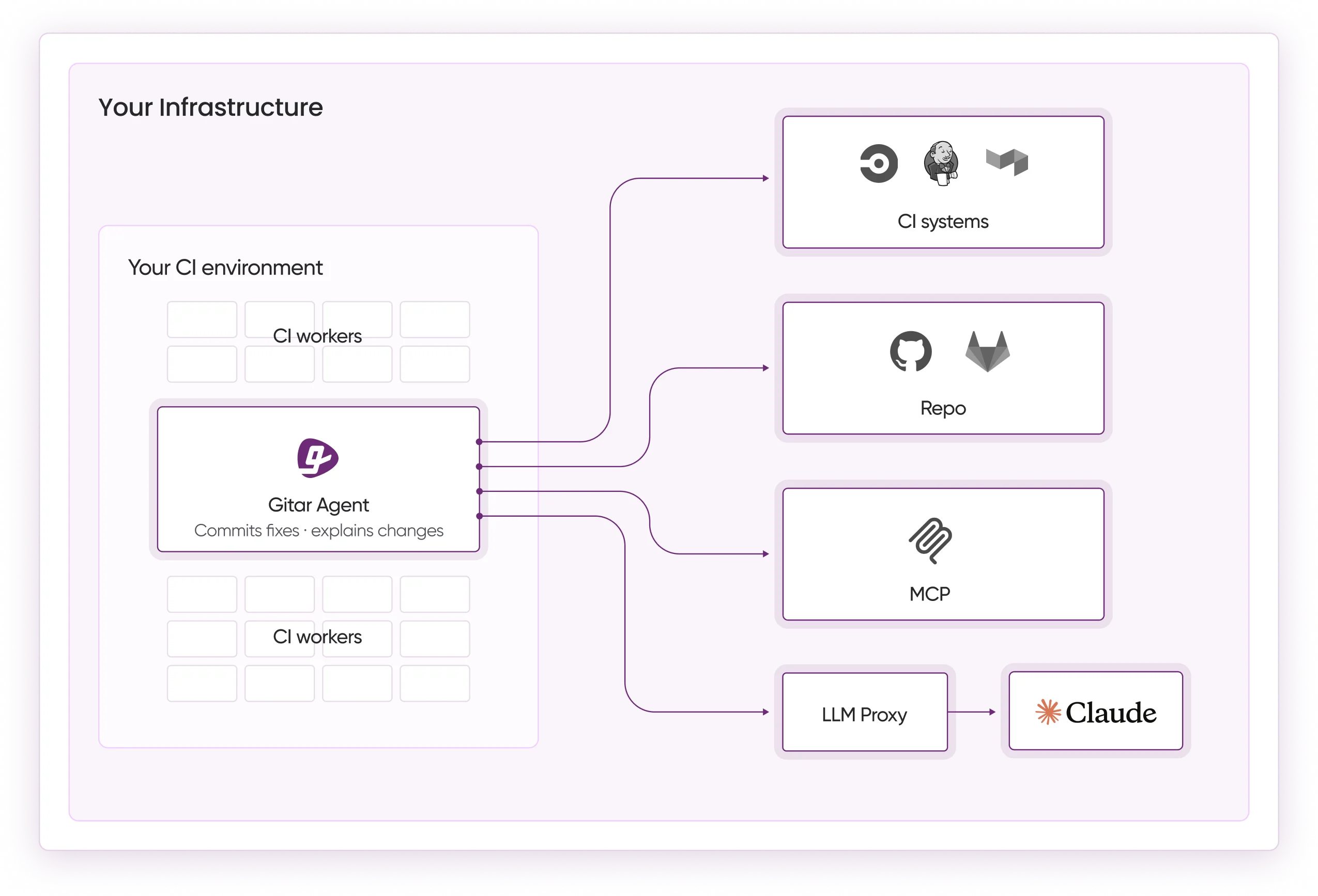
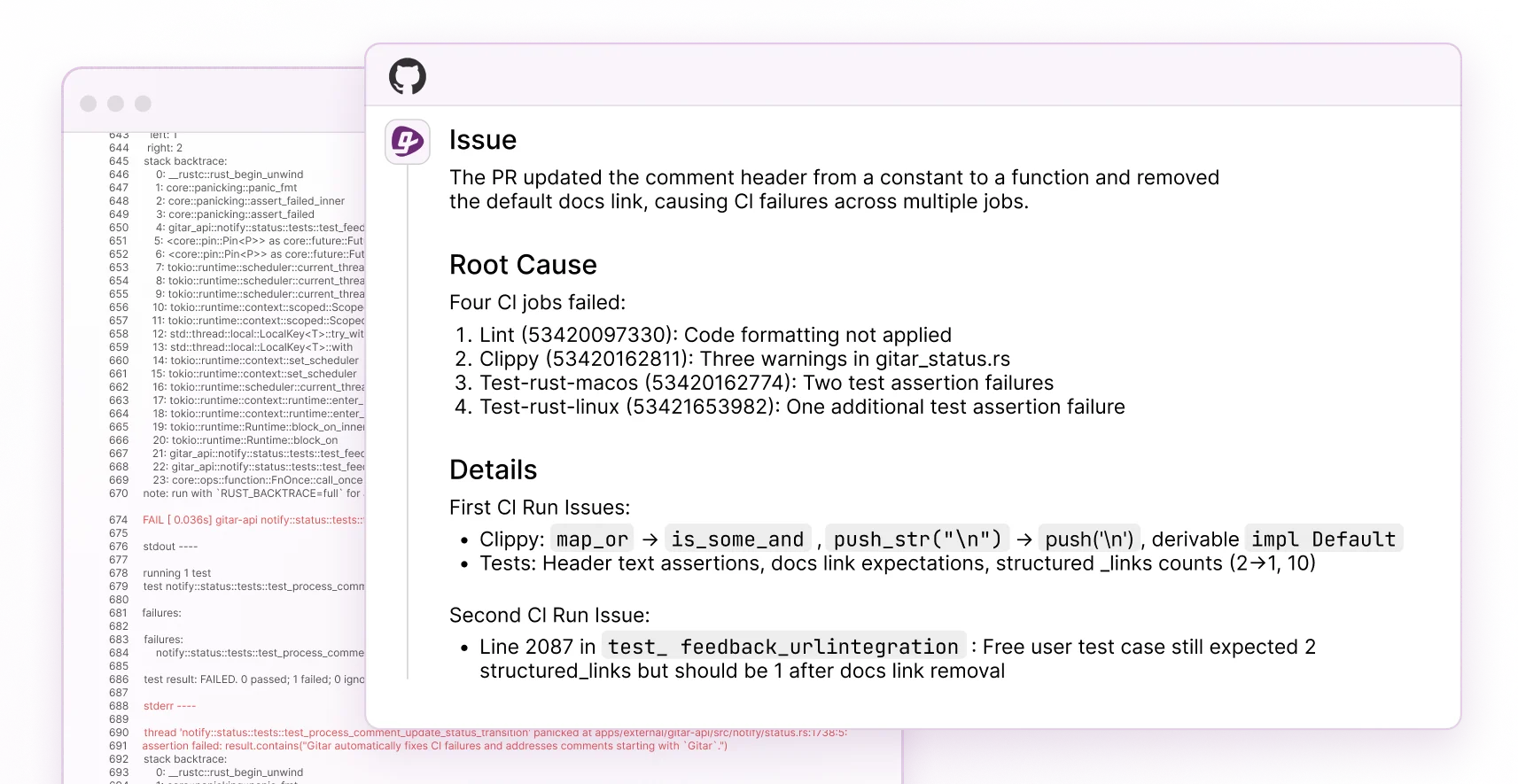
Gitar stands apart as the free AI code review platform that actually fixes code, automatically resolving CI failures and addressing review feedback. When CI fails from lint errors, test failures, or build breaks, Gitar’s healing engine analyzes failure logs, generates validated fixes, and commits them directly to your PR. This approach delivers reliable automation and consistently green builds.
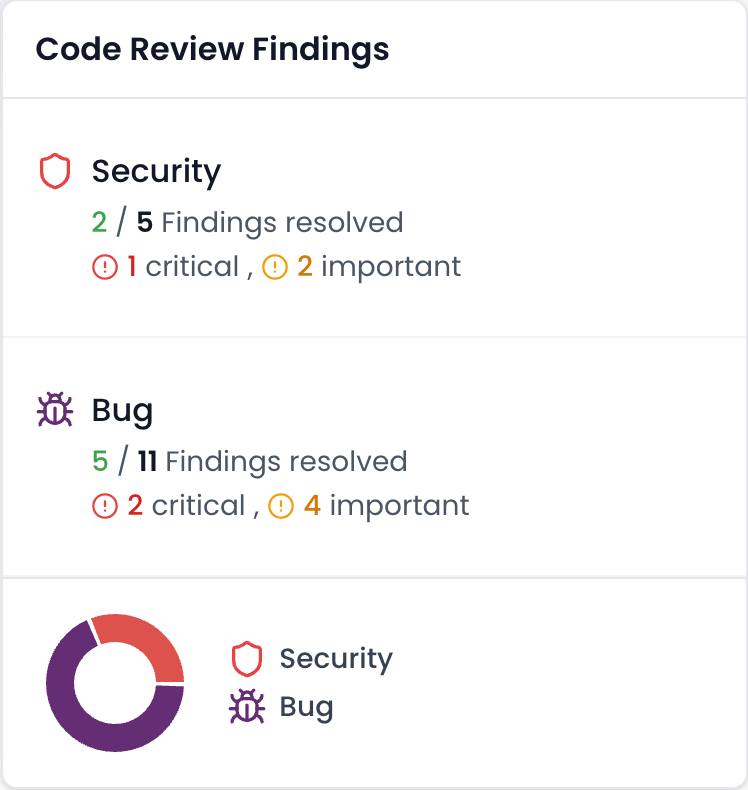
The platform uses a single updating dashboard comment instead of scattered inline noise, which keeps all findings in one clean interface. Natural language rules in .gitar/rules/*.md files let teams automate workflows without YAML complexity. Integration spans GitHub Actions, GitLab Pipelines, CircleCI, and Buildkite with a 30-second installation.
Unlike CodeRabbit’s $15-30 per seat suggestion engine, Gitar provides unlimited free code review for all repositories plus a 14-day free trial of autofix features. Teams report reducing daily CI and review time from 1 hour to 15 minutes per developer. That shift translates into significant annual savings for a 20-person team.
Pinterest validates Gitar at enterprise scale with 50M+ lines of code and thousands of daily PRs while maintaining zero data retention for security. The platform’s hierarchical memory system learns team patterns over time and provides context that competitors lack.
#2: Qodo Merge for Interactive Auto-Fix Commands
Qodo Merge offers strong auto-fixing capabilities with interactive slash commands and multi-repo context analysis. The platform integrates with GitHub, GitLab, and Bitbucket and provides more than 15 PR workflows, including risk scoring and testing automation. It lacks free unlimited access and does not match Gitar’s CI validation depth for auto-commits.
#3: CodeAnt.ai for AST-Based Analysis and One-Click Fixes
CodeAnt.ai provides AST-based analysis with one-click fixes across GitHub, GitLab, Bitbucket, and Azure DevOps. The platform offers advanced contextual understanding but requires more manual intervention than Gitar’s fully automated commit system. Pricing remains moderate and does not include free unlimited tiers.
#4: Greptile for Deep Codebase Graph Analysis
Greptile charges $30 per seat for comprehensive codebase context analysis with full GitHub and GitLab integration. The platform excels at understanding large codebases through detailed graph analysis. It provides suggestions rather than validated auto-commits, so developers still handle implementation work.
#5: Aikido Security for Targeted Security Fixes
Aikido Security focuses on security-specific code reviews and fixes with VCS and CI/CD pipeline integrations. The platform offers partial automation for security remediation. It does not provide the comprehensive auto-commit capabilities needed for general CI failures and review feedback.
#6: MatterAI for PR Workflow Automation
MatterAI provides PR automation with GitHub-focused integration and emphasizes workflow improvements over direct code fixes. The platform offers suggestions and analysis but falls short of Gitar’s validated auto-commit approach that guarantees working fixes.
#7: Graphite for Agentic PR Reviews
Graphite delivers agentic code reviews with GitHub integration and focuses on PR workflow optimization. The platform provides intelligent analysis but lacks comprehensive auto-fixing capabilities. It also does not validate fixes against CI systems before committing.
#8: Bito for Click-Based Fix Automation
Bito AI offers fix-in-click automation starting at $12 per user monthly with support for GitHub, GitLab, and Bitbucket. The click-based approach still requires manual intervention. Gitar instead provides a fully automated commit system.
#9: Cursor Bugbot for IDE-Centric Bug Detection
Cursor Bugbot detects logic bugs with IDE-based fixes for GitHub integration. The platform remains editor-bound and does not provide the CI-integrated auto-commit capabilities needed for comprehensive development workflow automation.
#10: Cubic.dev for Complex Codebase Insights
Cubic.dev excels at complex codebase analysis with full context understanding, used by n8n and Linux Foundation projects. The platform focuses on insights rather than automated commits, so development teams still implement changes themselves.
Top 10 Tools Ranked by Auto-Fix and VCS Integration
| Tool | Auto-Commit | CI Integration | Free Tier | Pricing |
|---|---|---|---|---|
| Gitar | Yes (Validated, 14-day trial) | Full (CircleCI+) | Yes (Unlimited) | $0 + Trial |
| Qodo Merge | Partial | Moderate | Individual Only | Paid Tiers |
| CodeAnt.ai | One-Click | Basic | No | Moderate |
| Greptile | No | Basic | No | $30/seat |
Qodo Merge vs CodeRabbit for Auto-Fix Performance
Qodo Merge and CodeRabbit both offer advanced analysis capabilities, yet neither provides the validated auto-commit system that development teams now expect. Qodo’s interactive slash commands require manual approval, and CodeRabbit’s one-click fixes do not guarantee CI success. Gitar’s healing engine validates fixes against actual CI environments before committing and delivers green builds without manual intervention.
Greptile vs CodeRabbit for GitHub-Centric Teams
Greptile’s $30 per seat pricing and comprehensive codebase analysis compete directly with CodeRabbit’s GitHub integration, but both platforms primarily provide suggestions. Teams paying premium prices for analysis tools still face a manual implementation bottleneck. Gitar removes this friction with free unlimited code review and validated auto-commits.
5-Minute Gitar GitHub Setup for Auto-Commits
Gitar setup finishes in minutes and requires no account creation or credit card. Add the GitHub App to your repositories or connect GitLab, and Gitar immediately begins posting dashboard comments on new PRs. Enable autofix features through the 14-day free trial in settings, then create optional .gitar/rules/*.md files for custom workflows. CI failures start resolving automatically, and the entire setup process takes under five minutes with minimal configuration.
2026 Trend: PR Growth and Self-Healing CI Demand
With 90% of engineering teams actively using AI tools and incidents per pull request rising 23.5%, demand for self-healing CI systems continues to surge. Traditional suggestion-based tools cannot keep pace with the volume and complexity of AI-generated code that requires validation and fixes.
Gitar ROI: Cutting Costs from $1M to $250K
| Metric | Before Gitar | After Gitar |
|---|---|---|
| Daily CI/Review Time | 1 hour/developer | 15 minutes/developer |
| Annual Productivity Cost | $1M (20-dev team) | $250K |
| Tool Cost | $450-900/month | $0 |
FAQs on CodeRabbit Alternatives and Gitar
What are the best free CodeRabbit alternatives with auto-fixes in 2026?
Gitar leads as the free CodeRabbit alternative that offers unlimited code review with autofix features available through a 14-day free trial and validated automatic commits. Other platforms like Qodo Merge provide free individual tiers but lack the comprehensive auto-fixing capabilities and enterprise scalability that teams require. Gitar delivers Pinterest-scale infrastructure at zero cost for code review, with optional paid features for advanced workflow automation.
Which tools offer the deepest GitLab VCS integration for auto-commits?
Gitar provides the most comprehensive GitLab integration with full CI pipeline support across GitLab CI, CircleCI, and Buildkite. The platform’s healing engine works seamlessly within GitLab’s merge request system and automatically fixes failures while implementing reviewer feedback. Competing tools focus primarily on GitHub, while Gitar treats GitLab as a first-class citizen with feature parity.
Can I trust automated commits from AI code review tools?
Gitar’s auto-commit system is fully configurable, so teams can start in suggestion mode and gradually enable automation for trusted fix types. The healing engine validates all fixes against your actual CI environment before committing, which ensures changes work with your dependencies, configurations, and test suites. Teams maintain complete control over automation levels and can disable auto-commits for sensitive code paths.
What is the ROI comparison between CodeRabbit and Gitar?
CodeRabbit costs $15-30 per developer monthly while providing only suggestions that still require manual implementation. For a 20-developer team, that pricing equals $450-900 monthly plus the productivity cost of manual fixes. Gitar removes both the subscription cost for code review and most manual work, delivering significant annual savings through automated CI failure resolution and review feedback implementation.
How does Qodo Merge compare to Gitar for auto-fixing?
Qodo Merge offers interactive slash commands and multi-repo context but requires manual approval for fixes and does not include free unlimited access. Gitar’s healing engine automatically validates and commits fixes without human intervention and provides deeper CI integration with zero-cost unlimited usage. Qodo excels at analysis, while Gitar focuses on solving the problems it identifies.
What is the strongest CodeRabbit alternative for CI auto-fixes in 2026?
Gitar stands alone as the leading CodeRabbit alternative for CI auto-fixes and offers validated automatic commits that consistently produce green builds. The platform’s healing engine understands CI failure contexts, generates appropriate fixes, and validates them against your environment before committing. This approach removes guesswork and manual loops that slow suggestion-only tools.
Can these tools scale for enterprise development teams?
Gitar has proven enterprise scalability at Pinterest with more than 50M lines of code and thousands of daily PRs. The platform’s architecture handles concurrent operations, force pushes, and complex CI environments while maintaining zero data retention for security. Enterprise deployment options include running the healing agent within your own CI infrastructure for maximum security and context access.
Conclusion: Gitar Leads the Free Auto-Fix Shift
The 2026 landscape shows a clear leader in the CodeRabbit alternatives space. Competitors charge premium prices for suggestion engines that leave implementation work to developers, while Gitar provides free unlimited code review with validated auto-commit fixes that consistently deliver green builds. The platform’s healing engine approach moves beyond traditional AI code review and into true development automation.