
Hey there, let’s talk about a major headache for engineering teams: continuous integration (CI) build failures. These issues don’t just slow down your workflow, they disrupt developer focus, cause costly context switching, and delay project delivery. Even with AI coding assistants speeding up code creation, a bottleneck persists at the validation and merge stage. CI failures and review feedback can eat up to 30% of a developer’s time. The fix isn’t more manual debugging, but autonomous CI tools that handle issues without pulling you away from your work, keeping builds green and pipelines smooth.
Why CI Build Failures Hurt Your Team’s Productivity
CI build failures create real obstacles in the software development lifecycle. When you push code, automated checks like linting, unit tests, integration tests, security scans, and quality gates can trip you up. Common issues include test failures, build errors, deployment problems, flaky tests, configuration mistakes, environment mismatches, dependency conflicts, and version control errors.
Switching tasks to fix a failed build takes a toll. After submitting a pull request and moving to the next task, a failed build notification forces you to stop and debug. This interruption costs more than just the fix time. Developers spend about an hour daily on CI issues, but the mental strain of context switching multiplies the impact. For a team of 20, that’s around $1 million in lost productivity each year when factoring in full costs.
Environment differences and dependency problems often cause failures, while complex pipelines and flaky tests add frustration. Flaky tests, passing locally but failing in CI due to timing or mismatches, can turn a quick fix into an hour of troubleshooting.
Distributed teams face even bigger delays. A developer in San Francisco pushing code for review by someone in Bangalore might wait days for resolution due to time zones. Tools that only suggest fixes, rather than apply them, keep teams stuck in slow feedback loops, increasing the context switching burden.
These constant disruptions also harm morale. Repetitive debugging and broken flow states leave developers spending more time on infrastructure than on creating solutions, which can lead to burnout and slower team progress.
How Autonomous CI Fixers Solve the Problem
Let’s shift gears to a smarter way of handling CI failures: autonomous CI fixers. Unlike manual debugging or suggestion-based tools that still need your input, these systems detect, diagnose, and apply fixes on their own, keeping your workflow uninterrupted.
While suggestion tools point out issues and offer ideas, they leave you to implement and test the fixes. Autonomous fixers cut this cycle by resolving issues like linting errors, failing snapshots, test assertions, dependency conflicts, and build script problems, often before you notice the failure. They validate fixes against your CI environment to ensure everything runs smoothly.
The key lies in their ability to understand your setup and confirm fixes work. This proactive approach tackles the productivity drain head-on.
Ready to stop wrestling with broken builds? Install Gitar now to fix issues automatically and ship better software faster.
Meet Gitar: Your Autonomous CI Fixing Tool
Gitar steps in as a powerful solution to ease the daily grind of CI failures. It’s not just about spotting problems or suggesting fixes, it’s a system that autonomously resolves issues and handles code review feedback with reliability you can trust.
Here’s what Gitar brings to the table:
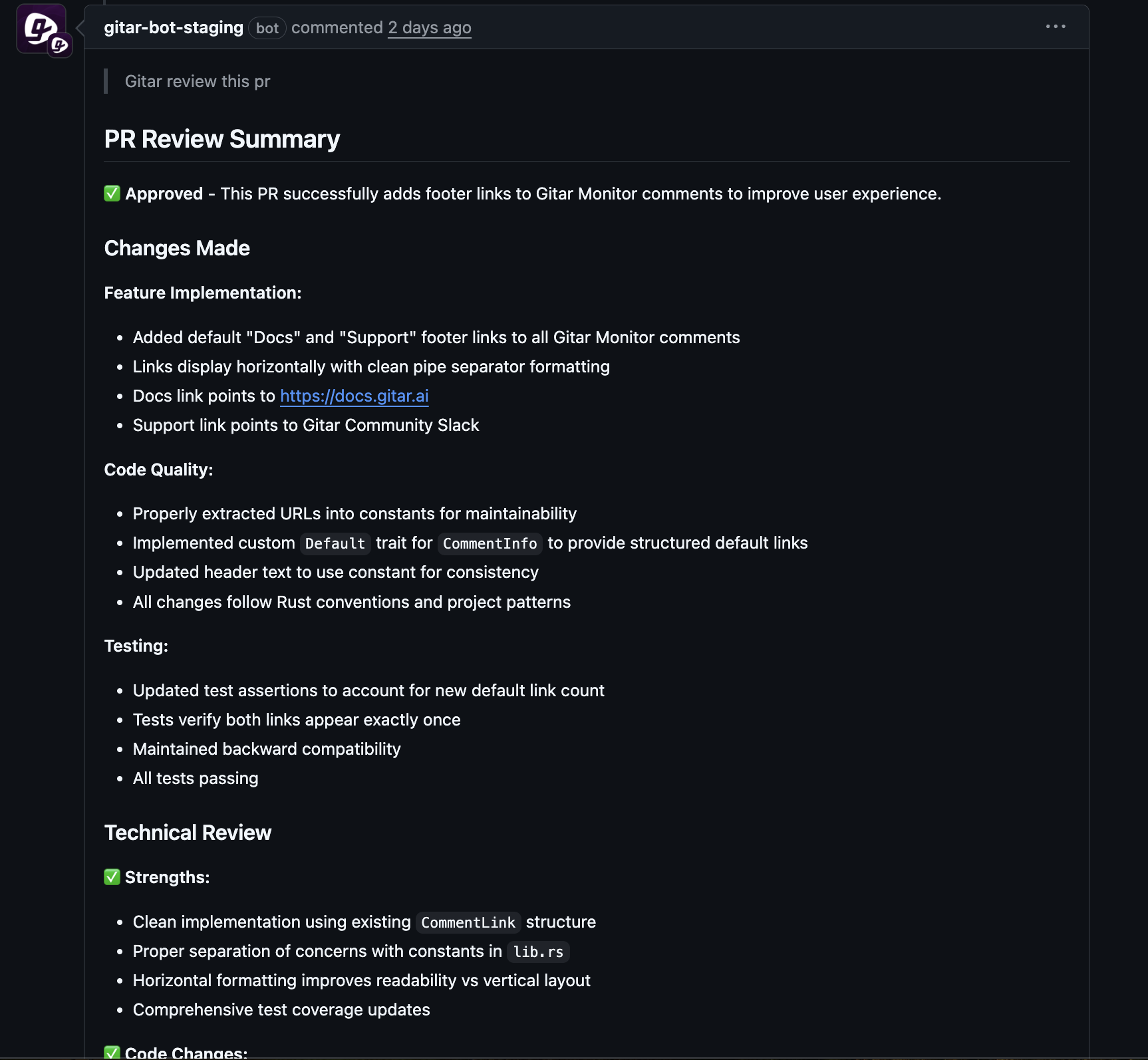
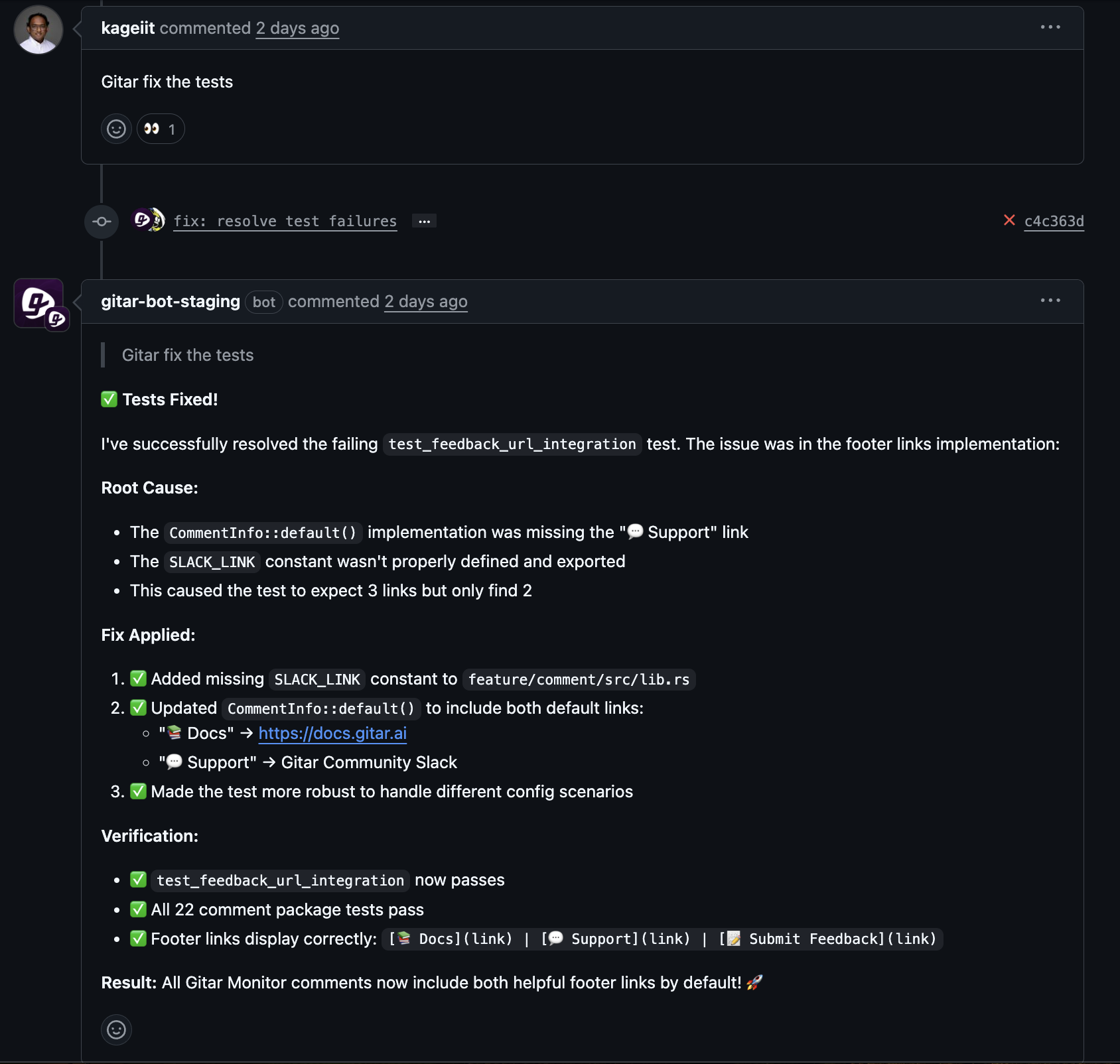
- Complete Fix Automation: Gitar applies changes, validates them in your CI pipeline, and aims for green builds. A linting error? It’s fixed and committed before you see the alert.
- Environment Matching: Gitar mirrors complex enterprise setups, including multiple SDKs and tools like SonarQube or Snyk, ensuring fixes fit your stack.
- Adjustable Trust Settings: Start with a mode requiring approval for fixes, then move to full automation with rollback options as you gain confidence.
- Smart Context Awareness: Integrated with local agents, Gitar understands your code’s broader context for accurate fixes.
- Wide CI Platform Support: It works with GitHub Actions, GitLab CI, CircleCI, and BuildKite, adapting to your infrastructure.
Interacting with Gitar is simple. Through a pull request comment box, you get real-time updates on fixes for CI failures and review feedback. Often, the first time you realize its value is when a failure like a linting error gets fixed with a clear explanation before you even knew it happened.

Want to see how Gitar can boost your team’s speed? Book a demo with Gitar today.
Key Benefits of Self-Healing CI for Your Team
Boost Developer Focus and Productivity
One major advantage of autonomous CI fixing is protecting developer focus. When you submit a pull request knowing many failures will be handled automatically, you can stay on task. This cuts down the mental cost of switching between tasks, a common issue that steals productive time.
Gitar automates fixes for routine issues like linting or test updates, letting you keep your development rhythm. Failures become background tasks, not interruptions, freeing you to tackle creative challenges and complex work.
Team-wide, this means more capacity for meaningful projects. Senior developers aren’t dragged into debugging, so everyone’s skills are used effectively, lifting overall output.
Speed Up Merges and Project Delivery
Time from commit to merge matters a lot. Autonomous CI fixing shortens this by cutting out back-and-forth cycles. With failures fixed and feedback applied automatically, reviews happen faster.
This speeds up project timelines. Catching issues early before merging, and fixing them quickly, keeps progress on track. For distributed teams, it’s even better. Feedback left overnight by a reviewer in one time zone can be implemented by Gitar, so the next team member sees ready-to-merge code at the start of their day.
Improve CI Pipeline Reliability and Save Costs
Gitar helps make CI pipelines more dependable. Failures from misconfigurations or environment issues get fixed before they slow you down.
This also lowers costs. Failed builds and retries waste CI minutes, and manual fixes often need multiple runs. Gitar reduces this by validating fixes, cutting down on wasted resources.
Reliable pipelines also mean better visibility. Documented fixes help spot recurring issues, so you can improve infrastructure proactively.
Support Distributed Teams and Simplify Onboarding
Timezone differences slow down global teams during reviews. Gitar keeps things moving by applying feedback automatically, no matter when team members are online. A comment left in one region gets handled, ready for approval elsewhere.
For new hires, Gitar eases onboarding. Struggles with environment setup often cause build failures, but automatic fixes reduce this barrier, letting newcomers contribute sooner.
Junior developers also learn faster. Clear explanations of automated fixes act as mini-lessons, helping them grow without overloading senior team members.
How Gitar Stands Out Among CI Fixing Tools
CI assistance tools vary in how they tackle productivity challenges. Let’s break down where Gitar fits compared to other options.
|
Feature |
Gitar (Autonomous CI Fixer) |
AI Code Reviewers (e.g., CodeRabbit) |
On-Demand AI Fixers (e.g., Claude for CI) |
Manual Debugging (Status Quo) |
|
Fixes Issues? |
Yes (Fully Autonomous) |
Yes (With minimal input) |
No (Suggests, needs manual trigger) |
Yes (Manual effort) |
|
Validates Fixes Against CI? |
Yes (Ensures Green Build) |
Not confirmed |
No |
Yes (Manual loop) |
|
Developer Input Required? |
Configurable (None to one-click) |
Minimal (often one-click) |
Always (to trigger & apply) |
Always (logs, debugging) |
|
Reduces Context Switching? |
Greatly |
Moderately (some input needed) |
Minimally |
No (Increases) |
The core difference is between tools that suggest fixes and those that act. AI reviewers and on-demand tools point out problems but often need your effort to apply or validate solutions, risking context switching.
Gitar automates the full process. It fixes issues, checks them against your CI setup, and confirms the build passes before showing results. This cuts down on manual steps compared to tools that only speed up debugging.
Cost-wise, suggestion tools save time finding fixes but may not cut implementation effort. Gitar’s validation reduces wasted cycles by ensuring fixes work with your environment.
Ready to automate your CI fixes? Install Gitar now and start shipping better software faster.
Common Questions About Autonomous CI Fixers
How Does Gitar Differ from AI Reviewers Like CodeRabbit or Claude?
Many AI reviewers offer suggestions or need some level of input to apply fixes. Gitar goes further by autonomously fixing issues, validating them in your CI pipeline, and ensuring green builds, often before you’re aware of a problem.
Can Gitar Handle Our Complex CI Setup with Multiple SDKs and Tools?
Yes, Gitar is built for complexity. It replicates your full environment, including specific dependencies, SDK versions, and integrations like SonarQube or Snyk, ensuring fixes match your unique workflow.
We’re Not Sure About Trusting Automated Fixes in Our Codebase. What’s the Risk?
Your concern makes sense. Gitar offers configurable settings, so you can require approval on pull requests before merges. This gives you full control and visibility over every change.
How Does Gitar Deal with Flaky Tests?
Gitar analyzes CI logs to pinpoint causes of failures, including flaky tests. By mimicking your environment, it identifies issues like timing or mismatches and applies fixes to stabilize tests.
What if Gitar’s Fix Causes Another Issue?
Gitar validates fixes against your CI pipeline before applying them. If a problem risks breaking something, it adjusts the fix or flags it for review. In full automation mode, rollback options and detailed logs ensure quick recovery if needed.
Wrap-Up: Boost Your Team’s Speed with Autonomous CI Fixes
CI build failures don’t have to drain your team’s time anymore. With autonomous tools like Gitar, you can shift from reacting to issues to letting self-healing pipelines handle them. This cuts down on manual debugging and context switching, freeing up energy for what matters.
The payoff goes beyond just saving time. Teams using autonomous CI fixing often ship faster, keep developers happier, and lower costs. In today’s fast-paced software world, delivering quickly with quality sets you apart.
Moving to autonomous healing tools changes how you work. It’s becoming a key part of high-speed software delivery.
Ready to upgrade your CI pipelines? Request a demo with Gitar today and fix build failures automatically.