
CI pipeline failures disrupt every software engineer’s workflow. You submit a pull request, only to find the build failing over a small error like a missing semicolon or a flaky test timeout. A quick fix turns into an hour of digging through logs and multiple commits. For a team of 20 developers, this inefficiency can cost $1 million in productivity each year. Gitar, an autonomous AI agent, offers a solution by creating self-healing CI/CD pipelines that address issues instantly, reduce time-to-merge, and keep developers focused on coding.
Why Traditional CI/CD Tools Slow Down Developers
Context Switching Costs Time and Money
Constant interruptions break a developer’s focus. You’re working on a complex feature when a notification pops up about a failed CI build. Suddenly, you shift from solving problems to debugging logs, figuring out why a test failed in CI but passed locally. This switch is costly. For a 20-person team losing one hour daily to CI issues, at $200 per hour, that’s $1 million lost annually. On top of that, it takes about 23 minutes to refocus after each interruption, turning a short fix into a major time sink.
Common CI Failures Waste Valuable Hours
CI failures often follow familiar patterns that eat up debugging time. Issues like flaky tests, build errors, deployment glitches, dependency mismatches, and configuration problems are frequent culprits. Flaky tests, which pass or fail unpredictably without code changes, undermine confidence in testing and demand extra effort to resolve.
Build errors often arise from differences between local and CI environments, such as using Node.js 18 locally but Node.js 16 in CI. Manually diagnosing these issues through logs and local testing pulls developers away from core work. Configuration mistakes in YAML files or dependency conflicts also stall pipelines, requiring significant effort for problems that are simple once identified.
CI/CD Becomes a Bottleneck as Code Generation Speeds Up
AI tools like GitHub Copilot have accelerated code creation, but this speed exposes a new issue. Faster coding means more pull requests and tests, increasing the chance of CI failures. The focus has shifted from writing code quickly to validating and merging it efficiently. A slow CI/CD pipeline now directly affects a team’s ability to deliver on time and stay competitive.
Time Zone Delays Slow Down Distributed Teams
Remote teams face extra hurdles with CI and code reviews. A developer in San Francisco submits a PR late in the day, needing feedback from a teammate in Bangalore. By the time feedback arrives, the original developer is offline, stretching a short review into days. Even with AI tools offering suggestions, manual fixes and validation still delay progress across time zones, adding unnecessary cycles to the process.
Constant Interruptions Harm Developer Morale
Beyond lost time, CI failures take a toll on mental well-being. Ongoing CI issues lead to frustration and lower job satisfaction among developers. Pushing code becomes stressful when it often means another round of tedious fixes. Many of these tasks feel repetitive and automate-able, leaving skilled engineers stuck on uninspiring work instead of meaningful projects, raising turnover risks.
Want to stop these productivity drains? Install Gitar to fix broken builds automatically and ship quality software faster.
Meet Gitar: Autonomous AI for Self-Healing CI
Gitar changes the CI/CD game by moving from reactive troubleshooting to automatic resolution. Unlike other AI tools that only suggest fixes, Gitar detects issues, creates solutions, applies them, validates against your full CI pipeline, and commits changes without breaking your workflow.
Here’s what Gitar brings to your team:
- Complete issue resolution by applying and validating fixes, ensuring builds stay green without manual effort.
- Accurate replication of complex environments, matching specific JDK versions, multi-SDK setups, and scans like SonarQube.
- Smart handling of reviewer feedback, applying changes independently across time zones.
- Flexible trust settings, from cautious suggestions to full auto-commits, adapting to your team’s comfort level.
- Compatibility with GitHub Actions, GitLab CI, CircleCI, BuildKite, and other platforms.

See fixes in action. Request a Gitar demo today.
How Gitar Improves CI/CD Operations
Pinpoint Issues Instantly for Quicker Fixes
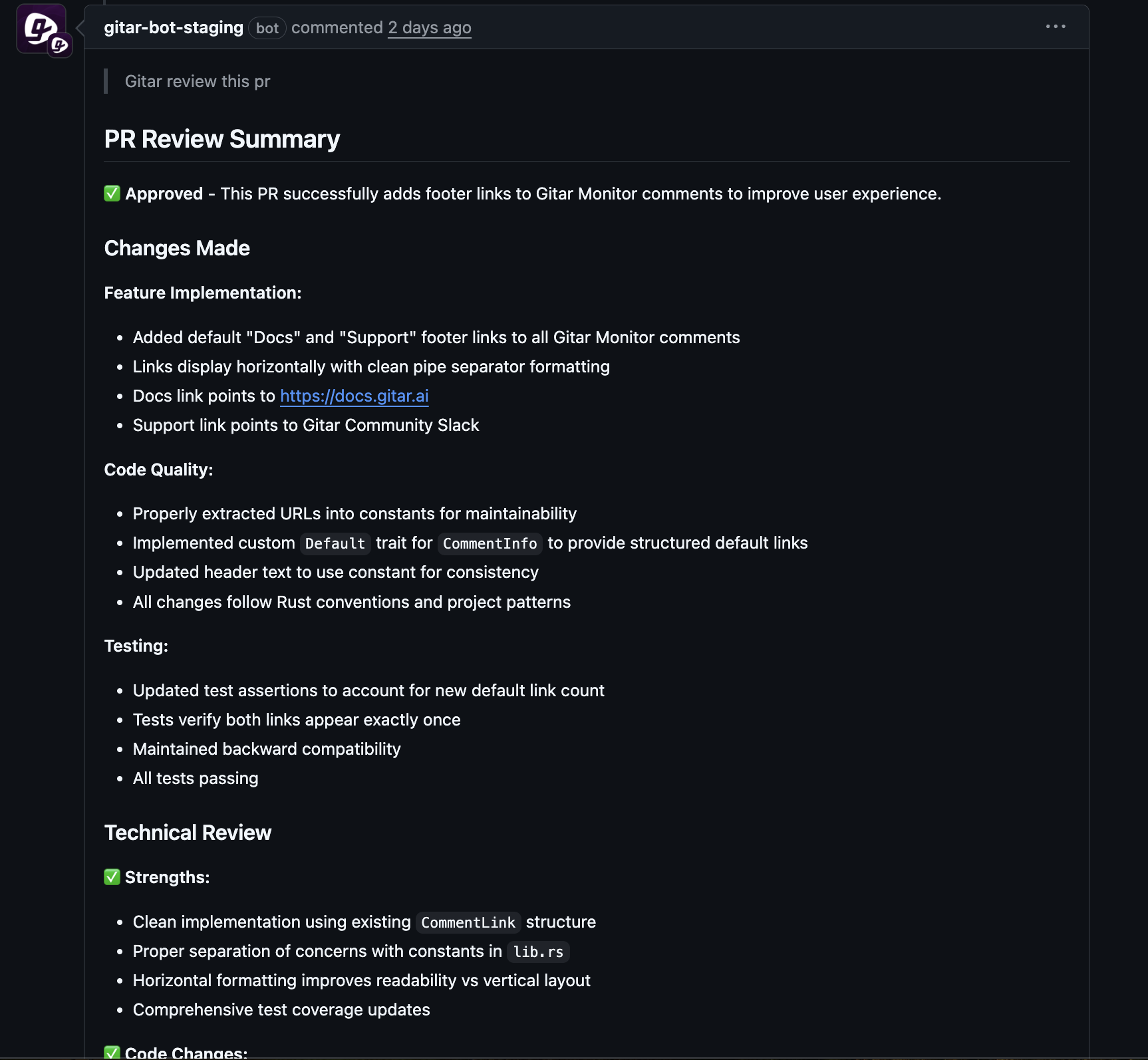
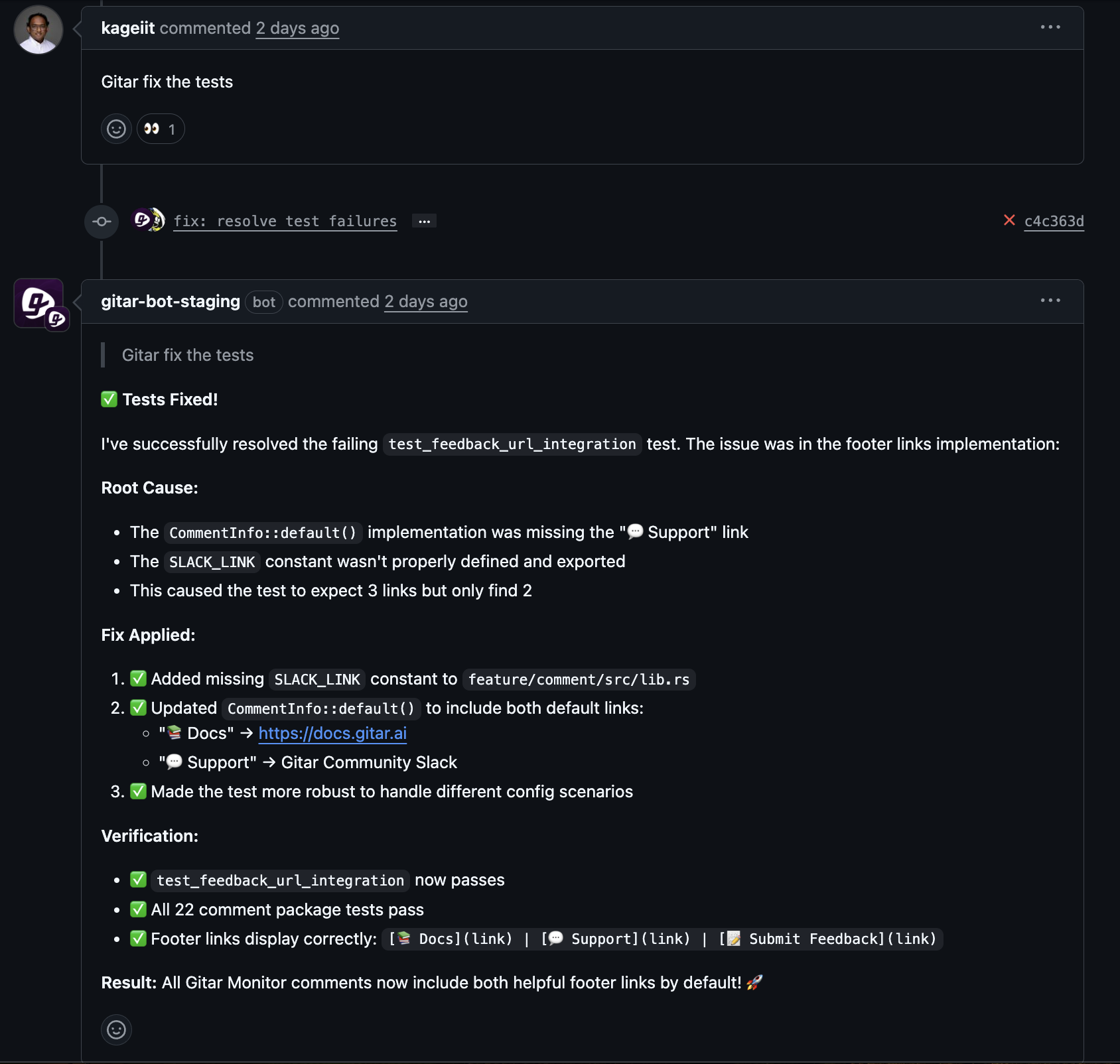
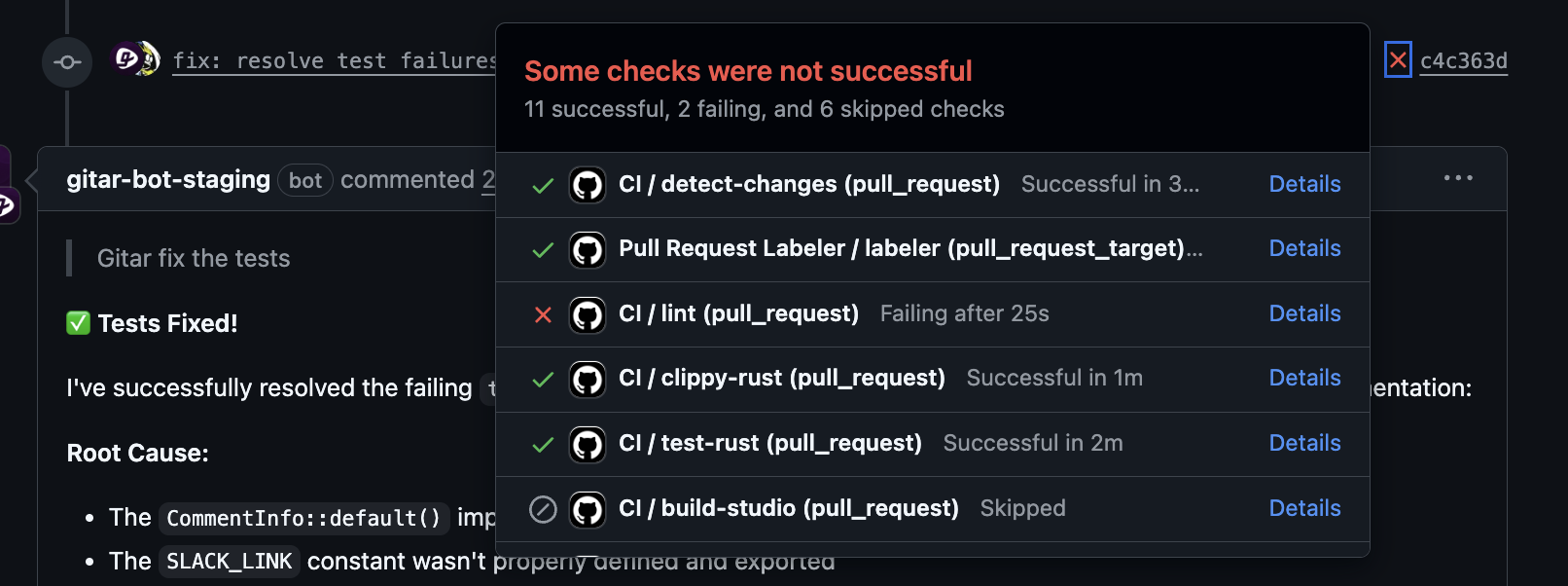
Gitar excels at spotting and solving CI problems fast. It scans failure logs, identifies the root cause, crafts a fix, applies it, and commits the change to your PR branch. This works for common issues like linting errors, test failures, and build problems tied to dependencies or scripts. Developers no longer waste time decoding vague error messages. Gitar handles it immediately, resolving style issues or broken tests in moments.
Eliminate Context Switching to Maintain Focus
Gitar’s biggest impact is keeping developers in their flow. When a CI failure happens, Gitar steps in to analyze, fix, and validate the solution against the full pipeline, often before you’re even aware of the issue. Imagine pushing a commit with a small linting error, continuing your work, and later finding the PR green with the fix already applied. No interruption, no wasted time. This saves the 30 to 60 minutes typically lost to context switching, letting you focus on creative tasks instead of routine debugging.
Cut Time-to-Merge from Hours to Minutes
Fixing CI failures manually takes too long: get notified, check logs, replicate the issue, apply a fix, commit, and wait for the pipeline to run again. Multiple rounds often stretch this into hours. Gitar shortens the process to minutes by automating every step. For distributed teams, this speed is critical. Instead of waiting for developers to address feedback across time zones, Gitar applies changes instantly, letting reviewers approve PRs without delay.
Boost Productivity with Measurable Returns
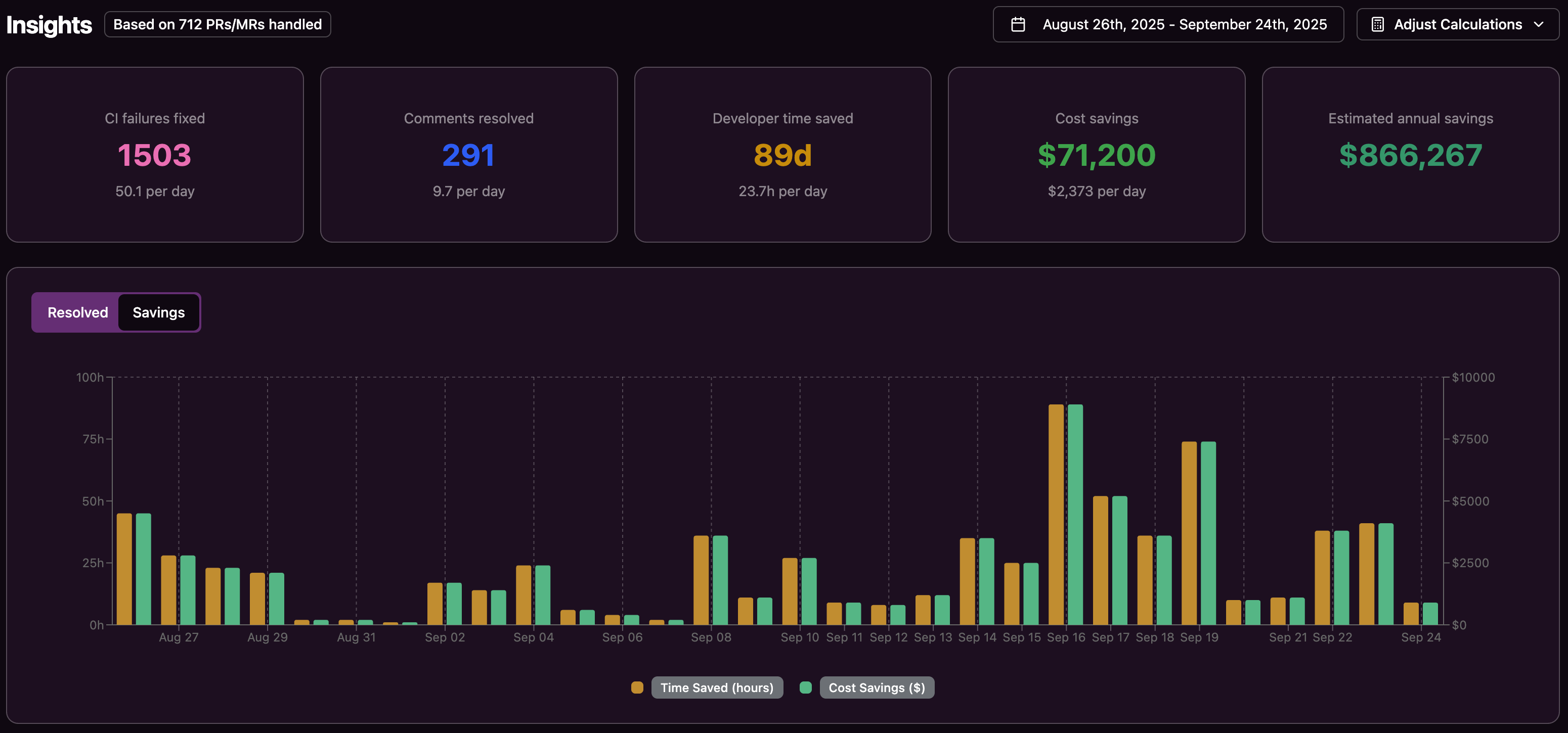
Automating CI fixes delivers clear financial benefits. For a 20-developer team, saving one hour daily on CI issues translates to $1 million in annual productivity gains. But the value goes further:
|
Feature |
Gitar (Autonomous Fixes) |
Traditional AI (Suggestions) |
|
Response to Failure |
Applies and Validates Fixes |
Suggests Fixes for Manual Action |
|
Context Switching |
Fully Eliminated |
Reduced but Still Present |
|
Time-to-Merge |
Significantly Faster |
Somewhat Faster |
|
Trust Options |
Adjustable from Suggestions to Auto-Commits |
Suggestions Only |
Beyond time savings, Gitar improves morale by freeing developers from repetitive tasks, reducing turnover costs. Faster merges also mean quicker deployments, enhancing customer satisfaction and market position.
Ready to upgrade your CI/CD process? Install Gitar to fix builds automatically and deliver quality software faster.
Answers to Common Questions About Self-Healing CI
How Does Gitar Manage Complex CI Setups?
Gitar handles intricate enterprise environments by mirroring your exact CI workflow. Whether your pipeline uses specific JDK versions, multiple SDKs, or tools like SonarQube, Gitar tests fixes in an identical setup. This ensures solutions fit your full system, including dependency and security requirements, minimizing the risk of new issues from mismatched conditions.
What If I’m Not Ready for AI to Commit Fixes?
Trust matters when automating processes. Gitar offers adjustable settings to ease you in. Start with a conservative mode where it suggests fixes as comments for your review and approval with a single click. As you see reliable results with fixes like linting or dependency updates, you can switch to a mode where Gitar commits directly, always with rollback options. This lets teams balance automation and control based on their needs.
How Does Gitar Fit Into Existing CI/CD Tools?
Gitar works as a GitHub App, integrating with minimal setup into platforms like GitHub Actions, GitLab CI, CircleCI, and BuildKite. It doesn’t alter your current pipelines or scripts. In under 10 minutes, it’s ready to monitor failures and act when needed, respecting your security policies and approval rules. It also updates PR comments with real-time status, keeping everyone informed.
How Is Gitar Different from Tools Like Copilot?
Gitar stands out as a healing tool, not just a suggestion provider. While GitHub Copilot speeds up coding before commits and tools like CodeRabbit offer review feedback, they leave fixes and validation to developers. Gitar steps in after commits,automatically resolving CI issues and ensuring changes pass your pipeline. It complements other AI tools by focusing on the merge-blocking phase they don’t cover.
Regain Focus with Gitar’s Self-Healing CI
Manual CI debugging no longer fits the pace of modern software demands. As teams push to deliver faster with high quality, relying on human effort for routine fixes creates a costly bottleneck, draining time and satisfaction. Gitar’s autonomous approach lets CI pipelines fix themselves, keeps developers focused, and speeds up feature delivery.
By removing the constant interruptions of traditional workflows, Gitar doesn’t just save hours. It changes how developers work, making development more creative and focused. Teams adopting self-healing CI gain an edge, delivering updates quicker while maintaining code quality and morale.
Ready to solve CI failures and support your developers? Integrate Gitar for automatic issue fixes now. Request a demo to see autonomous software delivery in action.