
CI build failures can halt progress for any engineering team. A critical feature, ready to ship, often gets delayed by a failing pipeline, costing time and money. In this article, we’ll uncover the real impact of manual CI issue resolution and show how automated fixes can help. We’ll focus on Gitar, an AI-powered tool that resolves these issues automatically, saving hours of debugging and getting your code to production faster.
Why Manual CI Fixes Hurt Your Team
Disrupting Developer Focus with Constant Interruptions
Developers often push a pull request (PR) expecting a smooth process, only to face a wall of CI errors. What should be a quick deployment turns into a tedious loop of reading logs, switching to local setups, making changes, committing, pushing, and waiting for the pipeline to rerun. This cycle eats up valuable time, turning a small fix into a major distraction.
After submitting a PR, developers typically move to other tasks, but CI failures or feedback pull them back. This constant switching between tasks breaks concentration and slows down meaningful work. A 30-minute fix can easily stretch into an hour when you account for the mental effort of refocusing.
For distributed teams, the problem worsens. A developer in California waiting on feedback from a teammate in India might face delays of 12 hours or more due to time zones. Standard AI tools that only offer suggestions don’t solve this, as they still require manual effort to apply and test fixes.
Slowing Down Projects and Increasing Costs for Leaders
CI failures delay projects for many organizations, pushing back launch dates and impacting revenue. These setbacks affect more than just the engineering team, causing late feature releases, missed market chances, and reduced customer confidence due to unreliable timelines.
The financial toll adds up quickly. For a team of 20 developers spending one hour daily on CI and review issues, the yearly cost of lost productivity nears $1 million, based on a $200 hourly rate over 250 working days. Even cautious estimates show CI inefficiencies taking up a large chunk of development time, draining budgets significantly.
These delays ripple through future projects, affecting planning and resource use. Engineering leaders must juggle the need to deliver features quickly with maintaining code quality and system stability over time.
Complex CI/CD Pipelines Challenge DevOps Teams
DevOps and platform engineers manage complicated CI/CD pipelines with multiple SDK versions, varied dependencies, and integrations with tools like SonarQube and Snyk. Keeping these enterprise systems running smoothly demands constant attention and deep knowledge.
Onboarding new team members adds another layer of difficulty. They need to learn intricate setups and configurations before contributing effectively. This slows down team expansion and project timelines, especially in fast-growing companies.
Existing programming tools and languages often don’t align well with AI agents, needing specialized systems for effective debugging and iterative development. This mismatch creates extra hurdles for platform teams trying to adopt automated solutions within their workflows.
More Code, More Failures: A Growing Bottleneck
Tools like GitHub Copilot speed up code writing but create a new problem: more pull requests, more tests, and more chances for CI failures. The challenge has shifted from writing code to validating and merging it efficiently.
This shift moves the bottleneck from creation to validation. Developers produce features faster, but traditional CI and review processes can’t keep up. The result is a backlog of PRs waiting for approval and deployment, making automated CI fixes a critical need.
Ready to stop CI failures from slowing you down? Install Gitar now to automate fixes for broken builds.
How Gitar Solves CI Failures with Automated Fixes
Gitar changes the game by acting as an automated fixer, not just a tool that points out issues. It identifies CI failures, figures out the cause, and applies tested solutions without needing developer input, turning frustrating manual work into a hands-off process.
Here’s what sets Gitar apart:
- Complete Automation: Detects, diagnoses, and fixes CI issues without any manual steps.
- Enterprise Environment Handling: Works with complex setups, including multiple SDKs and tools like SonarQube and Snyk.
- Flexible Control Options: Teams can choose between reviewing suggestions or allowing fully automatic commits with rollback options.
- No Interruptions: Keeps developers focused by handling fixes in the background.
- Wide Compatibility: Works with GitHub Actions, GitLab CI, CircleCI, BuildKite, and other platforms.

Want to see automated CI fixes in action? Install Gitar now to start fixing builds automatically.
Seeing Gitar Work: Fixing CI Issues Without Effort
Turning Failures to Success: Gitar’s Process
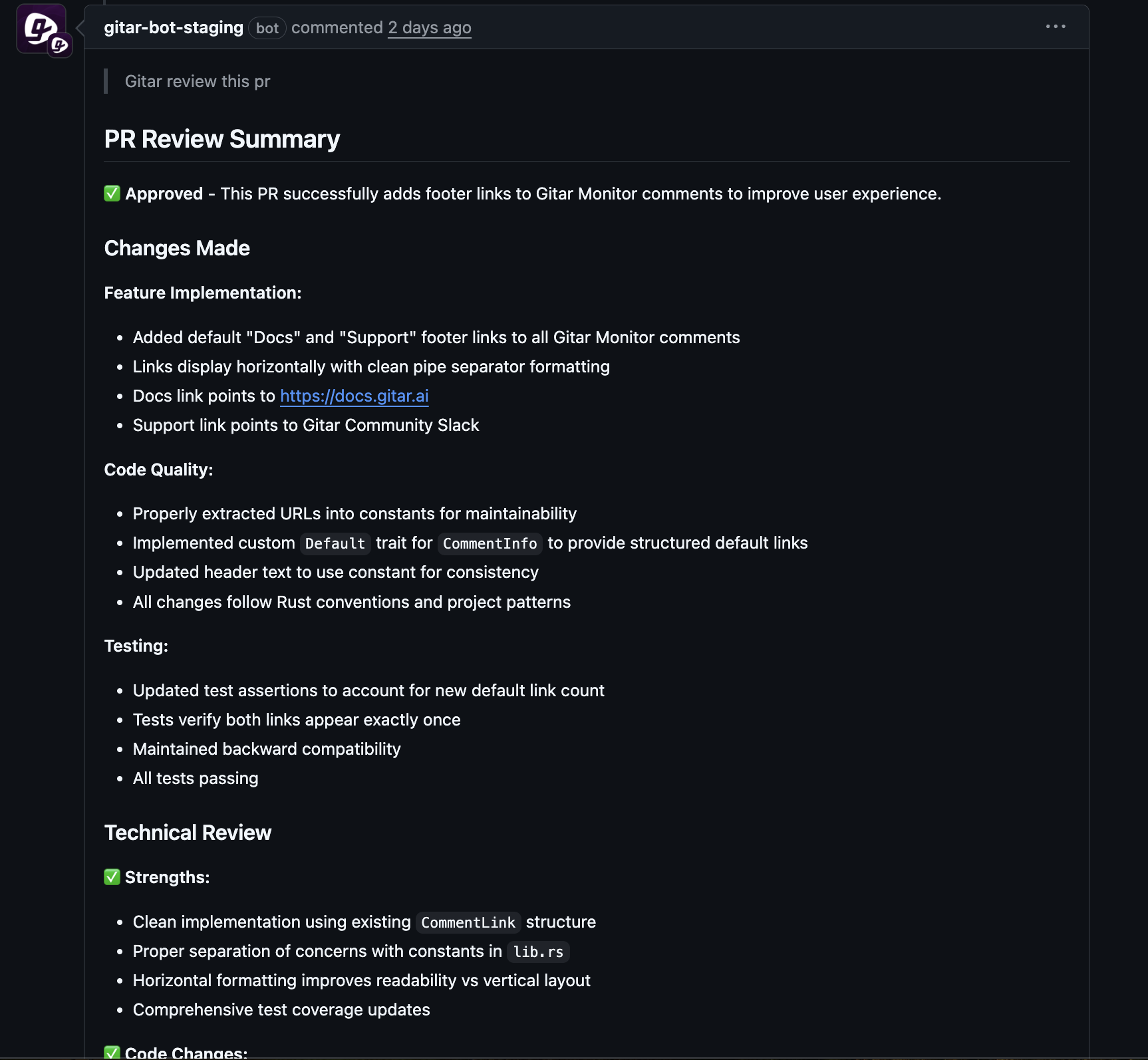
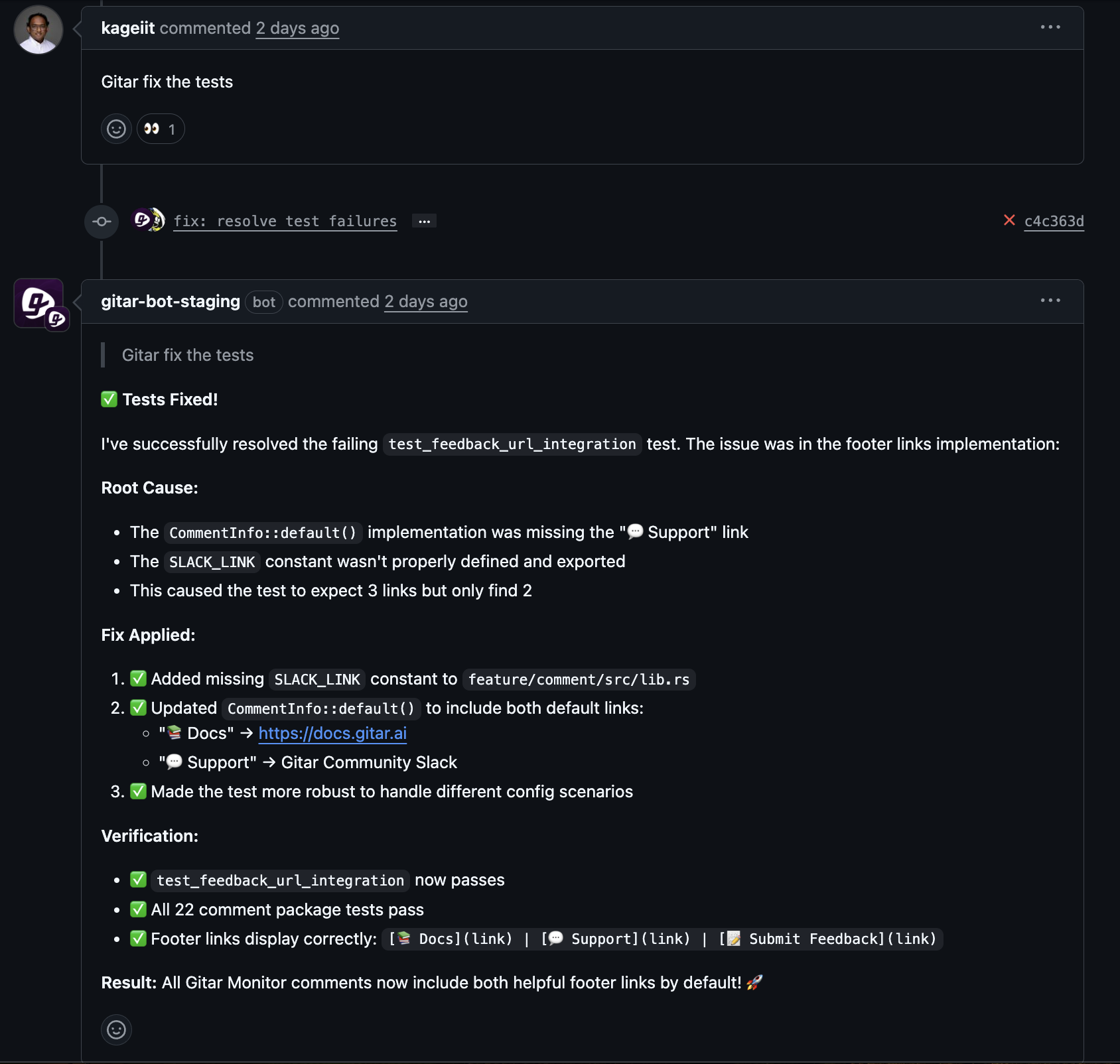
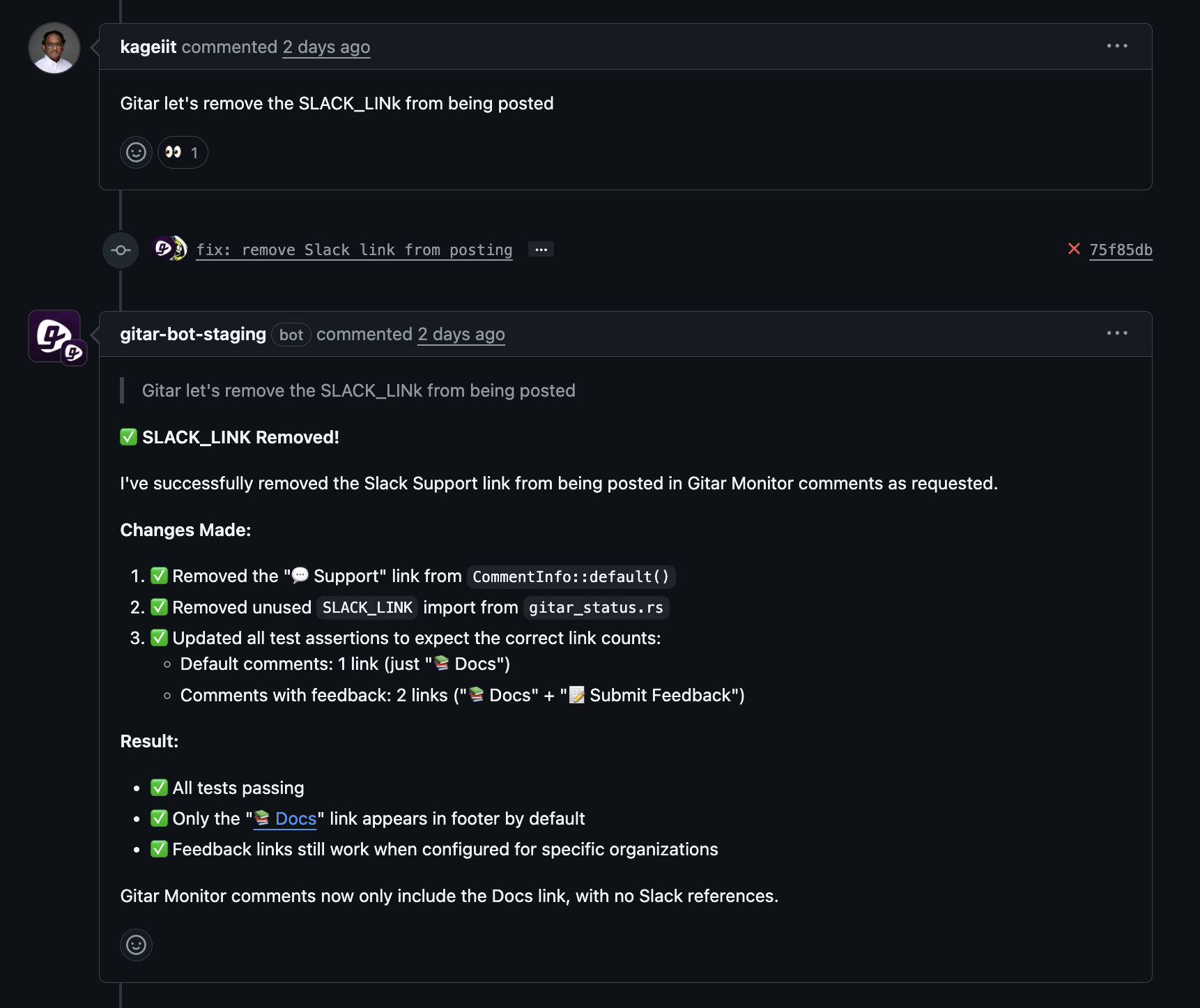
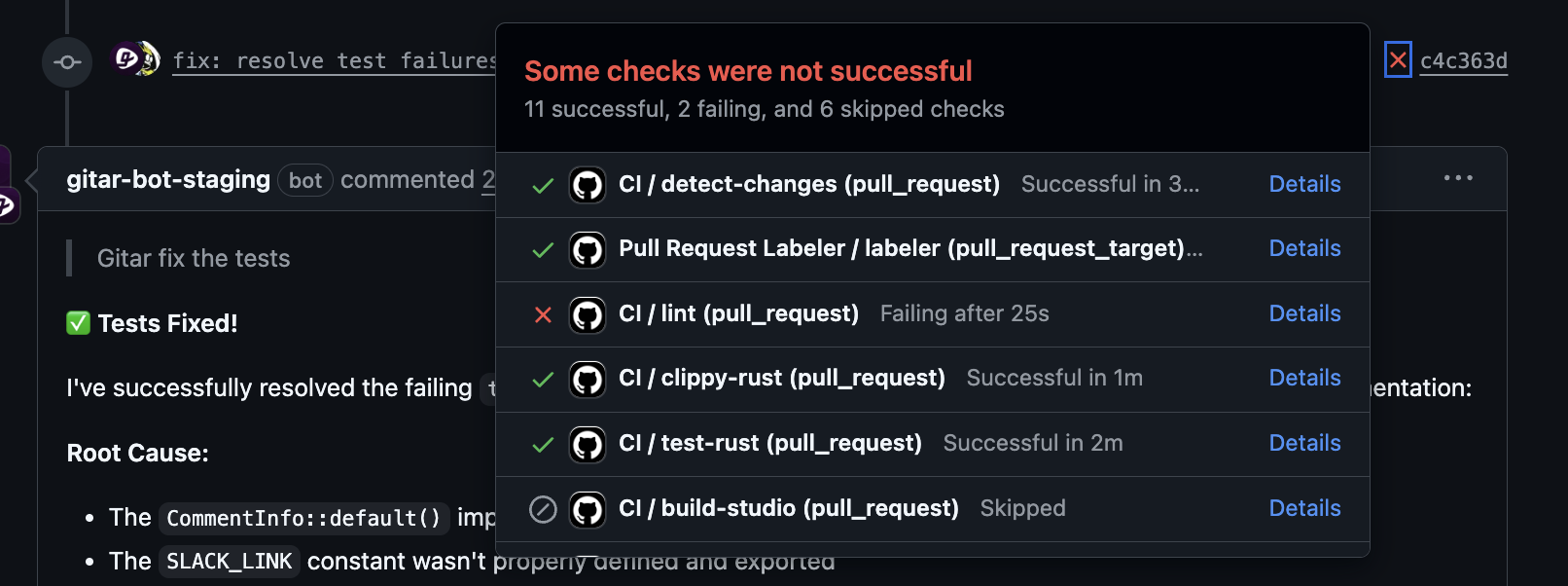
Picture this: a developer submits a PR, a linting error causes a CI failure, and before they even check the status, Gitar has analyzed the issue, applied a fix, and committed the change with a clear note explaining what was done. It’s a game-changer.
This all happens behind the scenes. Whether it’s a linting error, a failing test, or a build script issue, Gitar jumps in right away. It reviews logs, identifies the root cause, makes the necessary changes, and updates the branch with the fix.
Developers simply submit their PRs and come back to see a passing build with notes on the fixes. There’s no need to debug manually or lose focus, just a smooth path from submission to merge readiness.
Accurate Fixes with Full Environment Understanding
Gitar stands out by mirroring your exact enterprise setup. Other tools might suggest generic fixes that don’t fit your specific context, but Gitar accounts for unique SDK versions, dependencies, and integrations with tools like SonarQube. It ensures every fix works in your actual CI pipeline.
Each fix gets tested against your full workflow before it’s applied, avoiding the guesswork common with manual fixes or basic AI suggestions. Unlike tools that leave validation to developers, Gitar manages the entire process from spotting the issue to confirming the solution.
Faster Merges and Happier Developers
Automated fixes with Gitar directly improve merge times and team morale. By removing manual debugging, it cuts down the wait between submitting code and getting it merge-ready. PRs that once needed several rounds of fixes now pass more quickly.
The impact on developers is just as important. Eliminating repetitive debugging tasks lets them focus on meaningful work. Instead of dreading CI failures, teams gain confidence in a pipeline that fixes itself, keeping their momentum strong.
For distributed teams, this means even more. Time zone delays that stretched fixes over days now shrink to instant solutions, supporting continuous progress no matter where team members are located.
Clear ROI for Engineering Leaders
The numbers speak for themselves when you look at automated CI fixes across a team. A group of 20 developers spending one hour daily on CI issues wastes 5,000 hours yearly. That’s time that could go to building new features.
At $200 per hour, this equals $1 million in lost productivity each year, not counting delays in releases or competitive setbacks. Even if automation resolves half these issues, that’s $500,000 in savings, plus better team morale and lower turnover.
Time from first commit to merge, a key measure of speed, improves with automated fixes. Gitar’s immediate solutions help get features and updates merged faster.
How Gitar Outperforms Manual and Suggestion-Based Tools
Side-by-Side Comparison of CI Fix Approaches
|
Feature / Tool |
Manual Debugging |
AI Suggestion Tools (e.g., CodeRabbit) |
Gitar: Automated CI Fixes |
|
Resolution Type |
Manual |
Suggestions Only |
Automatic Fixes & Validation |
|
Impact on Developer Focus |
High Disruption |
Moderate Disruption |
No Disruption |
|
Fix Validation |
Manual |
Developer Responsibility |
Automated & Confirmed |
|
Environment Context |
Human Effort |
Limited |
Full Replication |
Manual debugging requires developers to pause their work, investigate CI failures, apply changes, and test solutions through trial and error. It’s slow, inconsistent, and pulls focus away from other tasks.
AI suggestion tools, like CodeRabbit, offer helpful ideas for fixes but still need developers to apply and verify them. This reduces some workload but doesn’t eliminate the manual steps that interrupt productivity.
On-demand AI fixers, such as Claude-based GitHub Actions, need manual activation and often lack full context of your setup. They can help when triggered but usually require extra effort to fit into workflows and may be limited to certain platforms.
Gitar takes a different path by automating the entire process. It doesn’t just suggest fixes; it applies solutions that are tested for your specific CI environment, removing both the work and uncertainty of other methods.
Ready to move past suggestions to real automation? Install Gitar now to automate fixes for broken builds.
Common Questions About Automated CI Fixes with Gitar
How Does Gitar Manage Complex Enterprise CI Setups?
Gitar is built to handle intricate enterprise environments. It mirrors your full CI setup, including specific SDK versions, varied dependencies, and connections to tools like SonarQube and Snyk. This detailed understanding ensures fixes work specifically for your pipeline.
Can Gitar Be Set to Require Approval Before Applying Fixes?
Yes, Gitar offers flexible settings to build trust. Teams can start with a mode where it suggests fixes as comments for review and approval with a single click. As confidence grows with successful fixes, you can switch to full automation with rollback options.
How Does Gitar Keep CI Failures from Interrupting Work?
Gitar runs quietly in the background, watching for CI issues across your repositories. When a build fails, it analyzes the problem, creates a fix, and commits the change to the PR, often before the developer notices, preserving their focus.
Does Gitar Work with CI/CD Platforms Other Than GitHub Actions?
Yes, Gitar supports a wide range of tools. It integrates with GitHub and GitLab for version control and works with CI platforms like GitHub Actions, GitLab CI, CircleCI, and BuildKite, offering a consistent solution across setups.
What Kinds of CI Failures Can Gitar Fix Automatically?
Gitar tackles many common CI issues that waste developer time. It fixes linting and formatting errors by applying corrections, resolves test failures by updating snapshots or assertions, and handles build issues tied to dependencies or scripts.
Wrap-Up: Speed Up Development with Gitar’s Automated Fixes
CI build failures remain a major drag on productivity in software development. Manual debugging interrupts focus, delays delivery, and costs engineering teams heavily. Relying on human effort for CI issues doesn’t match the speed and scale needed today.
Automated CI fixes shift the approach from reacting to issues to preventing them. With solutions that work independently, teams can save thousands of hours yearly, merge code faster, and keep developers satisfied.
Gitar’s unique system automates the full process, applying and validating fixes in your specific environment. Unlike tools that only suggest solutions, Gitar ensures reliable outcomes without pulling developers away from their work.
The measurable gains, from significant productivity savings for mid-sized teams to quicker merges, make automated CI fixes a smart choice for improving development efficiency.
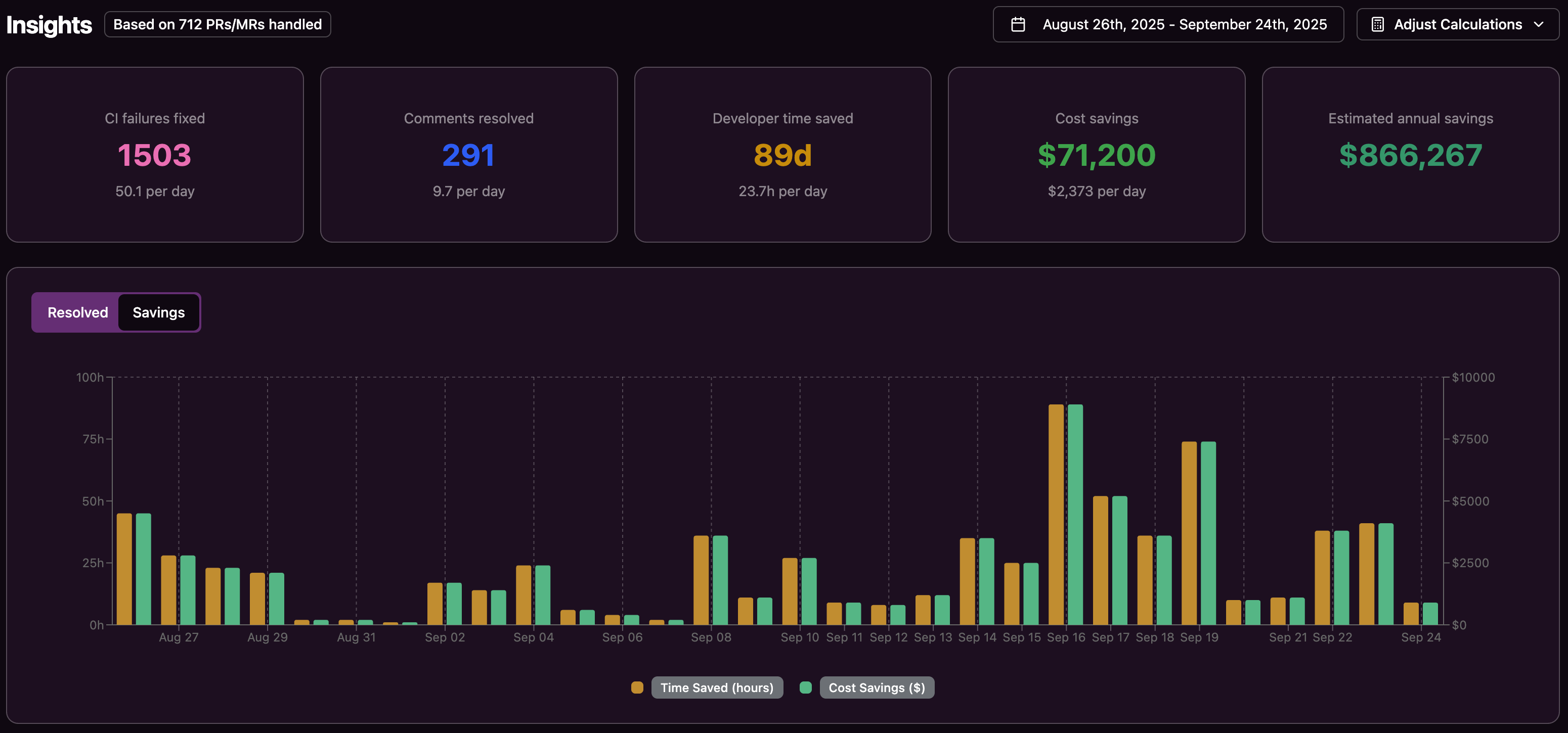
Stop losing hours to CI build failures. Upgrade your pipeline with reliable automated fixes. Install Gitar now to start automating broken builds.