
Last updated: February 3, 2026
Key Takeaways
- AI coding tools increase output 3-5x and create large PR backlogs because review capacity cannot keep up.
- Most free AI code review tools suggest changes that still require manual fixes and lack CI validation.
- Gitar focuses on automatic CI healing, validates fixes, and commits working changes directly to PRs across unlimited repos.
- Competitors like CodeRabbit and Qodo restrict free tiers to individuals and rely on manual implementation of suggestions.
- Teams blocked by CI failures should install Gitar now to repair broken builds automatically and ship faster.
How We Tested Free AI Code Review Tools
Our evaluation focused on capabilities that remove the post-AI coding bottleneck. We prioritized automatic fix application with CI validation, support for unlimited repositories, and native integration with GitHub, GitLab, and CircleCI. We also assessed single-comment consolidation versus notification overload and scalability for enterprise codebases above 50 million lines.
The analysis draws on 2026 GitHub benchmarks and hands-on testing with real CI failures. Each tool was measured on its ability to reach at least 80% automatic issue resolution without manual intervention.
#1 Gitar: Free AI Code Review With CI Healing
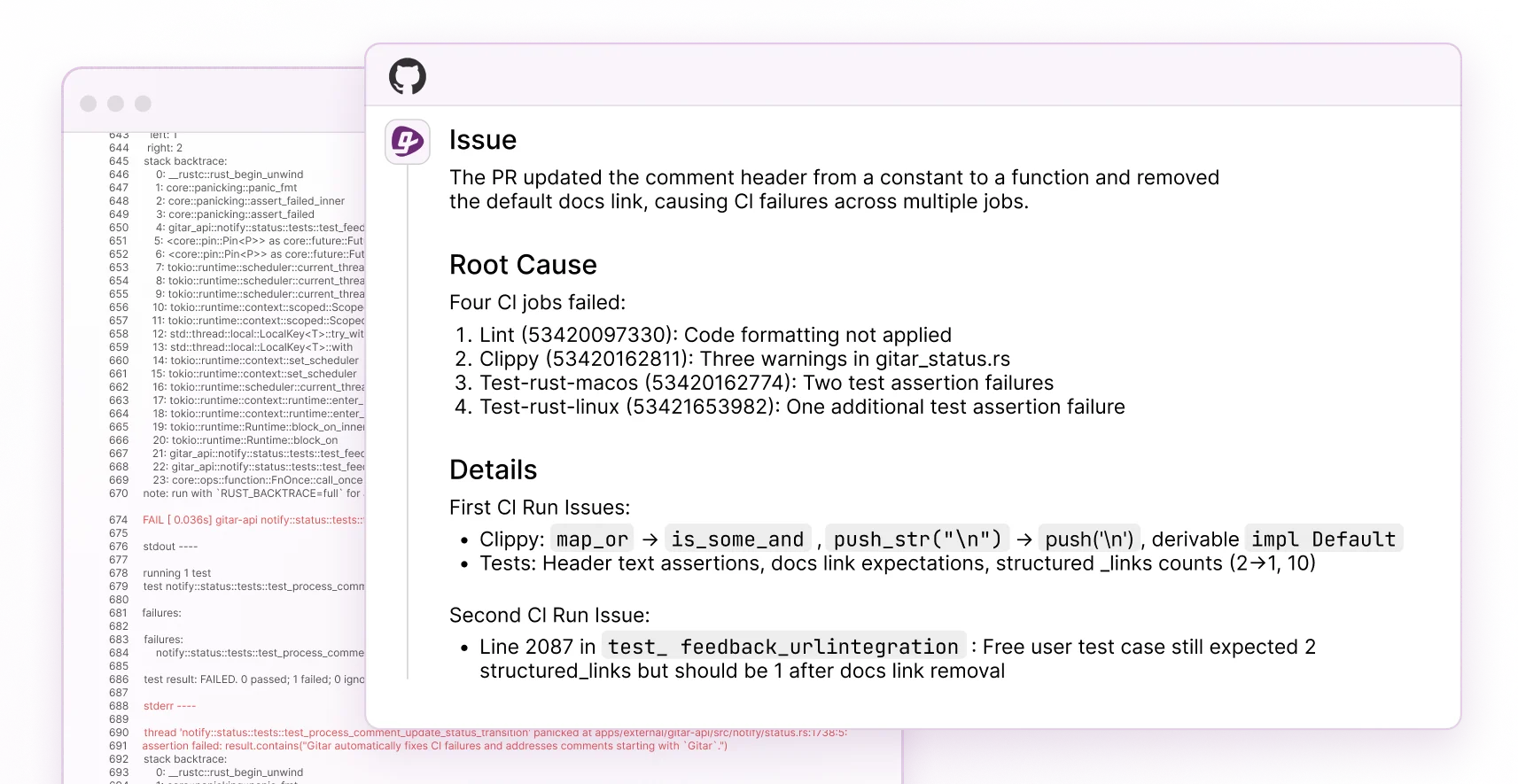
Gitar operates as a free AI code review platform that analyzes and fixes code issues automatically. When lint errors, test failures, or build breaks appear, Gitar reads failure logs, creates context-aware fixes, validates them in your CI environment, and commits working changes directly to your PR. Auto-fix capabilities are available through a 14-day free trial.
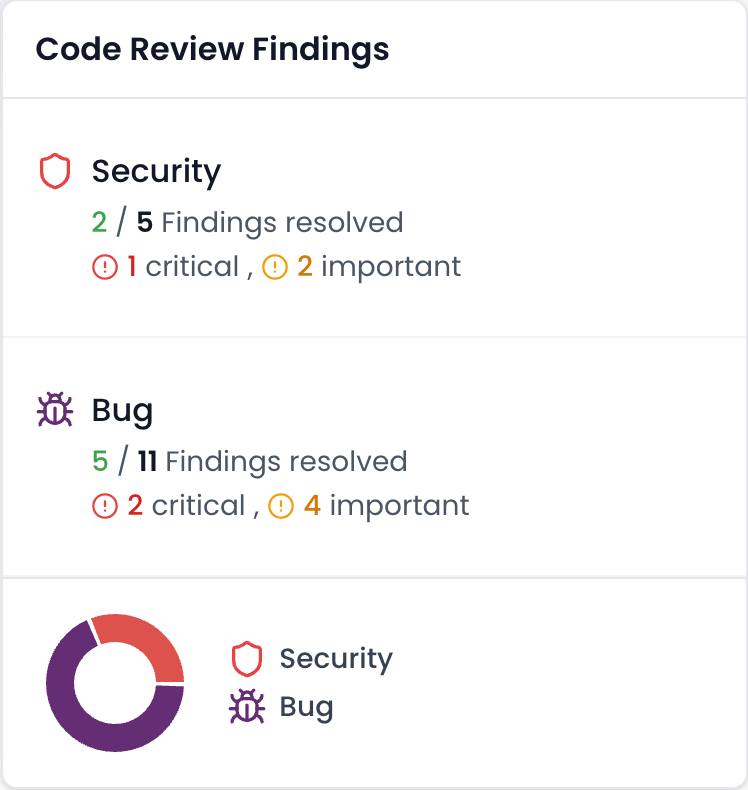
Key features include unlimited repositories with no seat limits and deep integration with GitHub, GitLab, CircleCI, and Buildkite. Gitar posts a single dashboard comment that updates in place, which prevents notification spam. The platform scales to codebases above 50 million lines and presents CI analysis, review feedback, and security findings in one clear interface that reduces cognitive load.
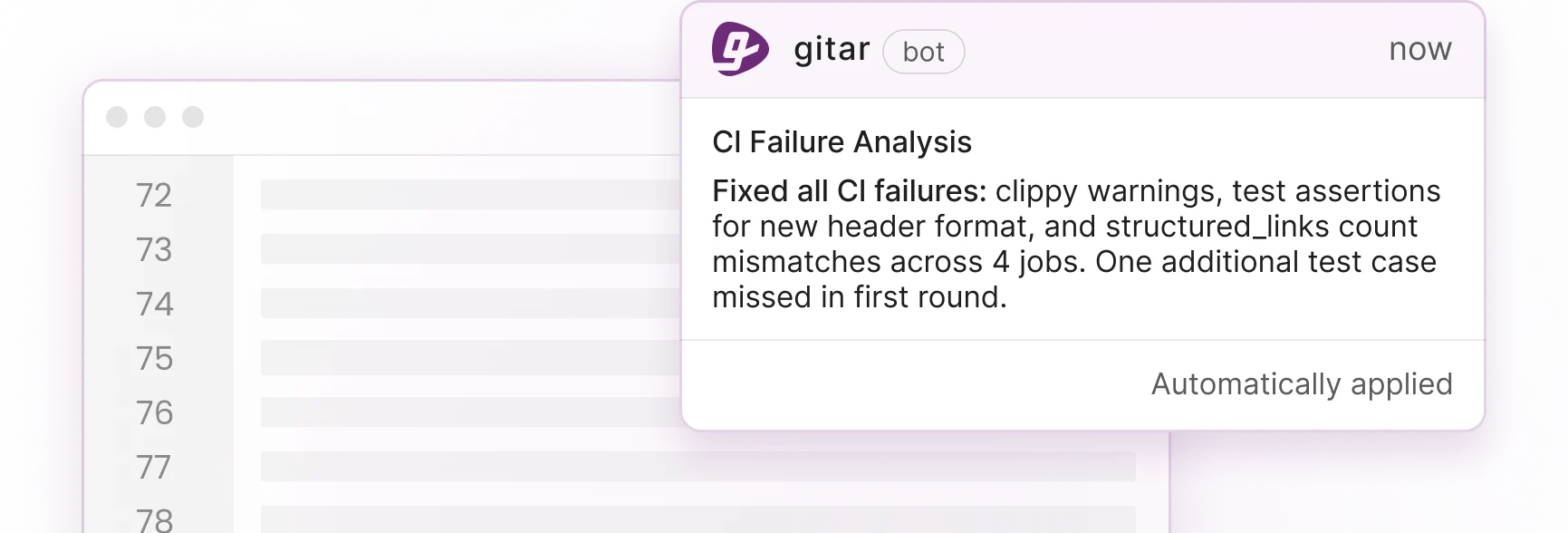
Hands-on testing showed that Gitar’s healing engine fixed lint failures and test breaks within minutes. Competing tools only suggested changes that engineers still had to apply manually. The single-comment workflow removed notification fatigue while preserving full visibility into fix progress.
Ideal for: AI-heavy development teams facing CI bottlenecks, engineering leaders tracking ROI from review automation, and platform teams that need cross-CI coverage without per-developer fees.
Install Gitar now to fix broken builds automatically and ship higher quality software faster.
#2 CodeRabbit: Strong Reviews With Manual Fix Steps
CodeRabbit offers limited free access for individual developers and open source projects, while teams move to paid plans starting at $15 per developer monthly. The platform delivers contextual PR analysis and can auto-fix smaller issues, but engineers must review and approve changes before they apply.
CodeRabbit produces high-quality contextual reviews with advanced learning features, yet it does not integrate deeply with CI for automatic failure repair. The tool posts inline suggestions across PR diffs without validating fixes against build pipelines, which leaves developers responsible for implementation and testing.
Testing confirmed that CodeRabbit identified issues accurately but required several manual steps to apply fixes. This behavior increased context switching instead of reducing it. Free tier limits also restrict adoption for teams beyond individual contributors.
Ideal for: Individual developers and open source maintainers who like suggestion-based workflows and do not need automatic CI healing.
#3 Qodo: Multi-Agent Reviews for Individual Users
Qodo provides free access for individuals and open source projects, with team plans at $15 per developer monthly. The platform includes multi-agent AI review features and test generation, with basic static analysis auto-fixes in the free tier and advanced features reserved for paid plans.
The tool performs well at spotting edge cases and generating broad test coverage, but advanced static analysis auto-fixes are available in paid tiers. Free users receive auto-fix suggestions and analysis, while full CI validation often requires an upgrade.
Our evaluation found Qodo useful for test-driven development workflows, yet it falls short for teams that need immediate CI failure resolution. Limits on advanced auto-fixing reduce its impact on the core bottleneck of manual fix work.
Ideal for: Individual developers focused on improving test coverage and open source projects that rely on manual review.
#4 Sourcery: IDE-First Fixes for Individual Developers
Sourcery offers free access for individual developers with instant fixes for security issues, logic errors, and code quality problems. The platform connects to GitHub and GitLab PRs and popular IDEs, giving real-time feedback during coding.
Sourcery can auto-fix some vulnerabilities across files, yet it behaves mainly as an IDE extension instead of a CI-integrated solution. The product targets code quality improvements and security patches and does not provide full CI failure analysis or automatic build healing.
Testing showed that Sourcery shines at preventing issues during active development rather than repairing failed CI pipelines. The free tier supports individual developers effectively, while enterprise plans add team-wide controls.
Ideal for: Individual developers who want proactive code quality and security improvements while they write code.
Install Gitar now to fix broken builds automatically and ship higher quality software faster.
#5 Open Source AI Code Review Options
Bugdar delivers free open-source AI code reviews for GitHub PRs using fine-tuned LLMs and RAG for contextual feedback. It supports Python, Rust, Solidity, and Move with low false positive rates, but it focuses on detection and analysis instead of automatic fix application.
SonarQube Community Edition offers broad static analysis with quality gates that can block risky PRs, yet it does not include AI-powered automatic fixing. These open source tools also demand significant setup and ongoing maintenance compared with managed platforms.
Our testing showed that open source tools work well for teams with strong DevOps capacity. They still fall short for organizations that need instant, zero-configuration CI healing.
Ideal for: Teams with mature DevOps practices that want customizable, self-hosted solutions and can live without automatic fixes.
Feature Comparison Table
|
Tool |
Auto-Apply Fixes |
CI Integration |
Free Unlimited Repos |
Single Comment |
|
Gitar |
Yes, validated + green guarantee |
Full CI healing |
Yes, unlimited |
Yes, consolidated dashboard |
|
CodeRabbit |
Manual approval required |
Limited |
Individual/OSS only |
No, inline comments |
|
Qodo |
Paid tier only |
Basic |
Individual/OSS only |
No, multiple notifications |
|
Sourcery |
IDE-focused fixes |
Limited |
Individual tier |
No, IDE-based |
Free Tier Tradeoffs and Cost Impact
The question “Can I use CodeRabbit for free?” highlights a core limitation of many AI code review tools. Several platforms provide free tiers for individual developers, while team usage usually requires subscriptions of $15 to $30 per developer each month. Most of these tools also stop at suggestions and skip CI validation, which leaves teams to implement and test fixes manually.
Real ROI from AI code review comes from automatic fix application with build validation. A 20-developer team that spends one hour each day on CI and review issues can lose roughly $1 million in productivity yearly. Tools that cut this friction by 50 percent create about $375,000 in annual savings, so free solutions that actually fix problems deliver far more value than paid suggestion-only engines.
Frequently Asked Questions
Which AI tool actually fixes code issues?
Gitar offers the most complete free code review experience with automatic code fixing through a 14-day free trial and CI validation. Gitar’s healing engine analyzes CI failures, generates validated fixes, and commits working changes directly to PRs. The platform handles lint errors, test failures, and build breaks automatically while supporting unlimited repositories without seat-based pricing.
Is there a free AI code reviewer that fixes problems?
Gitar provides free AI code review with automatic fix application available through a 14-day free trial for unlimited repositories. The platform validates fixes against your CI environment and commits working solutions, which goes beyond suggestion-only tools. Alternatives like CodeRabbit and Qodo include free tiers for individuals but still require manual fix work and paid plans for team features.
What are CodeRabbit’s free tier limits?
CodeRabbit’s free access covers individual developers and open source projects. Teams must purchase subscriptions starting at $15 per developer monthly. Even on paid plans, CodeRabbit focuses on suggestions that need manual review and approval instead of automatic fix application with CI validation, which adds workflow steps instead of removing them.
How effective is AI compared with human code review?
AI handles routine issues such as lint errors, security vulnerabilities, and test failures with more than 80 percent accuracy and processes them faster than human reviewers. AI still cannot replace human judgment for architecture, business logic, or complex design decisions. The strongest approach uses AI for automatic issue resolution and human reviewers for strategic changes.
Which tool works best with GitLab and CircleCI?
Gitar delivers the broadest cross-platform coverage, with native integrations for GitHub, GitLab, CircleCI, Buildkite, and other major CI systems. The healing engine behaves consistently across environments, while many competitors focus on GitHub and provide only limited CI integration.
Conclusion: Move From Suggestions to Automatic Healing
The 2026 development environment favors AI code review tools that fix issues instead of only flagging them. Suggestion-based platforms often charge premium prices while still relying on manual workflows, whereas Gitar delivers free code review with automatic CI healing that tackles the main bottleneck for AI-accelerated teams.
Organizations buried in PR backlogs and CI failures benefit most from tools that remove manual fix cycles. Gitar’s healing engine marks the shift from suggestion to solution and gives teams the automation required to match code generation speed with review capacity.
Install Gitar now to fix broken builds automatically and ship higher quality software faster.