Written by: Ali-Reza Adl-Tabatabai, Founder and CEO, Gitar | Last updated: February 11, 2026
Key Takeaways for Self-Healing CI in 2026
- AI coding tools have pushed GitHub activity to 82M monthly pushes, which creates CI/CD bottlenecks even with 3-5x faster coding.
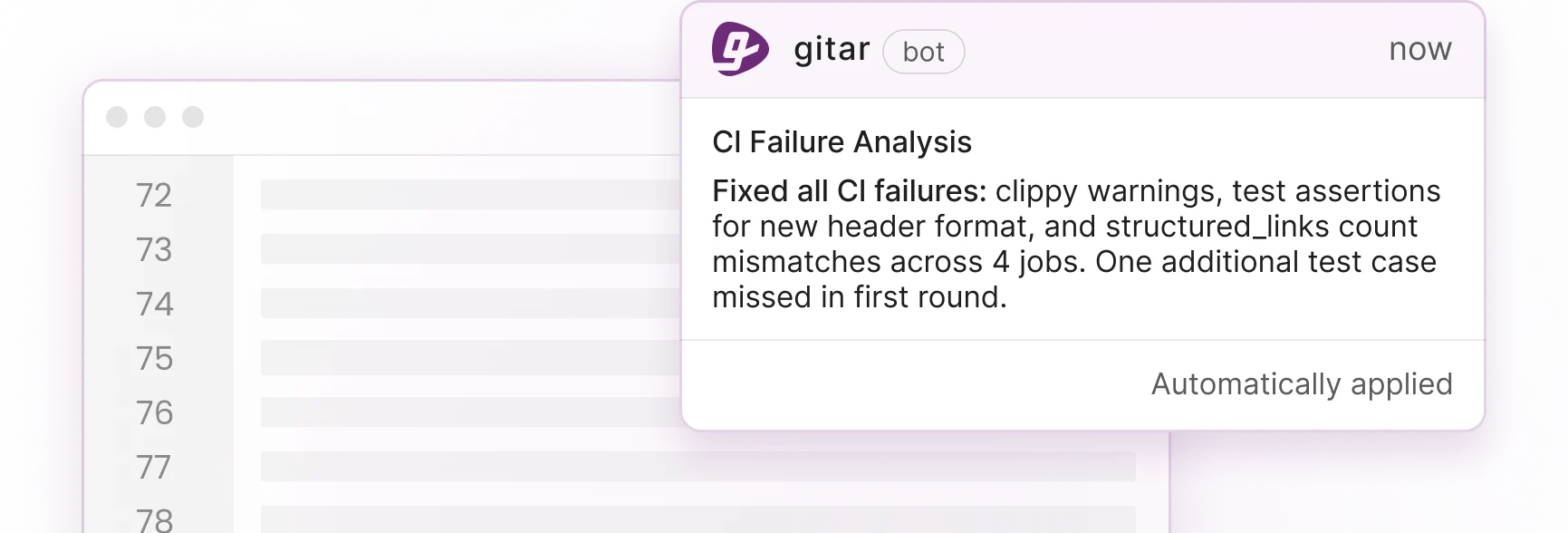
- Intelligent platforms now auto-resolve failures by reading logs, generating validated fixes, and committing solutions for green builds.
- Gitar ranks #1 with free unlimited PR analysis, cross-CI support (GitHub Actions, GitLab, CircleCI), and guaranteed auto-fixes.
- Competitors like GitLab Duo and Harness offer partial fixes but lack Gitar’s free tier, broad integrations, and full validation.
- Teams save about $750K per year on debugging; install Gitar now for self-healing CI that guarantees green builds.
How We Ranked These CI Auto-Fix Platforms
Our evaluation focused on platforms that deliver end-to-end automation instead of simple suggestions. We prioritized validated auto-fix capabilities beyond diagnostics, broad CI integrations across GitHub Actions, GitLab CI, CircleCI, and Buildkite, and accessible pricing with meaningful free tiers.
We also weighed enterprise scalability, rapid setup, SOC2 security compliance, and documented ROI. Sources included vendor documentation, engineering feedback from teams at companies like Pinterest and Collate, and 2026 industry reports on AI-native CI/CD plus QA automation trends. Our short list highlights platforms with true self-healing that resolve failures autonomously instead of stopping at diagnostics.
Top 7 Intelligent Platforms to Automatically Resolve CI Build Failures in 2026
1. Gitar: Free Self-Healing CI With Guaranteed Green Builds
Gitar leads this list with free AI code review that automatically resolves CI failures. Competing tools often charge $15 to $30 per developer for suggestions, while Gitar offers unlimited PR analysis, security scanning, and bug detection at no cost for unlimited repositories, plus a 14-day free trial of autofix features.
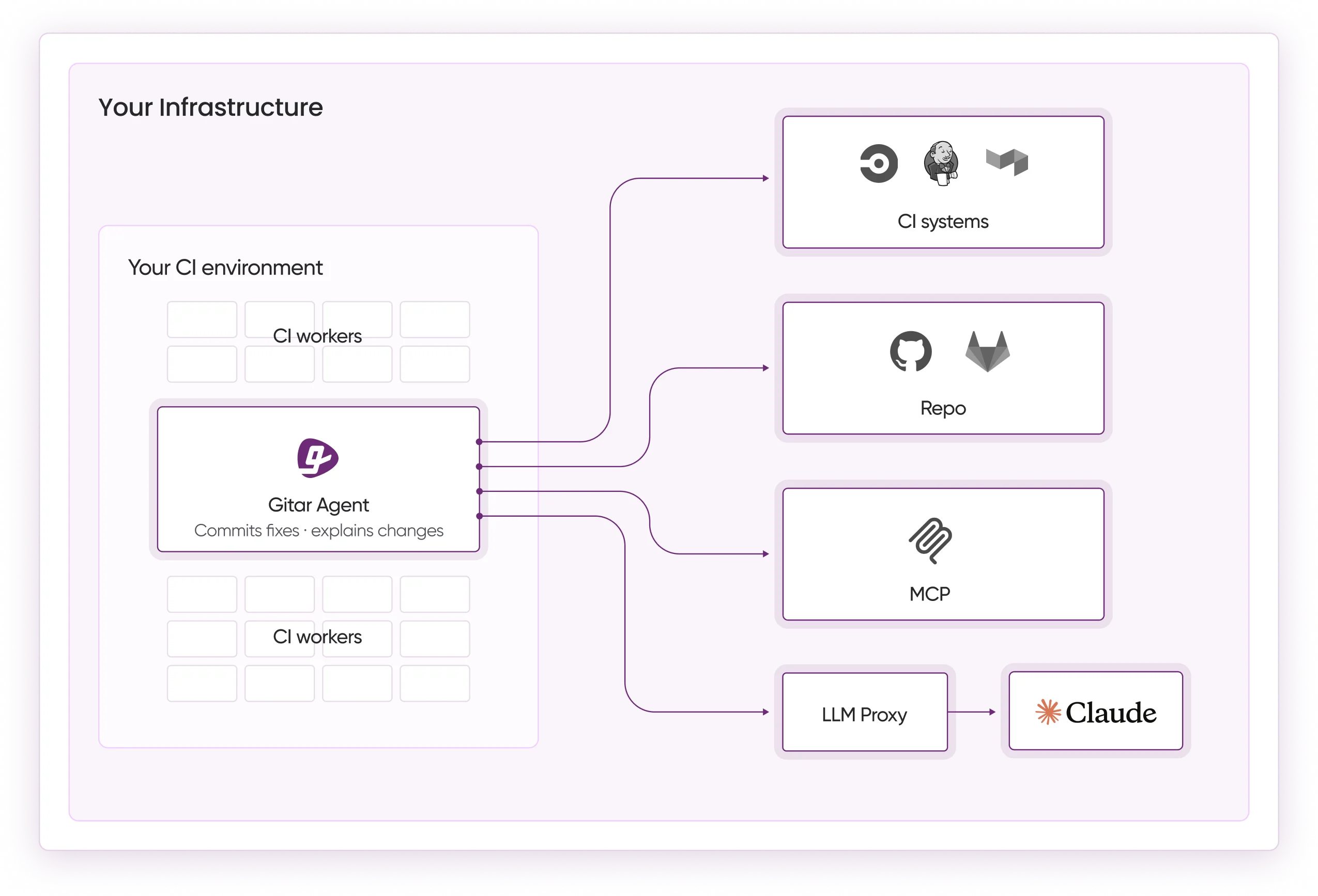
The healing engine reads failure logs, generates contextual fixes using full codebase understanding, validates solutions against your CI environment, and commits working code directly to PRs. Gitar supports GitHub Actions, GitLab Pipelines, CircleCI, and Buildkite with enterprise-grade security. Case studies show detection of high-severity security vulnerabilities in Copilot-generated code that other tools missed, along with “unrelated PR failure detection” that separates infrastructure flakiness from real code issues.
Install Gitar now to automatically resolve CI failures and eliminate manual debugging.
2. GitLab Duo: AI-Powered Pipeline Intelligence Inside GitLab
GitLab Duo embeds AI directly into GitLab’s CI/CD platform and delivers intelligent log analysis plus some automated fixes. It shines at in-pipeline diagnostics and AI-assisted suggestions for common build failures inside the GitLab ecosystem.
This platform requires GitLab infrastructure and does not match the cross-platform flexibility of standalone tools. Pricing starts around $19 per user each month, which can feel expensive for larger teams compared to free options. GitLab Duo handles basic auto-fixes for lint errors and simple test failures but does not offer the comprehensive validation and guaranteed fix application that define true self-healing platforms.
3. Bitrise: Mobile-First CI With AI Insights
Bitrise focuses on mobile CI/CD and provides AI-powered insights plus automated retry mechanisms for iOS and Android builds. It offers intelligent failure analysis and some automated remediation for mobile-specific problems such as provisioning profile issues and dependency conflicts.
Bitrise supports major mobile languages and frameworks like Swift, Kotlin, Flutter, and React Native, and integrates with popular Git providers and mobile tooling. Its mobile-first design and usage-based pricing can limit cost-effectiveness for non-mobile or polyglot teams that run large, mixed workloads.
Get comprehensive CI auto-fix across all platforms with Gitar’s free intelligent healing engine.
4. Dagger: Custom AI Agents for CI Workflows
Dagger lets teams build custom AI agents for CI workflows tailored to specific failure patterns. The framework supports intelligent CI agents that can analyze logs and open PRs with proposed fixes.
This flexibility comes with a tradeoff, because teams must invest engineering time to design, implement, and maintain those agents. Dagger does not provide plug-and-play auto-fix behavior and lacks built-in validation to confirm that generated fixes truly resolve the root cause.
5. Nx Cloud: Self-Healing Retries for Monorepos
Nx Cloud delivers intelligent retry mechanisms and build optimization with limited self-healing features for monorepo environments. It can retry failed tasks automatically and tune build graphs to reduce cascading failures.
The platform remains CI-agnostic and works well for monorepo management, but its self-healing centers on retry logic instead of code changes. Nx Cloud does not generate or apply code fixes to address underlying issues, which restricts its impact on long-term failure resolution.
Experience true self-healing CI that fixes code issues, not just retries failed builds.
6. Harness: AI-Driven CI Fixes and Smart CD Rollbacks
Harness provides AI-powered CI and continuous delivery with automated build failure fixes, Test Intelligence, and rollback features. It excels at deployment-level intelligence and AI automation that iteratively resolves build issues so code can reach production safely.
The platform works well for enterprises that want full CI/CD orchestration, although its focus leans toward deployment workflows instead of lightweight, developer-centric auto-fixes for everyday CI failures.
7. Greptile: Context-Aware Code Suggestions Without Auto-Fix
Greptile offers AI-powered code analysis with deep codebase context and delivers intelligent suggestions for improvements and potential fixes. It maintains a broad understanding of your codebase to surface relevant recommendations.
Despite this strong contextual analysis, Greptile functions as a suggestion engine and does not apply fixes or integrate directly with CI. Teams still implement recommendations manually and must validate changes themselves, which limits its usefulness for autonomous failure resolution.
Gitar vs Competitors: Feature Comparison Table
|
Feature |
Gitar |
GitLab Duo |
Competitors |
|
PR Analysis |
Yes (Free) |
Yes (Paid) |
Yes (Paid) |
|
CI Failure Analysis |
Full |
GitLab Only |
Limited/None |
|
Auto-Apply Validated Fixes |
Yes |
Partial |
No |
|
Free Tier |
Yes |
No |
Trial Only |
|
Cross-CI Support |
Yes |
GitLab Only |
Limited |
GitLab Duo vs Gitar for CI Auto-Fix
GitLab Duo delivers strong in-pipeline intelligence but stays locked to GitLab infrastructure with paid-only access. It handles basic auto-fixes within GitLab CI but does not support teams that rely on GitHub Actions, CircleCI, or Buildkite.
Gitar offers broader CI coverage and stronger validation while keeping core features free. Its healing engine runs across major CI systems with guaranteed fix validation, which suits diverse development environments. Teams using GitHub Actions gain particular value from Gitar’s deep integration and autonomous fix application.
ROI and Buying Checklist for Self-Healing CI
Small teams gain the most from free platforms like Gitar that remove the 85 percent of time usually spent on manual CI debugging. This shift can cut daily overhead from about one hour to 15 minutes per developer. Enterprise teams need proven scalability, SOC2 compliance, and configurable automation levels so they can maintain security while still improving efficiency.
Autonomous CI/CD systems can save $750,000 annually for 20-developer teams by removing manual failure resolution and shortening deployment delays. Teams should favor platforms that validate fixes instead of only suggesting them, because validated changes reduce the risk of new issues and keep pipelines stable.

FAQs About CI Auto-Fix Platforms
What is the best free option for automatically fixing CI failures?
Gitar offers the most complete free tier with unlimited PR analysis, security scanning, and bug detection, plus a 14-day free trial of auto-fix features. Competing tools often charge $15 to $30 per developer for basic suggestions, while Gitar’s healing engine validates and applies fixes automatically and still keeps core review features free.
Which platforms support GitHub Actions for automatic failure resolution?
Gitar provides the strongest GitHub Actions integration with full auto-fix capabilities. Bitrise supports GitHub-based workflows for mobile projects. Most other platforms either skip GitHub Actions entirely or stop at diagnostics without applying automated fixes.
Can teams trust automated commits from self-healing CI tools?
Modern self-healing platforms such as Gitar provide configurable automation levels. Teams can begin in suggestion mode, review every fix, and then enable auto-commit for specific failure types like lint errors or dependency updates. Trust improves when platforms validate fixes against the real CI environment instead of pushing untested changes.
How does Gitar compare to CodeRabbit for CI failure resolution?
CodeRabbit focuses on code review suggestions at $15 to $30 per developer and does not fix CI failures or validate changes. Gitar combines free code review with real CI failure resolution and validated auto-fixes, which makes it more suitable for teams battling build failures and flaky tests.
What setup time should teams expect for intelligent CI platforms?
Gitar installs in about 30 seconds through a GitHub App or GitLab integration and does not require account creation. Most enterprise platforms need longer setup, custom configuration, and integration work, while Gitar starts analyzing PRs immediately after installation.
Why Gitar Is the Top Choice for Guaranteed Green Builds in 2026
Intelligent platforms that automatically resolve CI build failures now define the next phase of DevOps automation, yet many tools still charge premium prices for simple suggestion engines. Gitar stands out by delivering full self-healing behavior for free, with validated auto-fixes that provide working solutions instead of unverified advice.