
Key Takeaways
- AI coding tools boost code generation 3-5x but create CI/CD review bottlenecks with 23% more pull requests and larger PR sizes.
- Traditional AI code review tools offer suggestions only and require manual fixes, with just 18% of suggestions leading to code changes.
- Self-healing CI/CD pipelines detect failures, generate validated fixes, and commit working code to keep builds green.
- Gitar provides free, unlimited AI code review with a 14-day auto-fix trial and supports GitHub, GitLab, and major CI platforms like CircleCI.
- Teams can implement self-healing pipelines with Gitar at gitar.ai and avoid more than $1M in annual productivity losses from CI failures.
AI Code Generation Now Overwhelms CI/CD Review Capacity
91% of engineering organizations have adopted AI coding tools, and 87% use assistants like GitHub Copilot or Claude Code. Developers now generate code 3-5x faster, but review capacity has not scaled at the same pace. Median PR size increased 33% from March to November 2025, which creates review bottlenecks that erase many AI productivity gains.
The suggestion engine trap makes this worse. Tools like CodeRabbit and Greptile analyze code and leave inline comments, yet developers still implement fixes manually, push commits, and wait to see if CI passes. Only 18% of AI code review suggestions result in actual code changes, which shows low confidence in unvalidated recommendations.
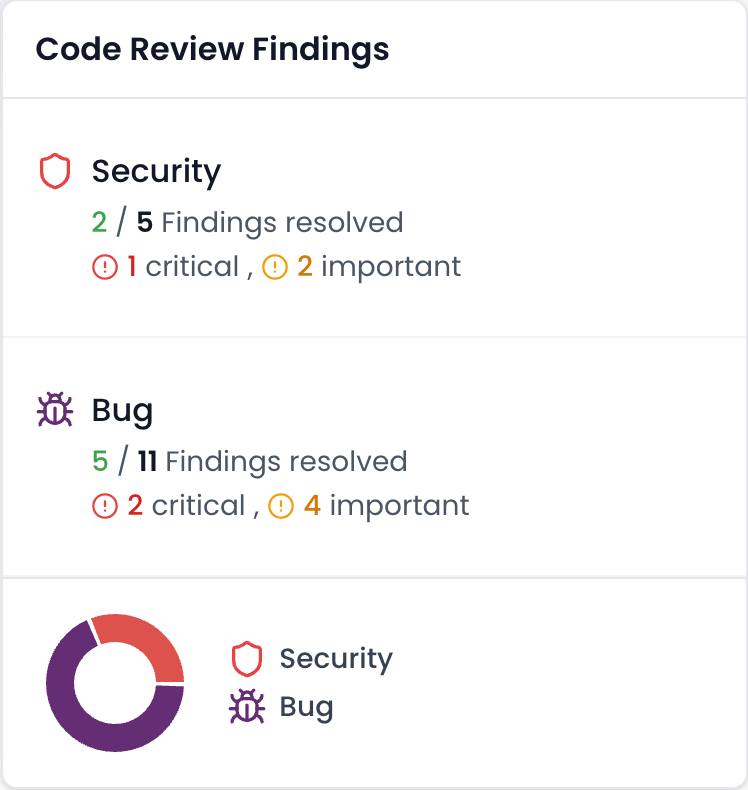
Flaky tests and unrelated PR failures add more friction to CI workflows. Flaky or unstable tests are worse than no tests, because they demand constant monitoring and manual triage. Teams lose hours deciding whether failures come from code changes or infrastructure issues, which delays deployments and frustrates developers.
Teams can move past manual CI fixes. Install Gitar to automatically fix broken builds and remove review bottlenecks from your pipeline.
How Self-Healing CI/CD Pipelines Keep Builds Green
Self-healing CI/CD pipelines go beyond monitoring and alerting and deliver autonomous remediation. These systems pair AI-powered root cause analysis with validated fix generation, creating closed-loop automation that maintains green builds without human intervention.
The architecture relies on four core components. Failure detection agents monitor CI logs and test outputs in real time. Analysis engines correlate failures with code changes and infrastructure state. Fix generation systems produce targeted solutions using full codebase context. Validation frameworks test fixes against real CI environments before deployment.
Key capabilities include flaky test detection through statistical analysis of failure patterns and unrelated PR failure identification that separates code issues from infrastructure problems. Natural language rule engines let teams define custom remediation workflows without complex YAML configurations.
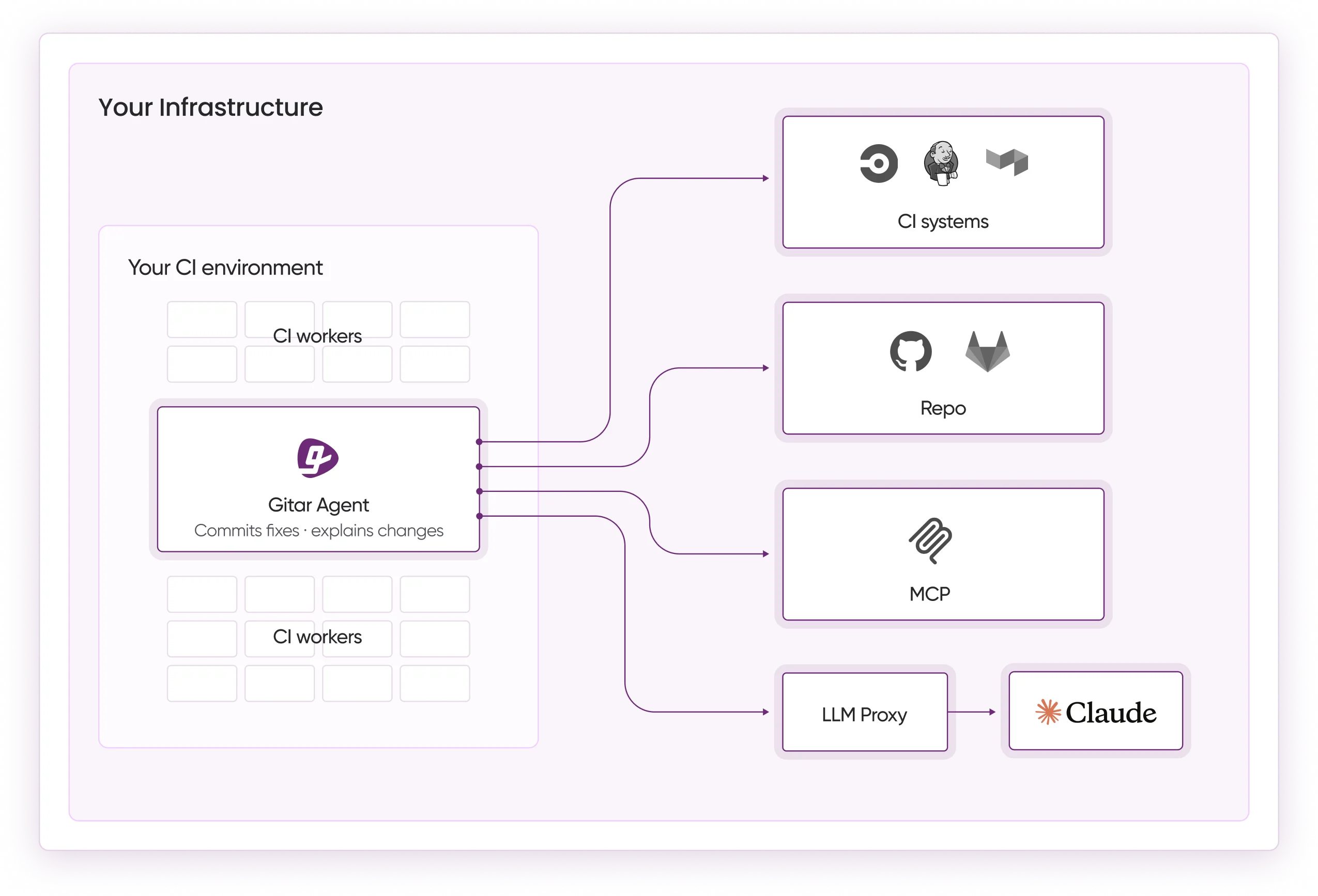
Most teams implement this model through webhook integrations with existing CI platforms such as GitHub Actions, GitLab CI, CircleCI, and Buildkite. The healing engine runs as a parallel process that receives failure notifications, analyzes context, generates fixes, and commits solutions directly to pull requests after validation succeeds.
Gitar: Free Self-Healing Engine for Modern CI/CD
Gitar delivers comprehensive AI code review at no cost and fills a market gap where competitors charge premium prices for suggestion-only tools. The platform supports unlimited repositories and users across GitHub and GitLab, with integrations for major CI systems including GitHub Actions, GitLab Pipelines, CircleCI, and Buildkite.
Gitar stands apart through its healing approach instead of pure suggestion engines. When CI failures occur, Gitar analyzes logs to find root causes, generates targeted fixes with full codebase context, validates solutions in the actual CI environment, and then commits working code during the 14-day free trial. This workflow removes the manual implementation loop that slows traditional review tools.
|
Capability |
Gitar |
CodeRabbit |
GitLab Duo |
|
Free Code Review |
Yes |
No ($15+/seat) |
No |
|
CI Auto-Fix |
14-day Free Trial |
No |
Suggestions Only |
|
Fix Validation |
Yes |
No |
No |
|
Green Build Guarantee |
Yes |
No |
No |
Enterprise customers such as Pinterest show that Gitar scales to 50+ million lines of code and thousands of daily pull requests. Unrelated failure detection saves engineering time by separating infrastructure flakiness from real code issues. Concise PR summaries also reduce notification fatigue compared with verbose inline commenting from other tools.
How Gitar Produces Validated Fixes and Real ROI
Gitar’s workflow starts when CI failures trigger automatic log analysis. The system reviews error messages, stack traces, and build context to identify root causes. It then generates targeted fixes using hierarchical memory that keeps context across lines, pull requests, repositories, and organizations. Generated solutions run through validation in the actual CI environment before automatic commit during the 14-day free trial, which ensures fixes behave correctly under production conditions.
The platform resolves common logic errors and lint failures automatically during the trial and shortens CI pipeline delays by removing manual fix cycles. Unrelated failure detection keeps developers from chasing infrastructure issues that appear as code problems, which saves hours of debugging time for each incident.

ROI modeling for a 20-developer team shows meaningful savings. Traditional CI friction often costs about $1 million per year through context switching, delayed deployments, and manual remediation work. Gitar cuts this burden sharply and delivers major productivity gains while offering free code review instead of the $450-900 in monthly tool costs that suggestion-based competitors charge.
Enterprise deployment options include cloud-managed agents for standard use cases and on-premises deployment for organizations that require full code isolation. SOC 2 Type II and ISO 27001 certifications support security and compliance needs in regulated industries.
Step-by-Step: Building a Self-Healing Pipeline with Gitar
Phase 1: Fast Installation and Setup
Teams install the Gitar GitHub App or GitLab integration in under 30 seconds without creating an account or providing a credit card. The platform immediately posts consolidated dashboard comments on pull requests, which replace scattered inline notifications with a single, updating summary.
Phase 2: Build Trust in Suggested Fixes
Teams begin in suggestion mode while Gitar analyzes failures and proposes fixes for manual review. This phase lets engineers evaluate fix quality and build confidence in automated solutions before they enable autonomous commits.
Phase 3: Turn On Safe Automation
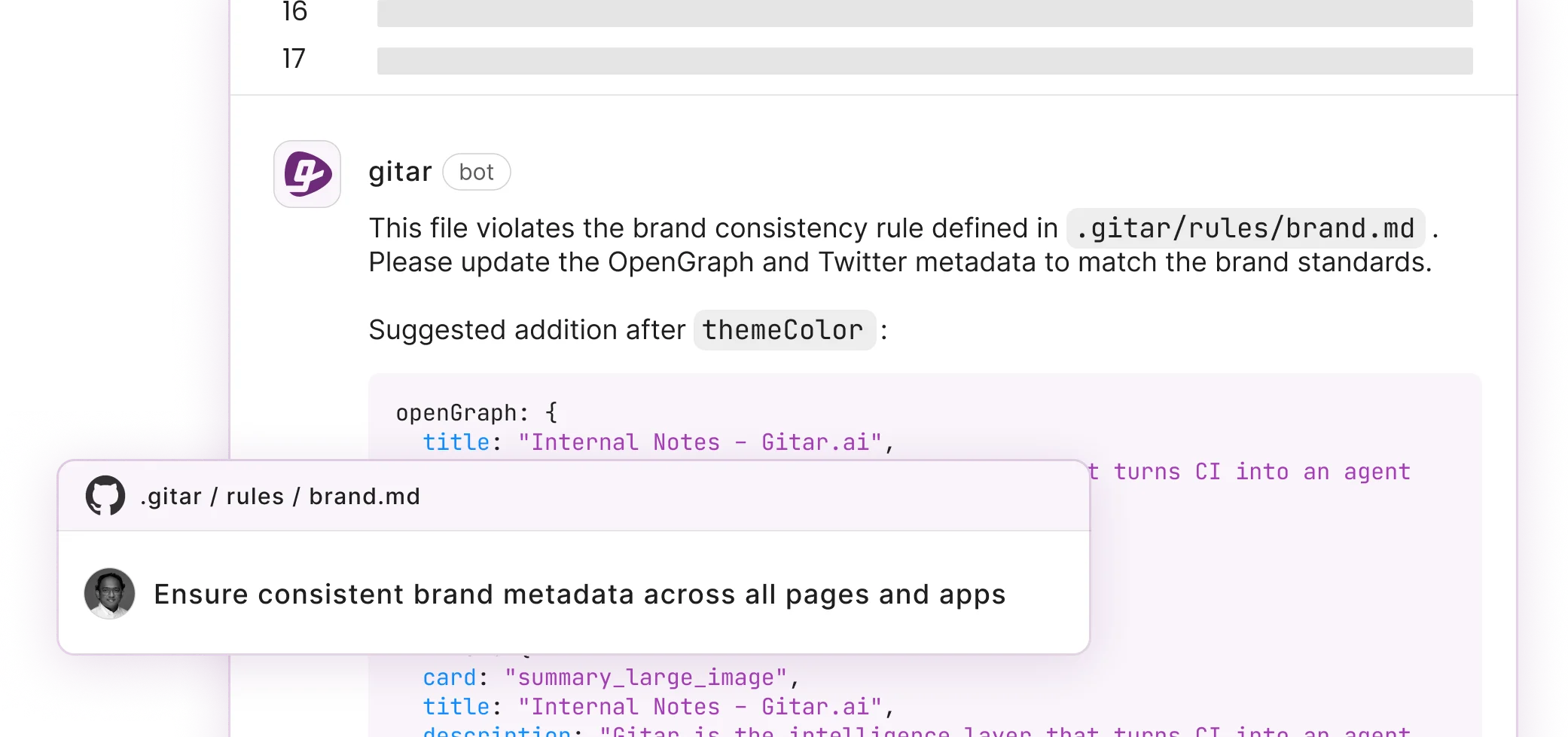
After trust grows, teams enable auto-commit for predictable failure types such as lint errors and simple test fixes. Natural language rules in .gitar/rules/*.md files define custom workflow automation and avoid complex YAML syntax.
Phase 4: Connect Gitar Across Your Toolchain
Teams then connect Jira, Slack, and Linear integrations for cross-platform context sharing. Analytics dashboards highlight systematic CI patterns and support data-driven improvements to pipeline performance.
Install Gitar to remove CI bottlenecks and ship higher quality software faster with automated self-healing pipelines.
Frequently Asked Questions
Is Gitar really free and what is the catch?
Gitar’s core code review features remain permanently free with no seat limits or repository caps. This coverage includes PR analysis, security scanning, bug detection, and performance review across unlimited public and private repositories.
Auto-fix functionality runs as a 14-day free trial and then becomes a paid feature. The business model focuses on advanced capabilities such as enterprise analytics, custom workflow automation, and on-premises deployment, while basic code review stays commoditized.
How does Gitar handle flaky tests and complex CI environments?
Gitar analyzes CI logs and historical failure patterns to separate code-related issues from infrastructure flakiness. The system maintains statistical models of test reliability and flags failures that do not relate to PR changes.
For complex environments, Gitar emulates the full CI context, including SDK versions, multi-dependency builds, and third-party integrations. Enterprise deployments run the agent inside your CI pipeline with access to secrets and caches, which ensures fixes work in your exact production environment.
Can teams trust automated commits from Gitar?
Gitar offers configurable automation levels that match each team’s comfort and requirements. Teams start in suggestion mode where all fixes need manual approval and then gradually enable auto-commit for specific failure types as trust grows.
The platform validates every fix in the actual CI environment before committing, so solutions prove themselves in practice. Enterprise customers can deploy agents within their own infrastructure to keep full control over automation while meeting security and compliance standards.
Does Gitar integrate with tools like Nx, Dagger, and GitLab?
Gitar supports cross-platform integration with major version control systems such as GitHub and GitLab and CI platforms such as GitHub Actions, GitLab CI, CircleCI, and Buildkite.
The webhook-based architecture adapts to existing workflows without infrastructure changes. Language support includes Python, Go, JavaScript, TypeScript, Java, Rust, and other major languages. Integrations with Jira, Slack, and Linear provide smooth workflow connectivity.
How does Gitar compare to custom LLM-based CI tooling?
Teams can wire Claude or GPT models directly into their workflows, but this approach demands heavy engineering effort to build failure detection, context management, fix validation, and commit automation.
Gitar delivers an end-to-end platform with infrastructure designed for CI environments, including long-running agents that handle force pushes, concurrent operations, and real-time event coordination. The hierarchical memory system and cross-platform integrations remove the need to build and maintain custom automation infrastructure.
Conclusion: Move from Suggestions to Self-Healing CI/CD
The AI coding wave has shifted the main bottleneck from code creation to validation and integration. Traditional tools charge premium prices for suggestion engines that still require manual work, while self-healing CI/CD pipelines provide autonomous remediation that keeps builds green and reduces context switching.
Gitar combines free, comprehensive code review with validated auto-fixes and directly addresses the need for tools that solve problems instead of only flagging them. Enterprise scalability, cross-platform support, and configurable automation levels make Gitar a fit for startups and Fortune 100 companies that manage millions of lines of code.
Software development is moving toward intelligent automation that cuts friction while preserving quality and security. Self-healing pipelines mark the next step beyond suggestion-based tools and deliver the autonomous remediation that modern teams need to maintain velocity in an AI-accelerated world.
Install Gitar to automatically fix broken builds and ship higher quality software faster with the industry’s leading free self-healing CI/CD platform.