
Last updated: January 28, 2026
Key Takeaways
- AI coding tools now generate code 3-5x faster, yet PR review capacity stayed flat and average PR size grew by 33%.
- Healing engines like Gitar auto-fix CI failures, validate changes against your build pipeline, and outperform suggestion-only tools.
- Gitar stands out as a free solution that scales to 50M+ LOC, offers a single-comment UX, and integrates with GitHub, GitLab, and CircleCI.
- Competitors such as CodeRabbit ($15-30 per seat) and Greptile ($30 per seat) only suggest fixes, which still require manual work and create notification noise.
- Teams see strong ROI from faster PR merges and consistently green builds; install Gitar now to automate fixes and ship higher quality software faster.
How We Compared AI Code Review and DevOps Agents
Our evaluation focused on how much each tool actually automates, from simple suggestions to full auto-fixes and CI healing. We compared pricing models, platform integrations across CI, VCS, and project management tools, and scalability for codebases with 50M+ lines of code. We also assessed user experience, notification management, security posture, and measurable ROI through build success rates and time savings.
We drew on vendor documentation, GitHub integration stats, and developer feedback from DEV and Reddit communities. We also referenced independent benchmarks comparing AI code review tools on real-world PRs. Tools with clear enterprise adoption and proven impact on development velocity ranked higher.
Top 5 AI DevOps Agents and Code Review Tools
The leading AI agents for DevOps automation and code review in 2026 take very different paths to solving the post-AI coding bottleneck.
1. Gitar – Free healing engine that auto-fixes CI failures, implements PR feedback, and validates changes against your build pipeline.
2. CodeRabbit – Suggestion-focused reviewer that adds contextual PR analysis and inline comments, priced at $15-30 per developer.
3. Greptile/Graphite – Codebase-aware suggestion engine with full repository context, charging $30 per seat.
4. Kubiya – DevOps workflow automation platform centered on infrastructure-as-code and operational tasks, not PR-level review.
5. Open-source alternatives – DIY stacks using Claude integrations and custom LLM setups that require in-house engineering effort.
The core difference sits between tools that only suggest fixes and tools that implement and validate those fixes. Install Gitar now, automatically fix broken builds, start shipping higher quality software, faster.
Why Gitar Leads: Free Healing Engine for CI and PRs
Gitar turns CI failures into background tasks that resolve themselves. When lint errors, test failures, or build breaks appear, Gitar reads the failure logs, generates fixes with full repository context, and validates those changes in your CI pipeline. It then commits working solutions directly to the PR, removing the manual implementation step that suggestion engines still require.
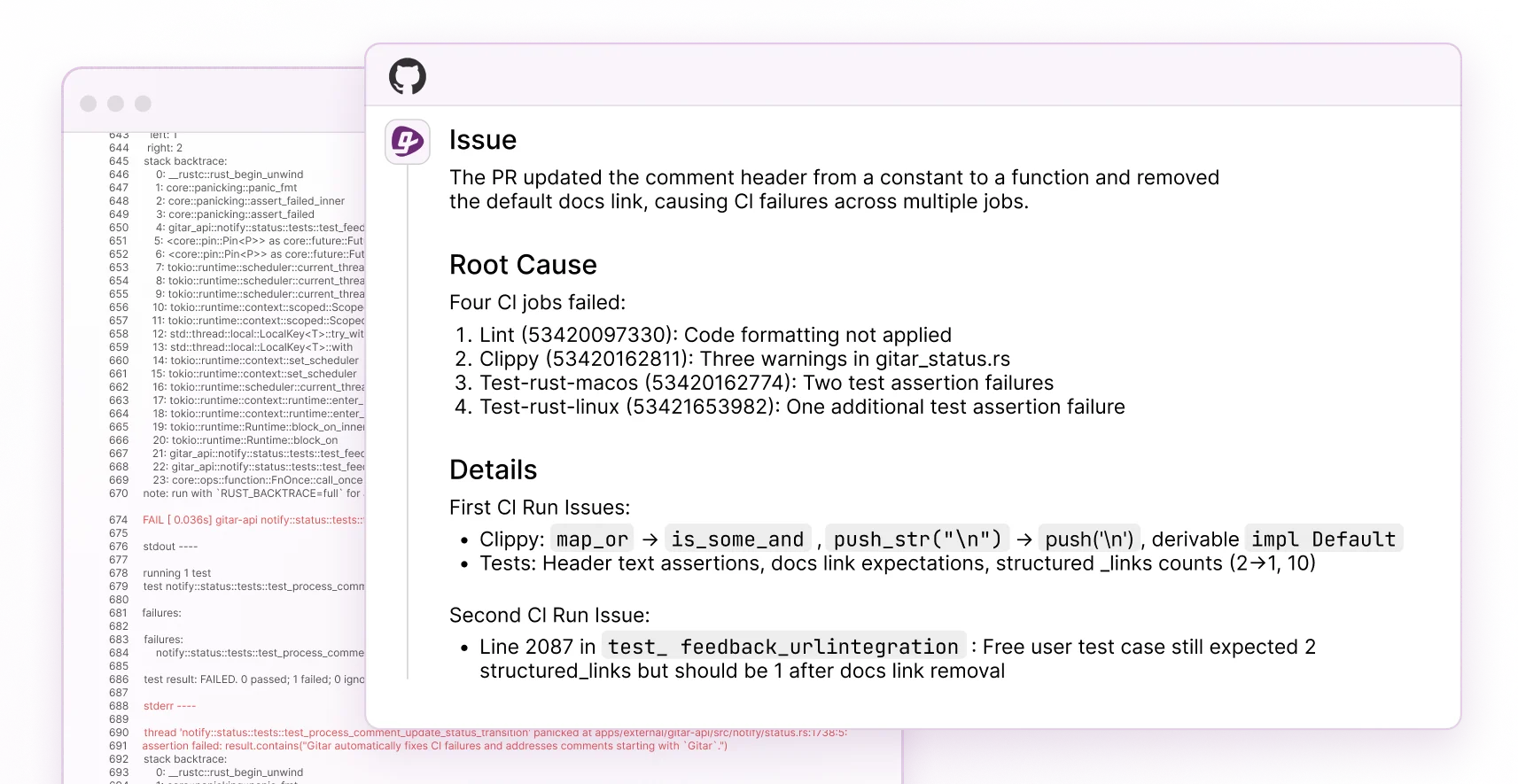
The platform rolls all findings into a single dashboard-style PR comment that updates over time, which sharply reduces notification noise. Competing tools often scatter many inline comments across the diff, which fragments attention. Gitar also supports natural language repository rules, so teams can automate workflows without wrestling with complex YAML files. Integrations with Jira, Slack, and Linear keep work items and conversations aligned with code changes.
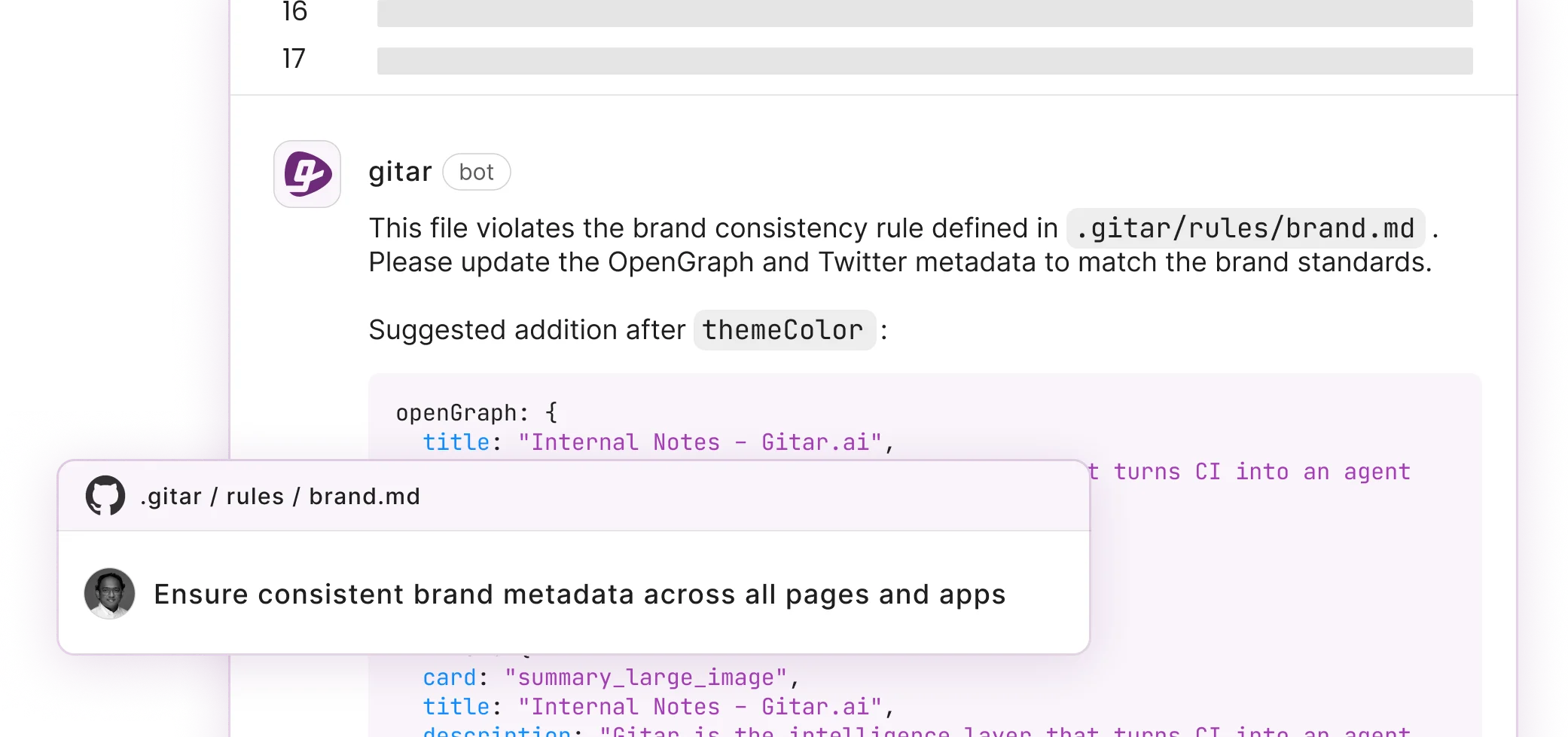
Gitar handles enterprise workloads, including codebases with more than 50 million lines and thousands of PRs each day, while keeping core code review features free. The 14-day free trial for auto-fix features gives teams a quick way to measure impact. Many 20-developer teams report large annual savings from fewer context switches and more reliable green builds.
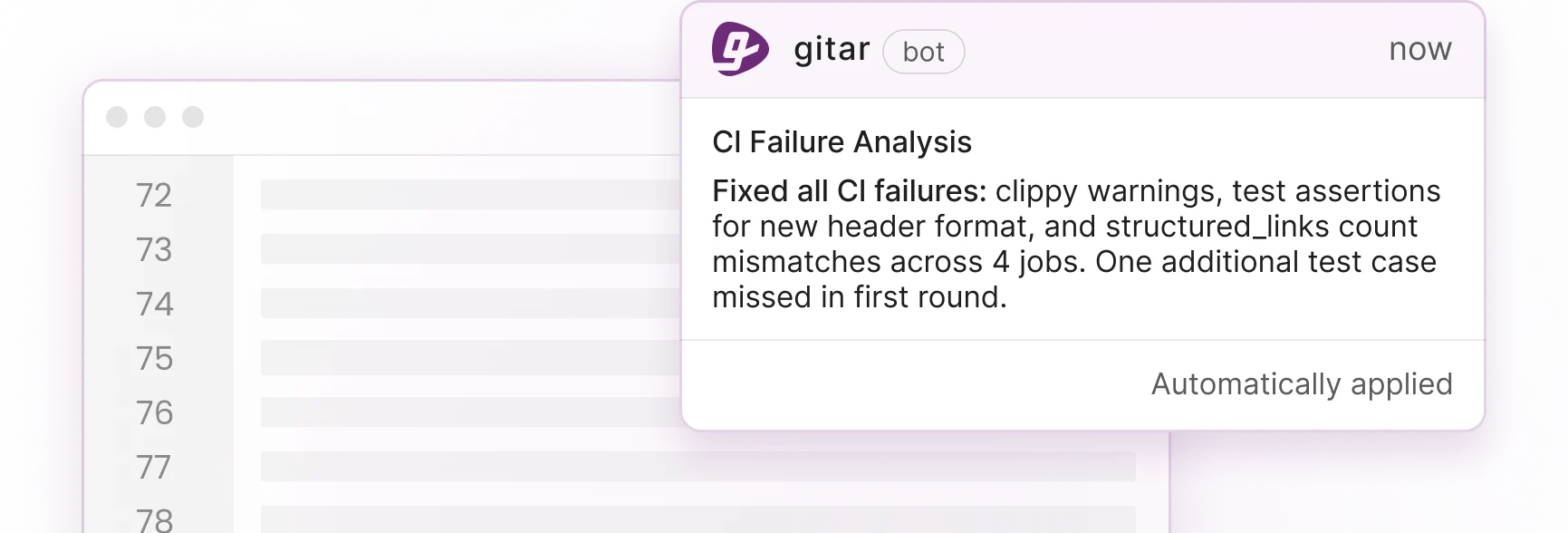
Gitar fits teams that feel buried under red builds and want issues resolved automatically instead of receiving more suggestions to apply by hand. Install Gitar now, automatically fix broken builds, start shipping higher quality software, faster.
Competitor Breakdown: CodeRabbit, Greptile, Kubiya, Open Source
CodeRabbit: Suggestion-Only PR Reviewer
CodeRabbit provides contextual, learning-based suggestions with GitHub, GitLab, and Azure DevOps CI integration. It stops at the suggestion stage. Priced at $15-30 per developer each month, it reviews PRs and posts inline comments that developers must still implement manually. The product does not analyze CI failures or apply auto-fixes, so engineers remain responsible for applying recommendations and confirming that changes actually resolve issues.
Greptile/Graphite: Codebase-Aware Suggestions
Greptile delivers advanced full codebase context suggestions with GitHub and GitLab CI support at $30 per seat. It excels at understanding large repositories and producing contextual recommendations. However, it often generates many inline comments that create notification overload and still does not validate whether suggested fixes work. Teams frequently report frustration when a high volume of suggestions fails to translate into working code.
Kubiya: DevOps and IaC Automation
Kubiya targets DevOps workflow automation and infrastructure-as-code tasks instead of detailed PR-level code review. It performs well for operational runbooks and platform engineering workflows. For most product teams, however, it does not meaningfully reduce the core code review bottleneck. Its enterprise pricing reflects a focus on specialized platform engineering use cases rather than everyday development work.
Open-source and DIY: High Flexibility, High Effort
Custom LLM setups using Claude or GPT models demand substantial engineering work to handle fix application and CI integration. Tools like cirolini/genai-code-review provide OpenAI-powered suggestions with CI support but lack auto-fixes. Licensing may be free, yet the time spent designing, building, and maintaining these systems makes DIY options costly in practice.
|
Tool |
Automation Level |
Pricing |
Platforms/UX/Integrations |
Scalability/ROI |
|
Gitar |
Execution/Healing |
Free (+14d trial) |
GitHub/GitLab/CircleCI/Buildkite, single comment, Jira/Slack |
50M+ LOC, significant savings for 20 devs |
|
CodeRabbit |
Suggestions |
$15-30/seat |
GitHub, inline noise |
Limited, manual fixes |
|
Greptile |
Suggestions |
$30/seat |
GitHub/GitLab, notification spam |
Codebase focus, no green guarantee |
|
Kubiya |
Workflows |
Paid |
DevOps IaC, limited PR |
Enterprise, no auto-PR |
|
Open-source |
DIY Suggestions |
Free (effort) |
Variable, no platform |
Custom, high maintenance |
How to Choose an AI DevOps Agent for Your Team
Teams should match AI DevOps agents to their main bottlenecks and priorities. Individual contributors usually care most about fewer notifications and faster feedback, so they benefit from single-comment interfaces and automatic fixes. Engineering leaders focus on ROI and total cost of ownership, where free tools like Gitar compare favorably with stacks that cost $450 or more each month for mid-sized teams. Platform engineers look for natural language rule configuration and broad integrations instead of complex YAML pipelines.
Migration planning must address data privacy, especially in enterprise settings. Options range from cloud-hosted agents to on-premises deployments that run inside existing CI infrastructure. Success metrics should track PR merge time, CI failure reduction, and developer satisfaction, not just the number of suggestions produced. 2026 trends show Claude 4 and purpose-built models delivering superior performance for infrastructure automation and deep code analysis.
The market is shifting toward agentic automation, so tools that only suggest changes will fade as teams demand end-to-end resolution. Install Gitar now, automatically fix broken builds, start shipping higher quality software, faster.
FAQs: AI Code Review and DevOps Automation
What are the best free AI code review alternatives in 2026?
Gitar leads the free AI code review category by offering full PR analysis, security scanning, and bug detection without seat limits or credit card requirements. Paid competitors charge $15-30 per developer for suggestion-only features, while Gitar adds auto-fix capabilities with a 14-day free trial and keeps core code review free. Open-source options demand heavy engineering investment to build CI integration and fix application, so Gitar becomes the most practical free choice for teams that want immediate productivity gains.
How do AI agents automate CI failure resolution?
AI agents such as Gitar follow a multi-step healing flow for CI failures. They parse failure logs to find root causes, generate code fixes using full repository context, and validate those fixes in the real CI environment. After validation, they commit working solutions back to the PR. Suggestion engines stop at pointing out problems and never implement or verify fixes. Healing agents cover test failures, lint issues, build breaks, and dependency conflicts, which keeps builds green without manual intervention.
How does CodeRabbit compare to Gitar for code review automation?
CodeRabbit centers on suggestions delivered through inline comments at $15-30 per seat, so developers still need to implement and validate each fix. Gitar offers free code review with similar analytical depth and then goes further by automatically applying fixes and validating them in CI. CodeRabbit often creates notification noise through many scattered comments, while Gitar summarizes findings in a single updating dashboard comment. For teams that want automation instead of more manual work, Gitar’s healing engine produces stronger ROI.
Do AI code review tools support GitLab and CircleCI integration?
Gitar ships with native support for GitLab, CircleCI, Buildkite, and GitHub Actions, which covers most modern CI/CD platforms. Many competitors focus almost entirely on GitHub, which limits their usefulness for teams on GitLab or alternative CI systems. Gitar’s cross-platform design includes webhook handling, API-level integration, and environment-aware configuration so fixes respect each platform’s constraints and security rules.
What ROI can teams expect from AI DevOps automation agents?
Teams often see strong annual savings for 20-developer groups through fewer context switches, faster PR turnaround, and reduced CI-related delays. ROI comes from time saved on manual fix implementation, lower CI re-run costs, and higher sprint velocity as fewer PRs remain blocked. Free tools like Gitar deliver immediate positive ROI compared with paid tools that add $450-900 in monthly fees while still relying on manual fix work.
Conclusion: Gitar as the 2026 DevOps Productivity Choice
The AI code review landscape has reached a point where suggestion engines alone no longer justify their price. Teams now expect healing engines that resolve issues automatically instead of adding more tasks to already busy developers. Gitar changes the market by offering free, comprehensive code review plus automatic fix implementation and CI validation, while many competitors charge premium prices without matching these capabilities.
Adoption follows a clear, low-risk path. Teams install Gitar for free code review, watch automatic fixes during the 14-day trial, then enable full automation for trusted fix categories. This staged rollout lets teams confirm ROI and maintain control over which workflows the agent handles.
Install Gitar now, automatically fix broken builds, start shipping higher quality software, faster.