
Engineering teams often struggle with CI build failures, and choosing the right Software Quality Assurance (SQA) tool can make all the difference. Some tools only suggest fixes, leaving the heavy lifting to developers, while others, like Gitar, automatically resolve issues and deliver validated solutions. Let’s explore different approaches to fixing CI failures, set clear criteria for evaluation, and show how autonomous tools like Gitar save time and boost productivity by reducing developer workload and speeding up the merge process.
CI failures cost teams heavily in both time and money. Unresolved build breaks can lead to thousands of lost work hours and significant financial setbacks. For engineering leaders, knowing the difference between tools that suggest fixes and those that autonomously heal pipelines is key to improving team efficiency.
Try Gitar today to automatically fix broken builds and ship better software faster
Why Effective SQA Tools Matter for CI/CD
CI/CD pipelines are the foundation of modern software development, ensuring quality and speed. But with complexity comes frequent failures, and manual fixes can’t keep up at scale. Build failures often stem from maintenance tasks like updating or removing dependencies.
These failures hit hard financially. For a team of 20 developers, the yearly cost of lost productivity due to CI issues can hit around $1 million. This accounts for time spent debugging, the delays in releasing features, and the frustration that builds when developers are stuck fixing issues instead of creating.
Key SQA components in CI setups include automated testing, version control, build automation, configuration management, and ongoing monitoring. Each piece is vital for quality, but success depends on how well they work together and handle failures.
In large organizations, the challenge grows. Multi-language codebases, intricate dependencies, and distributed teams across time zones create countless opportunities for errors. Continuous monitoring cuts fix times in half for teams using it compared to those without.
Delaying fixes only worsens the problem. The longer CI issues linger, the harder conflicts become to resolve, piling extra work on engineers. A small linting error can turn into hours of debugging when multiple changes clash, slowing down entire projects.
How to Choose the Right CI Failure Resolution Tool
When picking an SQA tool to handle CI build failures, look past shiny features. Focus on core differences that impact value over time. Here are the main factors to weigh for a decision that fits your team’s needs.
Autonomy or Suggestions: What’s the Real Difference?
The biggest divide in SQA tools is between suggestion-based systems and autonomous healing engines. Suggestion tools point out issues and offer ideas, but developers must apply and test fixes. Healing engines, like Gitar, take it further. They apply fixes, run them through full CI workflows, and ensure builds pass before delivery.
This changes everything for developers. Suggestion tools still interrupt workflows with reviewing and testing. Healing engines cut out that hassle, providing solutions ready to merge without extra effort.
Handling Complex Environments
Enterprise CI setups often involve unique SDK versions, mixed languages, and integrations with tools like SonarQube or Snyk. A major hurdle for autonomous tools is grasping both code and build configurations since failures often mix the two.
Good SQA tools mirror these environments accurately to create fixes that hold up in real pipelines. Tools without this depth often suggest fixes that fail when put to the test in actual conditions.
Building Trust with Validation
Trust is a common concern with automated fixes. Top tools offer adjustable trust settings, letting teams start with human oversight and ramp up automation as they gain confidence. Features like easy rollbacks and detailed change logs help maintain trust while embracing automation.
Integration Across CI/CD Platforms
Strong SQA tools connect with CI/CD systems like GitHub Actions or GitLab CI, offering clear feedback on build, test, and deployment progress. The best options support multiple platforms, giving teams flexibility instead of tying them to one setup.
Boosting Developer Focus and Speed
A tool’s true worth shows in how it improves developer productivity and minimizes disruptions. Solutions that cut down on repetitive debugging and speed up merges offer the best returns. Teams with solid SQA setups see better output, quicker feedback, and happier developers.
Comparing Tools for Fixing CI Build Failures
Let’s break down the strengths, limits, and best uses of different SQA tools. This overview helps match solutions to your team’s specific challenges and goals.
Manual Debugging: Full Control, High Cost
Many teams still rely on manual debugging. Developers dig into logs, write fixes, and push updates when CI fails. This gives complete control and deep understanding of every change made.
But the downsides stack up. Issues like unreliable tests and slow builds from large codebases drag teams down. Switching tasks to fix a quick issue can steal an hour of focus, not just minutes, due to mental overhead.
As teams grow and pipelines get messier, manual fixes become harder to sustain. Having senior developers waste time on routine errors like linting is a poor use of talent and resources.
AI Code Reviewers: Helpful but Limited
Tools like CodeRabbit or Ellipsis automate early code reviews, offering summaries and suggestions for pull requests. They’re great for spotting style issues, bugs, or security risks during reviews.
However, some of these tools stop at suggestions, leaving developers to apply and verify fixes. This means interruptions and uncertainty about whether recommendations will actually solve CI failures.
They suit teams aiming to catch issues early, but if manual steps remain, they don’t fully solve the time drain of CI failures.
Big Model Integrations: Flexible yet Demanding
Large language model setups, like Claude for CI, allow tailored AI solutions for unique needs. They offer huge potential for teams with the resources to customize.
But they’re essentially do-it-yourself kits. Teams must build integrations, refine prompts, manage context, and handle the final steps of applying fixes. This takes serious ongoing effort.
For most, the work to maintain these systems outweighs the benefits, especially when dedicated tools already exist for CI issues.
On-Demand AI Fixers: Targeted but Reactive
Tools like Claude Code or Anthropic GitHub Action help when developers call on them for specific failures. They review error logs and suggest fixes, but need manual activation and often use your CI resources.
They’re limited by their reactive nature and lack of full context. Many also stick to platforms like GitHub, which doesn’t help teams with varied systems.
These work as backup for tough debugging, but don’t tackle the everyday CI failures that eat up most developer time.
IDE-Based Assistants: Pre-Commit Power
Tools like GitHub Copilot speed up coding with smart suggestions right in the editor. They help write code faster and explore new ideas.
Yet, they only work before commits, with no insight into CI pipelines or remote contexts. They can’t help with failures or reviews after submission.
Interestingly, faster coding from these tools often worsens CI bottlenecks. More code means more pull requests and failures, making post-commit fixes even more critical.
Gitar: Automatic Fixes with Full Context
Gitar stands out by autonomously fixing CI failures. It detects issues, crafts solutions, applies them, and commits changes back to the branch, all without developer input.
What sets Gitar apart is its complete autonomy and deep understanding of environments. It fixes common issues like linting errors, test failures, and dependency conflicts. By mirroring enterprise setups, including specific SDKs and integrations, it ensures fixes work reliably.
Teams can start with a cautious mode where fixes need approval, then move to full automation as trust grows. It works with platforms like GitHub Actions, GitLab CI, and CircleCI, fitting into any workflow.
Gitar also helps distributed teams by removing delays across time zones. Reviewers leave comments, and fixes are ready by the next workday, keeping projects moving.

Feature Comparison: Solving CI Build Failures
Comparing features across tools shows clear differences in approach. This helps identify what fits your team’s needs and priorities.
|
Feature/Category |
Manual Debugging |
AI Code Reviewers |
Gitar (CI Healing Engine) |
|
Primary Automation Type |
None |
Suggestion-based |
Autonomous Action |
|
Fix Application |
Manual by developer |
Often manual by developer |
Automated commit & push |
|
CI Validation |
Manual re-runs |
None (only code review) |
Automatic & End-to-End |
|
Environmental Context |
Developer’s knowledge |
Limited (code-centric) |
Full Environment Replication |
|
Cross-Platform CI Support |
N/A |
Git provider-level |
Comprehensive Support |
|
Developer Toil Reduction |
Low (Increases toil) |
Moderate (reduces review burden) |
High (eliminates toil) |
|
Time-to-Merge Impact |
Significantly slows |
Limited direct acceleration |
Accelerates |
|
Configurable Trust Model |
N/A |
N/A |
Yes (suggestions to auto-commit) |
Try Gitar today to automatically fix broken builds and ship better software faster
Maximizing Value with Gitar’s Autonomous Approach
When assessing SQA tools, look beyond upfront costs. Consider the long-term value, including time lost to debugging, delayed projects, and the impact on team morale.
Manual methods and suggestion tools hide steep costs. Constant interruptions for CI fixes can drain hundreds of thousands in productivity yearly. Developers lose focus when pulled away from core tasks.
Gitar cuts these losses by tackling the root of developer workload. Scaling CI pipelines in enterprises needs careful resource management, especially with varied languages and environments. Gitar automates this with full environment replication.
For a 20-developer team spending an hour daily on CI issues, yearly losses can hit $1 million. If Gitar halves that, it saves $500,000 annually while boosting satisfaction and speed.
Enterprise tools need strong integration and validation to ensure fixes build stability without risking trust. Gitar meets these needs with wide platform support and adjustable trust settings.
Its value grows as teams expand and CI gets tougher. Unlike manual or suggestion tools, Gitar scales without extra human effort, offering lasting benefits.
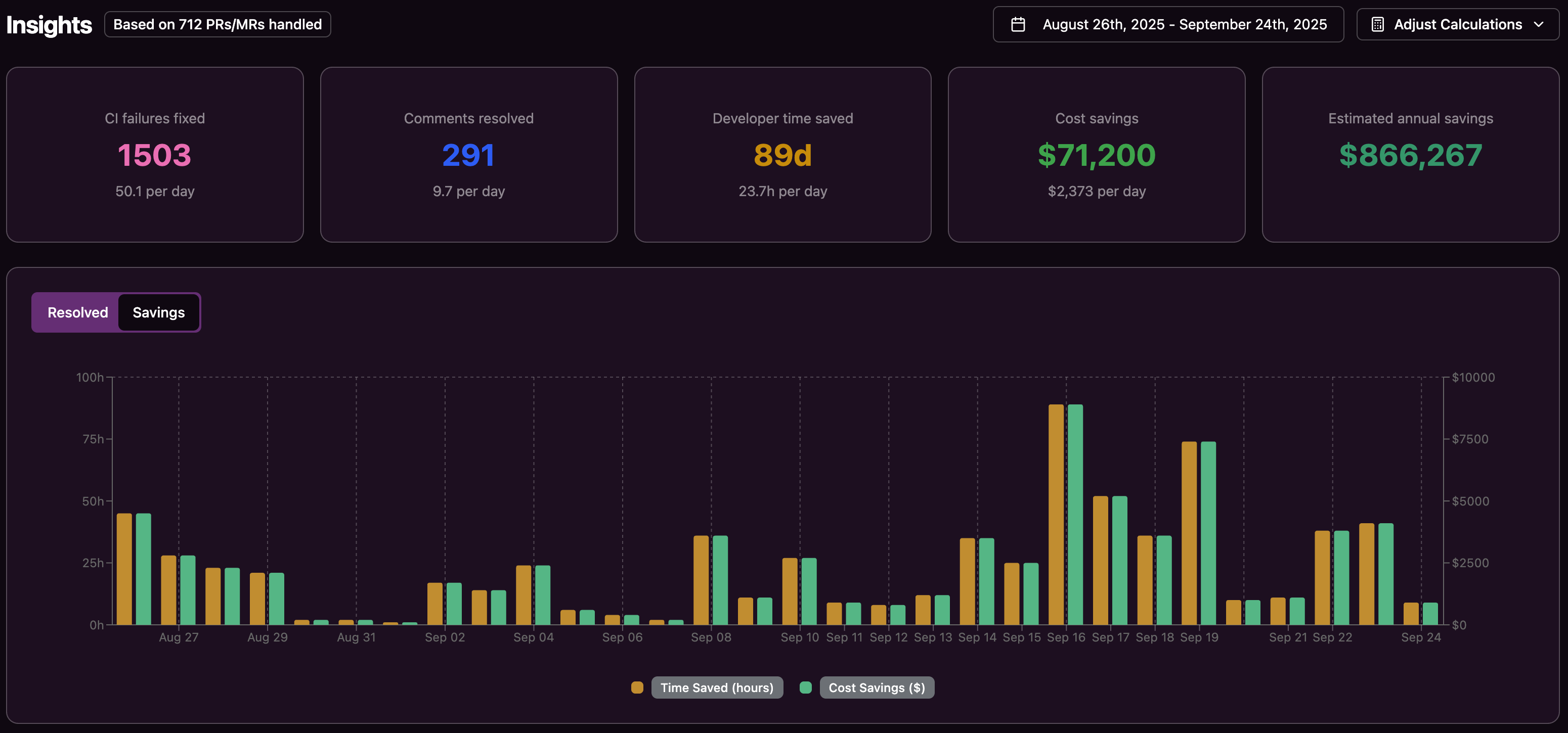
When to Choose a CI Healing Engine Like Gitar
Knowing when a healing engine fits best helps set clear expectations for adoption and results. Here’s where Gitar shines.
For Teams of Any Size
Bigger teams may see larger dollar savings, but Gitar helps organizations at any scale. Startups gain from avoiding CI delays that slow market response. Speed is their edge.
Enterprises face complex systems and integrations. Manual fixes grow costlier with size, making autonomy a smarter choice as teams expand.
For Distributed Teams Across Time Zones
Teams spread across time zones struggle with review delays. A fix flagged by someone in one region might wait a day for action elsewhere.
Gitar solves this by acting on review comments instantly. Fixes are ready for approval by the next workday, keeping progress steady across locations.
For Teams Facing Validation Bottlenecks
AI coding tools like GitHub Copilot speed up writing but create new hurdles. More code means more pull requests, tests, and failures to handle.
Teams using these tools often hit a wall at validation. Gitar clears this bottleneck, maintaining the speed gained from faster coding.
Common Questions About SQA Tools and CI Fixes
What Sets AI Code Reviewers Apart from CI Healing Engines?
AI code reviewers often suggest improvements on pull requests, focusing on style or bugs. But they may leave the application and testing to developers, which can interrupt workflows. CI healing engines like Gitar go beyond by automatically applying fixes, validating them through full CI processes, and delivering ready-to-merge solutions without extra steps.
How Can Teams Trust Automated Fixes in Complex CI Setups?
Trust comes from accurate environments and flexible controls. Gitar mimics enterprise setups, including SDKs and integrations, testing fixes in real conditions. Teams can begin with manual approvals and scale up automation over time. Audit trails and rollback options add safety, balancing automation with confidence.
Do Autonomous Tools Like Gitar Raise CI/CD Costs?
These tools generally lower costs by cutting failed runs and developer retries, reducing compute expenses. The real savings come from less time lost to debugging. For a 20-person team, this can save up to $1 million yearly. Fewer failures often cover tool costs, making gains cost-effective.
How Does Gitar Fit Into Existing CI/CD Pipelines?
Gitar connects easily as a GitHub App or through GitLab, linking to version control without major changes. It supports platforms like GitHub Actions, GitLab CI, and CircleCI via custom rules and webhooks. Setup involves simple authorization and trust settings through a web dashboard, avoiding complex configurations.
What CI Failures Can Autonomous Tools Fix?
These tools handle common, repetitive failures that eat up time. Examples include linting errors fixed by style rules, test issues like snapshot updates, and build problems like dependency conflicts. While simple individually, these collectively drain focus. Automating them lets developers tackle bigger challenges.
Conclusion: Upgrade Your CI Process with Gitar
SQA tools for CI failures have evolved from manual fixes to suggestion systems, and now to autonomous healing engines. While older methods and reviewers offer some help, they often keep developers stuck in cycles of interruption if automation isn’t complete.
CI failures drain significant time and money from teams. Build breaks are a frequent issue, and addressing them fast keeps developer momentum, especially in fast-paced settings.
Gitar shifts the game with autonomous fixes. As a healing engine, it cuts developer workload by providing validated solutions that match your environment, improving Stability and speeding up merges.
Its value goes beyond savings, enhancing morale, delivery speed, and flexibility by clearing pipeline hurdles. For teams dealing with floods of AI-generated code, Gitar is critical to sustaining efficiency.
As CI/CD grows more complex and teams spread out, adopting tools like Gitar offers a real edge in speed and resource use. The future points to autonomous fixes as standard, and early adopters will lead the way.