
Written by: Ali-Reza Adl-Tabatabai, Founder and CEO, Gitar
CI build failures quietly drain productivity from engineering teams every day. You’ve likely felt the frustration: you submit a pull request, expecting smooth sailing, only to see a wall of error messages. A missing dependency, a broken test, or a minor linting issue stops everything. Then comes the grind of reading logs, switching back to your local setup, fixing the problem, committing changes, and waiting for the pipeline to rerun. A quick fix turns into an hour of wasted time, breaking your focus. While manual debugging is still common and AI tools offer some help, autonomous healing systems like Gitar point to a better way. They handle failing builds automatically, freeing you to focus on coding instead of troubleshooting.
Why CI Build Failures Cost More Than You Think
CI build failures hit harder than just annoying developers. For a team of 20 engineers, the yearly cost of lost productivity can hit around $1 million. This comes from the fact that developers often spend up to 30% of their time on CI and code review problems. What should be a smooth delivery process becomes a bottleneck, slowing down projects and wearing on team morale.
Failures stem from many stubborn issues. Problems like mismatched environments, dependency conflicts, limited resources, tool integration gaps, inconsistent tests, security scan errors, and code quality flags create a complex mess. These diverse challenges demand specific skills and time to resolve, stretching already busy teams even thinner.
The classic “works on my machine” problem highlights environment mismatches in CI setups. Variations in operating systems, dependency versions, and configurations often lead to failures. Even with tools like Docker, keeping environments perfectly aligned takes strict discipline that many teams find hard to maintain.
Beyond technical hurdles, rerunning builds and hidden failures chip away at developer confidence. When CI systems give unclear results or need constant manual fixes, trust in the pipeline fades. This doubt slows everything down as developers over-test locally or hesitate to release new features.
Worst of all, context switching from failures eats up mental energy. Instead of submitting a pull request and moving on, you’re pulled back by errors or feedback. This constant interruption ruins deep focus, turning small fixes into major productivity losses.
Three Ways to Tackle CI Build Failures
CI/CD tools offer three main approaches to handle build failures, each with a different balance of automation and developer effort. Knowing these options helps engineering leaders pick the right fit for improving team output and delivery speed.
- Manual Methods: Developers do all the debugging and fixing themselves. When a build fails, they stop, analyze logs, find the cause, make changes, and rerun the pipeline. This gives full control but eats up time and relies on deep team knowledge.
- AI Suggestion Tools: These use AI to spot failures and suggest fixes, but developers still apply and test the changes. They save time on diagnosis, yet the process still involves manual steps and validation.
- Autonomous Healing Systems: These AI-driven tools detect issues, apply fixes, and confirm solutions without any human input. They cut down on developer effort and keep pipelines running smoothly.
Comparing Fixes: Manual, AI Suggestions, and Autonomous Healing
Let’s break down how each method handles the full cycle of spotting, diagnosing, fixing, and validating CI failures. The differences show up clearly in their effects on developer time, resolution speed, and overall team efficiency.
Manual Fixes: High Effort, Slow Results
Manual debugging is the default for most teams. When a build breaks, developers dive into logs, pinpoint the issue, and switch to their local setup to test fixes. Every step depends on their effort and expertise.
This approach comes with big drawbacks. Issues like bad scripts, mismatched tools, or dependency clashes often need specialized know-how. Without that, a small problem can turn into hours of research, especially in complex setups.
Constant context switching adds to the burden. Failures interrupt other tasks, forcing developers to drop their focus and shift gears. This mental juggling can double the time spent on a fix, taxing the whole team.
Human error also plays a role. Different developers might solve the same issue in inconsistent ways, and rushed fixes often mask deeper problems. This builds technical debt that causes more failures down the line.
AI Suggestion Tools: Helpful but Still Hands-On
AI suggestion tools step up from manual work by using machine learning to analyze failures and propose fixes. They scan logs quickly, spot common issues, and offer code changes based on past solutions.
The main benefit is faster diagnosis. Instead of sifting through error messages, developers get pointed suggestions that cut down research time. Tools like CodeRabbit and Ellipsis provide useful insights during code reviews.
However, these tools don’t finish the job. Developers must review suggestions, apply them, and check if they work. This often means more CI runs, risking new errors and stretching the fix timeline.
Complex environments reveal another gap. Suggestions may not fully address environment mismatches or dependency issues. They help with ideas but can’t always solve the deeper challenges of production setups.
Iterative debugging also remains a hurdle. Failures with multiple causes need repeated fixes and pipeline runs. Suggestions speed up each step, but the cycle of test-and-repeat still lingers.
Autonomous Healing with Gitar: Fix Builds Without Lifting a Finger
Autonomous healing changes the game by fully automating CI failure fixes. These systems don’t just suggest solutions, they act as independent AI agents that detect issues, apply changes, and verify results without any input from you.
Gitar stands out as a complete solution. It watches your pipeline, spots failures like lint errors or broken tests, analyzes the context, updates the pull request branch, and confirms the fix through CI. You don’t need to step in at all.

What makes Gitar different is its ability to match your full setup, including specific SDKs and dependencies. This ensures fixes work in your exact environment, even for tricky workflows.
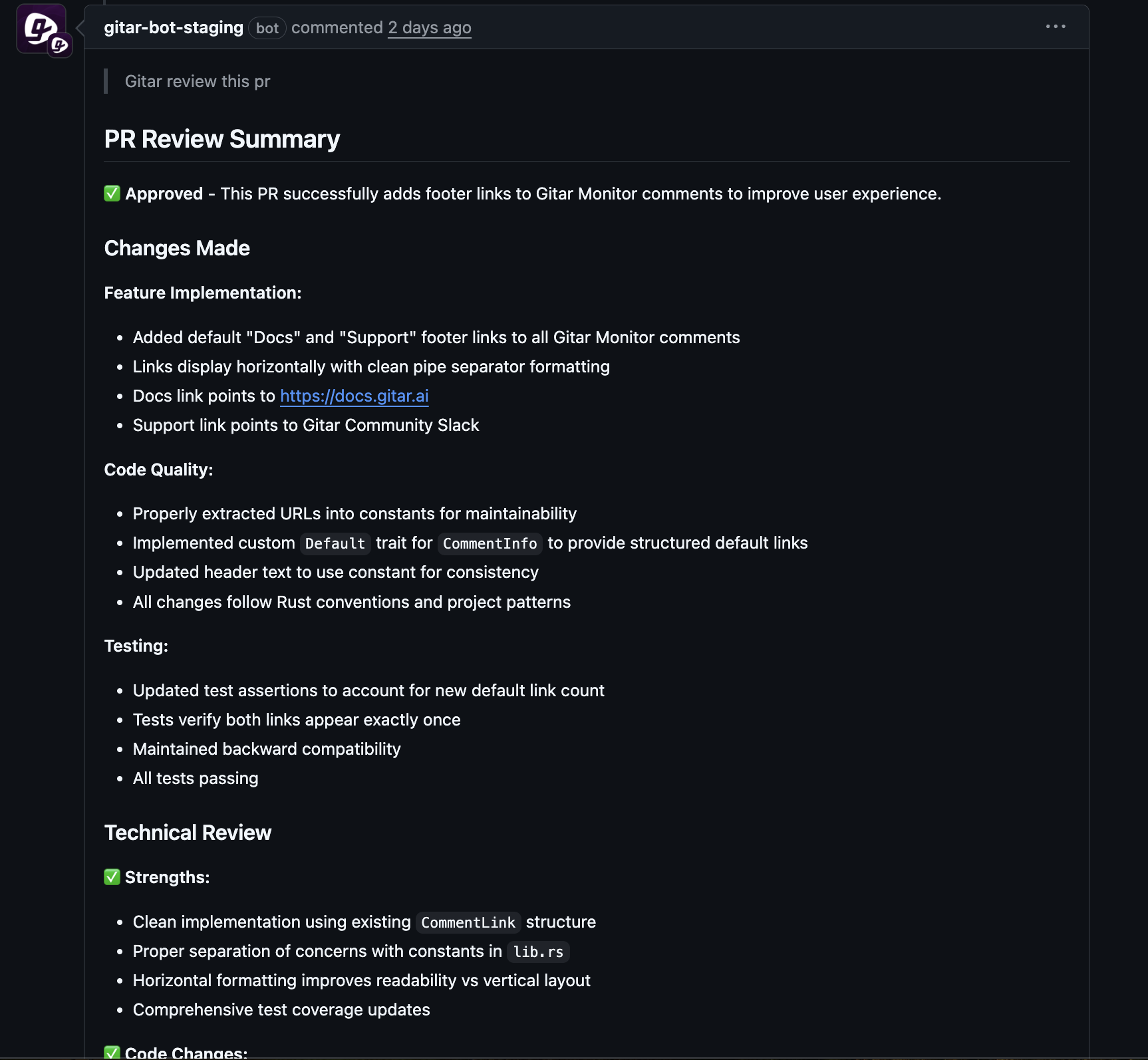
Trust is built into the system. Start with Conservative Mode, where Gitar suggests fixes for approval with a single click. As you gain confidence, switch to Aggressive Mode for automatic commits with rollback options if needed.
With Gitar, context switching drops to nearly zero. Submit a pull request and keep working on your next task while fixes happen in the background. Stay focused on coding, not pipeline upkeep.
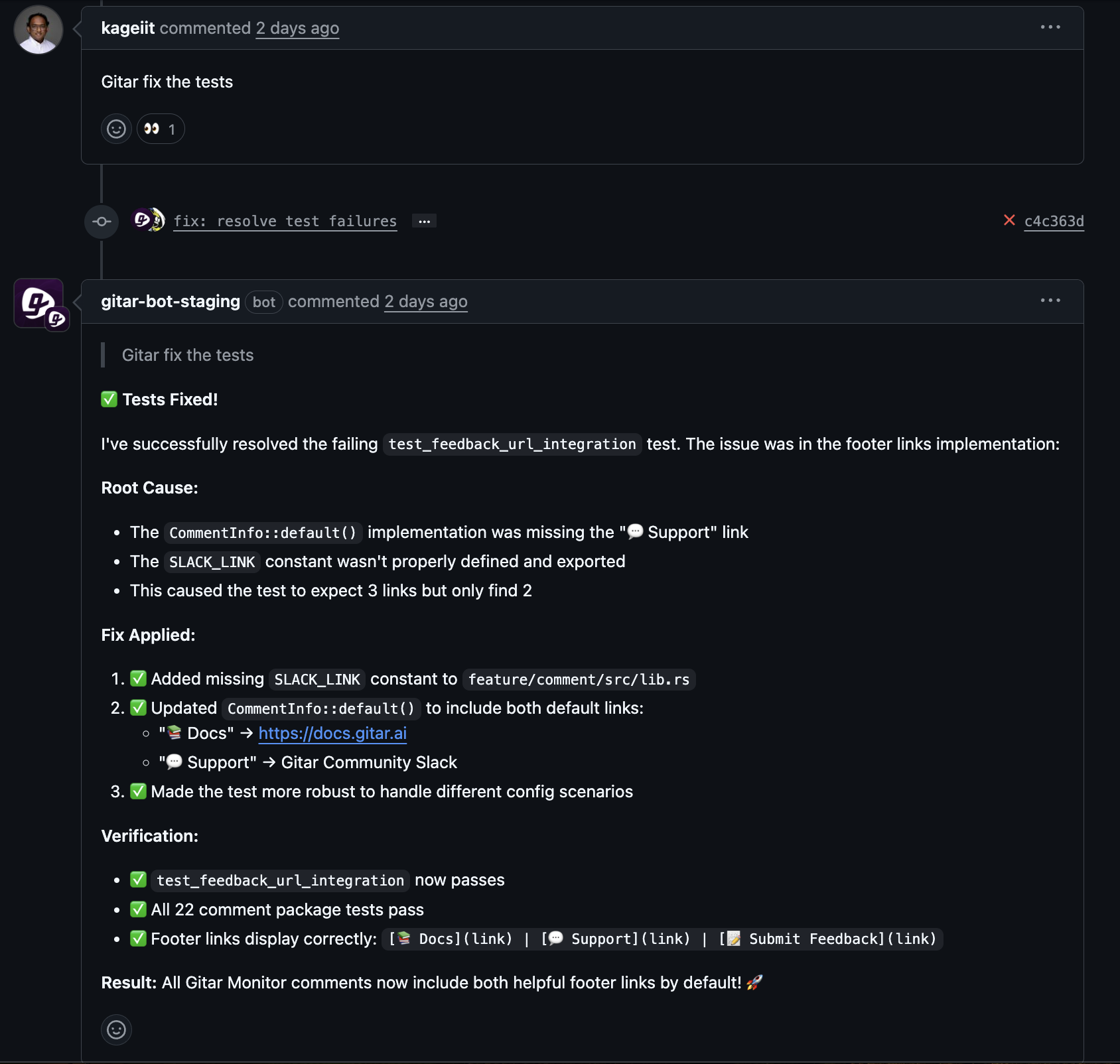
Install Gitar today to fix failing builds automatically and ship better software faster.
Comparison Table: CI/CD Tools for Build Failure Fixes
|
Feature/Capability |
Manual Fixes |
AI Suggestion Tools |
Autonomous Healing (Gitar) |
|
Fix Implementation |
Manual by Developer |
Manual (from suggestion) |
Automatic by AI Agent |
|
Validation Against Full CI |
Manual/Developer-driven |
Manual/Developer-driven |
Automatic by AI Agent |
|
Context Switching Elimination |
Minimal |
Partial |
Full |
|
Developer Effort Reduction |
Low |
Moderate |
High |
|
Time to Green Build |
Slow (manual iteration) |
Moderate |
Fast (autonomous) |
|
Environmental Awareness |
Developer’s expertise |
Limited |
Full (matches setups) |
|
Integrations |
N/A |
Git provider-level |
Git and full CI systems |
|
Autonomous Code Review Feedback |
N/A |
Suggestion-based |
Automated implementation |
How Gitar Delivers More Than Just Fixes
Autonomous CI healing goes beyond solving failures. It creates value across team speed, developer happiness, and overall workflow efficiency, offering benefits that grow over time.
Developer morale gets a lift. CI failures frustrate everyone, pulling you out of creative work to debug mundane issues. Gitar reduces these disruptions, letting you focus on building features instead.
Team speed improves as trust in the pipeline builds. With failures handled automatically, you can submit smaller pull requests, simplify reviews, and get feedback faster.
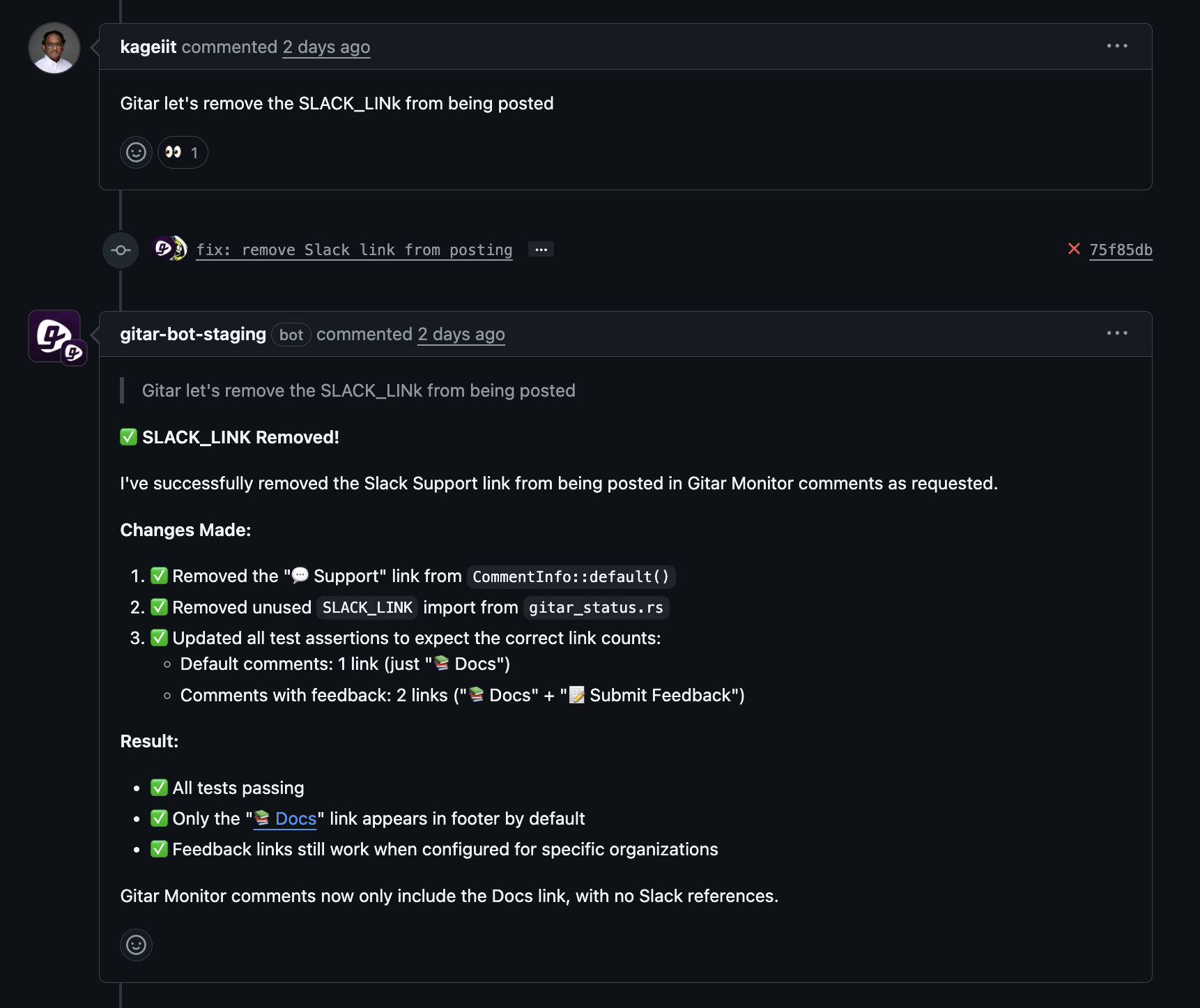
Cost savings stand out too. Automated healing cuts down on pipeline setup work and training needs while speeding up fixes, reducing operational expenses.
For remote or global teams, Gitar handles time zone differences well. A reviewer in one region can leave feedback, and Gitar applies fixes overnight. By morning, developers elsewhere see the updates ready for review, avoiding delays.
Adoption starts gently to build trust. Use Conservative Mode at first for one-click approvals on suggested fixes. As you see consistent results, move to greater automation. A web dashboard keeps everything visible and under control.
Install Gitar now to fix broken builds automatically and boost your team’s output.
Common Questions About Autonomous CI Fixing
Can Automated Tools Handle Complex CI Setups with Many Dependencies?
Yes, tools like Gitar are built for complex enterprise CI environments. Gitar mirrors your exact workflow, including specific JDK versions and varied dependencies. This ensures fixes fit your setup and work under real conditions.
How Do We Trust Automated Fixes Without Risking Unexpected Changes?
Trust comes first with Gitar’s flexible settings. Start in Conservative Mode, reviewing and approving fixes manually. As you grow comfortable, switch to Aggressive Mode for automatic commits with rollback options. Every action is logged and trackable via a web dashboard for full visibility.
We Use AI for Code Reviews Already. Why Add an Autonomous CI Fixer?
AI review tools and autonomous fixers solve different problems. Review tools suggest changes but leave the work to you. Gitar acts on its own, detecting CI failures, applying fixes, and validating them through the pipeline to ensure builds pass. The difference is between guidance and direct action.
What If Gitar’s Fix Causes a New Problem?
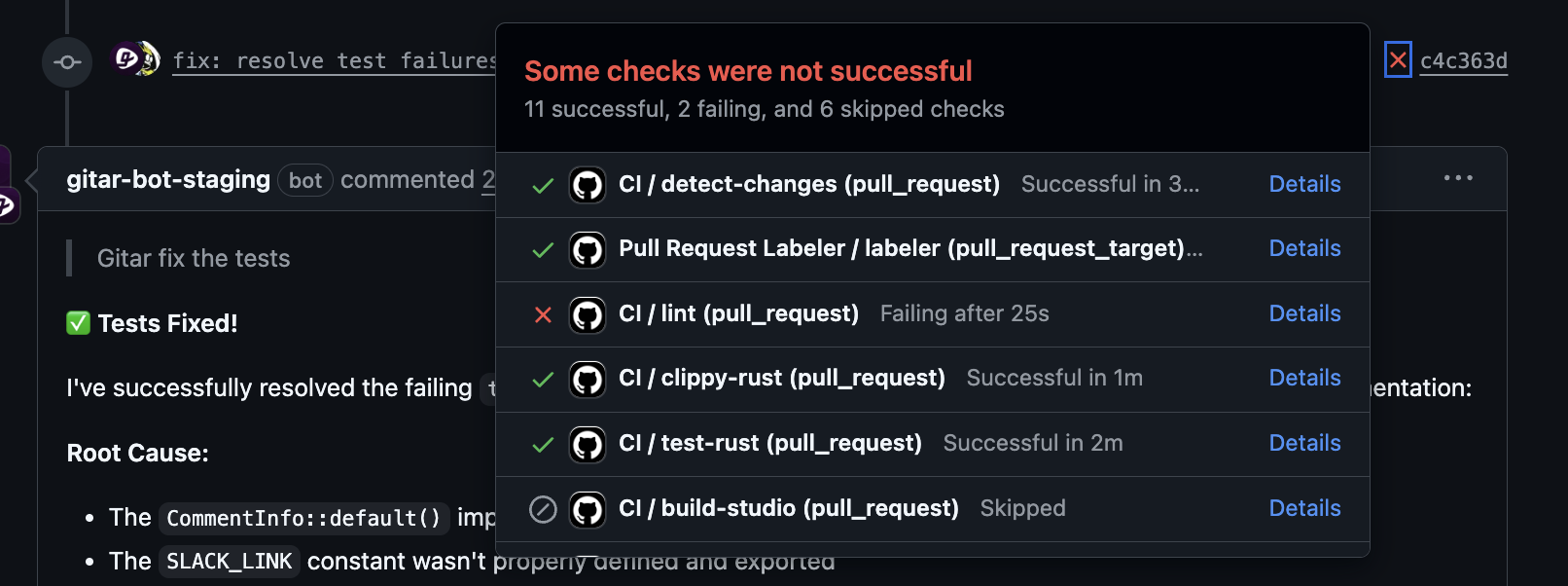
Gitar includes safety measures. Fixes are tested against the full CI pipeline before finalizing, confirming they solve the issue without creating others. Rollback options let you undo changes instantly, and detailed logs show exactly what was done. Conservative Mode adds a review step for extra caution.
How Does Gitar Fit Into Our Current CI/CD Workflow?
Gitar works smoothly with major platforms like GitHub Actions, GitLab CI, CircleCI, and BuildKite. Setup is simple, connecting as a GitHub or GitLab app using standard APIs. It appears in pull requests with status comments, and a web dashboard lets you adjust settings, starting with minimal automation and scaling up as needed.
Why Gitar Leads the Way in Fixing CI Build Failures
Moving from manual debugging to autonomous healing marks a major leap in CI/CD management. Manual fixes waste time, and AI suggestions only help partway. Gitar offers a full solution that today’s teams need to keep up in a fast-moving software world.
Old-school CI failure fixes can’t keep pace anymore. With growing code complexity, spread-out teams, and faster release demands, you need automation that acts, not just advises. Gitar cuts down on interruptions and matches your environment for reliable results.
For leaders choosing CI/CD tools, deciding between manual effort, limited AI help, or full automation is about more than just fixes. It’s about gaining time, keeping developers happy, and speeding up releases.
Autonomous CI/CD is here, and teams adopting it now see real gains from self-fixing pipelines. As software demands grow, jumping on this early can set your team ahead.