
Continuous Integration (CI) build failures create major hurdles for engineering teams, draining time and resources. This article covers practical ways to strengthen CI approval workflows and explores how autonomous AI can resolve failures efficiently. If you’re an engineering leader, software developer, or DevOps professional, you’ll find clear steps to turn CI challenges into a smooth, self-correcting system that speeds up code delivery and supports developer focus.
Why CI Build Failures Hurt Engineering Teams
CI build failures silently slow down software development teams, costing time and money while lowering morale. Those red indicators on your CI dashboard signal deeper issues that disrupt progress and team efficiency.
Understanding CI Build Failures and Their Causes
A CI build failure happens when automated processes meant to test and validate code hit errors, halting the build. Common causes include flaky tests, incorrect configurations, mismatched environments, dependency issues, and version control problems. These interruptions break developer momentum and delay projects.
Here are the main reasons builds fail:
- Test flakiness, where tests pass locally but fail in CI due to timing or environmental differences.
- Configuration errors, such as wrong build scripts or missing variables.
- Environment mismatches between local setups and CI systems.
- Dependency conflicts from version mismatches or missing packages.
- Version control issues, like merge conflicts or corrupted commits.
These failures, especially broken builds from syntax errors or incompatible dependencies, stop all downstream tasks, creating bottlenecks in the pipeline.
How CI Failures Impact Developers
CI failures do more than just stop a build; they disrupt developer workflow. Each failure forces developers to drop their current task, decode error logs, fix the issue, and rerun the process, eating up valuable time.
This constant interruption is a major productivity killer. A single failure can stall the entire development process, especially in collaborative setups, costing organizations thousands of hours. What might be a quick fix often turns into a long distraction due to mental fatigue from switching tasks.
CI failures also harm developers through:
- Breaking focus, making it hard to tackle complex problems.
- Causing frustration from repetitive, low-value debugging.
- Adding mental strain from juggling failed builds and active projects.
- Lowering code quality as developers rush fixes under pressure.
Install Gitar now to fix broken builds automatically and ship better software faster.
Business Consequences of CI Failures
CI build failures don’t just affect developers; they impact the entire organization. Slowed development cycles create measurable delays and financial losses that ripple beyond the engineering team.
Key business effects include:
- Delayed feature releases, slowing down time to market.
- Wasted resources as skilled developers debug instead of innovate.
- Damaged customer trust from inconsistent delivery timelines.
- Missed opportunities to focus on new features or debt reduction.
For a team of 20 developers, losing just one hour per day to CI issues adds up to 5,000 hours yearly. At $200 per hour, that’s $1 million in lost productivity, not counting delays in project delivery or market impact.
Why Common Fixes for CI Failures Don’t Work
Many teams rely on manual, reactive approaches to CI failures, which fail to solve underlying issues. These methods often waste more time than they save.
Typical approaches include:
- Manual debugging, where developers fix issues one by one, duplicating effort.
- Retrying builds without addressing root causes, delaying real solutions.
- Heavy documentation that quickly becomes outdated and burdensome.
- Overloaded alerts that flood developers with notifications but no clear fixes.
These methods turn CI into a series of manual roadblocks, focusing on symptoms rather than creating lasting, scalable solutions.
How to Strengthen CI Approval Workflows
Building effective CI approval workflows takes a mix of prevention, automation, and quick feedback. These practices help turn CI pipelines into reliable systems that support, rather than slow, software delivery.
Prevent CI Failures Before They Start
Stopping CI failures before they happen is the best strategy. Quality checks and validation processes can catch issues early, reducing the need for fixes later.
Practical steps include:
- Pre-commit hooks to catch errors like linting issues or missing dependencies locally.
- Branch protection rules to enforce quality checks before merging.
- Dependency lock files to maintain consistent environments across stages.
- Containerized setups that match production to avoid environment mismatches.
Proper setup, secure secrets handling, and version control discipline are essential to keep CI issues at bay.
Set Clear Approval Standards for Quality and Security
Strong approval workflows need defined checkpoints that balance thoroughness with speed. Automated enforcement and feedback make these checkpoints effective.
Key approval steps include:
- Reviews by code owners familiar with the system’s logic and design.
- Automated scans for security vulnerabilities and compliance.
- Minimum test coverage requirements for new code.
- Performance tests to catch slowdowns or regressions.
- Updated documentation for significant changes.
These steps should guide developers on meeting standards, not just block their progress.
Automate Validation to Save Time
Automation underpins efficient CI approval. It catches issues early without slowing down development.
Essential automations include:
- Testing across multiple environments, like different OS or browser versions.
- Integration tests to confirm external services work with changes.
- Regression tests to protect existing features from breaking.
- Compliance checks for coding standards and security rules.
This automation acts as a safety net, reducing the need for manual checks on technical details.
Speed Up Feedback for Faster Fixes
Quick feedback keeps developers productive by preventing small issues from growing. Clear, actionable information is critical for fast resolution.
Feedback improvements include:
- Detailed error reports with specific fixes, not vague alerts.
- Parallel checks to cut down total validation time.
- Running fast tests first, saving complex checks for later.
- Notifications with code snippets, error locations, and next steps.
Meet Gitar: AI That Fixes CI Failures for You
While standard practices help with CI approvals, they still rely on manual effort when things go wrong. Gitar changes that with autonomous AI, actively solving issues instead of just pointing them out, making CI a self-correcting system.

Gitar offers these core features:
- Complete problem resolution, applying fixes and validating them across CI workflows for successful builds.
- Accurate replication of complex setups, including specific JDK versions and third-party tools, for reliable fixes.
- Support for code reviews, letting teams request AI feedback and apply changes directly.
- Adjustable automation levels, from cautious suggestions to full independence as trust grows.
- Compatibility with GitHub Actions, GitLab CI, CircleCI, BuildKite, and more, unlike tools tied to one platform.
Unlike tools that only suggest fixes, Gitar acts on its own. It analyzes failure logs, applies corrections, and commits them to the pull request branch, keeping developers focused on their work.
Streamline CI approvals and fix build failures—book a demo with Gitar today.
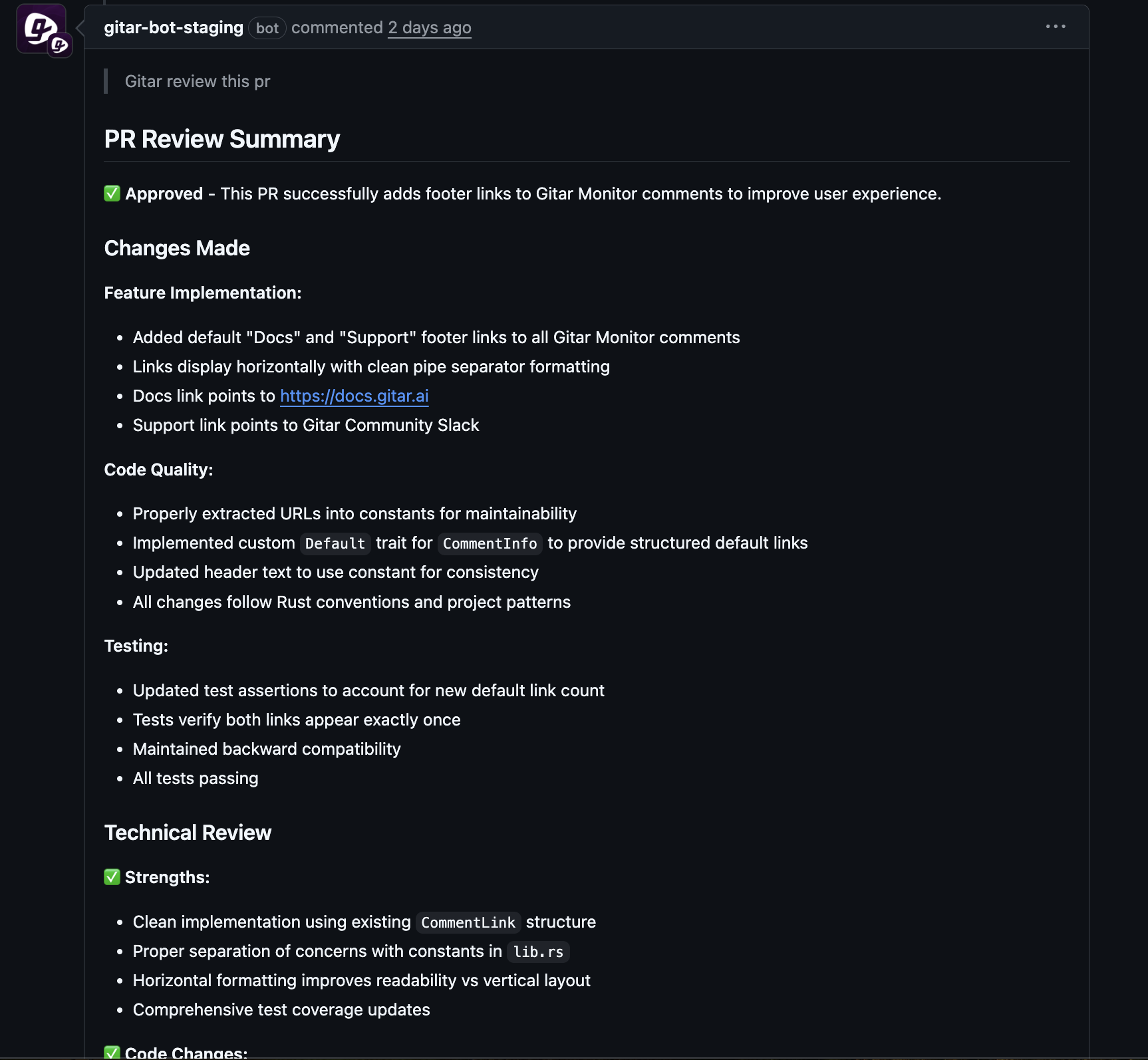
How Gitar Builds a Self-Correcting CI Pipeline
Moving from manual CI fixes to an autonomous system changes how teams deliver software. Gitar automates solutions to common CI pain points, saving time and effort.
End Manual Debugging and Distractions
CI failures often pull developers away from their work to fix errors, disrupting focus. Gitar eliminates this by handling issues automatically.
Here’s how it helps:
- Spots failures instantly as they happen in CI pipelines.
- Analyzes logs to pinpoint the root cause of errors.
- Applies fixes without needing developer input.
- Tests and confirms fixes across the full CI process before committing.
This handles routine issues like linting errors or simple test failures, letting developers stay focused on their tasks while Gitar works in the background.
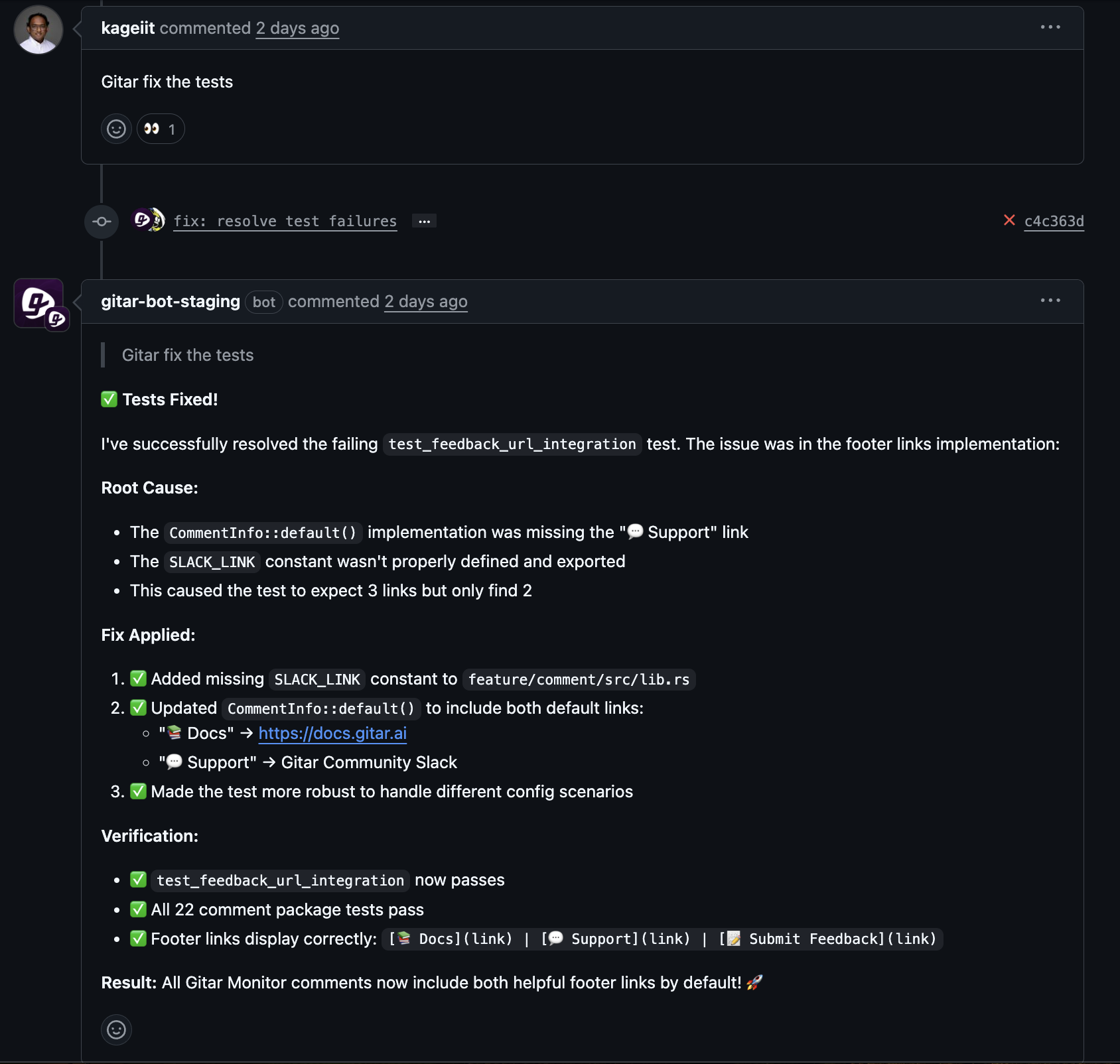
Speed Up Merges and Delivery
Traditional CI approvals slow down the journey from code to deployment with manual fixes and repeated validation. Gitar cuts through these delays.
It accelerates delivery by:
- Fixing issues within minutes of detection.
- Ensuring fixes work in the specific environment on the first try.
- Handling multiple problems at once without waiting.
For instance, when a reviewer provides feedback, Gitar can apply the changes, commit them, and explain what was done, often shortening review cycles.
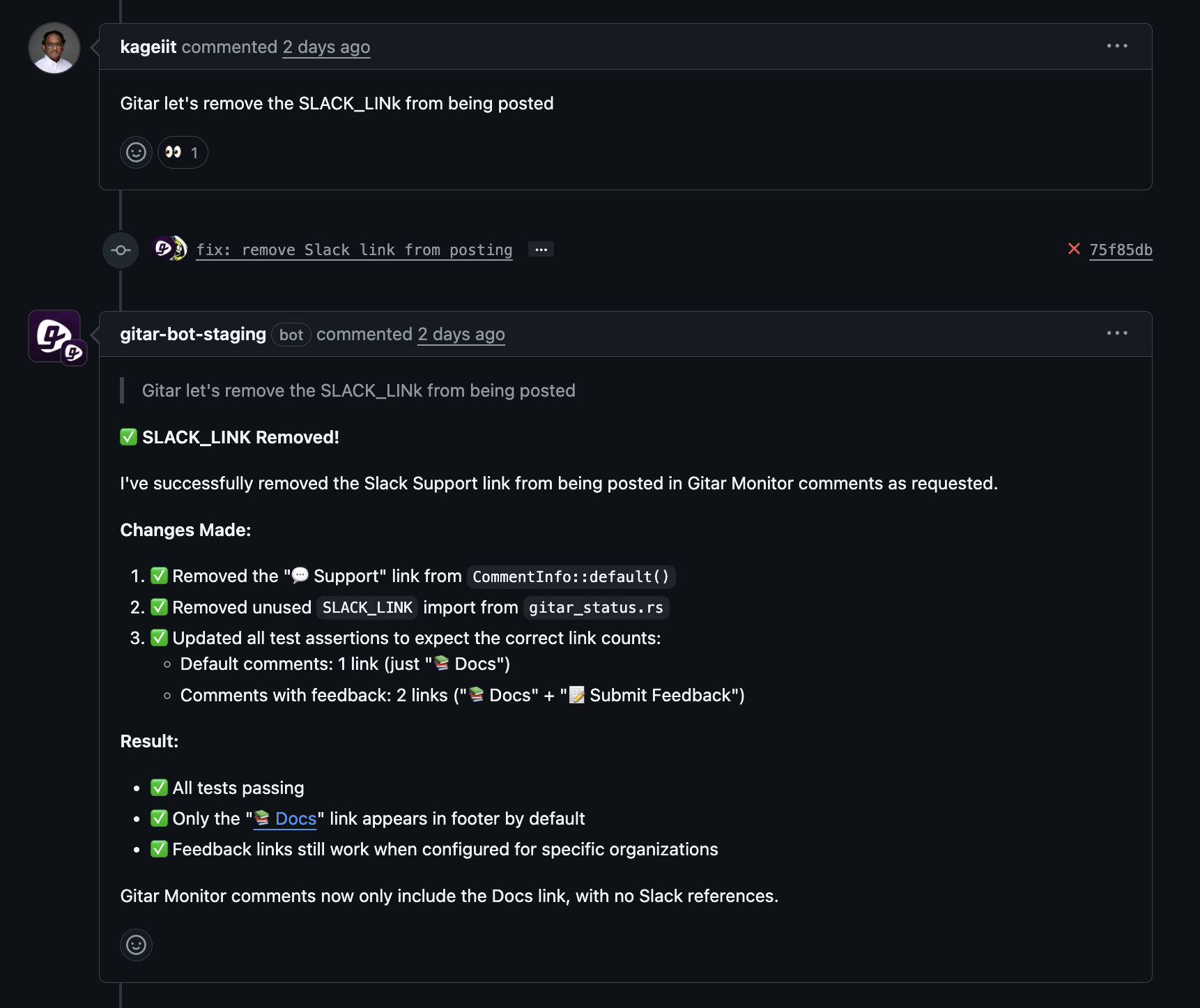
Ensure Consistency in Complex CI Setups
CI failures often stem from differences between local and CI environments, especially in enterprises with unique tools and requirements. Gitar addresses this directly.
It ensures reliability by:
- Mimicking exact CI conditions, including dependencies and integrations.
- Supporting complex enterprise toolchains and scripts.
- Validating fixes across various platforms and setups.
- Resolving dependency conflicts automatically.
Fixes from Gitar work in the real CI environment, cutting down on guesswork and repeated attempts.
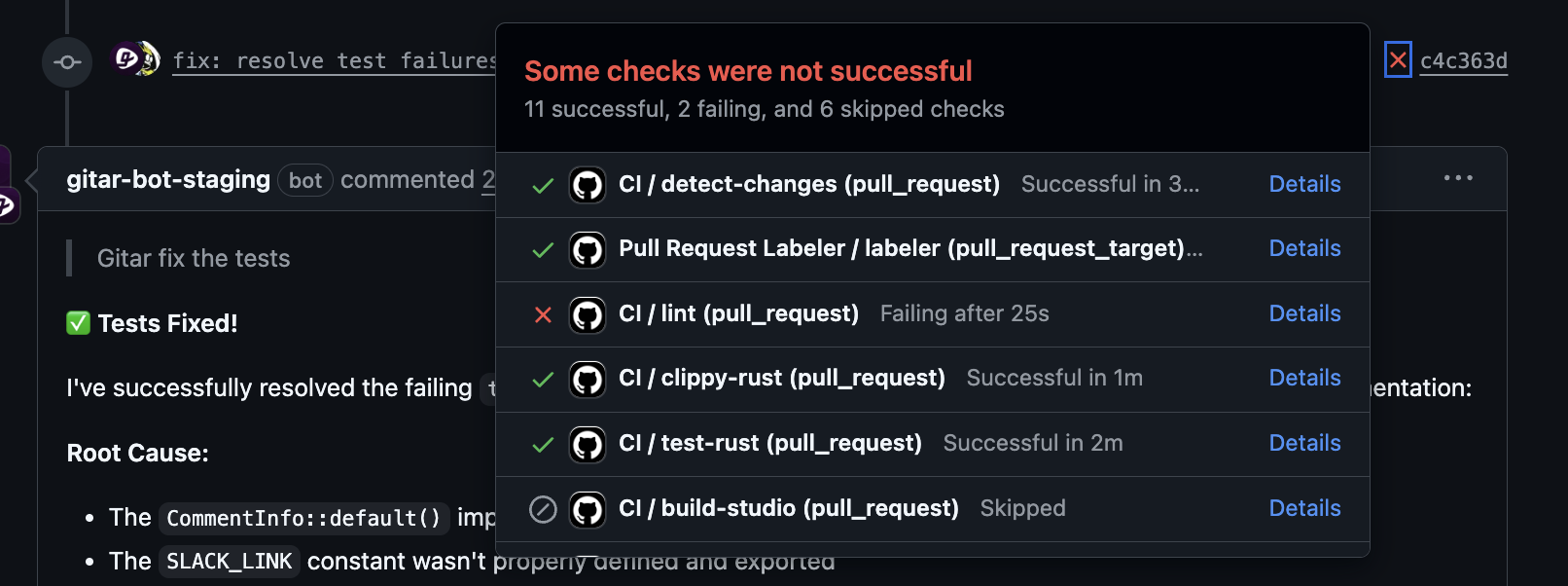
Support Distributed Teams and New Hires
Distributed teams face delays from time zone differences, and new developers struggle with complex CI setups. Gitar eases these challenges.
It helps by:
- Handling feedback and fixes across time zones, keeping work moving.
- Removing the need for deep CI knowledge among new team members.
- Applying coding standards consistently, regardless of experience.
- Letting junior developers focus on coding instead of troubleshooting.
This makes it easier for teams to grow without heavy onboarding or CI expertise requirements.
Comparing AI That Fixes vs. AI That Suggests for CI Issues
Not all AI tools for CI failures work the same way. Some, like Gitar, fix issues on their own, while others only offer suggestions for developers to apply. Knowing the difference helps in choosing the right tool.
|
Feature |
Gitar (Fixing Engine) |
Others (Suggestion Engine) |
Manual Work (Current Standard) |
|
Core Function |
Fixes CI failures and feedback, commits to PR automatically |
Offers ideas, needs manual application |
Developers debug and fix manually |
|
Fix Assurance |
Validates fixes in full CI workflow for successful builds |
Suggestions only, no build guarantee |
No assurance, relies on trial and error |
|
Developer Disruption |
Minimal, works in background |
Interrupts to apply fixes and retest |
High, constant breaks for fixing |
|
Environment Awareness |
Matches enterprise setups for accurate fixes |
Limited context, generic advice |
Depends on local setups, often mismatched |
The gap between fixing and suggestion tools goes beyond features; it’s about how they impact workflow and productivity.
Install Gitar now to fix broken builds automatically and ship quality software faster.
Common Questions About CI Approval Best Practices
How Do Automated CI Approvals Boost Team Productivity?
Automating CI approvals cuts down on manual delays and keeps developers focused. Pairing this with self-fixing tools like Gitar turns a stop-and-fix process into a continuous workflow.
Benefits include:
- Maintaining focus by reducing interruptions for CI issues.
- Speeding up feedback and merge times for faster iterations.
- Enforcing consistent quality without manual checks slowing things down.
- Freeing senior developers for higher-value tasks instead of troubleshooting.
- Scaling effortlessly as teams grow, without added manual oversight.
Can AI Handle Tough CI Problems or Just Basic Ones?
AI tools built for CI, like Gitar, manage a wide range of issues thanks to their understanding of specific environments.
They excel at:
- Fixing routine errors like linting issues or minor test failures for instant gains.
- Tackling complex dependency or configuration problems with full context awareness.
- Matching enterprise setups, including unique tools, for reliable solutions.
The key is how they’re built; tools with deep environment insight handle scenarios that generic AI can’t.
What Are the Security Risks of Automated CI Fixes?
Security matters with automated CI fixes, and solid tools address this through flexible settings and transparency.
- Adjustable modes in Gitar let teams start with suggestions and move to full automation over time.
- Detailed logs of all actions ensure compliance and easy security checks.
- Integration with existing permissions and rules keeps controls in place.
- Fixes remain visible in pull requests for review before merging.
- Rollback options allow quick fixes if problems arise after automation.
How Is Gitar Different from Other AI Code Tools?
Gitar stands apart from typical AI code assistants due to its scope and independence.
- It works after code is submitted, ensuring builds pass CI checks, unlike pre-commit tools.
- Gitar fixes issues and commits changes on its own, not just suggesting ideas.
- It understands full CI environments, not just local setups, for accurate fixes.
- Gitar supports various CI platforms and tools beyond just Git providers.
- It focuses on pipeline failures, build errors, and test issues, complementing other AI tools.
Conclusion: Achieve Faster Delivery with CI Approval Mastery
Moving from manual CI processes to self-fixing systems offers a huge opportunity to boost productivity in software development. Build failures remain the top reason for CI delays, directly affecting release speed and team output.
Standard CI practices are a start, but they’re not enough for larger teams. Combining prevention, automation, and AI-driven fixes creates a powerful system that turns CI into an advantage.
Core ideas for better CI approvals include:
- Automating checks to catch issues early and protect team time.
- Designing approval steps that add value without unnecessary delays.
- Using AI to resolve failures automatically, keeping development on track.
- Improving CI workflows continuously based on team needs.
For a 20-developer team, automating CI fixes could save over $500,000 yearly while boosting morale and delivery speed. These savings grow as teams expand.
Gitar offers a robust way to adopt autonomous CI management. With detailed environment matching, smart error handling, and flexible automation, it helps teams move faster without sacrificing quality.
Switching to proactive, automated CI isn’t just a tech update; it’s a new way to approach software delivery. Teams that make this shift gain a clear edge in speed and talent retention.