
CI failures can slow down your team and delay software delivery, especially as AI tools speed up code creation. This guide offers a clear way to understand and resolve these issues, helping engineering leaders save time and keep projects on track. Autonomous solutions like Gitar can handle these problems efficiently, letting developers focus on building rather than debugging.
Many teams lose significant time to CI pipeline issues, sometimes up to a third of their day. Manually fixing these failures isn’t practical with today’s fast-paced development. Let’s explore how moving from manual fixes to automated solutions can improve your workflow and reduce delays.
Why CI Failures Hurt Your Team’s Productivity and Business Results
How CI Issues Disrupt Developer Focus
CI failures do more than create technical hiccups; they break developers’ concentration. When a pipeline stalls, developers must stop their work, dig through error logs, recreate the problem, and test fixes. This context switch wastes valuable time.
The mental toll adds up. Even a short 15-minute fix can disrupt focus for over an hour. Studies show it takes about 23 minutes to regain full attention after a distraction, so repeated failures can wipe out productive hours.
For teams spread across time zones, the delay is worse. A developer in one region might push code late in their day, only to wait hours for feedback from a teammate halfway across the world. This stretches simple fixes into days, costing even more time.
The Real Cost to Your Bottom Line
CI failures impact more than just developers; they affect your business. Many failures stem from maintenance tasks like refactoring or dependency updates rather than new features. This means teams spend too much effort on overhead instead of progress.
For a team of 20 developers, losing just one hour daily to CI issues can cost around $1 million yearly, based on a $200 hourly rate including benefits. This loss grows during intense development phases or large updates.
The ripple effects hit harder with delayed releases, missed opportunities, and extended project timelines. Surveys find that 60% of companies blame CI issues for project delays, which can hurt market position and revenue.
Why AI Tools Make CI Bottlenecks Worse
AI coding tools like GitHub Copilot speed up writing code, but they create a new challenge. The bottleneck now sits in validating and merging code through CI pipelines. More code means more pull requests, tests, and potential failures.
Manual fixes can’t keep up with this increased pace. Teams often see their productivity gains from AI erased by slow validation processes. Addressing this requires automated solutions to match the speed of code creation.
Ready to save time? Install Gitar to fix broken builds automatically and ship quality software faster.
From Manual Fixes to Autonomous Solutions: A Quick History
Manually Tackling CI Failures
Traditionally, developers fix CI failures by hand. When a pipeline breaks, they stop their work, analyze logs, find the cause, apply a fix, and wait for the pipeline to rerun. This process eats up time and focus.
This manual method doesn’t scale well. It pulls developers away from coding to wrestle with build environments. Fixes often take multiple tries, and lessons learned rarely apply to future issues, leading to repeated effort.
As teams and codebases grow, the variety of CI setups and failure types multiplies. What works for a small group becomes a heavy burden for larger organizations.
AI Suggestions for Debugging
AI tools brought a step forward by analyzing failures and suggesting fixes. However, developers still need to apply these suggestions and verify they work, keeping them in the loop for every issue.
While this approach cuts down on diagnosis time, it doesn’t remove the need for context switching. Developers must still implement and test changes, which takes effort.
Sometimes, these tools offer incomplete or wrong suggestions, creating extra work. Teams end up debugging both the original failure and the flawed recommendation.
Moving to Fully Automated Fixes
Autonomous CI solutions mark a big leap forward. They don’t just suggest fixes; they apply, test, and deploy them without human input.
These systems spot patterns in failures and use proven methods to resolve them. Instead of treating every issue as new, they rely on established solutions.
What sets them apart is their ability to work within your exact CI environment. They mimic the full setup, test fixes in real conditions, and confirm everything functions before notifying developers.
Breaking Down Common CI Failures and Their Causes
Unreliable Tests and Environment Gaps
Test failures are a frequent CI headache, often varying by setup. Flaky tests and random failures often come from timing problems, async code, or inconsistent dependencies. Tracking down the root cause can be tough.
Flaky tests fail sporadically, often due to race conditions or assumptions that hold locally but break in CI with different settings. This inconsistency complicates debugging.
Differences between local and CI environments also cause issues. Developers might use mismatched versions or setups, hiding problems until CI runs. Even with containers, perfect alignment remains a challenge.
Build and Dependency Problems
Build errors frequently arise from missing dependencies, version mismatches, or setup mistakes that stop code from compiling or packaging correctly.
Managing dependencies gets tricky with apps using many external libraries. Updates to dependencies or bug fixes often lead to CI build failures. Teams may not foresee the impact of changes.
Configuration errors in CI environments add another layer of trouble. Small mistakes in variables or tools can derail pipelines, requiring specific expertise to resolve.
Deployment and Production Hiccups
Deployment issues differ based on a company’s setup and needs. Errors in packaging or releasing are more common in enterprise settings due to complex processes.
Enterprise pipelines include multiple steps like approvals and security checks, each a potential failure point. Issues can range from container builds to scan failures, often needing specialized skills to fix.
These late-stage failures sting the most. After investing time in development, teams may need to undo changes, investigate infrastructure, and coordinate with others to get back on track.
How Gitar Changes the Game for CI Failure Fixes
Complete Automation from Problem to Solution
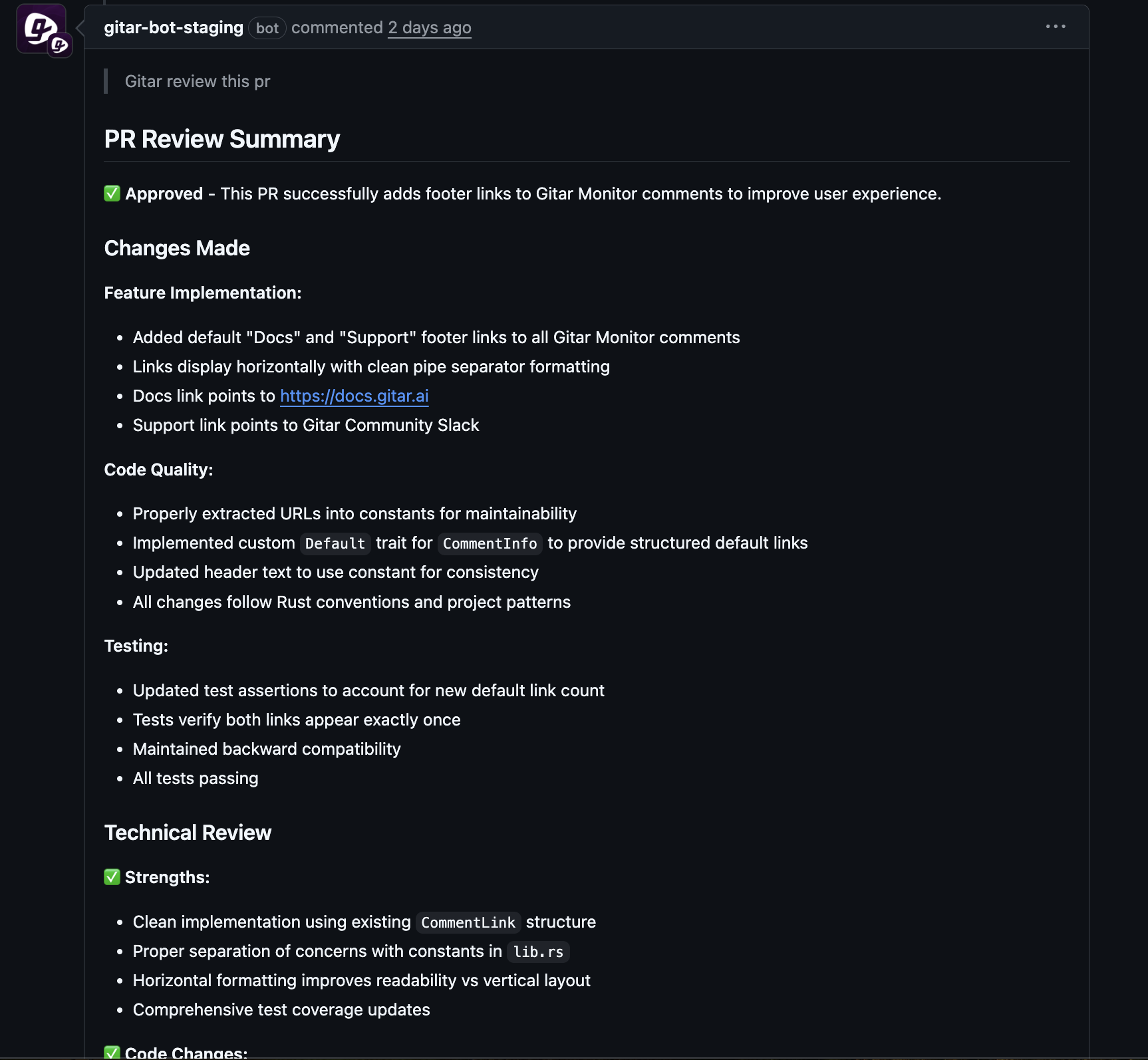
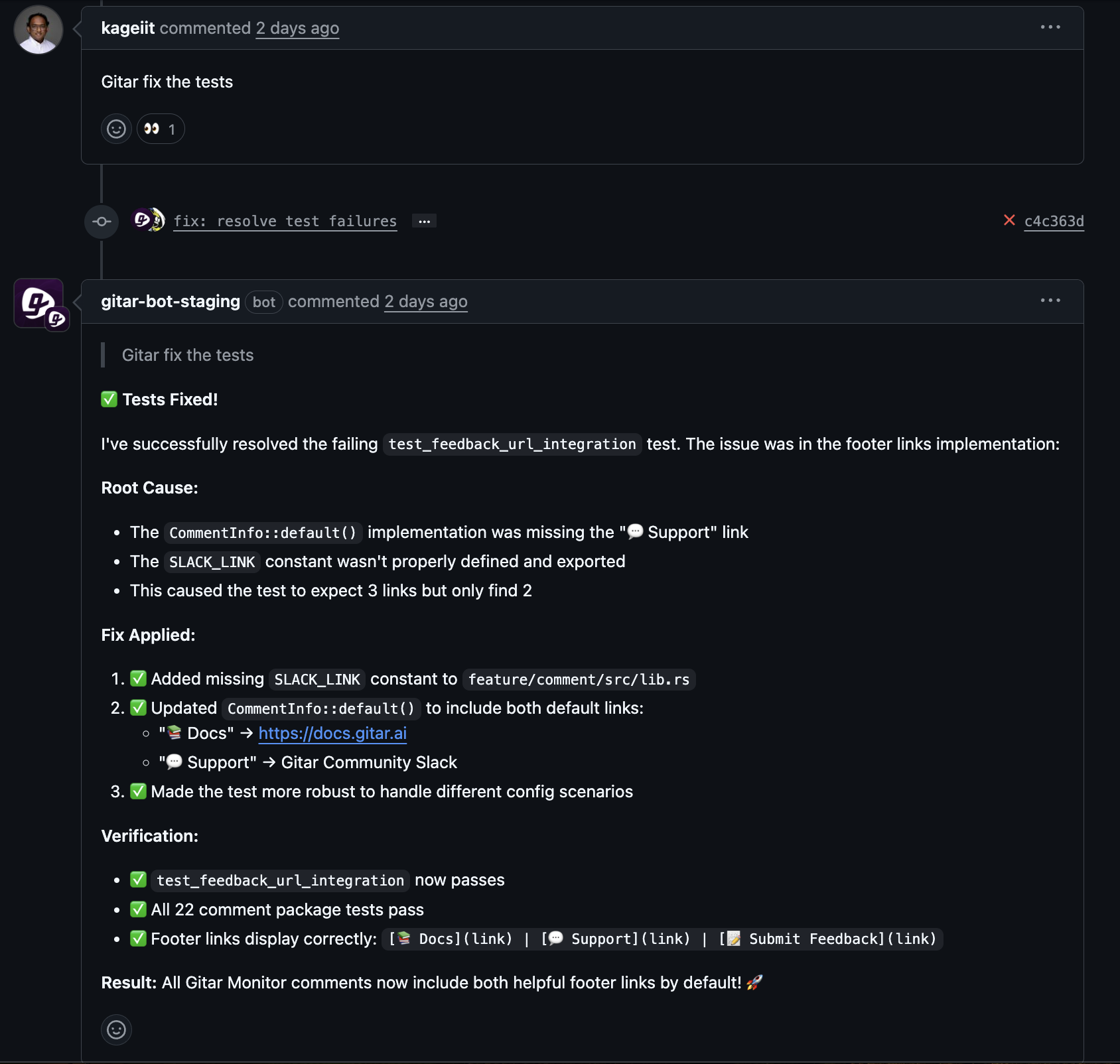
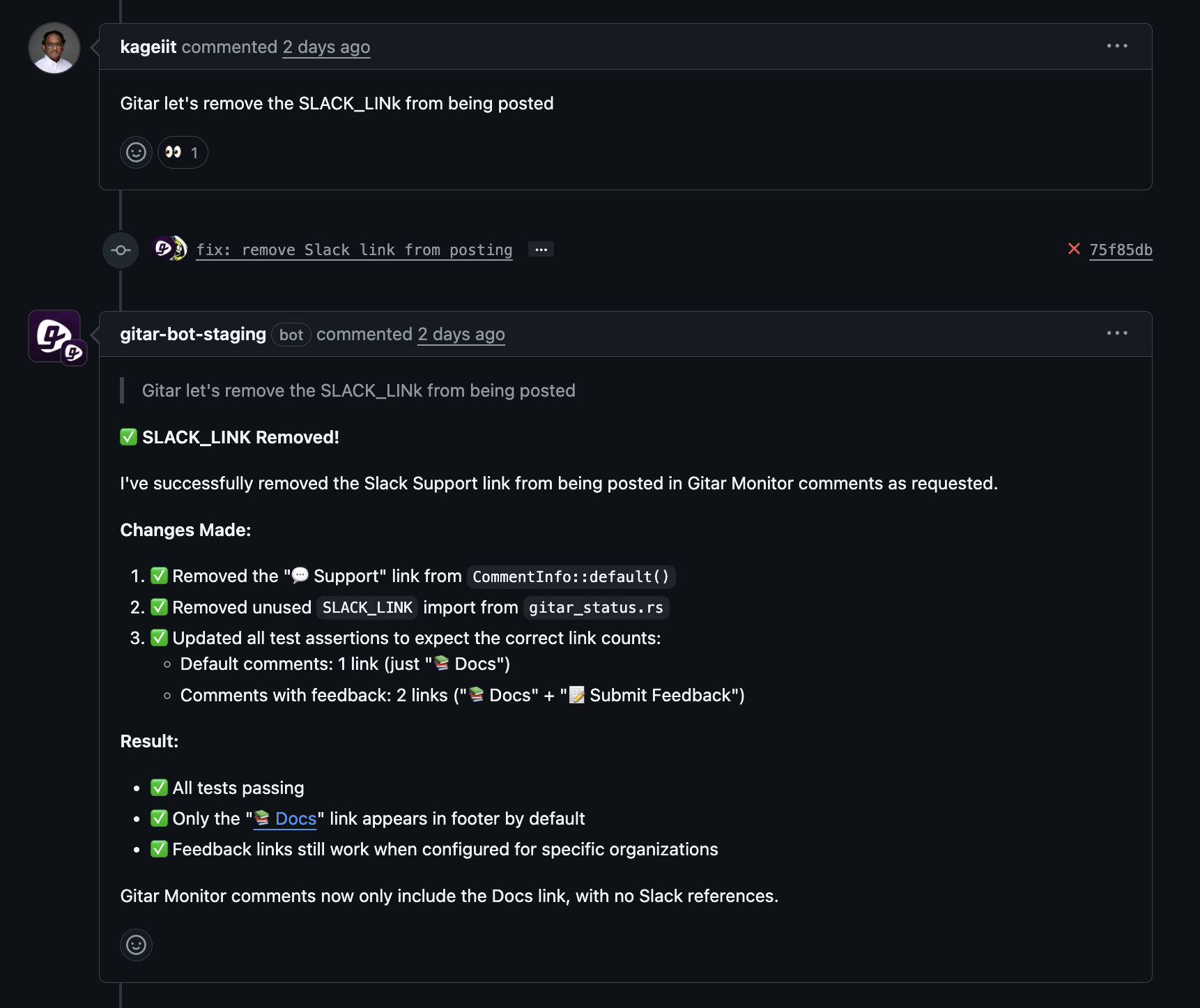
Gitar shifts CI failure resolution by acting as a full fix engine, not just a helper. When a failure happens, it identifies the issue, creates a solution, applies the change, and verifies it works in your CI setup.
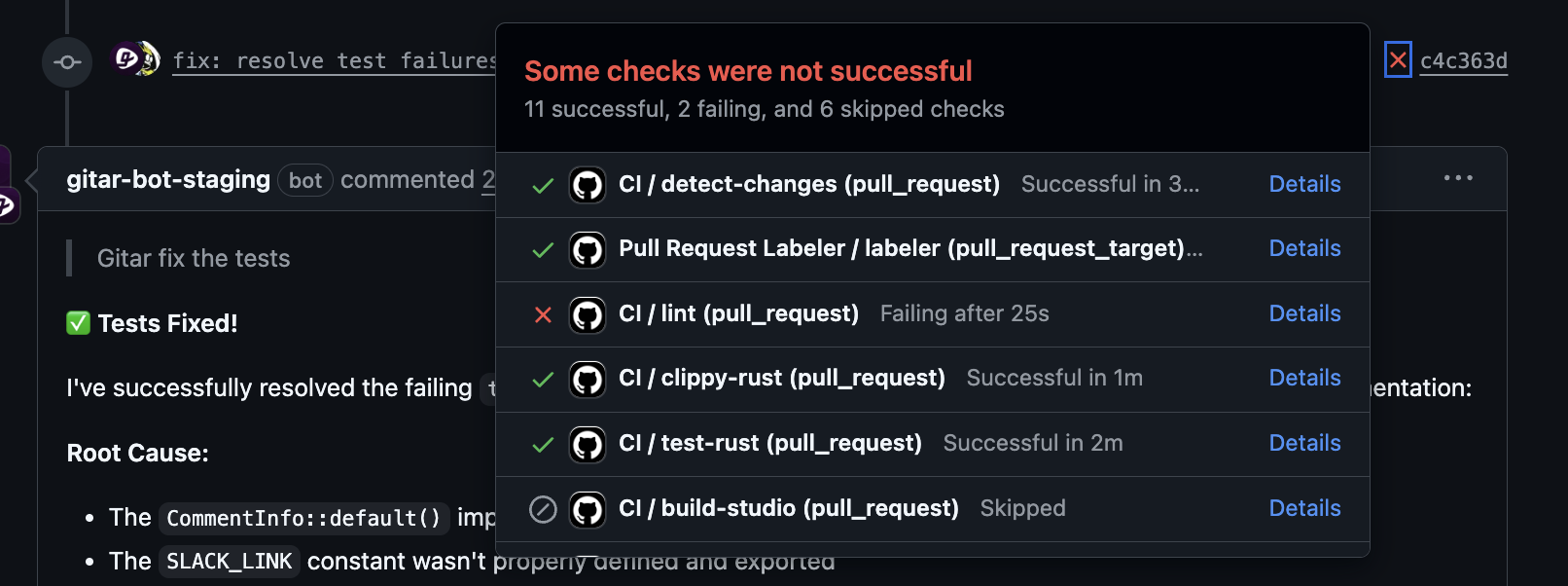
It tackles common problems like lint errors, test failures, build issues, and dependency conflicts. After spotting a failure, Gitar checks logs, updates the pull request branch, and commits the fix with clear notes.
This cuts out the usual loop of noticing a failure, investigating, fixing, and waiting for another run. Often, developers see the issue resolved before they even know it happened, keeping their focus on coding.

Understanding Your Unique CI Setup
Gitar stands out by mirroring your specific CI environment. It accounts for SDK versions, dependency setups, security scans, and custom workflows, unlike generic AI tools.
This matters for teams with intricate pipelines or unique tools. Gitar tests fixes in your actual conditions, ensuring they fit without causing new problems.
It manages diverse scenarios like multi-language projects, complex dependencies, and container setups. This tailored approach delivers reliable fixes for real-world use.
Earning Trust with Flexible Automation
Gitar builds trust with options to ease into automation. Start with a cautious mode where it suggests fixes for your approval with one click, letting you see results first.
As confidence grows, switch to a mode where Gitar applies fixes directly, with the ability to undo changes if needed. This step-by-step process matches your comfort level.
Teams often move from doubt to reliance after seeing Gitar handle small issues flawlessly. A key moment comes when a test failure gets fixed and documented before anyone notices.
Want to streamline your CI process? Install Gitar now to fix broken builds and ship quality software faster.
Why Gitar’s Healing Approach Beats Suggestions or Manual Work
Gitar’s method of fully resolving CI failures stands apart from tools that only suggest fixes or manual debugging. Here’s a clear comparison for engineering leaders weighing options.
|
Feature |
Gitar (Healing Engine) |
AI Code Reviewers |
Manual Debugging |
|
Action on Failure |
Autonomous Fix, Validate, Commit |
Provides Suggestions |
Manual Diagnosis, Fix, Re-push |
|
Environmental Context |
Full Replication |
Limited/No Context |
Local Environment Only |
|
Developer Intervention |
Minimal/Optional |
Required for Implementation |
Extensive Manual Work |
|
Guaranteed Results |
Yes, Validates Against CI |
No, Suggestions May Fail |
No, Requires Multiple Attempts |
AI tools that suggest fixes help with spotting issues but still need developers to apply and test them. This doesn’t fully remove the delay of switching tasks.
These suggestion tools handle the easier step of identifying problems but leave the harder work of fixing and verifying to your team. There’s always a chance the advice won’t work in your setup.
Manual debugging gives control but takes too much time for routine failures. It forces developers to dive into CI details that may not relate to their main work.
Your Step-by-Step Plan for Autonomous CI Fixes
Checking If Your Team Is Ready
Before adopting autonomous CI fixes, assess your team’s technical setup, culture, and needs. Look at how often CI failures slow you down and whether automation could help.
Technically, you need consistent CI pipelines and data on failure rates to justify the switch. Teams with frequent issues will see quick benefits.
Culturally, gauge how open your team is to automation. If they’ve used similar tools before, adoption will be smoother. Support from leadership and clear communication also help.
Rolling Out in Phases
Start with a simple setup phase. Connect Gitar to your CI system and track failure trends to understand your needs.
Next, build trust by using Gitar in a limited mode. It suggests fixes for you to approve, letting you see its accuracy while staying in control.
Finally, move to full automation for common issues as you gain confidence. Keep oversight for trickier problems and integrate with your review workflows.
Calculating the Benefits
The financial upside of automating CI fixes is significant. A 20-developer team losing one hour daily to CI issues faces a $1 million yearly cost at a $200 hourly rate.
Gitar can cut roughly half of that routine fix time, saving about $500,000 annually. Beyond money, it reduces frustration, speeds up delivery, and boosts code quality.
Most teams see returns within weeks, and the gains from better focus and smoother workflows often exceed initial estimates.
Common Mistakes When Addressing CI Failures
Overlooking the True Cost
Many leaders focus only on debugging time, missing the broader impact of context switching. A 30-minute fix might actually cost 90 minutes of lost focus.
CI issues also hurt morale. Developers often cite these failures as a key frustration, which can lead to turnover and higher hiring costs.
Sticking to Old Methods
Some teams cling to manual fixes out of habit, even when better options exist. As code volume grows, this approach becomes less sustainable.
Familiarity with hands-on control can block automation. Manual methods might feel transparent, but they don’t handle scale well.
Old habits often hide inefficiencies. Teams tweak manual processes instead of exploring whether automation could handle routine tasks better.
Missing the Importance of Trust
Automation works best when teams trust it. Focusing solely on setup while ignoring team buy-in can lead to pushback.
Start with small wins on simple tasks before automating complex ones. Rushing full automation without building confidence risks rejection.
Clear explanations and rollback options help. Showing how Gitar works and ensuring control over changes encourages acceptance.
Ignoring Unique Setup Challenges
Fixing CI failures needs solutions tailored to your environment; generic tools may not fit enterprise needs. Complex setups with custom tools or rules often trip up basic approaches.
Enterprise systems involve strict security and approval steps. Effective automation must work within these constraints to succeed.
Ready to tackle CI issues? Install Gitar to fix builds automatically and keep your team moving forward.
Key Questions About Autonomous CI Fixes with Gitar
Can Gitar Handle CI Failures on Its Own?
Gitar effectively fixes common issues like lint errors, formatting problems, basic test failures, and dependency conflicts without any input. These often make up a large share of CI troubles.
For trickier issues tied to business logic, Gitar switches to a support role. It offers insights and suggestions, flagging items for your review while handling routine fixes alone.
Over time, Gitar adapts to your codebase and CI patterns, expanding what it can handle. Teams usually see it cover more issues after initial use.
How Does Gitar Work with Complex CI Systems?
Gitar is built for intricate enterprise setups, managing custom tools, multi-step pipelines, and security rules. It replicates your exact build environment, down to SDK versions and integrations.
It connects with platforms like GitHub Actions, GitLab CI, and CircleCI, plus custom setups. For strict security needs, Gitar offers on-premise options.
Setup involves linking Gitar to your version control and CI tools via APIs, then mapping your environment details. Fixes get tested against your real CI config for accuracy.
What If My Team Isn’t Ready for Full Automation?
Gitar offers flexible modes to ease concerns. Begin with a setting where it suggests fixes for your approval, keeping you in charge while showing results.
As you see it resolve issues reliably, trust grows. Teams can then shift to automated fixes for routine problems, knowing they can step in if needed.
Rollback options and detailed logs add reassurance. You can undo changes quickly and track every action for clarity.
How Is Gitar Different from Other AI Tools?
Gitar focuses on post-commit CI validation, unlike tools that assist during coding or review. It applies fixes, tests them, and commits changes, going beyond mere suggestions.
Other AI tools leave the final steps to developers, hoping fixes pass CI. Gitar ensures solutions work by testing them in your full CI environment.
It also pairs well with your current tools. Keep using your favorite coding aids or reviewers while Gitar handles CI fixes to cut debugging time.
What Happens If Gitar Applies a Wrong Fix?
Gitar tests fixes in your CI environment before applying them, reducing the chance of errors. This step helps avoid introducing new issues.
Every change comes with detailed commit notes explaining what was done. If something goes wrong, rollback options let you reverse it quickly.
In cautious modes, no fix applies without your okay. Even in full automation, pre-testing and logs ensure issues are rare and fixable.
Final Thoughts: Gain an Edge by Automating CI Fixes
Fixing CI failures manually is no longer viable as development speeds up with AI tools. Teams stuck in old methods risk falling behind, losing the benefits of faster coding to slow validation.
Switching to autonomous fixes isn’t just a tech upgrade; it’s a way to work smarter. Your team saves money, ships faster, and stays happier by cutting repetitive tasks.
Acting now gives you a lead. Early adopters of tools like Gitar see productivity jumps while others struggle with outdated fixes.
The gains show up fast, beyond just saving costs. Freeing up time from routine CI issues lets your team focus on creating, building a stronger future.
Stop losing developer hours to CI failures. Install Gitar today to fix builds automatically and deliver quality software faster.