
Key Takeaways
- CI/CD failures and fragile pipelines consume a large share of developer time and delay releases, especially in complex enterprise environments.
- AI agents in CI can automatically diagnose issues, propose changes, and validate fixes, shifting work away from manual firefighting.
- Gitar functions as a CI healing engine that applies and verifies fixes across full environments, not just a tool for code suggestions.
- Security, trust, and measurable ROI should guide how platform teams roll out autonomous CI capabilities across repositories and teams.
- Platform engineers can reduce broken builds and code review delays by adding Gitar to existing CI pipelines. Get started with Gitar and book a demo.
Why Autonomous CI Matters for Platform Engineers
The Cost of Traditional CI/CD Bottlenecks
Pipeline reliability directly affects engineering throughput. CI/CD failures, flaky tests, and slow code reviews can consume up to a third of developer time and steadily erode delivery velocity and morale.
Fragile environments and dependency drift push platform teams into constant triage work. Each broken build or misconfigured environment ripples across squads, delaying releases and creating unpredictable delivery schedules.
For a team of 20 developers, these interruptions can translate into hundreds of lost engineering hours and large annual productivity losses that grow with team size and system complexity.
Managing the Right-Shift from Code Generation to Validation
Wide adoption of AI coding assistants has moved the bottleneck from writing code to validating and merging it. Code appears faster, but reviews, CI runs, and policy checks still follow traditional paths. Platform engineers now need CI systems that can keep pace with this higher throughput without weakening quality or compliance.
How Gitar Brings Autonomous Healing to CI Pipelines
Gitar raises CI automation from simple scripting to autonomous remediation. It behaves as an AI agent inside your pipelines that understands failures, proposes precise changes, applies them, and validates that the builds return to green.
Core capabilities include:
- End-to-end fixing across workflows, from root-cause analysis to validated commits
- Full environment replication, including SDK versions, dependency graphs, and tools like SonarQube and Snyk
- A configurable trust model that ranges from suggestions to auto-commits with rollback
- Compatibility with GitHub Actions, GitLab CI, CircleCI, Buildkite, and other major CI platforms
- Automated handling of code review comments, which reduces time zone delays for distributed teams
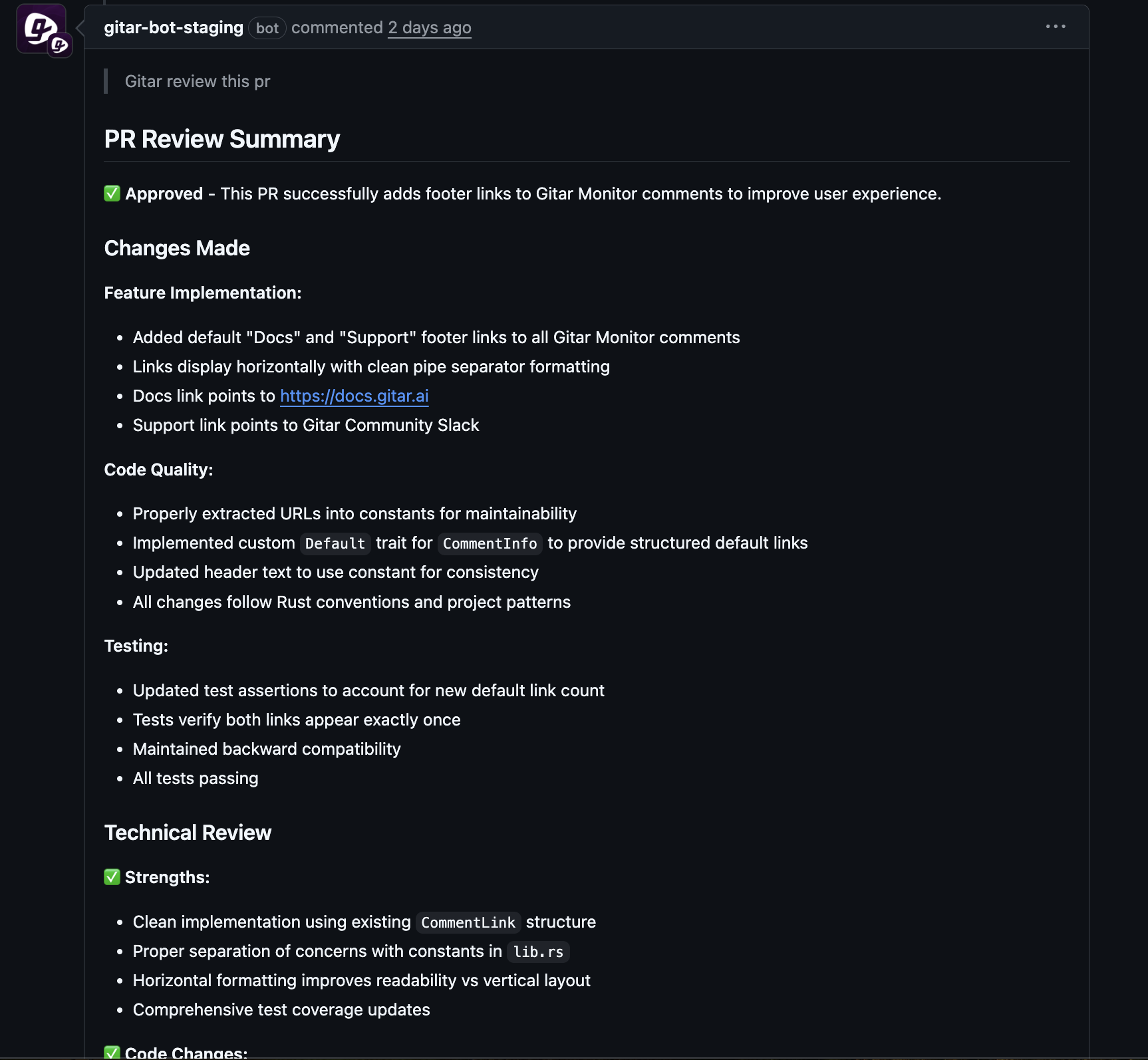
Platform engineers can plug Gitar into existing workflows and choose how much autonomy to allow in each repository or branch.
Install Gitar and start automating fixes for broken builds in your current CI pipelines.
How Gitar’s Architecture Supports Real-World CI Complexity
Agentic Design for Dynamic CI Environments
Enterprise CI environments are noisy and constantly changing. Gitar’s agentic design manages concurrent jobs, asynchronous events, and frequent updates such as force pushes and overlapping pull request comments.
Its context and state management keep track of what changed, which attempts already run, and which actions remain safe. This design reduces the risk of conflicting changes and helps Gitar operate reliably across large, distributed engineering organizations.
Repository Rules and Context-Aware Reasoning
Repository-level rules let platform engineers encode policies and workflows in natural language instead of brittle scripts. Gitar uses these rules with repository context to decide how to respond to failures, which checks to prioritize, and when to request human approval.
This approach allows teams to standardize advanced CI behaviors across projects while keeping configuration overhead low and avoiding complex custom tooling.
Environment Replication for Reliable Green Builds
Reliable automation depends on testing fixes in realistic conditions. Gitar recreates the full CI environment, including language runtimes, dependency graphs, and external tools, before validating changes.
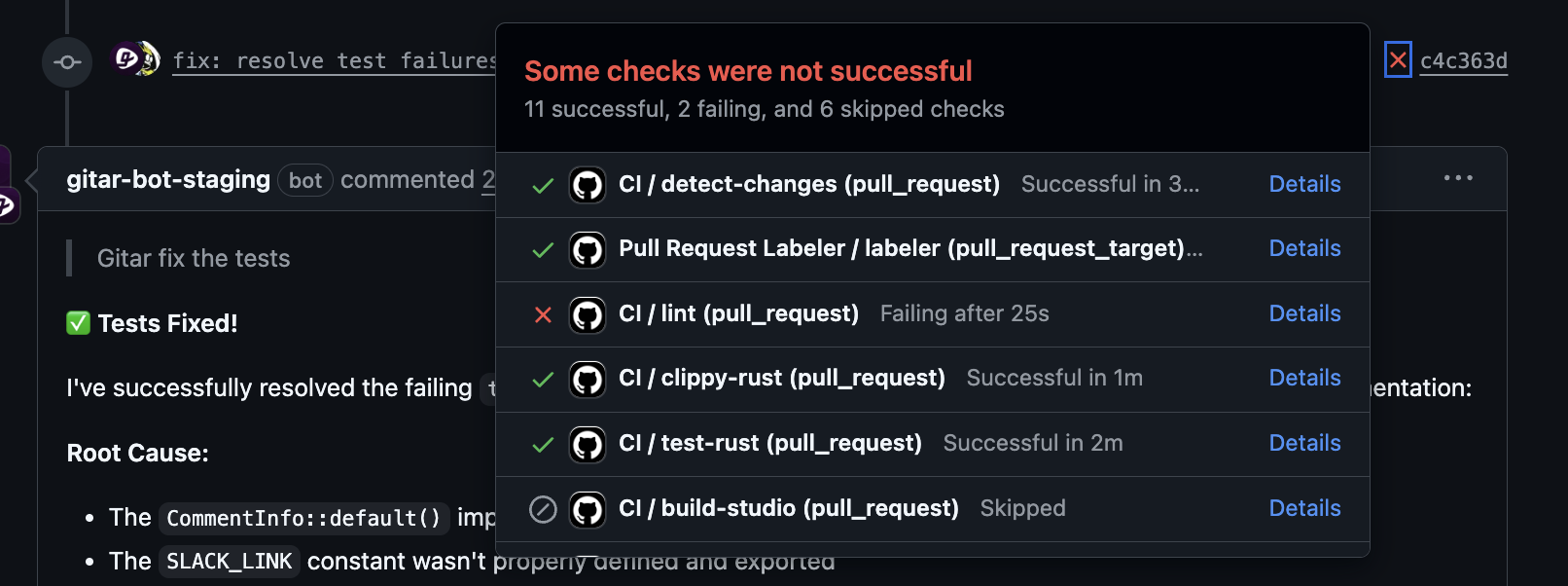
This replication step makes fixes more robust and reduces the risk of passing CI only to fail later in staging or production-like environments.
Adopting AI Agents in CI: Practical Steps for Platform Teams
Assess Readiness and Start with Targeted Pilots
Successful adoption begins with a clear view of current pain points. Platform teams can identify repositories with frequent CI failures or long review queues, then pilot Gitar in suggestion mode on those projects.
Running limited pilots with defined goals, such as reducing mean time to recovery or shortening review cycles, helps teams learn where autonomous fixes add the most value.
Address Security, Compliance, and Trust Boundaries
Security and compliance expectations must shape how AI agents operate. Gitar supports options such as on-premise deployment, scoped permissions, and approval workflows so organizations can align automation with internal controls.
Teams can choose where Gitar may auto-commit, where it may only open pull requests, and when it must request explicit human review, creating clear trust boundaries.
Measure ROI and Developer Productivity Gains
Clear metrics help demonstrate the value of autonomous CI. Useful measures include mean time to resolution for CI failures, build success rates, deployment frequency, and the number of developer interruptions from broken builds.
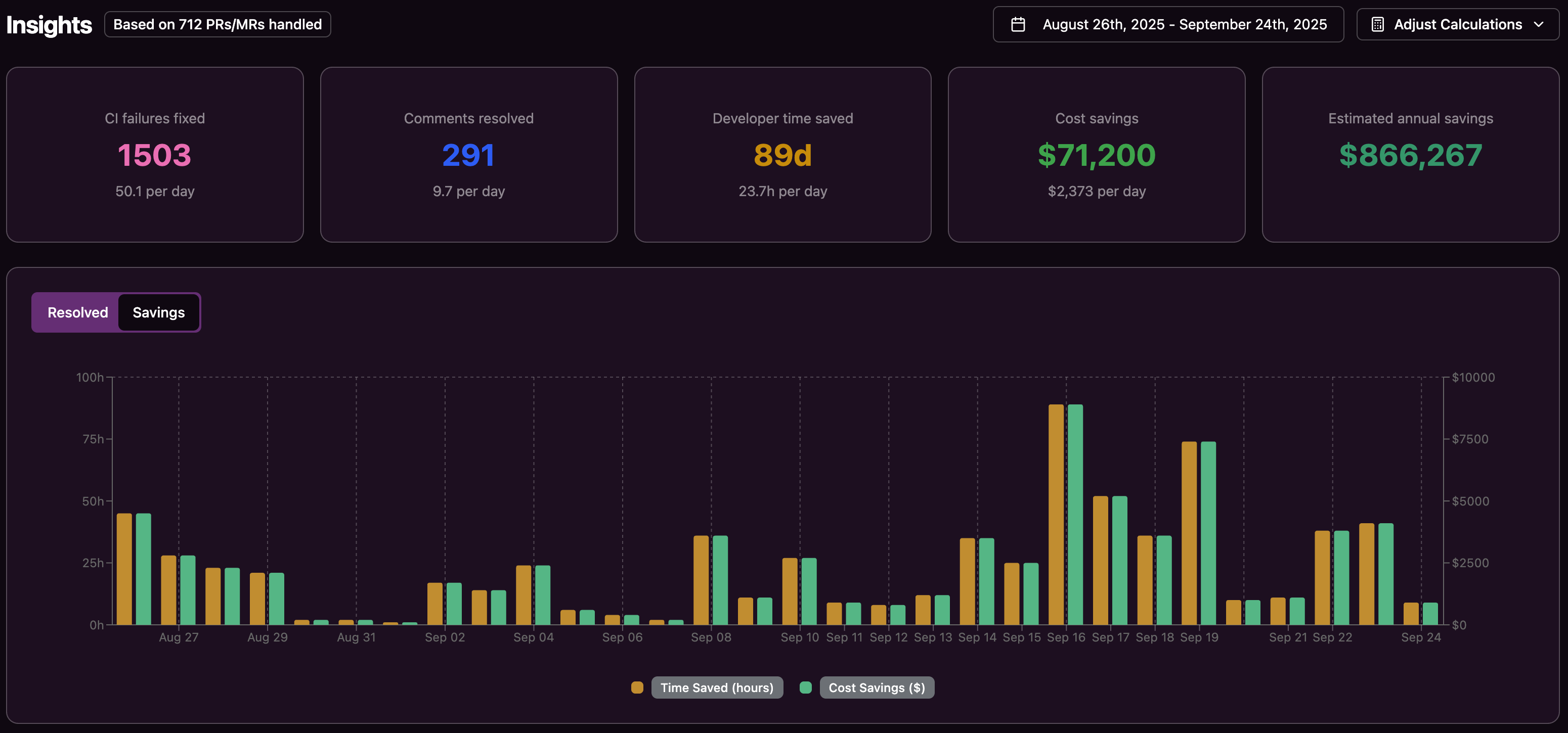
Teams that track these indicators can show how Gitar reduces manual CI work and frees developers to focus on feature delivery instead of pipeline repair.
Add Gitar to your CI and start reducing time spent on broken builds and review backlogs.
Healing Engines vs. Suggestion Engines in CI
How Current AI-Powered CI/CD Tools Differ
AI-assisted CI tools generally fall into two groups. Suggestion engines focus on analysis and recommendations that still require developers to implement and verify changes. Healing engines, such as Gitar, not only propose fixes but also apply and validate them inside full CI environments.
Gitar Compared with Alternatives
|
Feature |
Gitar (Healing Engine) |
CodeRabbit (Suggestion) |
Manual Work (Status Quo) |
|
Primary Function |
Autonomous fix and validate |
Code review and generation |
Manual debug and fix |
|
Fix Execution |
Implements and validates |
Generates suggestions for developer approval |
Developer task |
|
CI Integration Depth |
Full environment replication |
Ephemeral review environments |
None |
|
Trust Model |
Configurable automation levels |
Configurable automation options |
Developer discretion |
Solving the Last-Mile Problem in CI Automation
The key differentiator for Gitar is its focus on the last mile of CI workflows. Many tools can identify issues or suggest patches, but developers still need to wire those fixes into real pipelines and confirm that everything passes.
Gitar closes that gap by owning the full path from failure detection to validated green builds, which reduces repetitive manual steps for platform engineers and reviewers.
The Future of CI for Platform Engineers
Autonomous CI changes the daily work of platform teams. Instead of spending most of their time reacting to breakages, engineers can invest more effort in improving architecture, enhancing observability, and refining developer experience.
Organizations that adopt AI agents for CI in 2026 will be better positioned to handle increasing code volume without sacrificing reliability. As expectations for rapid, stable releases grow, autonomous healing tools like Gitar help teams keep pipelines fast and dependable.
Install Gitar to support a more reliable, less manual CI workflow for your platform teams.
FAQs for Platform Engineers About AI Agents in CI
How is Gitar different from AI reviewers like CodeRabbit or Claude?
Code-focused AI tools typically emphasize review, explanation, or code generation. Gitar acts as a healing engine that not only analyzes issues but also commits fixes and validates them across your CI workflow before developers revisit the pull request.
Can Gitar support complex, enterprise-specific CI environments?
Gitar is built for enterprise CI complexity. It can mirror custom dependencies, specific SDK versions, monorepo layouts, and third-party integrations such as security scanners or quality gates so that fixes reflect real production constraints.
How does Gitar keep automated fixes safe in production pipelines?
Safety comes from environment replication and configurable trust controls. Teams can require human approval for certain branches, restrict auto-commits, and rely on full CI revalidation before any change proceeds toward production.
What distinguishes AI agent-driven CI from traditional CI/CD automation?
Traditional automation follows predefined scripts and fails when issues fall outside known patterns. AI agent-driven CI allows systems like Gitar to reason about new failures, propose changes, and validate outcomes without always needing manual intervention.
How quickly can teams see ROI from implementing Gitar?
Teams often notice benefits soon after deployment as recurring issues such as lint errors and flaky tests stop blocking developers. Over the following weeks, reduced interruptions and faster merges typically add up to clear productivity gains.