
Key Takeaways
- Manual CI remediation and code review cycles consume significant engineering time and slow delivery, especially in large organizations.
- Autonomous code quality enforcement turns CI into self-healing infrastructure by detecting, fixing, and validating issues with minimal human input.
- Effective platforms combine code understanding, environment replication, CI validation, and configurable trust models to fit enterprise needs.
- Platform teams gain clear ROI by cutting failure rates, reducing context switching, and improving developer experience across complex environments.
- Gitar provides an autonomous CI healing engine that fixes failing builds and review feedback end to end, which you can try by installing Gitar for your pipelines.
The Strategic Imperative: Why Autonomous Code Quality Enforcement Matters
Modern CI/CD pipelines create heavy operational overhead for platform engineers. As services and teams scale, traditional quality gates slow developers, who may spend a large share of their time chasing CI failures and review comments.
The cost of this drag adds up quickly. A 20-developer team can lose thousands of hours each year to CI-related context switching, which can translate into hundreds of thousands of dollars in lost productivity, along with slower releases and rising frustration.
Manual code reviews introduce queues, inconsistency, and frequent context switches, which reduces delivery velocity. Autonomous code quality enforcement reduces this friction by resolving many issues before they interrupt developer flow.
Autonomous systems shift CI from passive alerting to active remediation. They diagnose root causes, implement validated fixes, and keep pipelines healthy with far less manual intervention.
Understanding Autonomous Code Quality Enforcement
What Self-Healing CI and Autonomous Remediation Mean
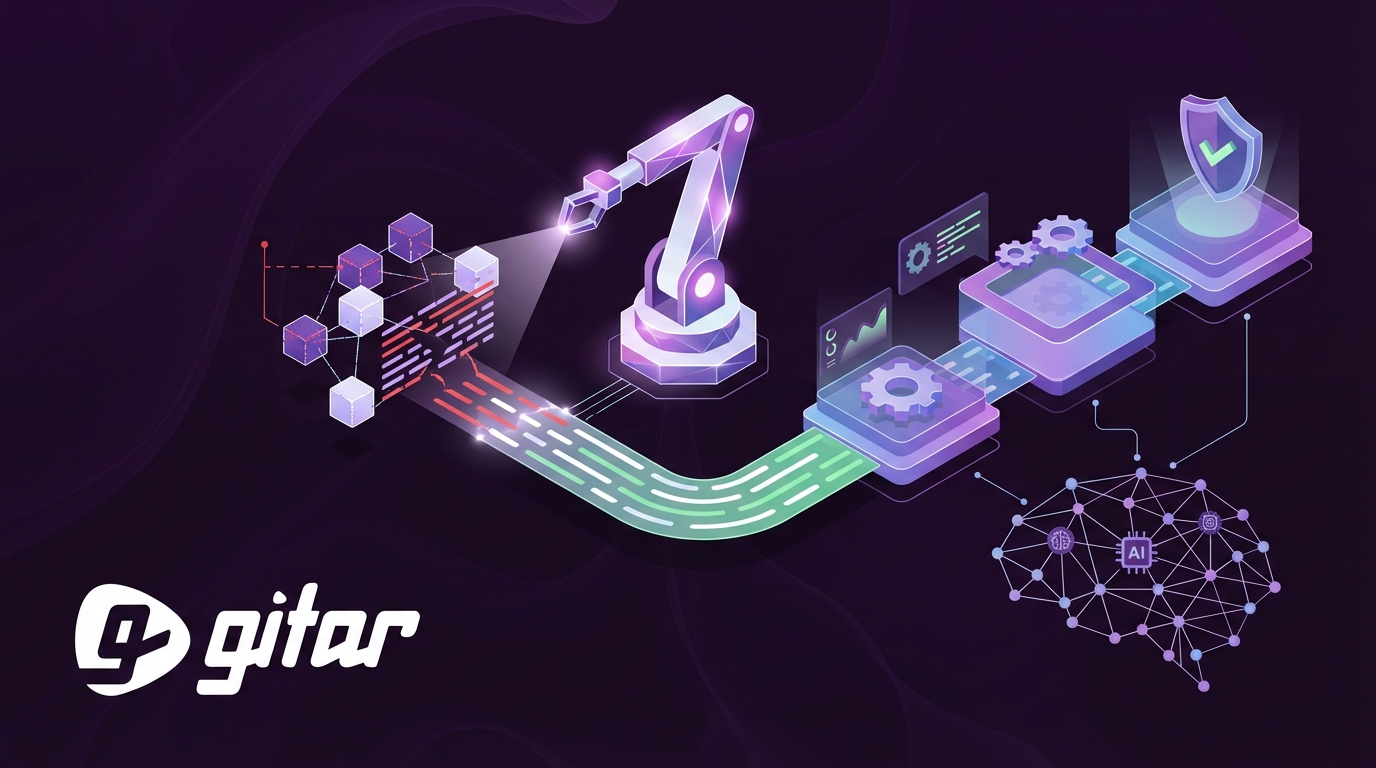
Autonomous code quality enforcement goes beyond static analysis and AI suggestion tools. Conventional tools point out problems and propose fixes. Autonomous systems act as healing engines. They detect issues, generate fixes, validate those fixes in CI, and apply them so builds stay green.
This approach turns CI pipelines into proactive, self-maintaining infrastructure. Autonomous agents can enforce standards, detect inefficiencies, and correct errors in codebases while keeping developers focused on feature work.
Strong systems share three traits. They understand code and environment context. They validate changes against real workflows. They use configurable trust models so teams can adopt automation gradually.
How Autonomous Enforcement Supports Business Goals
Autonomous enforcement supports faster delivery, lower operational cost, and a better developer experience. Platform engineers can maintain high reliability with fewer manual interventions, even as systems and teams grow.
Autonomous testing and enforcement improve code quality and increase deployment reliability, which is especially important for distributed teams and complex architectures.
Core Components of Effective Autonomous Systems
An effective platform for autonomous enforcement typically includes:
- Analysis engines that understand language, framework, and repository context
- Environment replication that mirrors CI conditions and external dependencies
- Validation workflows that run tests and checks before applying fixes
- Trust controls that range from suggestion-only modes to auto-commit behavior
The Evolving Solutions Landscape for Platform Engineers
From Linting to AI-Powered Fixing
Code quality tools have moved from simple linting to static analysis and then to AI suggestions. Many teams now face a new ceiling where suggestions still require manual remediation, which keeps CI as a bottleneck.
Autonomous software agents can enforce standards and correct errors directly in codebases, which pushes the landscape from suggestion engines toward healing engines.
Suggestion Engines vs Healing Engines
Many current products operate as suggestion engines. They deliver detailed reviews, comments, and in some cases patch suggestions, yet they still rely on developers to apply and validate fixes.
Large language model integrations for CI often ship as toolkits. They can be powerful but usually need custom engineering to achieve reliable, autonomous workflows.
Fixing the Right-Shift Bottleneck
AI-assisted coding speeds up code creation, which increases the number of pull requests and potential CI failures. Automated quality gates help address this right-shift bottleneck by handling detection and remediation together.
Suggestion tools can worsen the problem by adding more comments and tasks. Healing engines reduce this noise by resolving many issues without adding to review queues.
Strategic Considerations for Adopting Autonomous Enforcement
Build vs Buy for Platform Teams
Platform leaders often weigh custom agent architectures against purpose-built products. Internal builds require deep AI skills, environment management, and ongoing maintenance, especially when CI runs many concurrent workflows.
Off-the-shelf autonomous platforms provide tested integration paths and hardened behaviors. For most organizations, buying offers faster time to value and lower risk.
Resources, Change Management, and Trust
Successful adoption needs technical readiness and organizational alignment. Teams need stable CI/CD infrastructure, clear integration points, and well-defined ownership.
Teams build trust in autonomous behavior when it rolls out gradually with clear safeguards. Many organizations begin with suggestion-only modes, then expand to autonomous actions as confidence grows.
Measuring ROI and Avoiding Pitfalls
Effective measurement focuses on changes in failure rates, time to merge, and developer velocity. Teams can track metrics such as successful pipeline percentage, average retries per build, and merge lead time, along with developer feedback.
Common pitfalls include underestimating integration work and skipping trust-building phases. A staged rollout with clear metrics helps avoid these issues.
Gitar: Autonomous Code Quality Enforcement in Practice
Gitar’s Autonomous CI Healing Engine
Gitar is an autonomous AI agent for CI pipelines. It detects failing builds and unresolved review feedback, then generates, applies, and validates fixes across your workflows.
This behavior directly supports platform engineers who must keep pipelines reliable, manage complex environments, and enforce consistent standards across many teams.

Core Functionality for Platform Engineers
Gitar focuses on end-to-end fixing at scale:
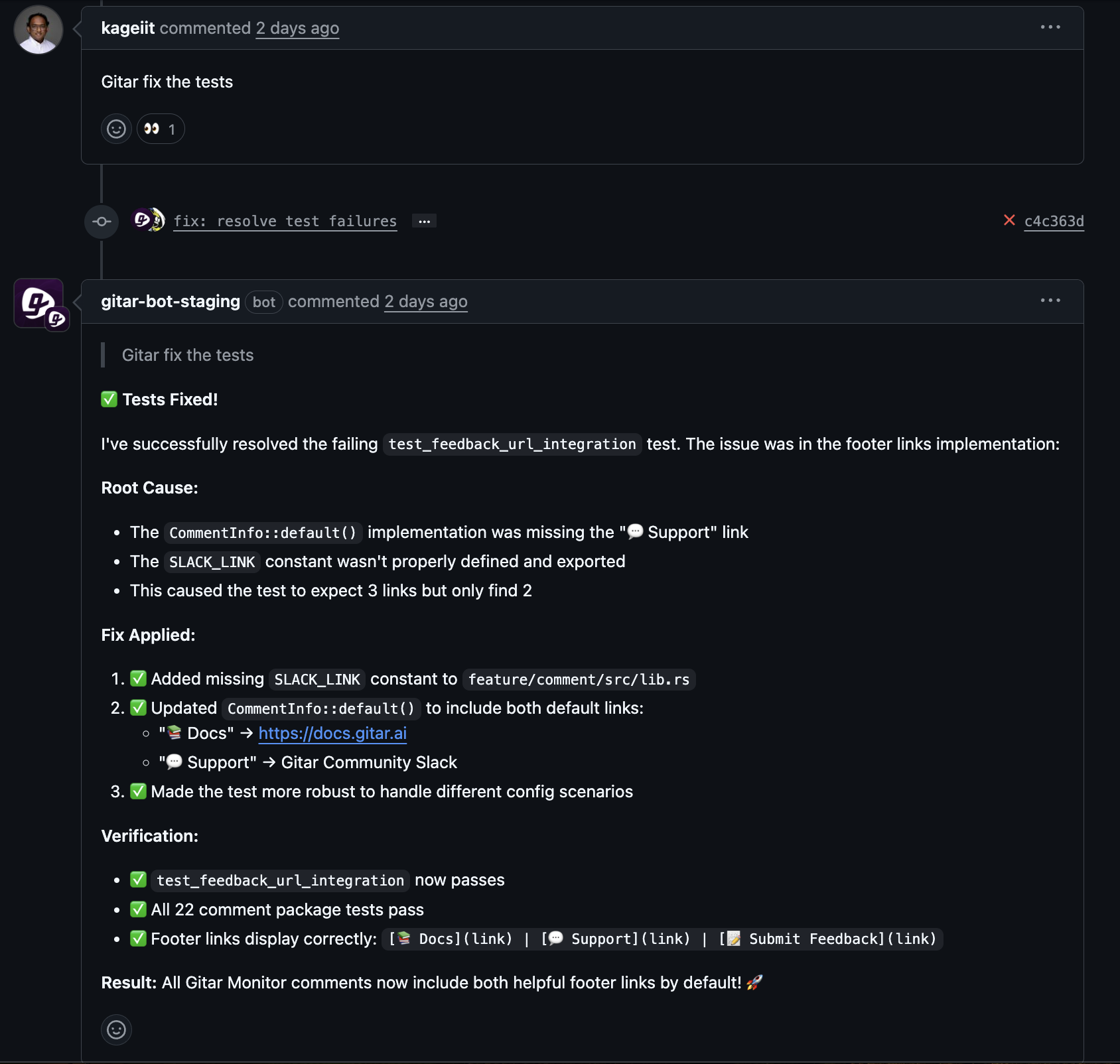
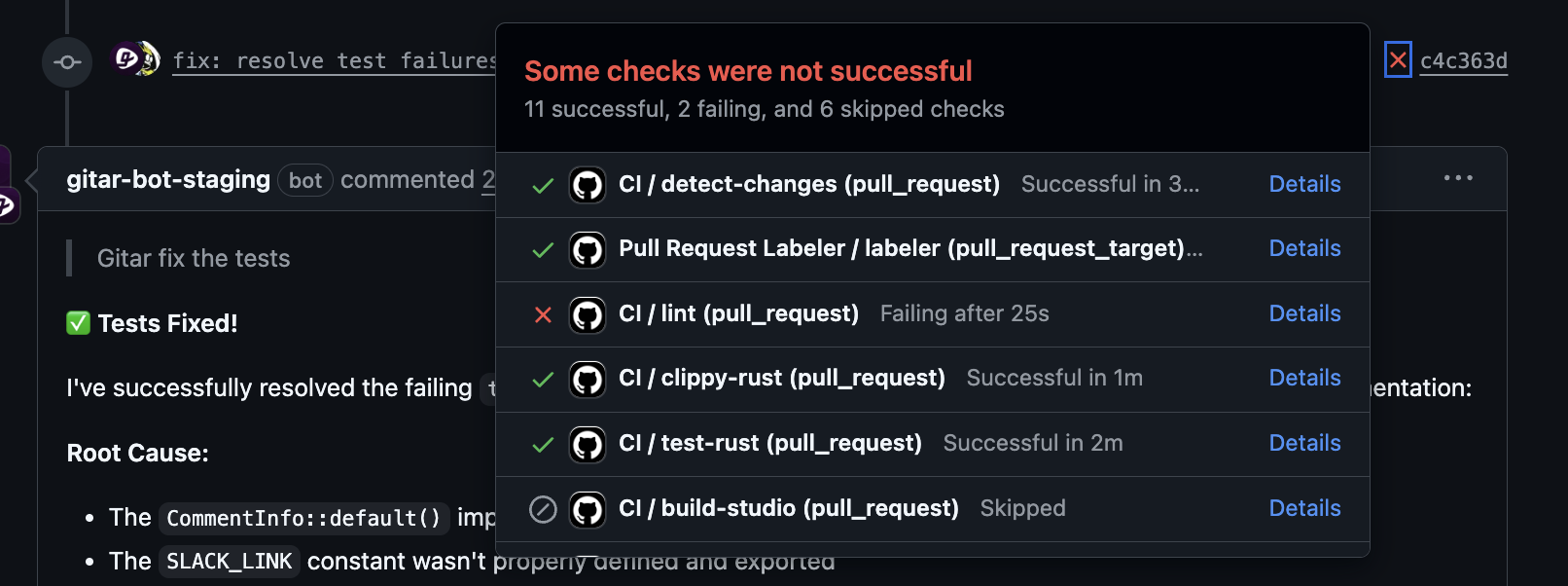
- End-to-end fixing. Gitar generates patches, updates code, runs CI workflows, and confirms that jobs pass before marking builds as healthy. Developers do not need to wire in or test each fix manually.
- Environment replication. Gitar emulates enterprise workflows, including SDK versions, services, and third-party tools, so fixes align with real infrastructure.
- Self-healing CI. Gitar turns pipelines into self-maintaining systems that reduce operational toil, lower CI cost overruns, and ease onboarding for new engineers.
- Configurable trust. Gitar offers conservative suggestion modes and progressively more autonomous options, including auto-commit, so teams can match behavior to their risk tolerance.
Real-World Impact for Platform Teams
Platform engineers use Gitar to keep pipelines stable, remove repetitive remediation work, and unblock feature teams quickly. These improvements support higher development velocity and reduce burnout related to CI firefighting.
Install Gitar to automatically fix broken builds and support higher quality releases. This upgrade helps your CI/CD platform behave more like a reliable product than a constant maintenance task.
Implementation Readiness for Platform Teams
Stakeholders and Rollout Sequence
Effective adoption involves platform engineering, feature team leads, and security stakeholders. Each group needs clarity on scope, controls, and fallback options.
Teams usually start with a limited pilot, define success metrics, then expand to additional repos and environments as results and trust improve.
Autonomous Maturity and Internal Developer Platforms
Most organizations sit between manual remediation and partial automation. This position leaves room for meaningful gains as they move toward autonomous fixing.
Internal developer platforms provide a natural entry point for embedding autonomous controls and exposing them consistently across teams.
Comparison: Gitar (Healing Engine) vs Suggestion Engines
|
Capability |
Gitar (Autonomous) |
AI Reviewers |
Big Model Integrations |
|
Core Function |
Autonomous fixing and validation |
Code suggestions and reviews |
Custom AI assistance |
|
CI Validation |
Full workflow guarantee |
No validation built in |
Custom logic required |
|
Environmental Context |
Complete environment replication |
Limited code-focused context |
Extensive custom setup |
|
Developer Flow |
Preserves flow state |
Requires context switching |
Manual orchestration |
Frequently Asked Questions
How does Gitar handle complex enterprise CI environments that regular AI tools cannot?
Gitar replicates full infrastructure context, including specific SDK versions, multi-platform dependencies, services, and third-party tools. This context helps Gitar generate accurate fixes that work in each environment.
What is the difference between Gitar’s autonomous code quality enforcement and current AI code reviewers?
Most AI reviewers highlight issues and suggest patches, but they rely on developers to apply and test changes. Gitar generates, applies, and validates fixes against CI workflows, which removes manual steps between failure and a green build.
How do platform teams maintain trust and control when they adopt Gitar?
Teams configure Gitar to match their risk profile, starting with suggestion-only or approval-required modes. As confidence grows, they can enable more autonomous behaviors while still keeping rollback options.
Can autonomous code quality enforcement with Gitar reduce CI infrastructure costs?
Gitar cuts the number of failed runs and retries by resolving many issues automatically. Fewer failures lead to lower compute use and better developer productivity, which together reduce effective CI cost.
How does autonomous code quality enforcement align with security and compliance?
Autonomous systems can enforce security and compliance checks consistently, log every change, and provide clear audit trails. This consistency reduces manual oversight and supports compliance programs.
Conclusion: Moving Toward Self-Healing CI in 2026
CI/CD infrastructure in 2026 is trending toward autonomy. Autonomous code quality enforcement helps organizations move from reactive maintenance to reliable, predictable delivery.
AI-driven automation already plays a key role in modern CI/CD pipelines, and autonomous healing builds on that foundation for platform teams.
Gitar offers an autonomous agent that focuses on pipeline reliability and developer productivity rather than more review noise. Platform teams that adopt healing engines alongside existing tooling put themselves in a strong position for modern software delivery.
Install Gitar to automatically fix broken builds and support faster, more reliable releases.