
Key Takeaways
- Manual intervention for CI failures slows platform teams, creates context switching overhead, and reduces developer satisfaction.
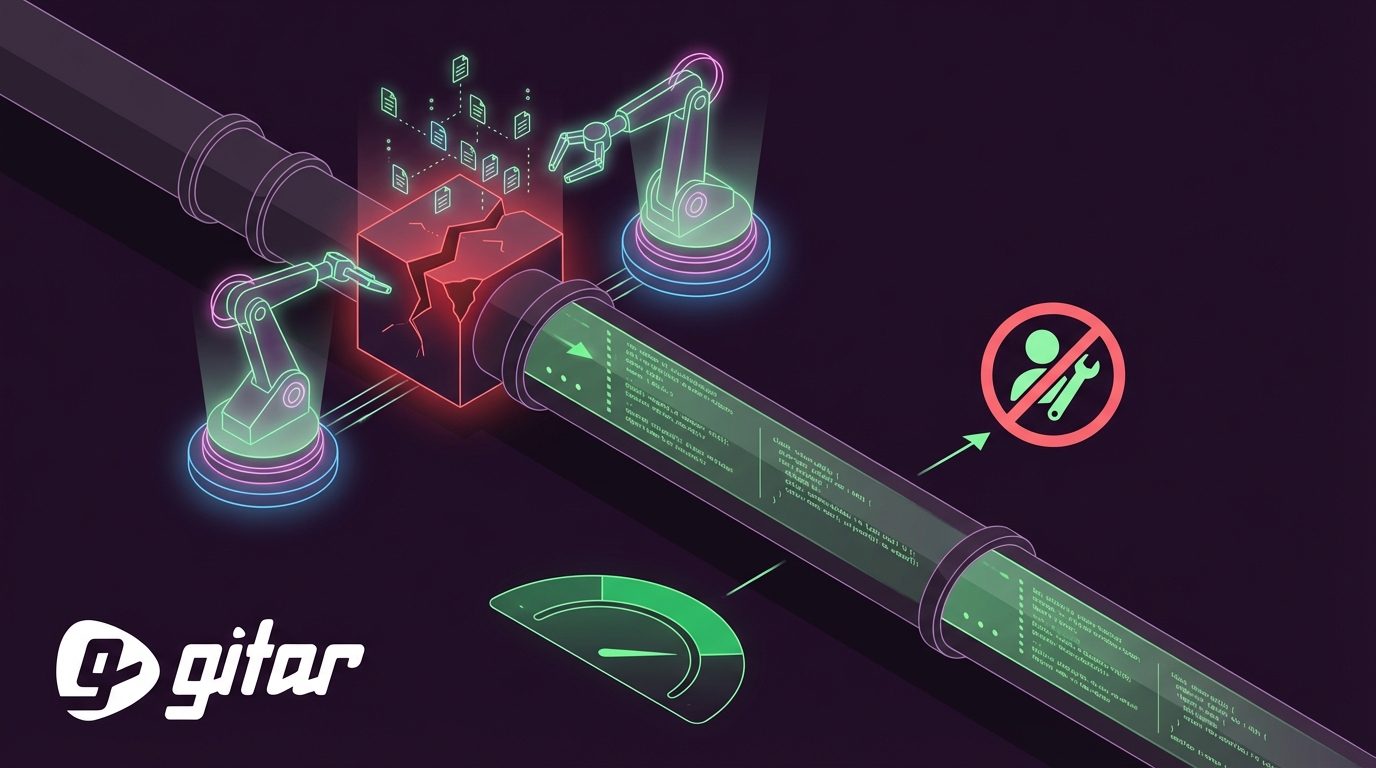
- Autonomous AI tools move beyond suggestion engines by analyzing failures, generating fixes, and validating them inside real CI environments.
- Self-healing CI improves DORA metrics by cutting change failure rate, shortening lead time, and increasing deployment frequency.
- Successful adoption depends on phased rollout, clear trust controls, and ongoing review of fix quality and impact.
- Gitar provides autonomous CI failure resolution and code review assistance, and you can get started by Book a demo.
The Strategic Imperative: Why Self-Healing CI Is a Priority for Platform Engineering
Manual CI troubleshooting creates a persistent drag on engineering output. As AI-assisted coding speeds up delivery of pull requests, validation and merging have become the primary bottlenecks. More PRs and more tests lead to more failures that still demand human attention.
For a 20-developer team, even an hour per day of CI intervention per engineer can approach $1 million in annual productivity cost. The impact shows up in slower feature delivery, frequent context switching, and growing burnout risk.
The Cost of Manual Toil: Beyond Just Time
Manual CI work disrupts deep focus. Each failure forces developers to stop feature work, reorient around logs and test output, then rebuild context when they return to their original task. That overhead often exceeds the time required for the fix itself.
Distributed teams feel this even more. A failed build that needs clarification or a small code change can stretch across several days as handoffs move between time zones, delaying reviews and releases.
DORA Metrics and Competitive Advantage Through Automated Reliability
Self-healing CI directly supports core DORA goals. Change failure rate, deployment frequency, and lead time improve when failures are detected and fixed quickly, without waiting for manual intervention. Faster feedback loops help teams ship smaller, safer changes and respond to market needs more quickly.
Evolving the Landscape: Autonomous AI Tools vs. Suggestion Engines
Current AI tools fall into two broad categories. Suggestion engines highlight problems and propose edits for humans to apply. Autonomous healing engines go further by implementing and validating fixes inside the CI workflow.
The Healing Engine vs. Suggestion Engine Distinction
Suggestion engines provide partial help. Developers still must interpret the recommendation, update the code, push changes, and wait for CI to confirm the result. The loop remains manual and interrupts focus.
Autonomous healing engines analyze failures, generate code changes, run the relevant checks, and surface only validated fixes. Developers review and approve outcomes instead of performing every step themselves.
Core Capabilities of Autonomous CI Fixers
Effective autonomous CI tools share several capabilities:
- Full environment replication for complex enterprise stacks, including language versions, SDKs, and security or quality scans.
- Cross-platform compatibility across major CI providers and Git platforms.
- Configurable trust models that range from suggestion-only to auto-commit with clear rollback.
Platform teams can Book a demo to see how these capabilities reduce manual toil without losing control of their pipelines.
Gitar: Autonomous CI Fixes for Complex Enterprise Environments
Gitar is an autonomous AI agent that focuses on CI failure remediation and practical code review assistance. The system observes failing checks, identifies root causes, proposes code changes, validates them, and updates the pull request branch when configured to do so.
Gitar stands out through several design choices:
- End-to-end fixing with validation, so proposed changes pass the same CI workflows that originally failed.
- Full environment replication for realistic enterprise setups, including specific JDK versions, multiple SDKs, and third-party scanners.
- A configurable trust model that supports suggestion-only, approval-required, or auto-commit workflows.
- Broad support for popular CI platforms and Git providers.
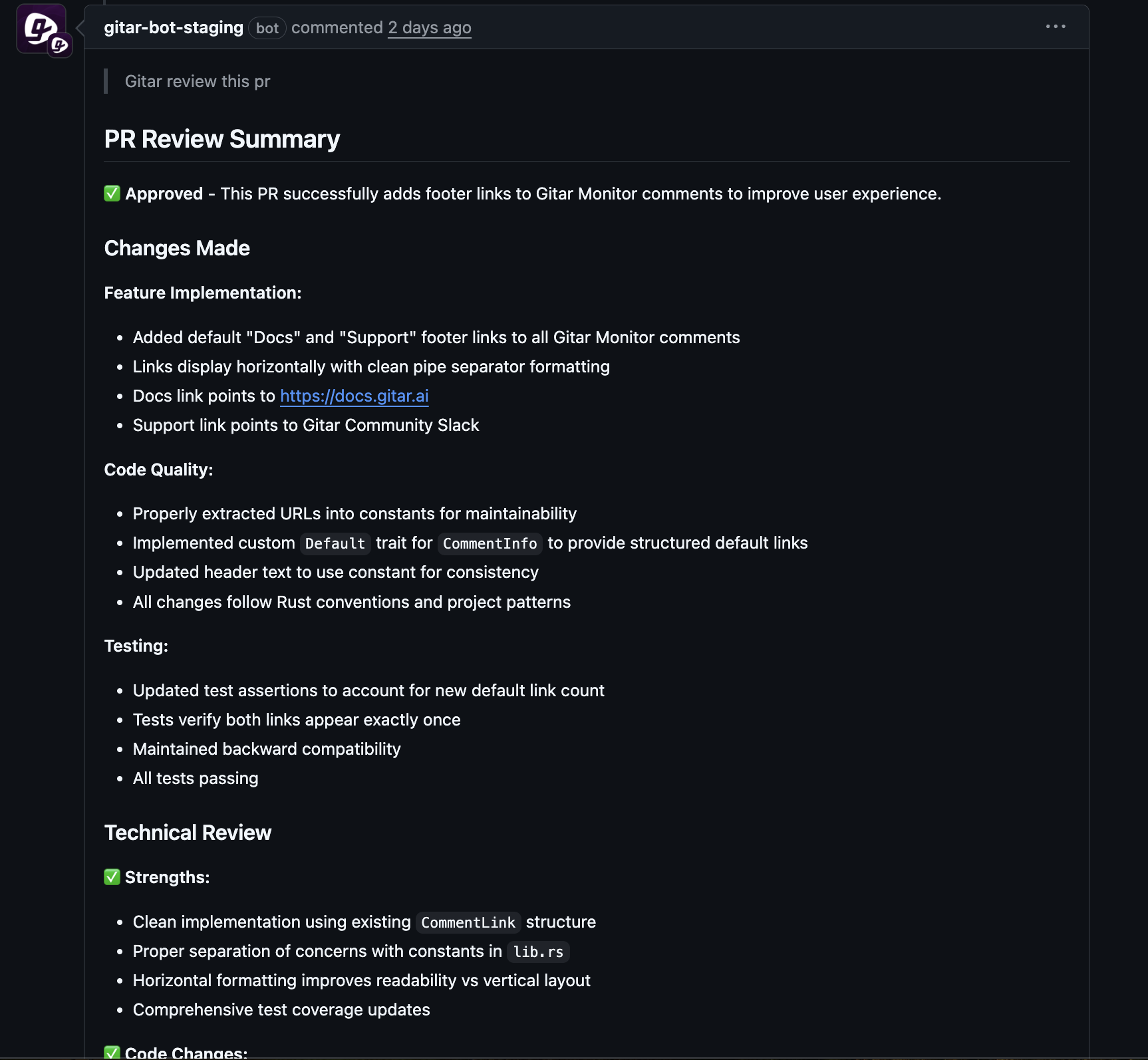
- Code review assistance where reviewers request changes and Gitar implements them, which cuts down time zone delays.
How Gitar’s Agentic Architecture Delivers Self-Healing CI
Gitar is built to operate inside noisy, concurrent CI environments. The agent maintains context across jobs and users, handles retries and duplicate events, and keeps its view of the repository consistent as new commits arrive.
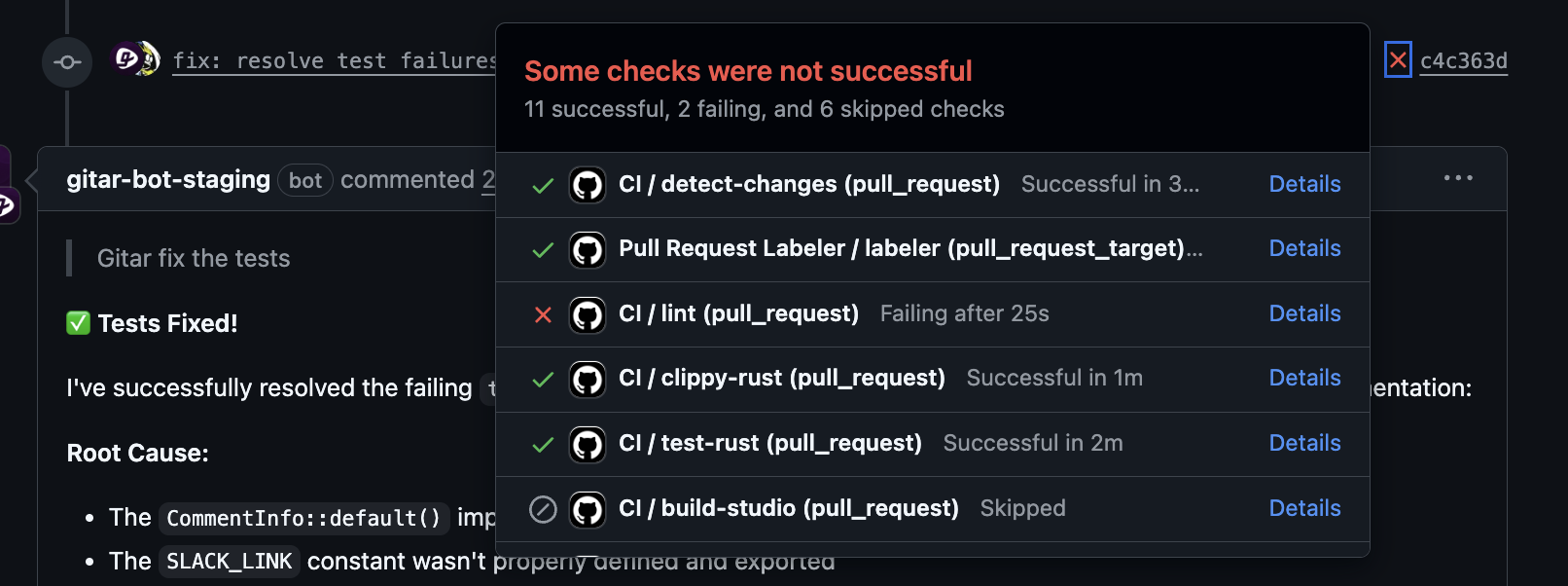
When a CI check fails, Gitar analyzes logs, pinpoints the cause, prepares candidate fixes, and tests those changes. It can resolve common issues such as lint violations, flaky or failing tests, build configuration errors, and dependency conflicts without waiting on a developer.
Solving Bottlenecks for Developer Flow and Distributed Teams
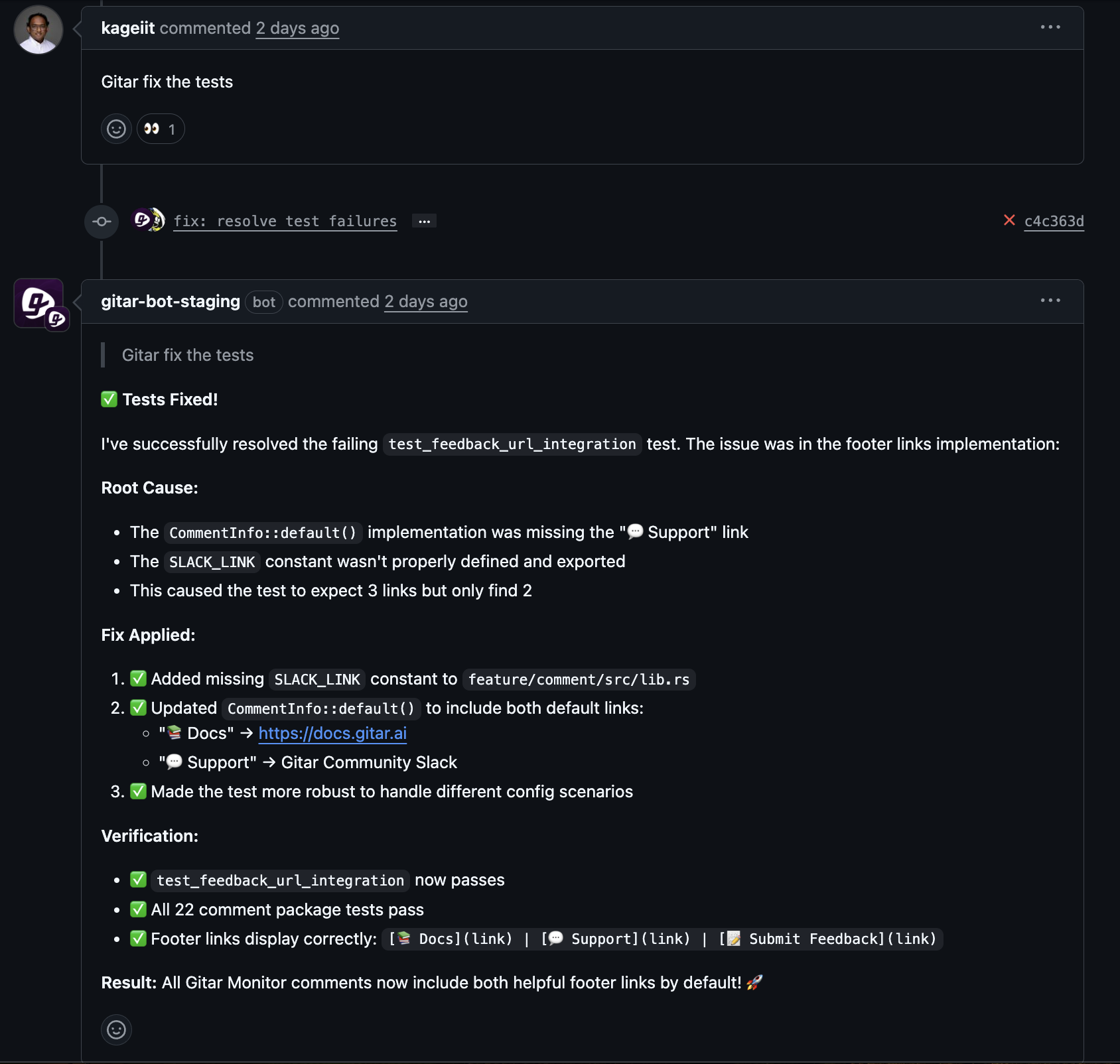
Gitar protects developer flow by resolving many failures in the background. Developers can stay focused on feature work and review validated fixes during normal feedback cycles instead of stopping to debug every red build.
Distributed teams benefit from shorter feedback loops. A reviewer can leave comments, have Gitar apply and validate the changes, and present the original author with a ready-to-merge pull request at the start of their next workday.
A Strategic Framework for Adopting Autonomous CI Tools
Strong outcomes from autonomous CI depend on organizational readiness and a deliberate rollout plan. Tools should fit existing developer workflows rather than forcing large process changes upfront.
Readiness Assessment: When Teams Are Prepared for Autonomous CI
Teams with standardized pipelines, mature code review practices, and clear CI pain points are good candidates. Prior use of AI coding or review tools helps, because developers already understand AI-assisted workflows and expectations.
Useful readiness signals include measurable time lost to CI issues, frequent CI-related release delays, and collaboration friction across locations.
Implementation Roadmap: Phased Approach for Trust and ROI
Most teams see success with a phased rollout:
- Start with suggestion-only mode on a subset of repositories, focused on low-risk fixes such as linting or simple test issues.
- Expand coverage as developers build confidence in fix quality and accuracy.
- Enable auto-commit for well-understood failure types, with clear rollback paths and audit logs.
This approach lets platform teams demonstrate value early while keeping risk low.
Navigating Organizational Change and Gaining Buy-In
Engineers need visibility into how autonomous fixes are generated and where humans remain in control. Clear documentation, regular demos, and easy ways to override or revert changes help build trust.
Champions in both platform and feature teams can share results, raise edge cases, and shape configuration so the tool feels like a practical assistant rather than an imposed requirement.
Measuring Success: Quantifying the ROI of Autonomous CI
Platform teams can track the impact of autonomous CI using DORA metrics alongside developer-centric indicators. This mix gives leadership both reliability and experience views.
Key Metrics for Success: Beyond Just Green Builds
Success measurements typically include:
- Change failure rate, deployment frequency, and lead time for changes.
- Time spent on CI-related debugging and number of context switches per developer.
- Fix accuracy rates and time to resolution for CI failures.
- Developer survey responses about CI friction and flow interruptions.
These metrics make it easier to communicate results and justify continued investment.
Calculating Autonomous CI ROI
ROI analysis starts with baseline effort. For a 20-developer team with an average loaded cost of $200 per hour, one hour per day spent on CI issues equates to roughly $1 million per year. If automation cuts this effort by half, the team recovers about $500,000 in productivity while also improving shipping cadence and morale.
Strategic Pitfalls for Experienced Platform Teams
Even advanced platform teams can stumble when they treat tool installation as the finish line instead of part of a broader reliability strategy.
The Trap of Set It and Forget It: Why Human Oversight Remains Key
Autonomous CI tools still need ongoing attention. Codebases, dependencies, and failure patterns evolve over time. Regular reviews of automated fixes, configuration updates, and escalation rules help keep outcomes aligned with team expectations.
Overcoming Trust Barriers and Fostering Adoption
Teams that push too quickly to aggressive automation can face resistance. A more sustainable approach focuses on transparency, clear audit trails, and reliable rollback options. Consistent, low-risk wins build confidence and open the door to deeper automation later.
Platform leaders can Book a demo to learn how to introduce autonomous CI gradually while maintaining the level of governance their organization requires.
Comparison Table: Autonomous AI Healing Engine vs. Suggestion Engines
This comparison outlines how autonomous healing engines differ from traditional suggestion engines when reducing manual intervention for build failures.
|
Feature or Approach |
AI Suggestion Engines |
Autonomous AI Healing Engine (Gitar) |
|
Primary action |
Suggests fixes or improvements for manual application |
Analyzes, generates, applies, and validates fixes |
|
Intervention level |
Moderate, developer still implements changes |
Low, automation with configurable approval |
|
CI validation |
No guarantee that suggestions pass CI checks |
Runs fixes through CI to ensure passing checks |
|
Context switching |
Moderate to high, requires manual effort |
Low, minimizes interruptions to feature work |
|
Complexity handling |
Limited contextual awareness of full stack |
Replicates full environment for complex setups |
|
Trust model |
Suggestions with manual approval required |
Configurable modes from suggestion to auto-commit |
|
Distributed team benefit |
Limited, suggestions still need human follow-through |
Reduces time zone delays in feedback loops |
|
CI system support |
Often tied closely to a single platform |
Designed for broad compatibility with many CI systems |
Frequently Asked Questions (FAQ) About Autonomous CI Tools
How do autonomous CI fix tools handle complex, custom CI environments?
Autonomous CI tools like Gitar replicate full enterprise workflows, including language runtimes, SDKs, and third-party scans such as SonarQube or Snyk. Fixes are validated against the same constraints that produced the original failure, which increases confidence that they will behave correctly in production pipelines.
What mechanisms ensure trust and control when automating build fixes?
Autonomous CI tools provide configurable modes that range from suggestion-only to full auto-commit. Teams can require human approval, enforce audit logging, and keep rollback commands close at hand. Engineers retain override capabilities so automation always operates within defined governance boundaries.
How do autonomous CI fixers impact DORA metrics like change failure rate and lead time?
Validated fixes lower change failure rate by catching and resolving issues before deployment. Lead time shortens as fewer builds wait in queues for manual debugging. Time to restore service improves because CI failures are addressed quickly and consistently.
Can autonomous CI tools integrate with existing CI or Git platforms?
Solutions like Gitar integrate with common Git providers such as GitHub and GitLab, along with major CI platforms. Setup typically requires connecting the tool to repositories and granting scoped permissions, without forcing teams to redesign their pipelines.
Conclusion: Autonomous Tools and the Future of Platform Engineering
Autonomous CI represents a practical next step for platform engineering in 2026. As systems grow more complex and release cycles speed up, manual build failure intervention becomes increasingly expensive and difficult to scale.
Gitar helps platform engineers move toward self-healing CI by handling many failures automatically and supporting reviewers with actionable, validated changes. Teams that adopt this approach can improve reliability, protect developer focus, and ship features more quickly.