
Key Takeaways
- Engineering teams in 2026 face growing test maintenance costs as brittle and flaky unit tests slow delivery and weaken trust in CI pipelines.
- Autonomous unit test quality assurance uses AI to analyze, fix, and re-run failing pipelines, so teams spend less time on repetitive debugging.
- Replicating the full CI environment, including dependencies and tools, increases the likelihood that automated fixes work on the first try.
- Engineering leaders gain measurable benefits in developer focus, time-to-merge, and reliability by phasing in autonomous CI fixes with clear trust controls.
- Teams can use Gitar to automatically diagnose and fix CI failures, keep pipelines green, and ship reliable code faster.
The Escalating Challenge of Unit Test Quality in Modern CI/CD
Unit testing at scale exposes structural issues that manual processes cannot manage well. Common pain points include high maintenance overhead, brittle assertions, slow suites, and flaky tests that waste CI minutes.
High Maintenance Overhead and Brittle Tests
Tests that couple tightly to implementation details become brittle and break on minor refactors, so teams spend more time fixing tests than enhancing the product.
Flaky Tests and Trust Erosion
Frequent false failures cause developers to distrust the test suite, which leads to ignored failures, skipped checks, and rising technical debt.
Slow Execution and Productivity Drag
Poorly maintained tests increase production defects and downstream fix costs, while slow, unreliable pipelines stall feedback loops and delay merges.
The Context Switching Tax from Test Failures
Each failing run forces developers to pause feature work, inspect logs, patch tests or code, and wait on new builds. Small fixes often expand into long interruptions that reduce focus and momentum.
For a 20 person engineering team, even short daily interruptions from CI issues add up to significant annual productivity loss and slower delivery.
How Autonomous Unit Test Quality Assurance Works
Autonomous unit test quality assurance moves beyond basic automation. Traditional systems run tests and report failures. Autonomous systems inspect failures, identify likely causes, apply fixes, and validate results in the CI environment.
This approach aligns with automated test adaptation, where tests and infrastructure evolve along with the codebase. The system keeps suites healthy as services, dependencies, and tools change.
As AI coding assistants speed up feature development, validation becomes the bottleneck. Autonomous QA helps keep review and testing capacity in line with faster code creation.
How Gitar Enhances CI Pipeline Reliability
Gitar operates as an autonomous CI healing engine that focuses on practical, repeatable fixes for common failure patterns.

Automatic Fixes for Common CI Failures
Gitar watches CI runs, analyzes failing jobs, and then generates and applies code or config changes to resolve issues. Typical fixes include:
- Correcting linting and formatting violations
- Adjusting straightforward unit tests that fail on predictable conditions
- Resolving dependency and build configuration errors
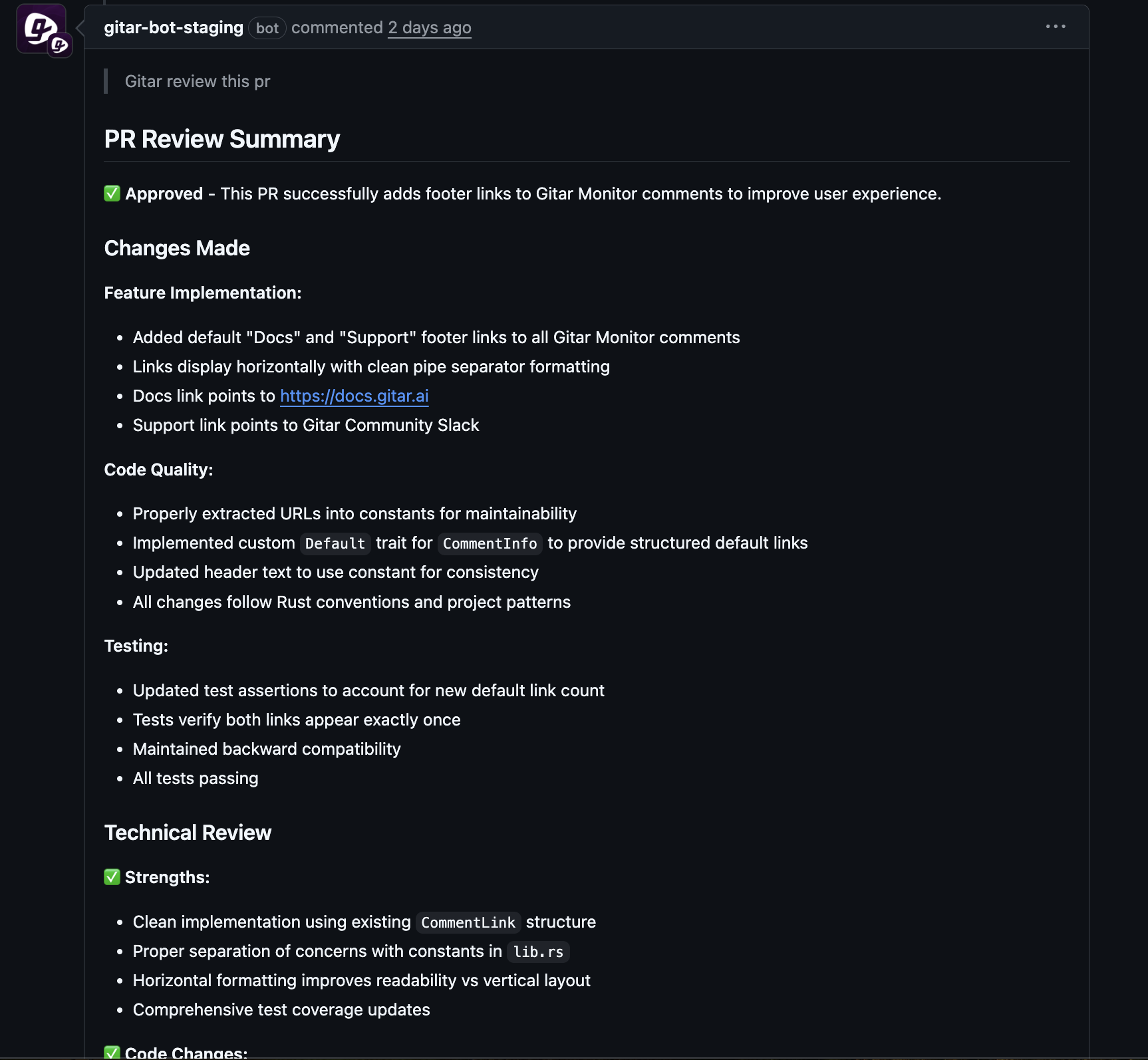
After applying a fix, Gitar commits changes to the pull request branch and lets the pipeline re-run, so reviewers see a clean build.
Environment-Aware Fixes That Match Real CI
Gitar replicates enterprise CI environments, including SDK versions, dependency graphs, and integrations such as SonarQube and Snyk. This context reduces the risk that a fix passes locally but fails again in CI due to mismatched tooling or configuration.
Support for Human Code Review Feedback
Gitar also helps with reviewer comments. Reviewers can tag Gitar or write a clear request. Gitar interprets the feedback, applies the change, and commits with an explanation of what changed and why.
Configurable Trust Levels
Trust builds over time, so Gitar supports multiple modes:
- Conservative mode, where Gitar proposes fixes as suggestions for manual approval
- Aggressive mode, where Gitar commits fixes automatically with rollback options
Teams can start with suggestions, review outcomes, then move to higher autonomy when the results match expectations.
Install Gitar to keep builds green with automated fixes and clear, reviewable commits.
Strategic Benefits for Engineering Leaders and Teams
Autonomous CI resolution improves both individual productivity and organizational delivery speed.
Reclaiming Developer Time
Gitar removes many of the small but frequent interruptions from failing builds. Developers stay focused on feature work while the system handles routine test, lint, and configuration issues.
Well-structured unit tests already shorten debugging by isolating failures, and autonomous fixes protect those benefits by keeping pipelines stable.
Faster Time-to-Merge and Reduced Delays
Automated fixes cut repeated back-and-forth cycles on pull requests. Reviewers spend less time waiting for authors to correct minor issues, and distributed teams avoid multi day delays from time zone gaps.
Continuous testing within CI/CD improves feedback speed and stability, and Gitar helps maintain that continuity without constant manual intervention.
Implementing Autonomous CI Fixes with Gitar
Teams gain the most value by phasing in Gitar with clear expectations around scope and control.
The first phase usually keeps Gitar in conservative mode, where it suggests fixes instead of committing directly. Developers review early changes, confirm that fixes are safe, and learn where Gitar performs best.
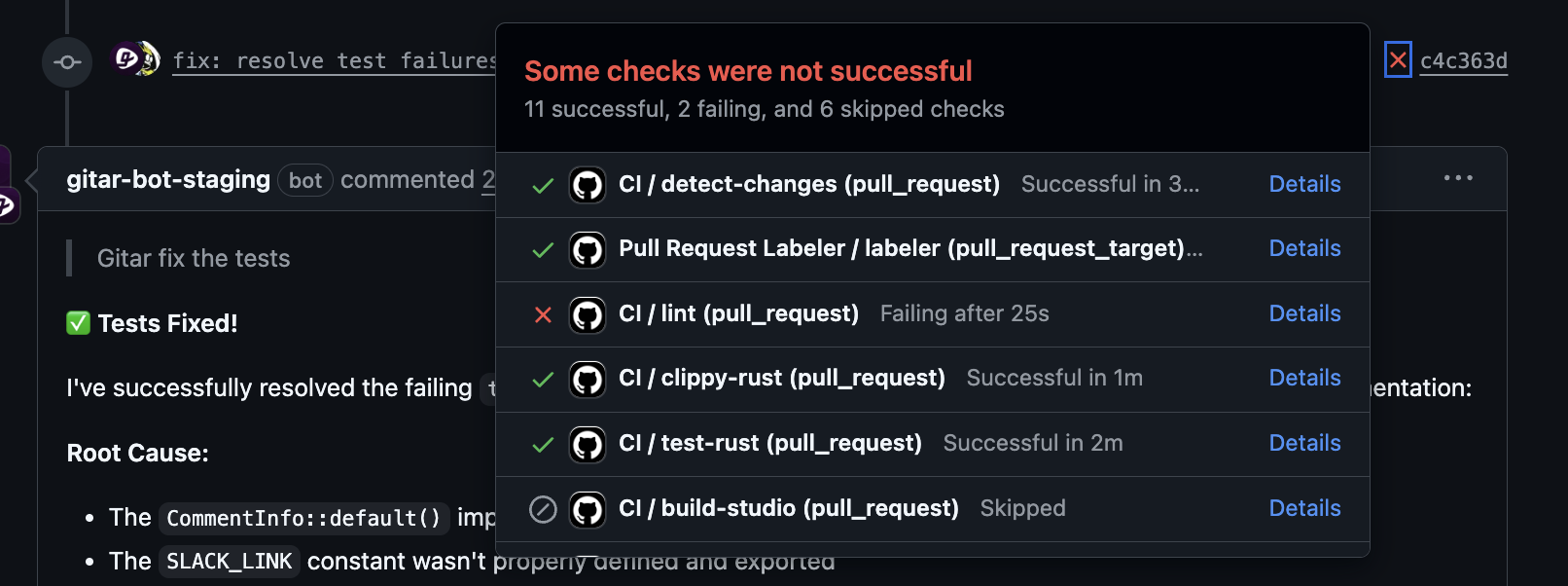
Gitar integrates with major CI platforms such as GitHub Actions, GitLab CI, CircleCI, and BuildKite through standard connections, so teams do not need to redesign pipelines.
As confidence grows, teams can expand Gitar’s responsibilities and move to more autonomous modes for routine classes of failures.
Why Gitar Stands Apart from Other AI Tools
Many AI tools suggest fixes but still rely on humans to apply and validate changes. Gitar focuses on healing, not only advice.
|
Capability |
Gitar (Healing Engine) |
AI Code Reviewers |
On-Demand AI Fixers |
|
Action on CI Failures |
Automatically fixes and validates |
Provides suggestions only |
Runs when manually triggered |
|
Environment Awareness |
Replicates full CI/CD setup |
Limited to code context |
Basic environment context |
|
Integration Scope |
Works across major CI platforms |
Often tied to git provider |
Often tied to git provider |
|
Trust Model |
Configurable auto-commit levels |
Manual approval required |
Manual approval required |
Large and active projects need tests and tooling that evolve alongside the codebase. Gitar’s environment replication and autonomous healing focus on this need, especially in complex enterprise CI setups.
Install Gitar to turn CI from a source of recurring failures into an environment that repairs itself.
Conclusion: Moving Toward Reliable, Self-Healing CI Pipelines
Autonomous CI pipeline resolution offers a practical response to the rising cost of manual test maintenance and debugging. As codebases grow and delivery expectations increase, manual reaction to each failure no longer scales.
Gitar helps teams move toward self-healing pipelines that keep builds passing, reduce interruptions, and support more predictable delivery.
Disciplined unit testing practices make AI-powered tools more effective, and autonomous CI resolution amplifies those practices by handling routine failures automatically.
Teams that adopt autonomous CI fixing now position themselves for more stable, scalable development in the years ahead. Request access to Gitar and see how automated CI healing fits into your workflows.
Frequently Asked Questions
How does autonomous CI pipeline resolution differ from traditional automation?
Traditional automation runs tests and reports the outcome. Autonomous CI pipeline resolution analyzes failures, identifies likely causes, applies fixes, and re-runs checks. Pipelines become self-maintaining instead of requiring manual attention for each broken build.
Can autonomous systems be trusted to modify code without breaking functionality?
Trust depends on clear controls and validation. Systems like Gitar start with suggestion-only mode so teams can review changes. Full CI environment replication and automatic re-runs help confirm that fixes behave correctly before they reach production branches.
What types of CI issues can autonomous systems actually fix?
Autonomous systems perform best on structured, repeatable failures. These include lint and formatting errors, straightforward test fixes, and dependency or build configuration problems. Complex business logic decisions still benefit from human review.
How do autonomous systems integrate with existing CI/CD pipelines?
Most integrations rely on platform APIs and webhooks. Tools like Gitar connect to GitHub Actions, GitLab CI, CircleCI, and BuildKite, watch for failures, and push commits back to pull requests after applying fixes.
What return on investment can engineering teams expect?
Return on investment usually comes from reduced time spent on CI debugging and faster time-to-merge. For teams that face frequent pipeline failures, even modest daily time savings per developer can add up to substantial yearly productivity gains and fewer production incidents.