
Key Takeaways
- Unit testing productivity now has a direct impact on feature velocity, code quality, and reliability for engineering teams in 2026.
- Flaky tests, slow CI feedback, and context switching around failures are the main sources of wasted time and frustration.
- Clear principles for isolation, fast feedback, and alignment with SRE practices keep unit tests reliable and maintainable over time.
- Autonomous AI that diagnoses and fixes CI failures can reduce manual debugging and protect developer focus without removing team control.
- Teams can install Gitar to automatically fix CI issues and unit test failures inside existing workflows, with configurable guardrails and quick rollout.
Why Unit Testing Productivity Is Your 2026 Competitive Edge
Modern software teams ship more code than ever, so the constraint has shifted from writing code to validating and merging it. The teams that keep unit testing fast and reliable ship features sooner, recover from defects faster, and avoid costly production incidents.
The impact of poor test workflows goes far beyond annoyance. Common challenges include flaky tests, weak isolation, and confusing failures that slow delivery when pipelines fail intermittently. For a 20-person engineering team that spends one hour per developer per day on CI failures and review issues, the annual productivity loss can approach $1 million in loaded cost.
Teams that build a focused unit testing culture see clear gains: faster delivery, fewer regressions, and less firefighting. Developers stay in flow, pull requests move quickly, and leadership can plan with more confidence.
Current Challenges That Limit Unit Testing Productivity
Many teams have CI/CD in place, yet still struggle with slow, noisy, and unreliable unit tests. The main challenges are slow feedback loops, flaky tests, poor test design, high maintenance effort, and constant context switching caused by CI failures.
Every failed build can trigger a multi-step interruption. Developers stop feature work, read logs, reproduce the issue, write a fix, and wait for another pipeline run. Distributed teams feel this even more when a simple failure in one time zone waits for a response in another.
The rise of AI coding tools has also shifted the bottleneck to the right. Tools that speed up code generation increase the volume of code that must be validated. Teams that do not modernize their CI and unit test workflows risk turning that extra code into queue time instead of shipped value.
Teams that want to reduce these delays can start by addressing flakiness, shortening feedback cycles, and introducing automation that handles predictable failures before they reach busy developers.
To immediately remove some of this friction, teams can install Gitar and begin automatically fixing common CI failures in their existing pipelines.
A Practical Model For Modern Unit Testing Productivity
Principles For High Value Unit Tests
Automated unit tests that run early in the development lifecycle catch issues before they reach later stages and form a core DevOps practice. Teams that treat fast unit tests as a first-class product of development avoid many production issues.
Broken unit tests work best when treated as critical blockers that require quick attention to keep pipelines healthy. Productive teams do not let red builds sit. They either prevent these failures or resolve them within minutes, often with automation.
Healthy unit tests connect directly to deployment frequency, lead time for changes, and change failure rate. Measuring how fast a commit moves from push to merge, and how often tests block that flow, gives leaders a clear view of where to invest.
Technical Foundations That Support Automation
Small, isolated tests that use mocks and stubs for dependencies produce consistent and reliable results. This structure also makes it easier for autonomous systems to pinpoint failures and generate precise fixes.
Unit tests that act as executable documentation clarify expected behavior and support refactoring and onboarding. Clear tests help both humans and AI understand what the system should do.
Fast-running unit tests in CI/CD pipelines create quick feedback loops and support short iterations. The most effective loop not only reports failures quickly but also proposes or applies fixes without waiting for manual effort.
Using SRE Practices To Keep Pipelines Reliable
Aligning unit test strategy with SLOs and error budgets keeps attention on reliability instead of only feature throughput. Some teams now track CI uptime and failure rates with the same rigor they apply to production services.
Manual debugging of frequent CI failures is a classic form of toil that SRE practices aim to reduce or eliminate. Automated remediation, including autonomous AI, turns this recurring work into a managed system behavior instead of an ongoing drain on engineering time.
How Autonomous AI Changes Unit Testing Workflows
From Scripted Automation To Autonomous Problem Solving
Traditional automation runs predefined scripts and checks. Autonomous AI in CI pipelines goes further by analyzing logs, understanding context, and generating targeted changes that resolve specific failures. This shift allows systems to handle many cases that used to require a developer to stop and investigate.
Gitar As An Autonomous CI Healing Engine
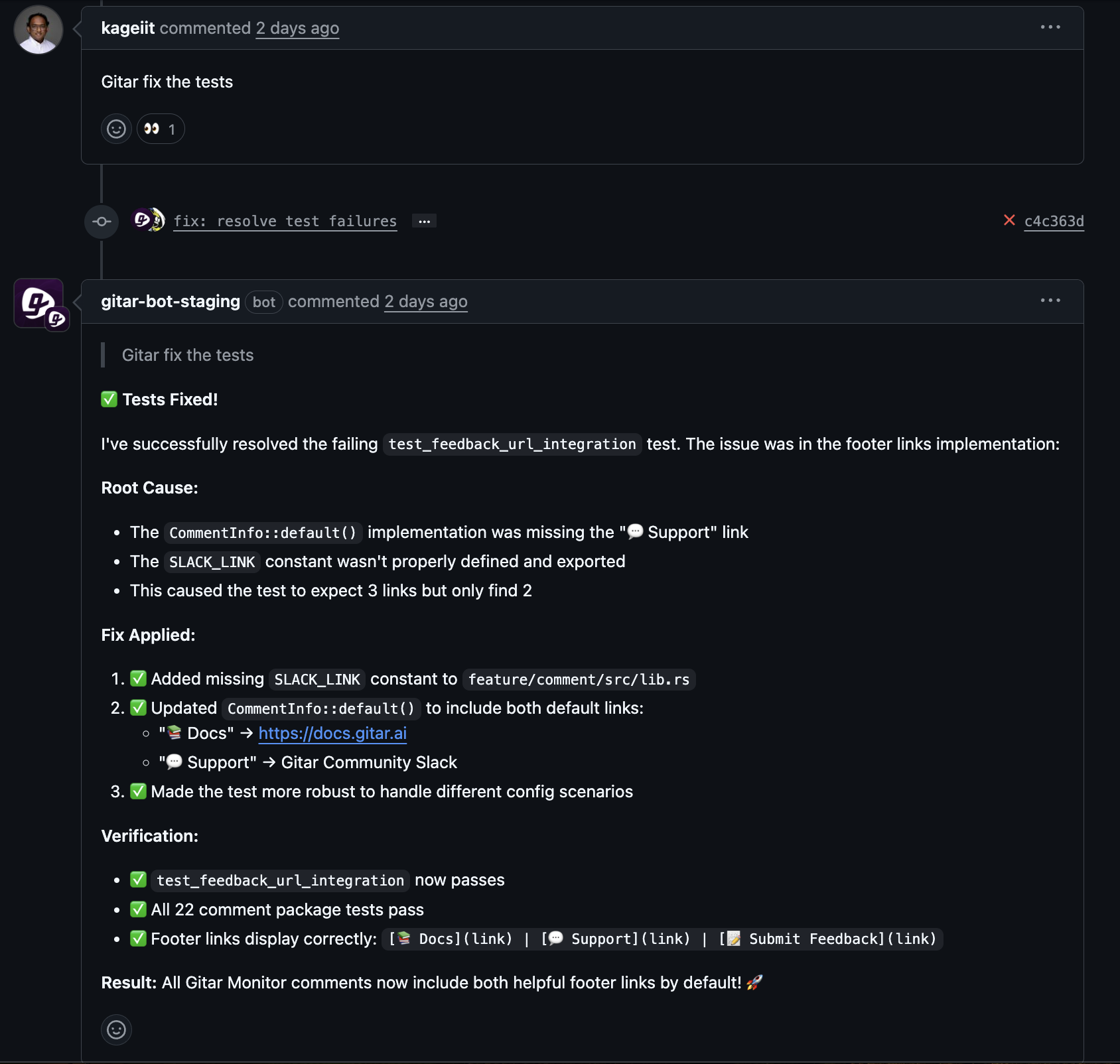
Gitar operates as an autonomous agent inside your CI workflows. The system inspects failing pipelines, diagnoses the root cause, proposes and applies code changes, updates pull requests, and re-runs checks so that builds return to a green state before developers lose focus.
Gitar replicates complex enterprise environments, including exact JDK versions, multi-SDK setups, and tools such as SonarQube and Snyk. This context allows it to fix a wide range of common issues, including unit test failures, lint errors, and build configuration problems, under conditions that match real deployments.
Impact On Developer Time And Focus
Gitar preserves developer flow by resolving many failures in the background. Engineers can keep working on features while Gitar investigates the failing pipeline and applies a fix.
Time to merge improves because pull requests spend less time blocked on red builds or back-and-forth comment cycles. Instead of waiting for someone to pick up a failure, Gitar resolves much of the queue automatically.
Repetitive work, such as updating brittle tests or fixing small configuration errors, moves from individual developers to the platform. Teams can then focus on higher-value architecture and product problems.

Autonomous AI Versus Traditional Approaches
|
Feature |
Manual Fixing |
AI Suggestion Tools |
Gitar Autonomous Healing |
|
Problem resolution |
The engineer investigates and fixes |
The tool suggests possible changes |
Agent diagnoses, fixes, and validates |
|
Context switching |
High, interrupts focus work |
Moderate, still requires action |
Low issues are resolved in the background |
|
Validation |
Engineer re-runs CI |
Often requires manual validation |
Full CI pipeline re-run by the agent |
|
Control model |
Developer only |
Developer only |
Configurable from suggestions to auto-commit |
|
Impact on time to merge |
Slow, many blocked PRs |
Moderate improvement |
Fast, fewer CI and review bottlenecks |
How To Adopt Autonomous Unit Testing Tools Safely
Evaluating Build Versus Buy
Organizations that build their own AI-based fixing systems must invest in CI infrastructure, observability, AI models, and long-term maintenance. Many teams instead choose specialized platforms such as Gitar so they can focus on product work while still gaining the benefits of autonomous remediation.
Establishing Trust And Guardrails
Gitar supports configurable modes so teams can choose how much autonomy to grant. One mode keeps Gitar in suggestion-only behavior, where developers review and apply changes. Another mode allows auto commits once the system demonstrates reliable performance, with full rollback available for every change.
Measuring ROI And Developer Experience
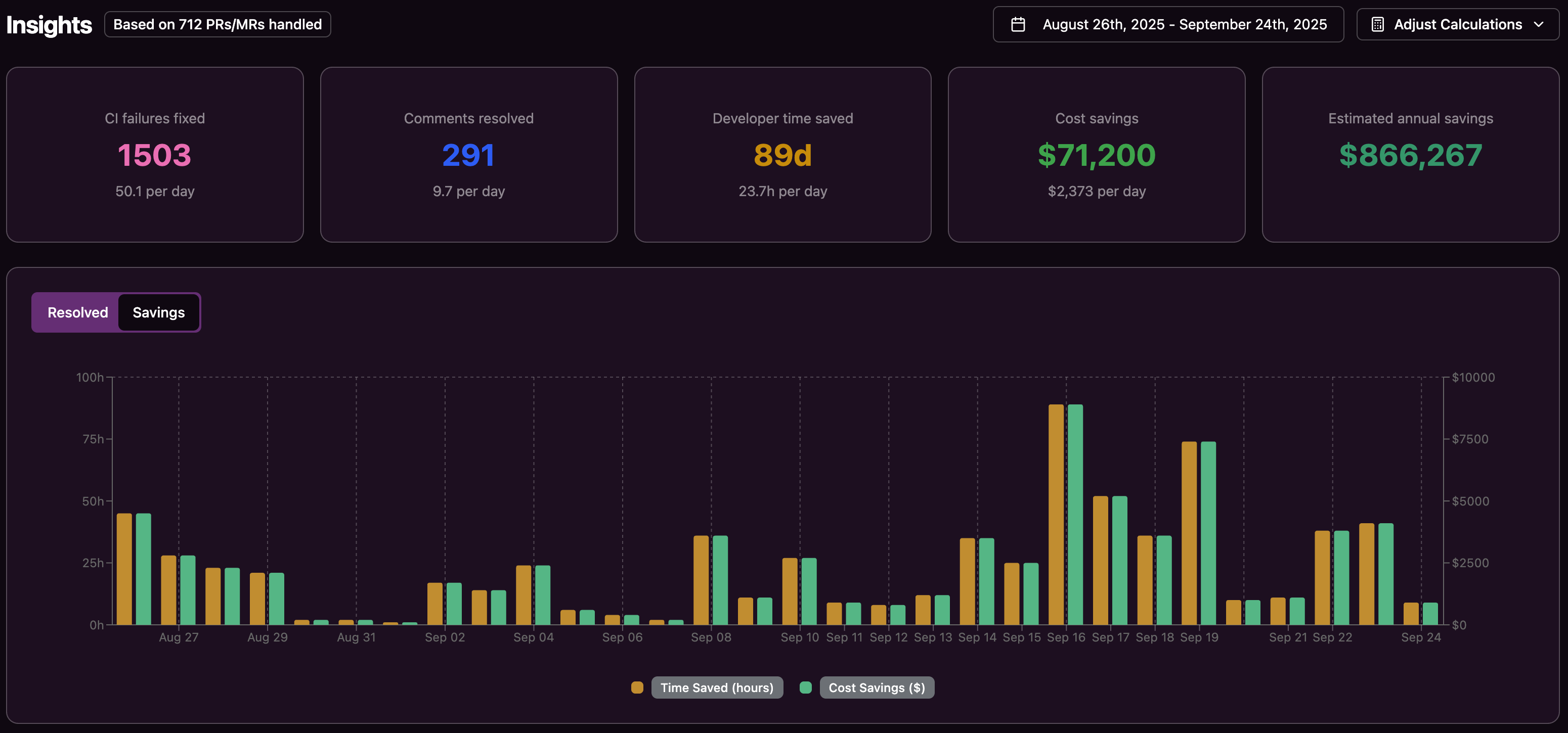
Time saved on CI failures is often the easiest metric. Removing one hour of failure handling for each developer in a 20-person team can reclaim hundreds of hours per month. Teams also track improvements in deployment frequency and lead time for changes, along with survey-based measures of developer satisfaction and burnout.
Avoiding Common Strategic Pitfalls
- Treating tests as write-once assets leads to test rot and declining trust over time. Regular refactoring and cleanup keep the suite valuable and automation-friendly.
- Focusing only on coverage percentages without checking test quality can create false confidence. Teams benefit more from meaningful assertions and clear edge case coverage.
- Allowing tool sprawl and inconsistent pipelines raises maintenance costs and complicates automation. Standardizing core workflows helps both humans and AI operate effectively.
- Leaving manual gates in otherwise automated pipelines keeps releases slower than they need to be. Fully automated paths with clear controls support faster, safer shipping.
- Distributed teams that ignore time zone delays in code review often experience multi-day cycles for simple fixes. Autonomous remediation reduces this delay by addressing many comments and failures immediately.
Teams that want support in these areas can install Gitar to automatically diagnose and fix many CI failures as they occur.
Frequently Asked Questions About Unit Testing Productivity And AI
Our team already uses AI code reviewers. How is Gitar different for unit testing productivity?
Many AI reviewers focus on suggestions that still require engineers to make changes and re-run CI. Gitar instead acts as a healing engine for your pipelines by applying fixes, running the full workflow, and returning a green build when possible.
How does Gitar handle complex environments with specific SDKs and integrations?
Gitar recreates your environment, including language versions, build tools, and scanners such as SonarQube and Snyk. This context allows the system to generate fixes that work reliably in the same conditions used by your production builds.
What control do we keep over automated fixes?
Teams configure Gitar to match their risk tolerance. Many start with suggestion mode, then move to auto-commit for specific repositories or branches once they are comfortable. Every change is auditable and reversible.
What happens if Gitar applies an incorrect fix?
Gitar validates all fixes against your CI pipeline. When a change does not behave as expected, you can revert it quickly using built-in rollback tools and review detailed logs that describe what changed and why.
Conclusion: Turning Unit Testing Into A Productivity Advantage With Gitar
Unit testing productivity in 2026 directly shapes how fast engineering teams deliver and how reliable their systems remain. Teams that keep relying on manual investigation and ad hoc fixes will spend more time reacting to failures and less time building value.
Autonomous AI offers a practical path forward. Gitar focuses that capability on CI pipelines by diagnosing and fixing many unit tests and configuration failures automatically, preserving developer focus and shortening time to merge.
Teams that want to capture these gains can install Gitar and start resolving CI failures automatically inside their existing workflows.