
Key Takeaways
- Traditional automated testing often turns CI/CD into a bottleneck, with developers losing hours each week to flaky tests, failed builds, and slow feedback cycles.
- Autonomous, self-healing CI reduces context switching by detecting, fixing, and validating many failures without manual investigation, which shortens lead time and improves deployment frequency.
- Data-driven quality and integrated security help teams focus on failures that matter most to users while keeping application and supply chain risks under control.
- A phased rollout and configurable trust model allow teams to adopt autonomous testing gradually, proving value in low-risk cases before expanding automation.
- Teams that use Gitar to autonomously fix CI failures and apply code review feedback can cut CI time, ship more often, and improve ROI; they can book a demo.
The Problem: How Traditional Automated Testing Slows Continuous Deployment
Many teams invest heavily in automated tests, yet still experience slow, fragile continuous deployment. Pipelines fail, developers stop feature work, read logs, patch code, and rerun jobs. Each interruption breaks focus and delays releases.
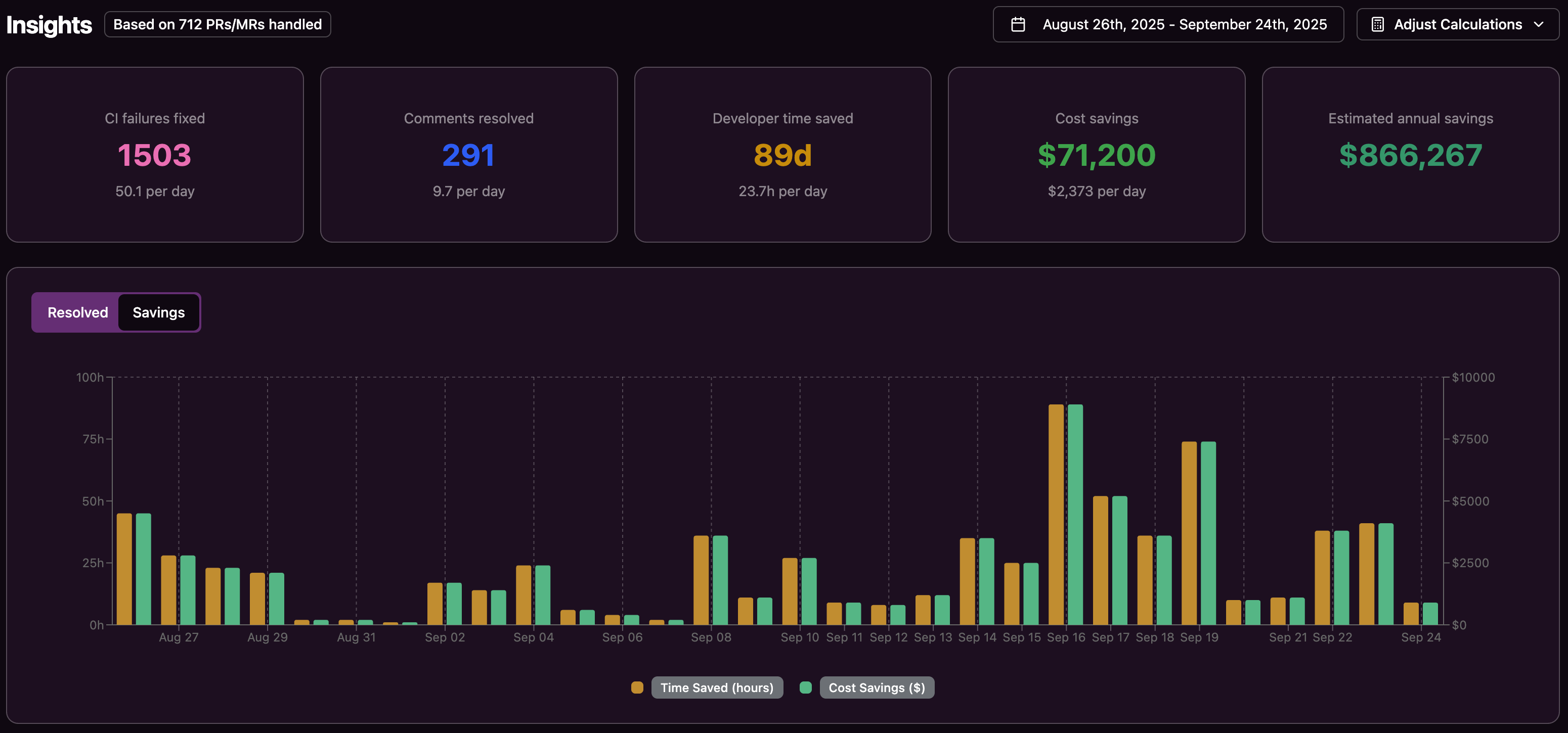
This reactive loop is expensive. Four core CI/CD health metrics directly influence delivery speed and operations cost. Longer lead times and higher mean time to recovery translate into substantial engineering overhead. For a 20-developer team, losing around an hour per day to CI and review issues can approach $1 million per year in productivity cost.
Code generation tools increase this pressure. Developers who use AI assistants produce code faster, which raises the volume of pull requests and tests. Many organizations still see errors in 10–25% of releases, showing how rising velocity can expose weak review and testing processes.
Distributed teams feel the impact more. Time zone gaps stretch review cycles, while flaky tests dilute trust in CI signals. Developers may start bypassing gates or retrying jobs until they pass, instead of fixing root causes.
Even elite teams accept that some changes will fail. Change failure rates of 0–2% are common targets. This reality points to a need for systems that can detect, diagnose, and often repair issues on their own, instead of relying entirely on manual intervention.
The Solution: Gitar for Autonomous CI Fixes in High-Velocity Teams
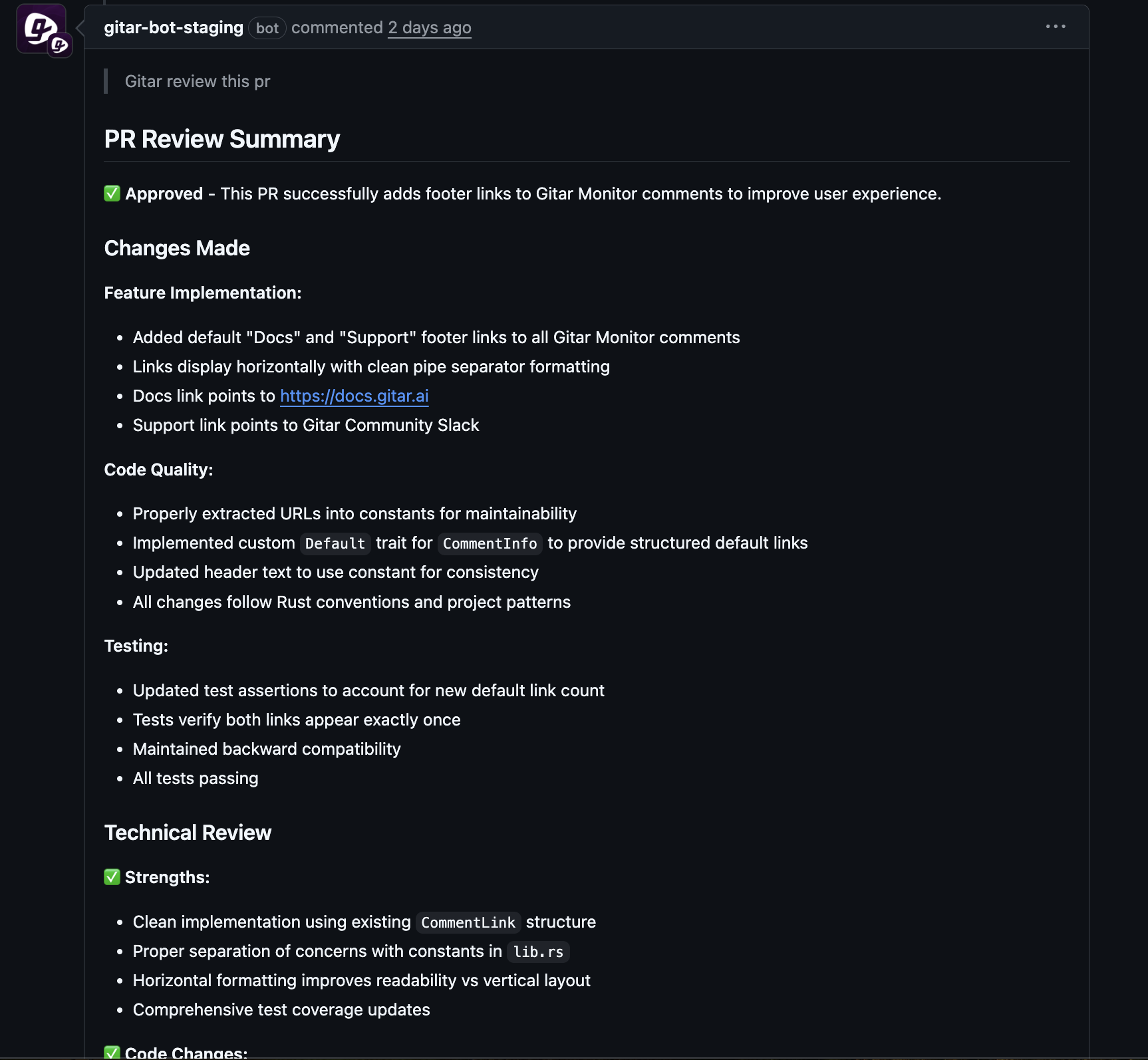
Gitar shifts CI from reactive debugging to autonomous recovery. The platform acts as an intelligent agent that analyzes failed pipelines and code review comments, generates fixes, validates them in your CI environment, and commits changes when they pass.
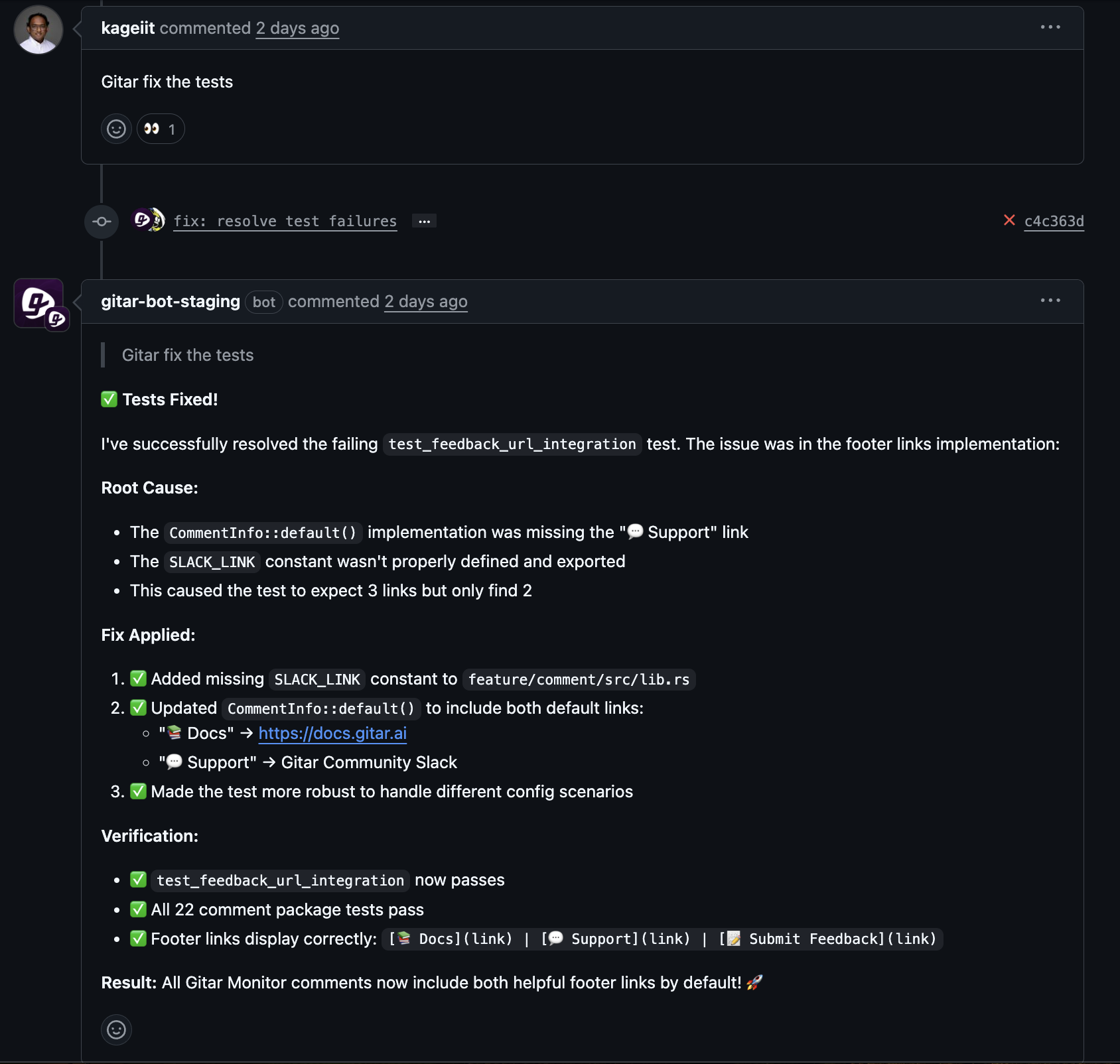
When a pull request fails CI or receives actionable feedback, Gitar examines logs, code, and configuration. The agent proposes and applies a fix, reruns jobs, and updates the pull request once everything is green. Developers stay focused on feature work instead of chasing red builds.
Key Capabilities of Gitar’s Autonomous AI Agent
End-to-end fixing: Gitar does more than suggest edits. The agent applies changes, runs the full CI workflow, and verifies that all jobs pass before marking the pull request as ready. Teams gain confidence that fixes work in their exact environment.
Full environment replication: Gitar mirrors complex enterprise setups, including language versions, dependency graphs, and integrations with tools such as SonarQube and Snyk. This context helps the agent generate fixes that are both correct and operationally reliable.
Intelligent code review assistance: Reviewers can describe desired changes in comments. Gitar interprets the request, updates the code, and commits with clear messages. Distributed teams reduce back-and-forth and avoid waiting a full day for simple edits.
Configurable trust model: Teams can start in suggestion-only mode, then progress to auto-commit on low-risk repositories, and finally enable broader automation as confidence grows. Rollback controls and transparent logs support careful adoption.
Teams that want to offload CI firefighting and keep developers in flow can book a demo.
Strategic Imperatives: Build a Self-Healing CI Pipeline for Continuous Deployment
Autonomous testing works best when it supports clear business goals. Engineering leaders can align CI improvements with velocity, quality, and cost by focusing on data-driven quality signals, cost of inefficiency, and integrated security.
Use Data-Driven Quality Signals, Not Only Pass/Fail
Modern QA practices combine test results with production behavior and telemetry. Teams benefit from understanding which failures affect real users and which are low-impact.
Autonomous platforms can learn from this data. Systems like Gitar can focus attention on failures that block user value, while scheduling lower-risk fixes for later. This approach reduces noise, increases trust in CI, and supports more confident deployments.
Quantify the Cost of CI/CD Inefficiency
High-performing teams often target lead times under three hours from commit to production. Many organizations exceed this by a wide margin because humans must frequently intervene.
Key pipeline metrics include:
- Lead time for changes
- Deployment frequency
- Mean time between failures (MTBF)
- Mean time to recovery (MTTR)
Time to fix failed tests provides a practical signal of CI drag. Longer resolution times suggest deeper issues in tooling or process. Estimating the loaded hourly rate of developers, multiplying by time spent on CI issues, and adding opportunity cost for delayed features usually shows that autonomous fixes pay back quickly.
Make Security a First-Class Part of Continuous Delivery
Application-level security failures remain among the most expensive incidents in software delivery. CI/CD workflows benefit from integrating SAST, DAST, and supply chain scanning into the same pipelines that run functional tests.
Autonomous testing should treat security checks as normal CI work. That includes running scans, interpreting findings, and helping teams resolve issues without slowing deployments unnecessarily.
Implementation Readiness and Building Trust in Autonomous Testing
Successful adoption of autonomous CI requires both technical integration and trust. A phased rollout gives teams experience with low-risk scenarios before they rely on automation for critical paths.
Phase Your Rollout from Conservative to More Automated
Phase 1, installation and observation: Connect Gitar to selected repositories through your Git provider. Start in suggestion-only mode so developers can review proposed fixes before they commit.
Phase 2, early wins: Once teams see real failures resolved and validated automatically, confidence grows. Examples include lint errors, straightforward unit test failures, or minor refactors requested in reviews.
Phase 3, advanced workflows: After trust is established, teams can use Gitar for more complex scenarios, such as large refactors guided by reviewers or cross-time-zone collaboration where Gitar processes feedback overnight.
Address Common Objections and Build Confidence
Many teams worry about trusting automated fixes. Gitar addresses this with a configurable trust model, transparent logs, and the ability to restrict automation to certain repositories, branches, or issue types.
Teams with complex CI stacks can also be hesitant. Gitar mitigates this risk by replicating the full environment, including multi-SDK builds, specific dependency versions, and integrations with tools such as SonarQube. This depth helps the agent propose changes that respect existing workflows.
Organizations that want to reduce CI bottlenecks and keep developers focused on product work can book a demo.
Comparison Table: Gitar vs. Traditional Approaches and AI Code Reviewers
|
Feature |
Gitar (Autonomous CI Healing Engine) |
AI Code Reviewers |
Manual Work |
|
Issue resolution |
Autonomous fixing and validation in full CI |
Suggestions only, manual implementation |
Manual investigation and fixing |
|
Environment context |
Replication of enterprise build and tooling |
Limited, often focused on repository context |
Manual context switching by developers |
|
CI system support |
Cross-platform support, including GitHub Actions, GitLab CI, CircleCI, and Buildkite |
Varies by provider |
N/A |
|
Trust model |
Configurable from suggestions to auto-commit with rollback |
Relies on developer judgment for each suggestion |
Fully manual validation |
Frequently Asked Questions (FAQ) on Automated Testing for Continuous Deployment
How does autonomous automated testing affect lead time and deployment frequency?
Autonomous automated testing shortens lead time by fixing many CI failures without waiting for a developer. Gitar reduces investigation time and speeds up review cycles, which lets teams deploy more often with fewer interruptions.
Can Gitar handle complex enterprise CI environments?
Gitar is built for multi-language, multi-SDK environments that use third-party tools such as SonarQube and Snyk. The agent learns the build graph and dependencies so that fixes align with existing pipelines and pass the same quality gates developers rely on today.
How does Gitar influence developer morale?
Gitar removes repetitive CI troubleshooting and many minor review edits. Developers spend more time on design and feature work, experience fewer context switches, and see faster progress on their pull requests, which often improves satisfaction and reduces frustration.
What is the ROI of an autonomous CI system like Gitar?
For a 20-developer team, losing about an hour per day to CI and review issues can approach $1 million per year in productivity cost. If Gitar recovers even a portion of that time, the investment often pays for itself within months through saved hours and faster feature delivery.
How does autonomous testing align with security and compliance needs?
Modern autonomous testing workflows incorporate checks from SAST, DAST, and supply chain tools into CI jobs. Gitar can work alongside these tools so that security findings are surfaced and addressed without adding separate manual review steps.
Conclusion: Move Toward Self-Healing CI in 2026
Manual intervention in CI/CD pipelines no longer scales for teams that aim for frequent, reliable deployments. Traditional automated testing helps, but it often leaves developers responsible for investigation and repair.
Gitar offers a practical path to self-healing CI. By autonomously fixing many CI failures and applying code review feedback, the platform reduces context switching, shortens lead time, and supports consistent deployment practices.
Teams that adopt autonomous CI can cut the cost of failed pipelines, recover lost developer time, and improve delivery predictability. Organizations ready to take this step can book a demo.