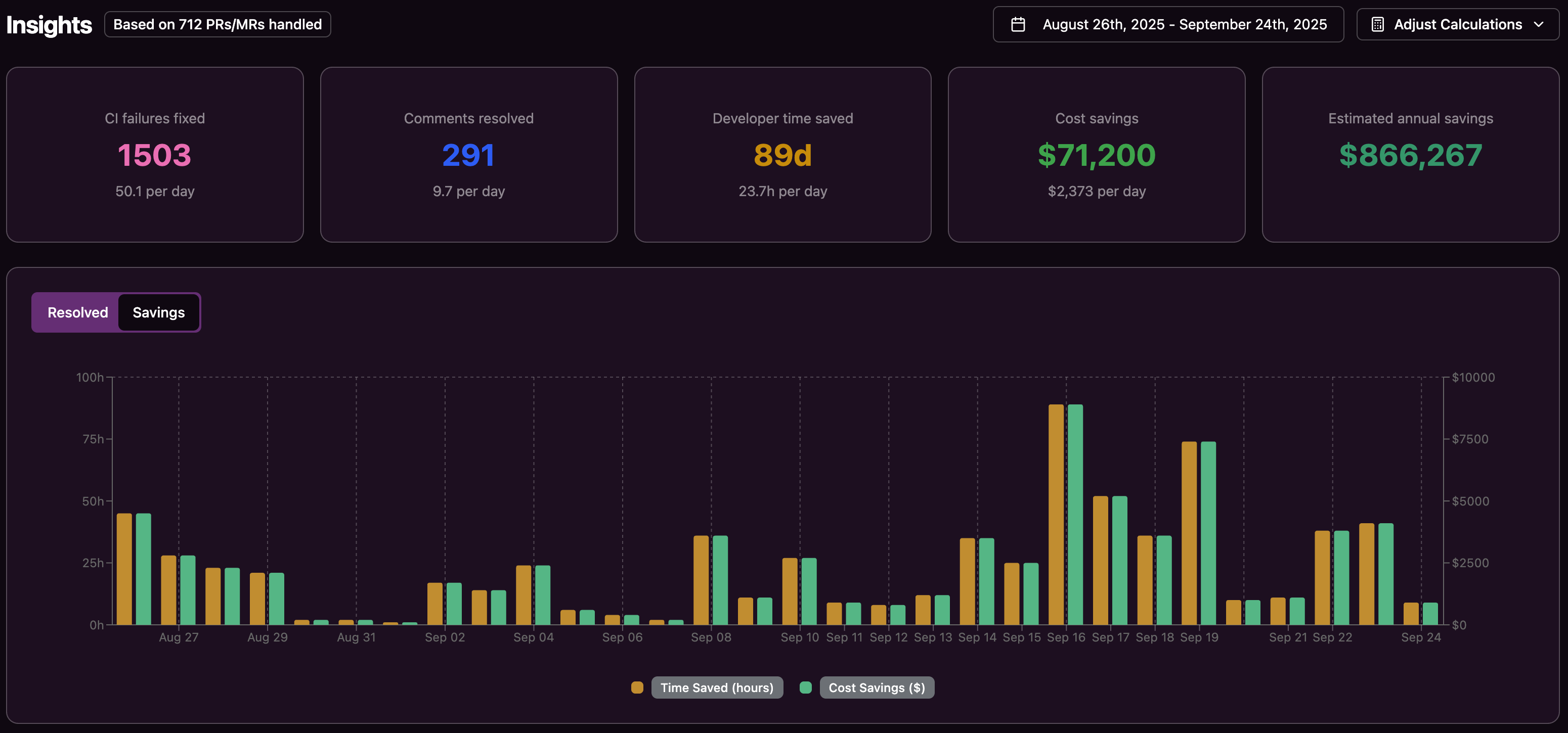
Manual code reviews and CI/CD pipeline failures often slow down development teams, costing time and focus. This article explores how a structured code review checklist, combined with autonomous AI, can streamline these processes. You’ll see how this approach enhances code quality, speeds up delivery, and improves team productivity.
Why Manual Reviews and CI Failures Hurt Your Team
Today’s software development environment is challenging. While AI tools like GitHub Copilot help write code faster, teams still struggle with CI/CD issues and review delays. Developers often spend up to 30% of their time fixing CI and review problems, leading to significant yearly losses for organizations.
For a team of 20 engineers, this inefficiency can cost around $1 million annually in lost productivity. If each developer spends just one hour a day on CI failures or review feedback, that adds up to 5,000 hours a year, equivalent to hiring over two full-time engineers.
Context switching is another major issue. When a pull request fails CI checks, developers must stop their current task, decipher error logs, apply fixes, commit changes, and wait for the pipeline to run again. A quick fix can easily turn into an hour-long distraction.
Distributed teams face even bigger challenges. A developer in California waiting for feedback from a teammate in Bangalore might experience delays of days due to time zone differences. Traditional AI tools don’t help much, as their suggestions still require manual effort, adding more time to the process.
These delays impact more than just engineering, slowing down feature releases and affecting market competitiveness. When CI issues become routine, teams focus on firefighting instead of innovation, building technical debt that grows harder to fix over time.
Manual review processes often fail to catch critical issues, despite taking up significant time. Human fatigue and inconsistent checklist application create gaps, giving a false sense of security where long reviews don’t always mean better code quality.
How a Code Review Checklist Solves These Issues
A well-structured code review checklist turns disorganized reviews into efficient, repeatable workflows. Such a checklist helps spot issues and improve readability, maintainability, and performance. Beyond quality control, it standardizes processes, reduces mental effort, and fosters a shared standard for excellence across teams.
Effective checklists cover all aspects of software quality while remaining practical for everyday use. They convert vague review standards into clear, actionable steps that can be checked consistently and, eventually, automated.
Does the Code Work as Intended?
The first step in any review is confirming the code meets its purpose. Check if it matches acceptance criteria, handles inputs correctly, and delivers expected results. Look at edge cases, boundaries, and integration with other systems. Ensure it avoids regressions and maintains compatibility where needed.
Is the Design Scalable and Maintainable?
Good architecture keeps codebases sustainable. Evaluate if the code follows design patterns, separates concerns properly, and fits the overall system. Check adherence to SOLID principles, abstraction levels, and ease of integration. Consider if the design allows for future changes without major rework.
Is the Code Easy to Read and Documented?
Clear code reduces maintenance costs and speeds up onboarding. Verify that variable names are descriptive, functions are logically split, and comments explain complex parts. Confirm that algorithms, API contracts, and style guidelines are well-documented for team consistency.
Is Performance Optimized?
Performance checks prevent future bottlenecks. Look for inefficient algorithms, memory leaks, or unoptimized database queries. Balance the need for optimization with avoiding over-engineering, focusing on clear issues that affect user experience or resource use.
Does it Handle Errors and Edge Cases Well?
Robust code manages unexpected issues gracefully. Ensure error handling covers null values, network failures, and other common problems. Check for proper logging and user feedback during failures to maintain reliability.
Is the Code Secure?
Security is critical with sensitive data and growing threats. Scan for risks like SQL injection, cross-site scripting, or data exposure. Verify input validation, access controls, and adherence to security practices for your tech stack.
Are Tests Comprehensive?
Strong testing ensures reliability and supports refactoring. Assess test coverage, quality, and strategy for the code’s complexity. Confirm unit tests handle edge cases and integration tests validate system interactions for smooth CI workflows.
A clear checklist shifts reviews from random checks to a reliable quality process. Standardizing reviews boosts team collaboration and efficiency. The real value comes when checklists move from manual tasks to automated enforcement.
Enhance Your Checklist with Gitar’s Autonomous AI
Even with a solid checklist, manual reviews remain slow and repetitive. Traditional AI tools only suggest fixes, leaving the work to developers. Gitar changes this by using autonomous AI to turn checklist items into automatic actions, solving issues directly.
Gitar integrates into your workflow as an AI agent that doesn’t just identify problems but fixes them, validates solutions, and keeps teams in control with full transparency.

Here’s how Gitar makes a difference:
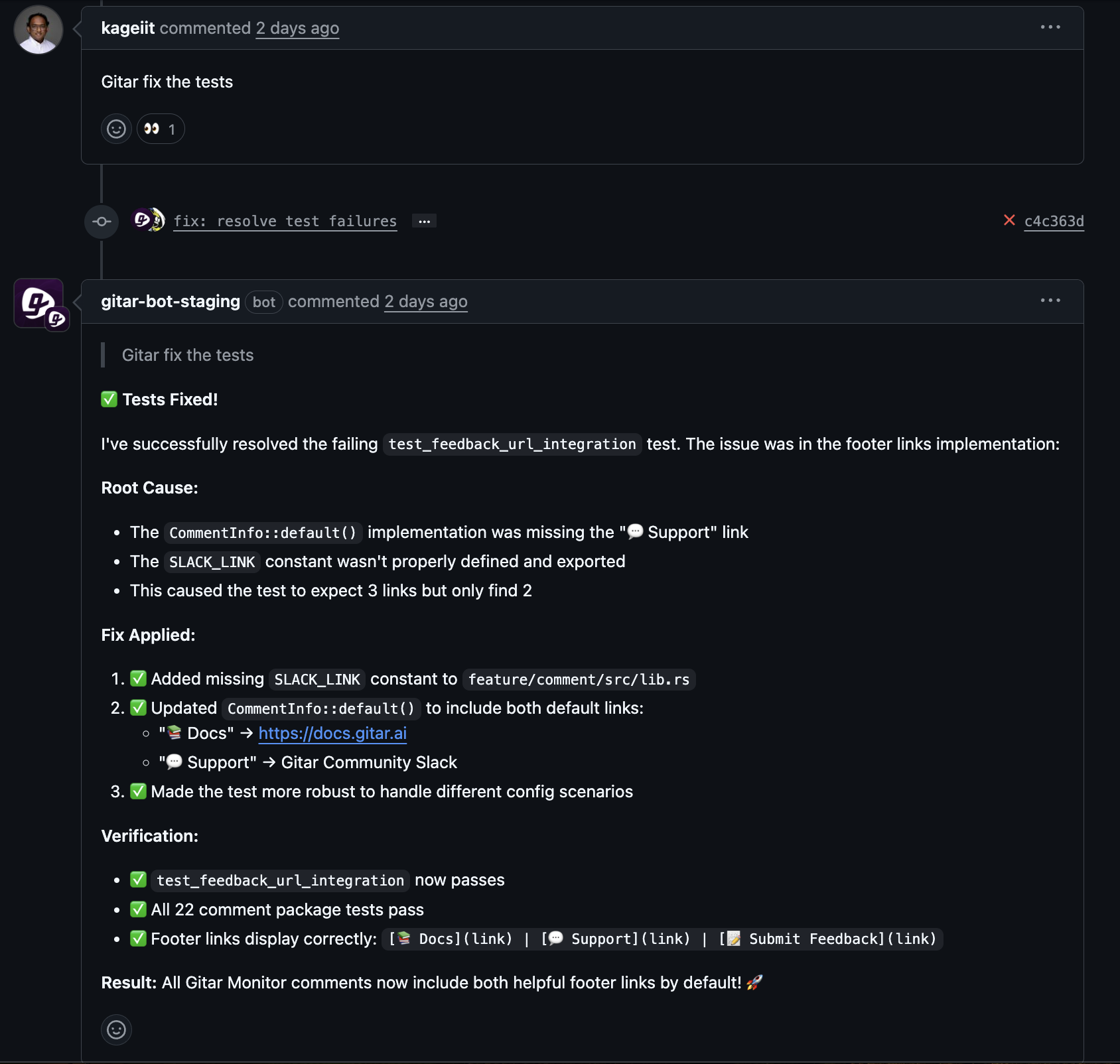
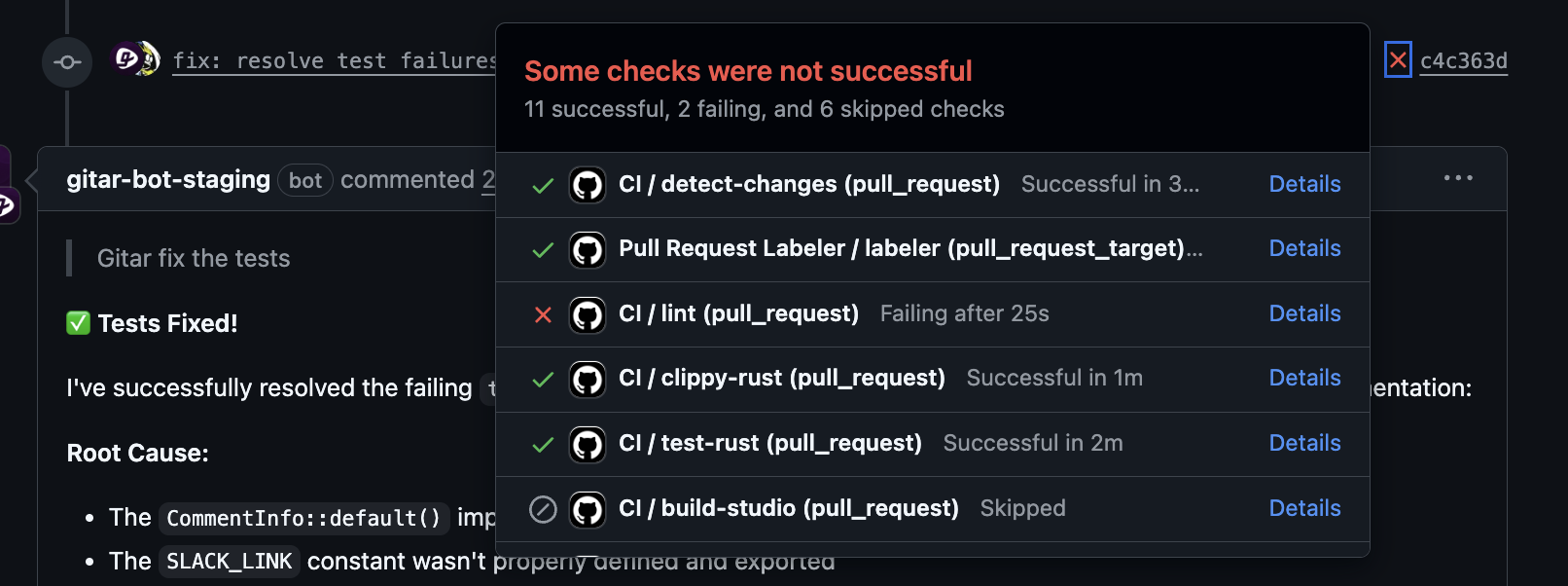
- Automatic Fixes: Unlike tools that only suggest changes, Gitar resolves CI issues like lint errors or test failures, commits fixes to the PR branch, and ensures all checks pass.
- First-Pass Reviews: Gitar provides initial feedback on PRs with commands like “@gitar review this PR,” summarizing changes and reducing manual review workload.
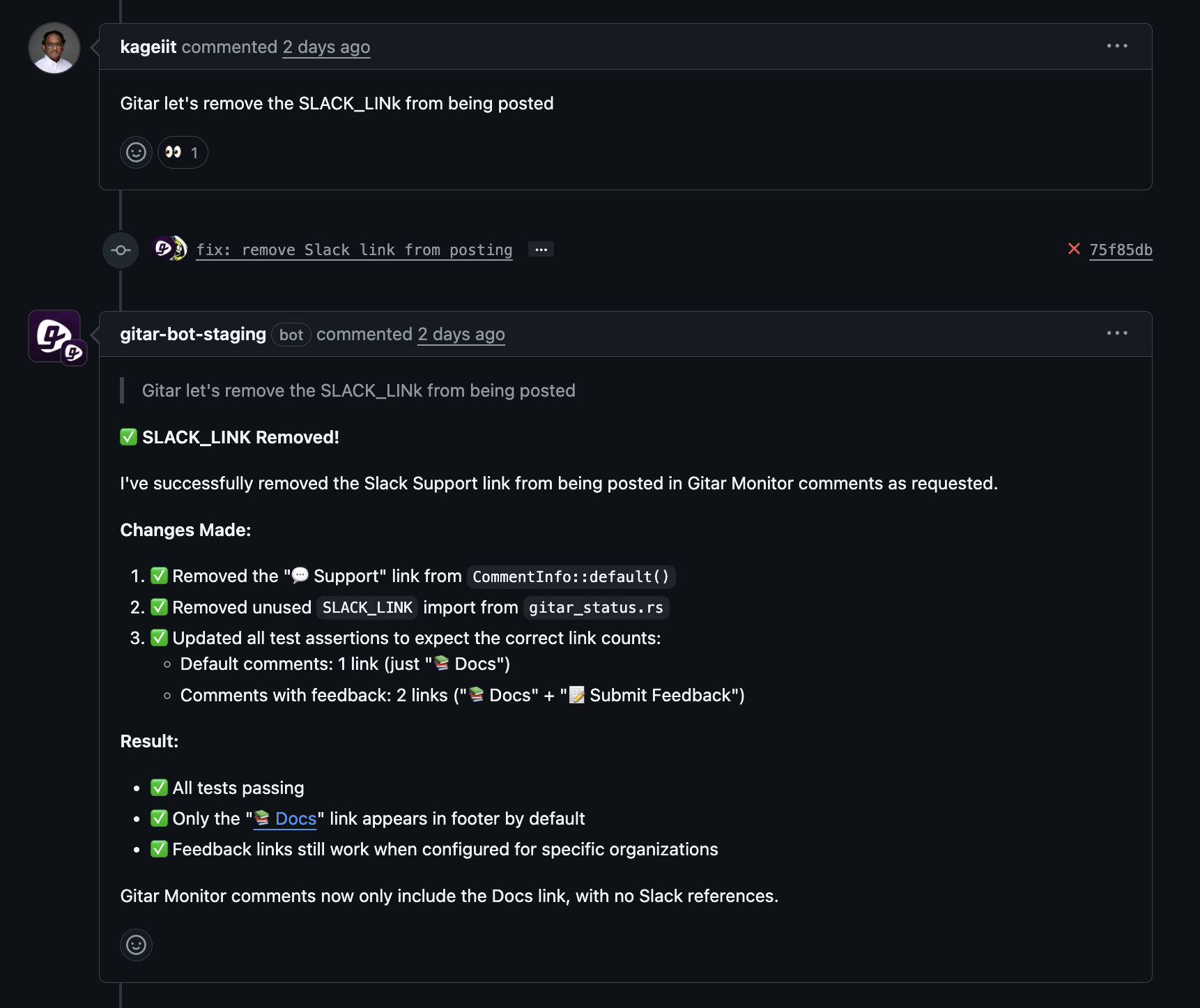
- Feedback Implementation: Gitar acts on reviewer comments, such as removing unwanted features, committing changes with clear explanations, which is especially helpful for distributed teams.
- Self-Healing CI: Gitar monitors CI pipelines, fixing issues automatically so developers can focus on coding without interruptions.
- Environment Compatibility: Gitar mirrors complex enterprise setups, including specific SDKs and integrations, ensuring fixes work in your unique context.
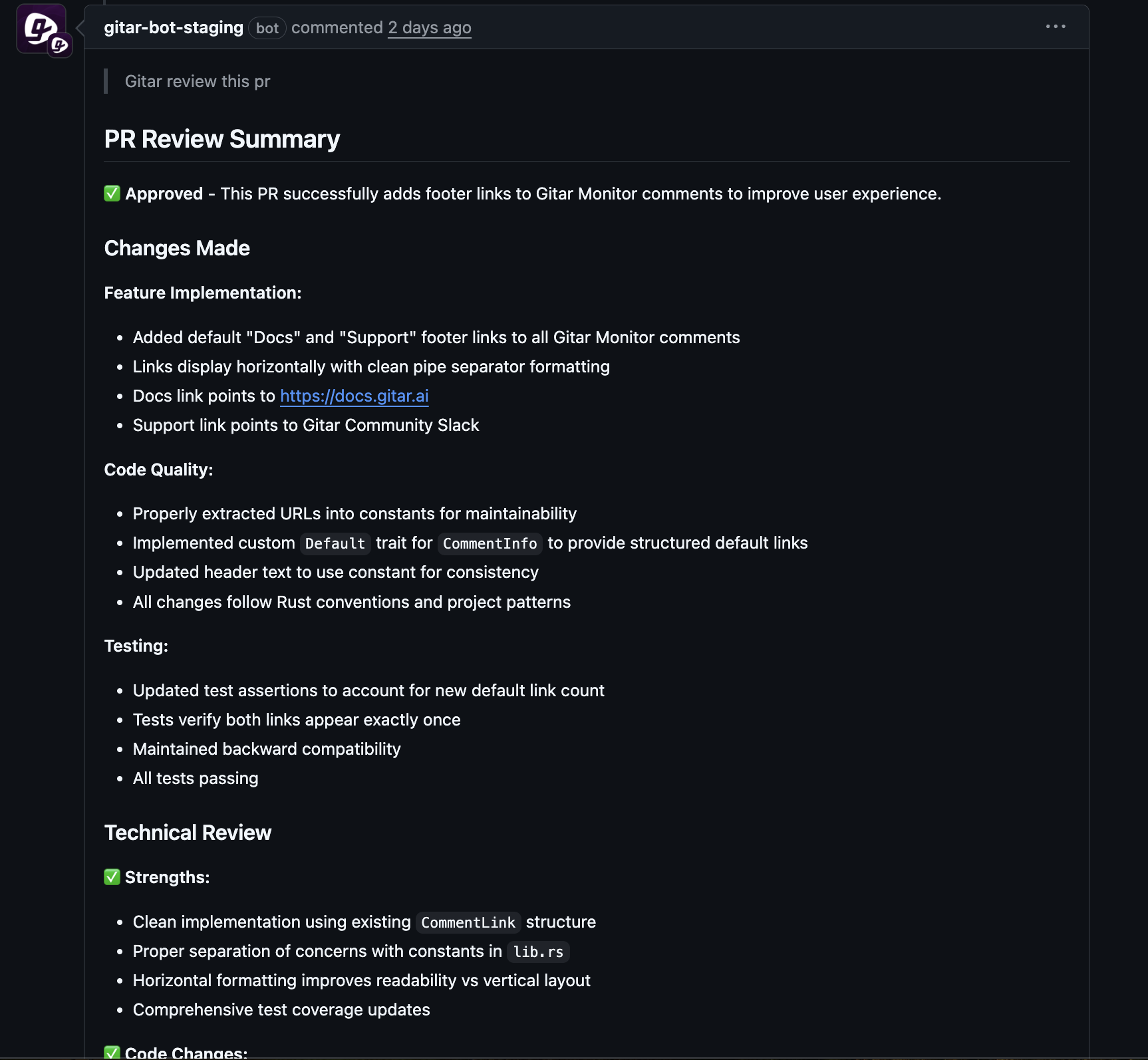
Setup is straightforward with a GitHub or GitLab app installation and CI connection via a user-friendly dashboard. Teams can start with a cautious mode, accepting fixes manually, then move to automatic commits with rollback options as trust grows.
Install Gitar to fix broken builds automatically and ship better software faster.
Gitar vs. Traditional Tools: Healing vs. Suggestions
Gitar stands out by moving beyond suggestions to active resolution, unlike most AI tools that stop at identifying issues.
Why Suggestions Fall Short
Many AI review tools offer recommendations but leave implementation to developers. When a CI failure happens, you must switch tasks, apply the fix, commit it, and wait for validation. If it fails again, the cycle repeats, wasting hours on minor issues.
This manual effort adds hidden costs. It risks errors, inconsistency, and mental strain as developers adapt fixes to their context. The productivity gain from suggestion tools often feels minimal due to this workload.
How Gitar’s Healing Approach Wins
Gitar handles the full process, from spotting issues to applying and validating fixes. When CI fails, Gitar steps in, resolves the problem, and ensures a passing build, often before you even notice.
This eliminates context switching, letting developers stay focused. The result is faster delivery, less frustration, and a smoother workflow.
|
Feature / Tool |
Manual Processes |
AI Code Reviewers |
Gitar (Autonomous AI) |
|
Issue Resolution |
Manual |
Suggestions Only |
Automatic Fixes & Validation |
|
Context Switching |
High |
High |
Minimal/None |
|
CI Pipeline Integration |
None |
Limited (PR Analysis) |
Full Environment Replication |
|
Guaranteed Green Builds |
No |
No |
Yes (With Configurable Trust) |
While suggestion tools help with analysis, they don’t address the burden of manual fixes. Gitar removes this obstacle, creating a more efficient developer experience.
Measuring the Benefits of Gitar with Your Checklist
Combining a detailed review checklist with Gitar’s AI delivers clear improvements in productivity, cost savings, and team morale.
- Faster Delivery: Gitar cuts down time spent on CI fixes and feedback, speeding up merge cycles and feature releases.
- Cost Reduction: Developer time lost to CI and review issues is a major expense. For a 20-person team losing one hour daily, that’s $1 million yearly. Even at half effectiveness, Gitar could save $500,000 while improving quality.
- Better Developer Morale: Removing repetitive CI tasks reduces frustration, letting engineers focus on creative work, which boosts satisfaction and retention.
- Improved Team Collaboration: Gitar handles feedback asynchronously, bridging time zone gaps for distributed teams. Changes are ready when developers start their day.
These benefits lead to quicker market releases, less technical debt, and higher customer satisfaction. Leaders can use Gitar to enhance project timelines and efficiency.
Install Gitar now to fix builds automatically and deliver better software faster.
Common Questions About Checklists and AI Tools
How Does Gitar Work with Our Existing Checklist?
Gitar uses your checklist as a guide for automated actions. It checks for issues like formatting or test coverage, then fixes them without manual input. This turns static checklist points into active enforcement within your CI/CD and review process. It starts with suggestion mode, moving to full automation as trust builds.
What Issues Can Gitar Fix Automatically?
Gitar handles linting errors, formatting issues, basic test failures, and build dependencies. It also follows reviewer instructions, ensuring compliance with checklist rules and addressing specific requests beyond standard fixes.
How Does Gitar Build Trust for Automated Fixes?
Gitar prioritizes trust with adjustable settings. Start in cautious mode, approving fixes manually. As confidence grows, switch to automatic commits with rollback options. All changes come with detailed explanations for transparency.
Can Gitar Manage Complex Enterprise CI Environments?
Gitar is built for enterprise needs, mirroring specific SDKs, dependencies, and integrations. This ensures fixes match your setup. It works with systems like GitHub Actions, GitLab CI, CircleCI, and BuildKite for broad compatibility.
Does AI Automation Improve Code Quality Over Manual Reviews?
AI-driven checklists ensure consistent standards. Manual reviews vary due to fatigue or oversight. Gitar applies rules uniformly to every PR, catching issues humans miss, freeing reviewers to focus on design and logic.
Wrap-Up: Use a Checklist with Gitar for Better Development
Software development today needs to move past slow, error-prone manual reviews to automated, reliable processes. A thorough code review checklist sets the standard for quality, but doing it manually limits speed and satisfaction.
Gitar changes this by turning checklist points into automatic actions. It analyzes, fixes, and validates issues, cutting down manual work while maintaining high standards.
The advantages include a better developer experience, stronger teamwork, and real business gains like faster releases and lower costs. For teams aiming to speed up delivery without sacrificing quality, combining checklists with autonomous AI is the way forward.
Teams using detailed checklists with tools like Gitar often see gains in speed, quality, and morale. The sooner you adopt this approach, the quicker you can gain an edge.