
Key Takeaways
- Continuous testing optimization keeps code flowing from commit to deployment by detecting and resolving CI issues early and consistently.
- Autonomous CI healing reduces the high cost of CI failures and review delays, which can reach hundreds of thousands of dollars per year for mid-sized teams.
- AI-generated code increases pull request volume, so CI, testing, and review workflows now represent a primary delivery bottleneck rather than a peripheral concern.
- A phased rollout with clear metrics, a configurable trust model, and a strong DevEx focus helps teams adopt autonomous CI with lower risk.
- Gitar provides autonomous CI fixing inside existing workflows, and teams can start now by installing Gitar to automate CI fixes.
The Strategic Imperative: Why Continuous Testing Optimization is a 2026 Priority
Continuous testing optimization has become a core capability for engineering leaders in 2026. Competitive teams maintain a continuous flow from commit to deployment, even as release frequency and code volume increase.
CI failures and code review delays now carry material cost. For a 20-developer team, productivity losses can approach $1M per year. Analysis of more than 8.1 million pull requests from over 4,800 organizations shows that delivery bottlenecks consistently affect cycle time, deployment frequency, and change failure rates.
AI-generated code amplifies this pressure. Nearly half of all code is now estimated to be AI-generated, so validation, testing, and review activities now define throughput. Modern productivity frameworks like SPACE and DevEx link CI health directly to developer experience and business outcomes, and teams with strong developer experience perform four to five times better across speed, quality, and engagement metrics.
Defining Continuous Testing Optimization Software: Beyond Traditional QA
Continuous testing optimization describes a move from manual or scripted QA to self-managing pipelines. Traditional tools focus on executing tests. Optimization software focuses on keeping the pipeline healthy.
Key ideas include continuous testing, continuous feedback, autonomous testing, and CI healing. These capabilities work across DevSecOps and platform engineering practices, and they aim to detect issues early, fix them quickly, and keep developers in flow.
Modern tools operate at the intersection of AI, workflow automation, and DevEx. Effective platforms understand context, propose changes, apply fixes, and validate results. The result is a self-healing development environment instead of a sequence of manual firefights.
Navigating the Landscape: Categories of Continuous Testing Optimization Solutions
Continuous testing optimization spans several tool categories. Each offers different levels of automation and impact.
TABLE: Evolution of Continuous Testing Optimization
|
Category |
Primary Focus |
Key Limitation |
Emerging Leaders |
|
Manual Testing |
Human-driven validation |
Slow, error-prone, non-scalable |
N/A |
|
Automated Testing |
Scripted test execution |
Requires maintenance, brittle |
Selenium, Cypress |
|
AI Test Generation |
AI-assisted test creation and maintenance |
May require human oversight for complex scenarios |
Testim, Mabl |
|
Autonomous CI Healing |
Auto-fixing and validation |
Leading-edge technology |
Gitar |
Autonomous CI healing sits at the top of this maturity curve. Platforms in this category do more than suggest fixes. They apply and validate changes inside real CI environments, which reduces manual work and shortens feedback loops.
Gitar: Autonomous Continuous Testing Optimization in Practice
Gitar operates as a CI healing engine that focuses on practical pipeline outcomes. The platform fixes CI failures and implements code review feedback directly in pull requests.
When a pull request fails or receives review comments, Gitar analyzes the context, generates a code change, and updates the branch. The system then validates the fix against the full CI workflow so developers return to a passing build instead of a failing one.
Key capabilities include:
- End-to-end fixing, including lint errors, test failures, and build issues, which reduces context switching and unplanned work.
- Environment-aware execution that respects SDK versions, multi-SDK dependencies, and third-party security scans such as SonarQube and Snyk.
- A configurable trust model that ranges from suggestion-only behavior to fully autonomous commits with rollback options.
- Support for distributed teams, where reviewers can leave comments for Gitar to implement while other team members are offline.

Teams can start with suggestion mode, then increase automation as they gain confidence in the quality and safety of automated fixes.
Strategic Considerations for Continuous Testing Optimization Implementation
Build vs. Buy for Continuous Testing Optimization
Engineering leaders often evaluate whether to build autonomous CI capabilities in-house or adopt a platform. Organizations dedicate an average of 4.7% of engineering headcount to DevProd functions, so internal platforms carry meaningful ongoing cost.
Custom autonomous CI systems require skills in AI agent design, CI integrations, context management, and failure pattern analysis. The need to manage concurrency, asynchronous events, and distributed state adds risk and complexity. A specialized platform such as Gitar usually delivers faster time-to-value and lower maintenance overhead.
Organizational Readiness and Change Management
Successful adoption depends on clear roles and expectations. Engineering managers, DevOps teams, and developers need alignment on goals, guardrails, and rollout stages.
Strong candidates for early adoption already have stable CI/CD pipelines, openness to automation, and leadership support. These teams define success criteria, communication plans, and review processes before enabling autonomous fixing.
ROI Expectations and Success Metrics
Measurement frameworks should connect optimization to outcomes. Useful views include cycle time, change failure rate, and developer experience indicators rather than output-only metrics. Teams also need to interpret DORA metrics in the context of AI-driven automation, since automation can change both throughput and failure modes.
Implementation Roadmap: Phased Approach to Autonomous CI
A phased rollout helps teams prove value and build trust without disrupting delivery.
Step 1: Pilot and Trust Building
Teams often begin with a small set of repositories and Gitar in suggestion-only mode. Developers see CI failures analyzed and proposed fixes prepared for them to review. This phase validates correctness and safety while building familiarity.
Step 2: Expanding Automation
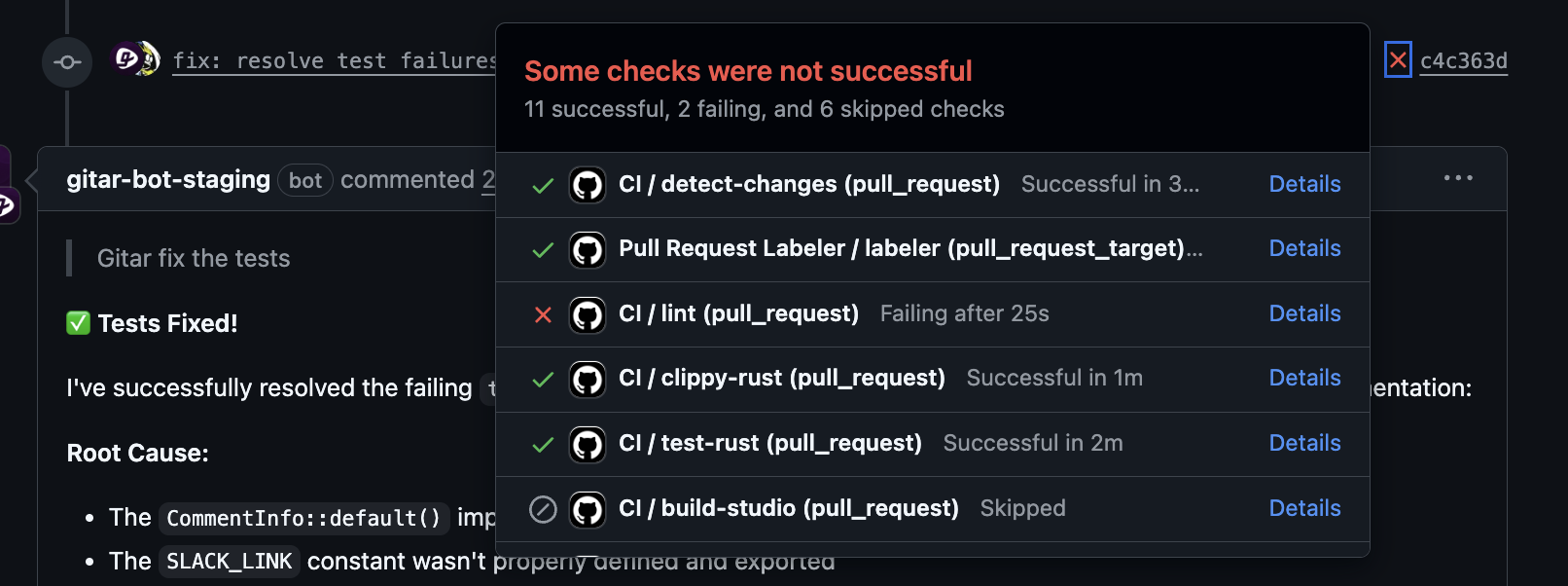
After the pilot, teams expand Gitar to more repositories and enable direct auto-commits for well-understood failure classes. This shift reduces context switching and lets developers stay focused on feature work. Tracking improvements in cycle time and deployment frequency during this phase helps quantify ROI.
Step 3: Advanced Workflows and Optimization
Mature deployments use Gitar for broader workflows, such as automated refactoring in response to review comments, or enforcing standards across many repositories. Insight dashboards then support continuous improvement and highlight new automation opportunities.
Strategic Pitfalls for Experienced Engineering Teams
Experienced teams sometimes face predictable challenges when adopting continuous testing optimization.
Underestimating the Last-Mile Problem
Teams that rely on suggestion-only tools often retain a heavy manual burden. Continuous testing optimization reaches full value when tools both suggest and implement validated fixes.
Overlooking Developer Experience
Optimizing for metrics while ignoring developer flow can reduce overall performance. Poor DevEx can lead to four to five times worse outcomes across speed, quality, and engagement, so automation should reduce cognitive load, not add new friction.
Fragmented Tooling and Weak Measurement
Disconnected tools that focus on single pipeline stages can introduce new handoffs and delays. AI investments in 2026 benefit from clear, end-to-end metrics and visible business impact, not isolated improvements.
Frequently Asked Questions (FAQ) about Continuous Testing Optimization Software
How does autonomous CI fixing impact DORA metrics in 2026?
Autonomous CI fixing improves DORA metrics by reducing lead time, increasing deployment frequency, and lowering change failure rates. Gitar resolves many failures before developers engage, so pipelines stay green more often, and delivery becomes more predictable.
How is Gitar different from AI code reviewers for continuous testing optimization?
AI reviewers typically propose changes that developers must apply and validate. Gitar acts as a healing engine that applies fixes, runs the full CI workflow, and confirms a passing state, which removes much of the remaining manual work.
How does Gitar manage trust and control when automating changes?
Gitar uses a configurable trust model. Teams can start with suggestion-only mode, then move to direct commits with rollback once they are comfortable with the behavior and results. This approach keeps engineering leaders in control of automation levels.
How does Gitar support quality for AI-generated code?
Gitar validates fixes against the complete CI environment, including SDK versions, dependency interactions, and security or quality scanners such as SonarQube and Snyk. This process helps ensure that automated changes meet existing quality gates.
What is the typical ROI timeline for continuous testing optimization software?
Many teams see quick wins in the first weeks as routine CI issues stop interrupting developers. For a 20-developer team spending one hour per day on CI problems, Gitar can reclaim significant time and reduce frustration within the first one to two months.
Conclusion: Moving Toward Autonomous CI in 2026
Continuous testing optimization software is shifting CI/CD from a manual constraint to an area of strategic advantage. In 2026, teams that rely purely on reactive debugging face higher costs and slower delivery than those that automate failure detection and remediation.
Gitar gives engineering leaders a practical path to autonomous CI. The platform reduces unplanned work from CI failures and review loops, supports better developer experience, and helps teams ship reliably at higher velocity.
Teams that adopt autonomous continuous testing optimization now can improve delivery speed, lower operating costs, and create a more sustainable development pace. To explore this approach in your own environment, install Gitar and start automating CI fixes.