
Written by: Ali-Reza Adl-Tabatabai, Founder and CEO, Gitar
Key Takeaways
- Flaky tests cause intermittent pass and fail behavior that erodes confidence in CI pipelines and wastes engineering time.
- Most flakiness comes from timing issues, concurrency and shared resources, environment drift, external dependencies, and fragile test design.
- A clear framework of detection, categorization, and targeted remediation improves CI test pass rates and reduces reruns.
- Autonomous CI healing reduces manual debugging of common failures, preserves developer focus, and shortens time-to-merge.
- Teams can install Gitar to automatically diagnose and fix many CI failures, improving reliability with minimal workflow change.
How Flaky Tests Reduce CI/CD Reliability and Productivity
Flaky tests are tests that pass and fail intermittently with no corresponding code or environment change. This instability forces engineers to re-run pipelines, inspect logs, and hunt for non-reproducible issues instead of writing or reviewing code.
Time loss adds up quickly. Developers can spend close to 30% of their time on CI and code review issues, often losing around an hour per day to debugging and fixing CI failures. For a 20-developer team, this can translate into roughly $1M in annual productivity loss when factoring in loaded engineering costs.
Most flaky tests fall into a few repeatable categories:
- Timing and race conditions, where assumptions about execution order or timing do not always hold.
- Concurrency and shared resources, where parallel tests interfere through shared state or resources.
- Environment issues, including unstable or inconsistent environments, infrastructure and network issues, and subtle configuration discrepancies between local and CI.
- External dependencies and inputs, such as unreliable external services, unstable test data, or asynchronous API calls.
- Test design problems, including poor test design or fragile locators, especially in UI automation.
A Practical Framework for Managing Flaky Tests
Engineering leaders benefit from treating flaky tests as recurring technical debt rather than isolated incidents. A simple three-step framework keeps efforts focused.
Step 1: Detect and Monitor Flaky Tests Proactively
Reliable detection is the foundation. Teams gain visibility by:
- Running continuous monitoring of historical runs and pattern analysis across branches and pipelines.
- Using CI platforms that offer built-in flakiness detection from test history.
- Adding test management tools for deeper analytics and long-term trends.
This approach flags tests with intermittent failures early, so teams can act before developers start ignoring red builds.
Step 2: Analyze Root Causes and Categorize Debt
Once a flaky test is identified, structured diagnosis keeps work targeted. Teams can:
- Compare failure patterns, validate external dependencies, and check behavior across environments.
- Classify flakiness by cause type, such as environment, concurrency, or test design.
- Rank tests by frequency, impact on critical paths, and time to fix.
Treating flaky tests as first-class technical debt helps teams prioritize them alongside security and performance work.
Step 3: Apply Targeted Remediation Instead of Workarounds
Effective remediation aims to remove non-determinism rather than hide symptoms. Common strategies include:
- Stabilizing environments, isolating resources, and fixing brittle timing assumptions.
- Preventing shared state interference between tests through better isolation.
- Improving data management and refactoring brittle tests to remove dependency on fragile selectors or external timing.
Simple automatic retries can keep the pipeline green temporarily, but they extend CI duration and delay root-cause fixes when used as the main strategy.
Improve CI Stability with Autonomous CI Healing from Gitar
Traditional flaky test work often requires developers to stop feature work, inspect logs, and patch failing tests or infrastructure. Autonomous AI agents such as Gitar reduce this burden by diagnosing and fixing many CI failures on behalf of the team.
How Gitar Resolves CI Failures
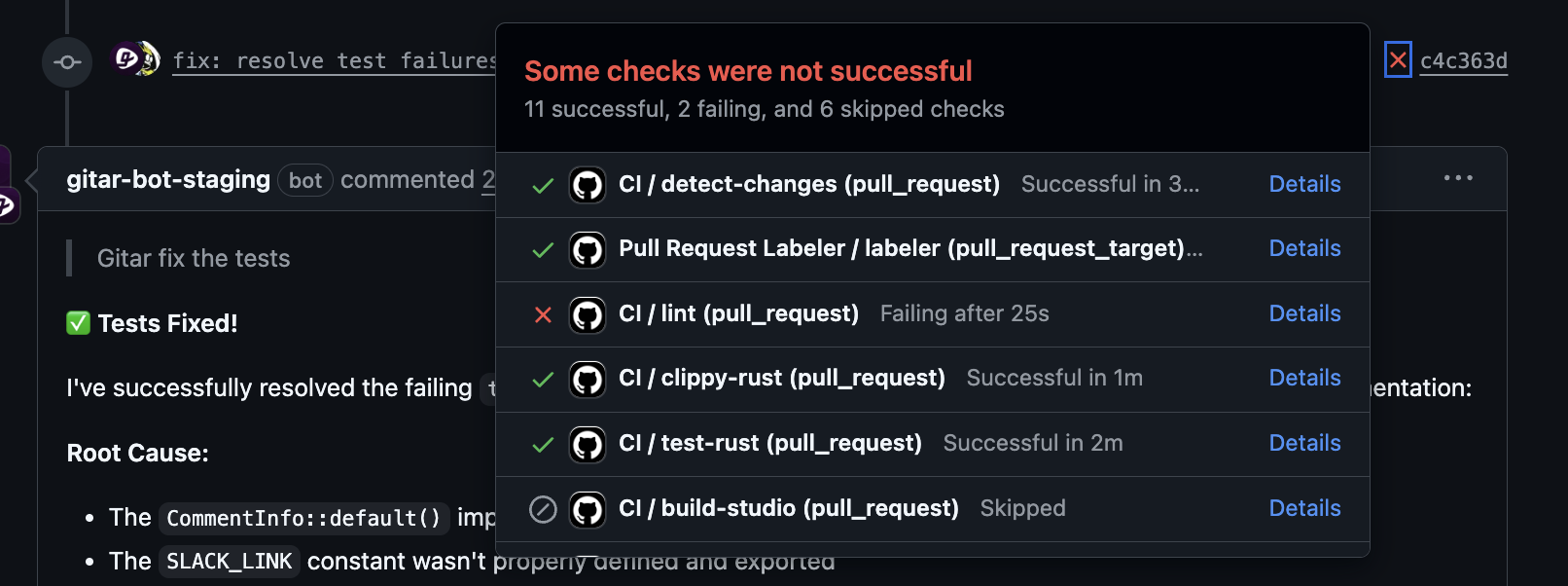
When CI checks fail, including failures from flaky or unstable tests, Gitar follows an automated loop:
- Analyzes failure logs to infer likely root causes.
- Proposes and constructs code or configuration changes.
- Applies fixes to the pull request branch and re-runs checks.
This workflow handles many common issues, such as lint errors, build failures, and straightforward test failures, without requiring developers to leave their current task.
Teams can choose how much control they keep. In conservative mode, Gitar posts suggested fixes that developers review and accept with a click. In more automated modes, Gitar commits fixes directly while preserving rollback options. This flexibility allows gradual adoption without forcing a single trust model.

How Gitar Differs from Suggestion-Only Tools
AI code review tools, such as CodeRabbit, focus on generating suggestions and comments. Gitar operates as a CI healing engine that emphasizes automated resolution and validation.
|
Feature |
Gitar (CI Healing Engine) |
CodeRabbit (Suggestion Engine) |
Manual Work (Status Quo) |
|
CI failure resolution |
Autonomously applies and validates fixes |
Provides suggestions with optional auto-apply |
Requires manual debugging, fixing, and retrying |
|
Ensures green builds |
Targets green builds with automated checks |
Does not guarantee CI success after applying suggestions |
Depends on human changes and judgment |
|
Environmental context |
Replicates the CI environment for validation |
Uses code graph and repository context |
Relies on human understanding of systems |
|
Impact on developer flow |
Reduces interruptions by handling failures in the background |
Minimizes disruption but still needs confirmation |
Interrupts flow with frequent context switches |
Gitar focuses on getting pull requests back to a passing state, so developers can merge with fewer interruptions.
Install Gitar to begin automatically fixing many CI failures and raising test pass rates without large process changes.
Implement Autonomous CI Healing and Measure ROI
A phased rollout helps teams adopt autonomous CI healing with minimal risk and clear metrics.
Phase 1: Start in Conservative Mode and Build Confidence
Most teams begin by installing Gitar in suggestion-only mode. Gitar integrates with GitHub, GitLab, and CI systems such as GitHub Actions, CircleCI, and Buildkite. Teams typically:
- Connect a limited set of repositories.
- Scope Gitar to certain failure types, such as lint or basic test failures.
- Review and accept suggested fixes to understand how the system behaves.
This phase builds trust while maintaining full human control over code changes.
Phase 2: Expand Coverage and Automate Fix Application
Once teams trust Gitar’s recommendations, they often expand usage to more repositories and allow automatic commits for lower-risk fixes. Over time, Gitar can handle a large portion of repetitive CI failures, leaving only complex or high-risk cases for manual investigation.
Estimate ROI from Reduced CI Debugging
For a 20-developer team spending about an hour per day on CI and code review issues, the annual cost can reach $1M based on an average loaded cost of $200 per hour. If autonomous healing removes even half of that time, the organization recovers approximately $500K annually, while also shortening feedback loops and releases.
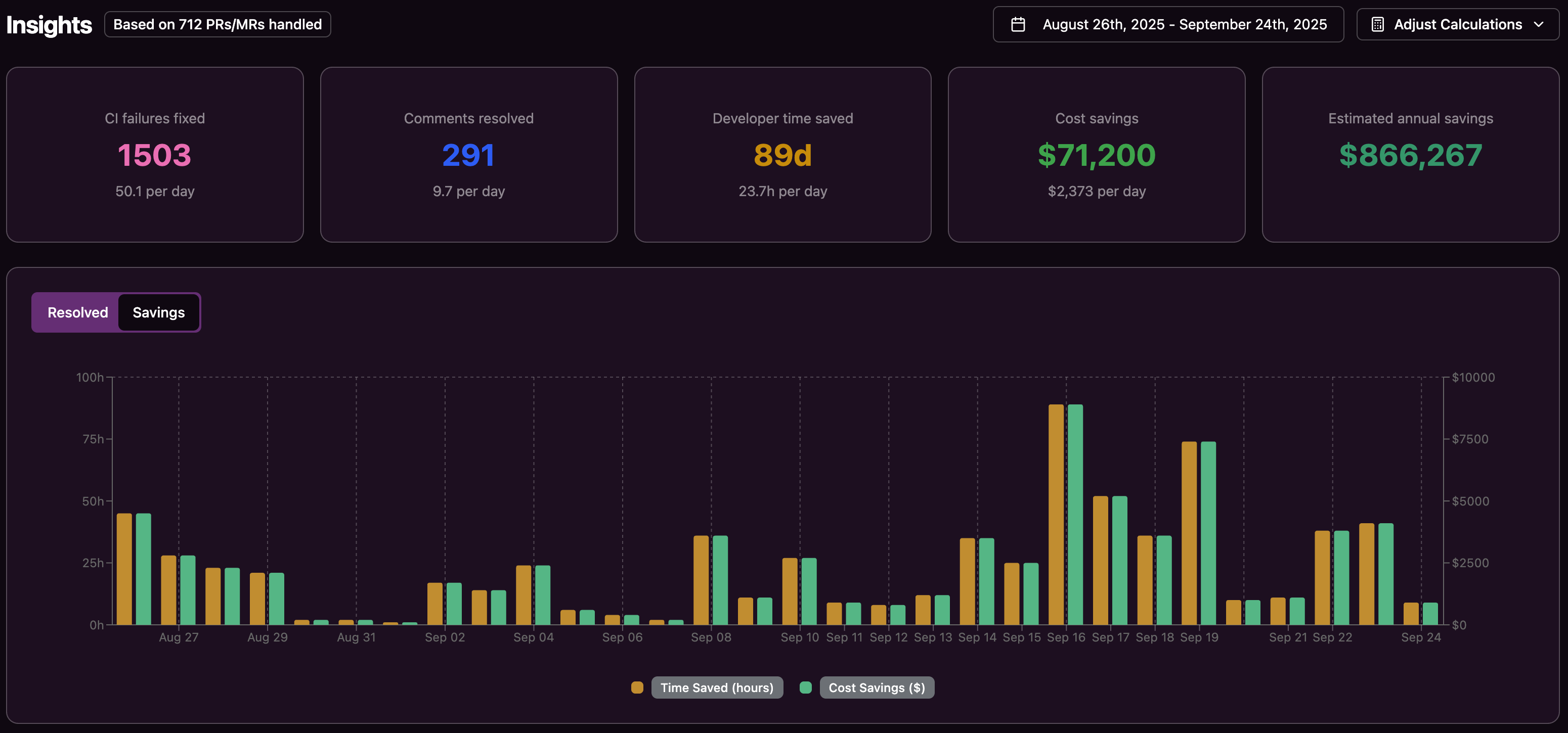
Benefits also include less context switching, higher developer satisfaction, and slower growth of CI-related technical debt.
Avoid Common Pitfalls in Flaky Test Management
Build a Culture That Treats Test Reliability as Quality
Teams that make progress on flaky tests usually treat reliability as a core quality attribute. Leadership highlights how unstable tests slow delivery and increase burnout, and invests in both remediation work and tools that improve stability. Framing flaky tests as quality issues helps secure ongoing attention instead of short-term cleanup efforts.
Replace Blind Retries with Root-Cause Fixes
Simple retries can be useful for temporary relief, but should not be the main strategy. Removing non-determinism through systematic fixes improves long-term stability. Gitar supports this approach by examining logs, identifying likely causes, and applying targeted fixes so that issues are resolved rather than repeatedly retried.
Account for Hidden Environmental Differences
Subtle differences in OS, dependencies, and hardware often explain why a test passes locally but fails in CI. Gitar’s ability to work against the real CI environment reduces the risk that a fix only works on a developer machine.
FAQ: Gitar and Improving CI Test Pass Rates
How is Gitar different from AI reviewers like CodeRabbit for CI failures?
CodeRabbit and similar tools concentrate on code review suggestions. They may offer one-click application of changes, but they do not always validate those changes against the full CI pipeline. Gitar focuses on CI failures, autonomously applies fixes, and re-runs checks to move pull requests back to a passing state across platforms such as GitHub Actions, CircleCI, and Buildkite.
Can Gitar handle complex enterprise CI setups?
Gitar is built for complex environments. It can mirror CI settings, including SDK versions, language runtimes, dependencies, and third-party scans such as SonarQube and Snyk. This context allows Gitar to propose fixes that respect the constraints of each organization’s pipeline.
How can teams control the level of automation and risk?
Gitar offers configurable modes. Teams can begin with conservative behavior, where Gitar only suggests patches for developer review. As confidence grows, they can enable automatic commits for selected failure types, with logging and rollback options to preserve safety and traceability.
Conclusion: Raise CI Pass Rates with Less Manual Effort
Flaky tests and CI failures limit engineering productivity and delay releases when addressed only through manual debugging. A deliberate framework for detection, analysis, and remediation, combined with autonomous CI healing, offers a more sustainable path.
Gitar reduces repetitive CI work by diagnosing and fixing many failures automatically, improving test pass rates and protecting developer focus. Teams that adopt this approach gain faster feedback cycles, more predictable pipelines, and clearer insight into where human attention is most valuable.
Install Gitar to start reducing CI debugging time and improving the reliability of your test suites in 2026.