
Key Takeaways
- Unit test debugging often consumes more developer time than feature work and quietly slows delivery schedules.
- Brittle tests, fragile test design, and context switching drive up the real cost of failed test runs.
- Autonomous CI systems can diagnose and fix a subset of unit test and CI failures, reducing interruptions and wait times.
- A staged rollout of autonomous fixes helps teams build trust, measure impact, and expand automation safely.
- Teams can use Gitar to automatically fix many CI and unit test failures and reduce manual debugging work.
The Hidden Costs of Unit Test Debugging: Why Traditional Approaches Struggle
Unit test debugging time creates a significant productivity drain that many teams do not track explicitly. Common unit-test failures often come from testing implementation details instead of behavior, which makes tests brittle and tightly coupled to internal code structure. Small refactors then cause wide test breakage, even when behavior has not changed.
Weak test design multiplies this effect. Incomplete coverage, fragile tests, and slow execution increase the time needed to understand and fix failures. Over-mocking and testing trivial code paths add ongoing maintenance work without catching many additional defects.
Context switching adds another major cost. When CI reports a failure, developers must pause current work, interpret logs, reproduce issues locally, apply fixes, and wait for another pipeline run. A short fix can expand into an hour of disrupted focus and lost momentum.
Distributed teams feel this even more. A failing test that appears in an overnight CI run can delay integration by 12–24 hours and push back dependent work across time zones. These delays accumulate across sprints and reduce predictable delivery. Gitar helps reduce these delays by automatically fixing many CI failures as they occur.
How Autonomous CI Reduces Unit Test Debugging Time
Autonomous CI shifts unit test debugging from a manual, interrupt-driven task to a background process that can resolve many failures on its own. A self-correcting pipeline detects, analyzes, and fixes a subset of issues before a human needs to step in.
Effective unit testing focuses on fast, deterministic tests that run in milliseconds, support CI/CD, and provide clear feedback. Well-structured tests with clear naming and scope make it easier for both humans and AI systems to understand what went wrong.
Frequent bug types such as off-by-one errors, boundary issues, and logic mistakes often show up as unit test failures that require detailed investigation. These failures tend to follow recognizable patterns in logs and stack traces.
Autonomous CI tools can learn these patterns and apply targeted fixes based on failure signatures. Instead of waiting for a developer to read logs and patch code, the system proposes or applies changes, re-runs tests, and reports back only when human review is needed.
How Gitar’s Autonomous AI Fixes Unit Tests in Real Time
Gitar focuses on closing the loop from CI failure to a validated fix. Rather than only suggesting code, it can diagnose issues, propose changes, apply them, and ensure the pipeline returns to a passing state for supported failure types.
End-to-End Fix Generation and Validation
Gitar analyzes CI logs when a failure occurs, identifies likely root causes, and generates code or configuration changes. It then applies those changes and validates them against the full CI pipeline before committing the fix back to the pull request branch.
Full Environment Replication for Accurate Fixes
The platform mirrors complex CI environments, including specific SDK versions, multiple language runtimes, and tools such as SonarQube. This environment awareness reduces the risk of fixes that pass locally but fail in CI due to configuration differences.
Context-Aware Intelligence and Local Agent Integration
Gitar can connect to local developer agents through MCP server integrations to gain additional context about ongoing changes. This connection helps the system align fixes with the latest code, rather than only what exists in the main repository.
Configurable Trust Model for Team Control
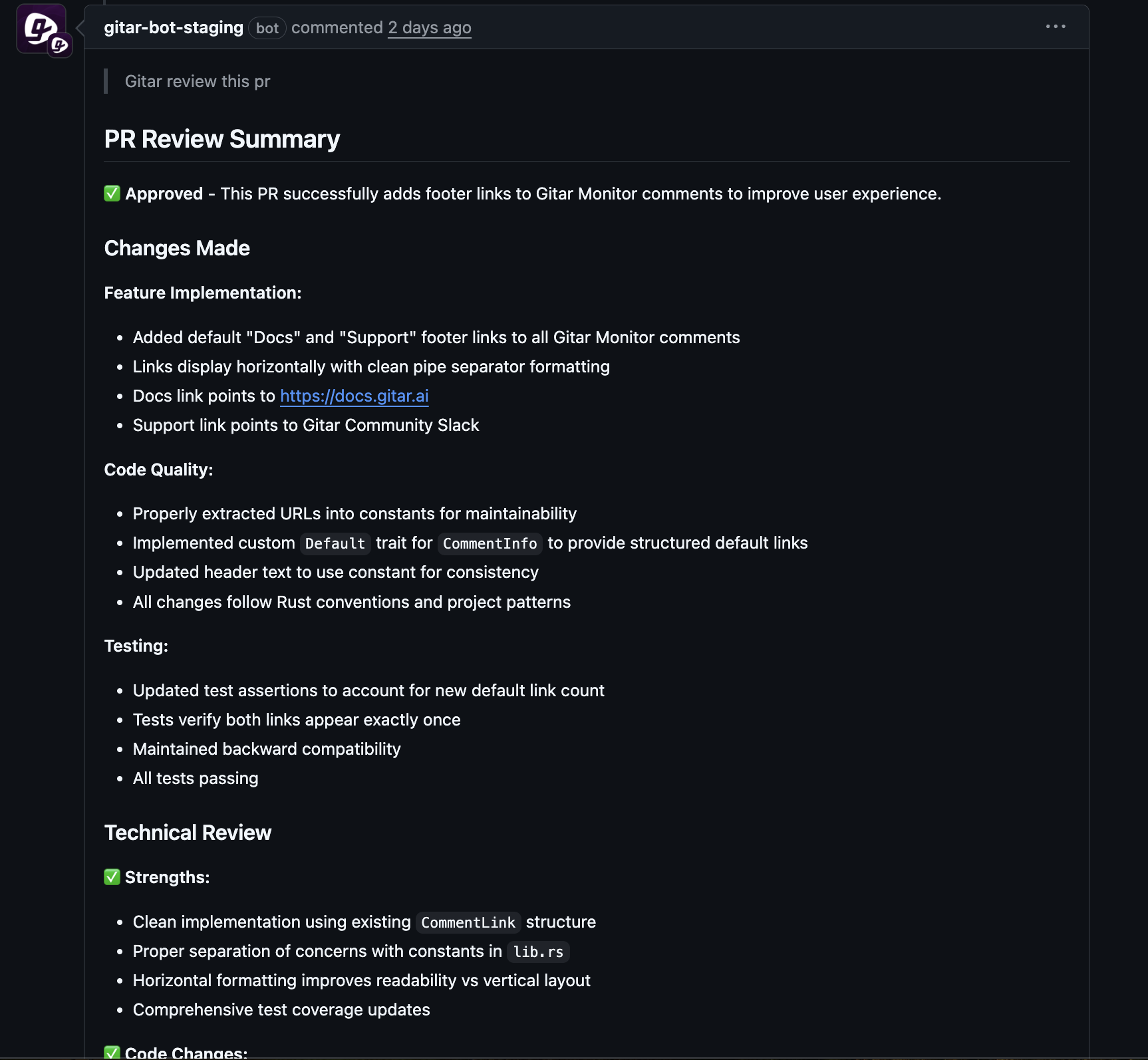
Gitar supports configurable modes, from suggestion-only behavior to fully autonomous commits with rollback options. Teams can start with human review of every change, then gradually enable more automation for specific failure types as confidence increases.
Support for Multiple CI Platforms
Gitar integrates with platforms such as GitHub Actions, GitLab CI, CircleCI, and BuildKite. This support allows teams to adopt autonomous fixes without replacing existing CI infrastructure.
Rolling Out Autonomous Fixes in Your Workflow
Phase 1: Install and Build Initial Trust
Teams typically begin with GitHub App authorization on selected repositories and basic configuration through Gitar’s web dashboard. Developers start in conservative, suggestion-focused modes so they can inspect proposed fixes before they modify any code.
Phase 2: Automate Low-Risk CI Failures
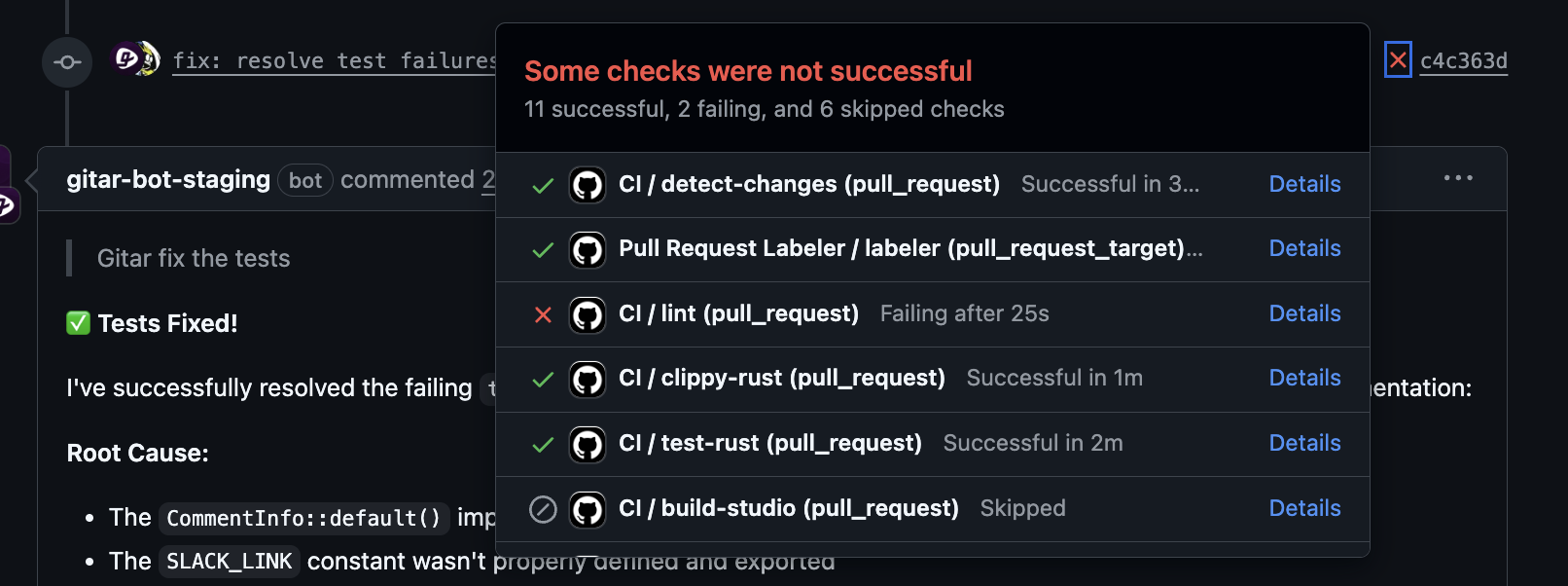
After teams observe accurate fixes for issues such as linting violations, formatting problems, and simple test failures, they often enable automated commits for those categories. This shift removes repetitive tasks while keeping more complex logic changes under direct review.
Phase 3: Expand to Code Review and Advanced Workflows
Mature deployments use Gitar during code reviews. Senior developers can leave comments requesting specific refactors or fixes, and Gitar implements the requested changes. The trust model allows teams to keep a human in the loop for sensitive services while using full automation elsewhere. Teams can start this process by installing Gitar on a small set of repositories and expanding over time.
Measuring ROI: The Impact of Faster Unit Test Debugging
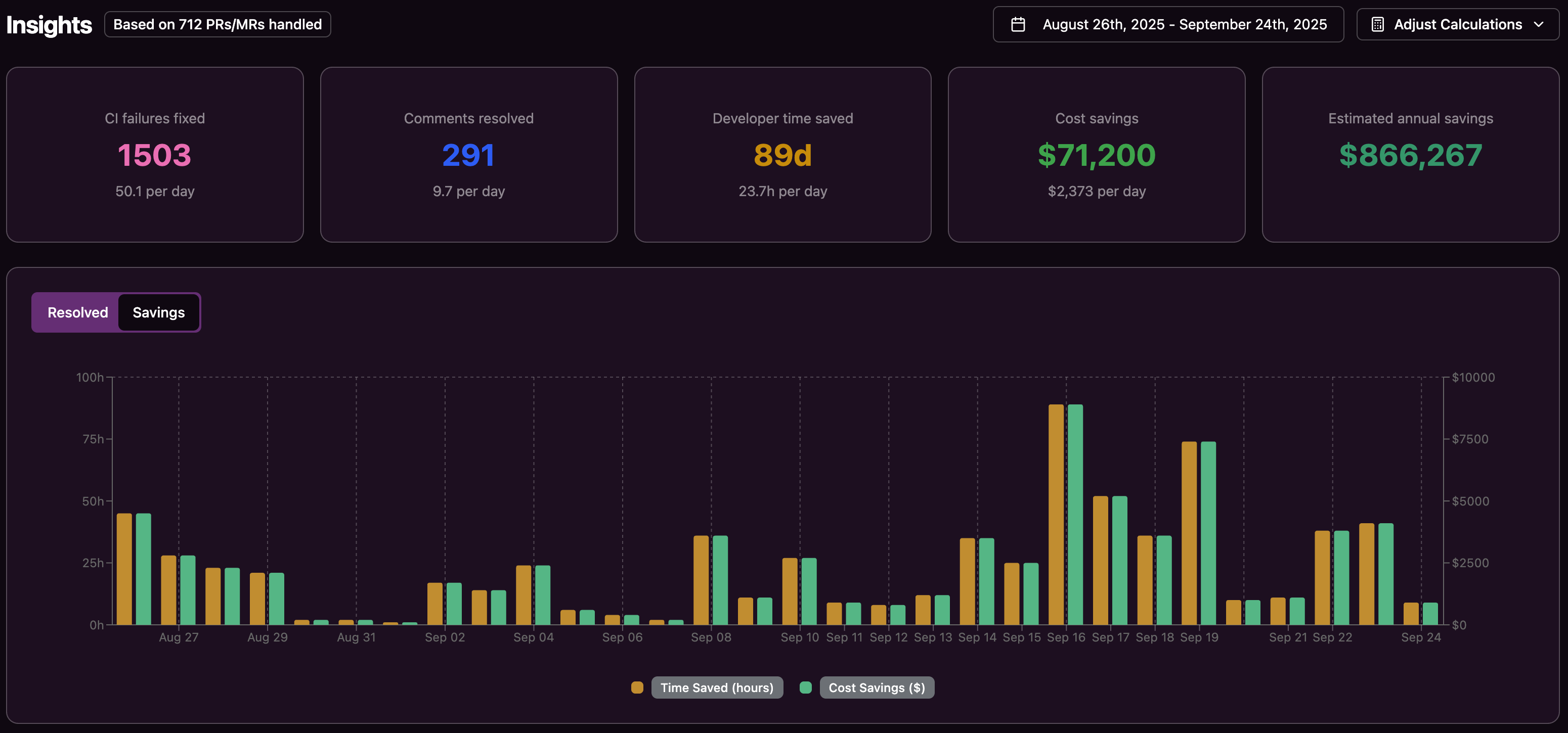
Reduced unit test debugging time delivers both direct and indirect benefits. For a 20-person engineering team that spends about one hour per day on CI and code review issues, the numbers add up quickly.
Time investment: 20 developers × 1 hour per day × 250 workdays equals 5,000 hours per year. At a $200 average loaded hourly cost, this represents roughly $1 million in productivity tied up in CI and debugging work.
If autonomous fixes reduce that time by even 50 percent for supported failures, teams can reclaim around 2,500 hours, or about $500,000 of value annually. Additional gains come from less context switching, fewer overnight delays, and more predictable delivery.
Teams also report secondary benefits, including higher developer satisfaction, less burnout from repetitive debugging tasks, and more time available for design, architecture, and performance work.
Gitar Compared to Other Unit Test Debugging Approaches
|
Feature / Approach |
Manual Debugging |
AI Suggestion Engines |
Gitar (Autonomous CI Fixer) |
|
Primary Action |
Manual investigation and fix |
Provide suggestions |
Detect, propose, apply, and validate fixes for supported cases |
|
Context Switching |
High |
Medium (developer still applies changes) |
Low for supported failures |
|
CI Validation |
Manual retries |
Developer responsibility |
Automated re-runs in existing CI pipeline |
|
Time Zone Delays |
High |
High |
Reduced through continuous automated fixes |
This comparison highlights how Gitar extends beyond suggestion engines by closing the loop from detection to a validated fix for applicable CI failures. Developers stay focused on complex logic and design work while the system handles routine breakages.
Conclusion: Using Autonomous AI To Reduce Unit Test Debugging Time
Unit test debugging and CI failures create a persistent drag on delivery speed and developer focus. Traditional, manual approaches do not scale well as codebases, teams, and time zone coverage increase.
Autonomous AI-driven fixing offers a practical way to reduce this burden. Systems like Gitar take on a growing share of routine CI and unit test failures, turning interruptions into background operations that keep pipelines healthy.
Engineering leaders who invest in this approach gain measurable time savings, fewer context switches, and more predictable releases, while developers gain more uninterrupted time to build features. Teams can explore these benefits by installing Gitar and enabling autonomous fixes for their CI workflows.
Frequently Asked Questions (FAQ) About Autonomous Unit Test Fixing
How does Gitar handle complex unit test failures that require deeper logical understanding?
Gitar uses full environment replication and context-aware analysis to understand the behavior of your build pipeline. It can integrate with local developer agents for richer context about recent changes and then generate fixes for a range of CI failures, including certain unit test issues. All fixes run through your existing CI workflow, so only passing changes are merged.
Can Gitar address flaky or non-deterministic unit tests effectively?
Gitar focuses primarily on deterministic failures. Its ability to re-run tests and observe patterns can help teams identify flaky behavior, and it can be configured to react differently to non-deterministic tests. This approach supports more stable pipelines over time.
How does Gitar limit the risk of introducing new bugs or regressions?
Gitar reduces risk by matching your CI environment closely and requiring all fixes to pass the full pipeline before completion. Teams can start with suggestion-only or approval-required modes so developers review changes before they merge. As confidence grows, teams can expand automation while keeping safeguards in place for critical services.
How does Gitar handle brittle unit tests that break during refactoring?
Gitar analyzes build context, failure messages, and related code to understand why tests broke after refactoring. It can often resolve issues related to linting, formatting, snapshots, and straightforward assertion changes, helping restore passing tests so developers can focus on more complex refactor tasks.
What types of unit test and CI failures can Gitar fix automatically?
Gitar can address many routine CI failures, including linting violations, code formatting issues, snapshot test updates, simple assertion failures, dependency resolution problems, and certain build script errors. For these categories, Gitar either applies autonomous fixes or proposes changes for review, reducing the manual time developers spend on each failure.