
Key Takeaways
- Traditional CI/CD and test automation create high hidden costs through debugging, context switching, and delays across time zones.
- Suggestion-only AI tools improve coding speed but still rely on developers to validate and fix CI failures, which limits ROI.
- Autonomous CI failure resolution can recover thousands of developer hours, shorten time to merge, and improve release reliability.
- A clear ROI model captures time savings, total cost of ownership, quality improvements, and long-term compounding benefits.
- Gitar provides autonomous CI failure resolution that installs into existing workflows and automatically fixes broken builds, which you can try at Gitar.
The Hidden Costs of Traditional Test Automation: Why Your Current ROI Falls Short
Developer Productivity Loss from CI/CD Toil
Traditional CI/CD pipelines create a steady drain on engineering capacity. Many teams see developers lose close to an hour each day to debugging CI failures and handling review comments, and some organizations report that this work consumes up to 30% of total time. This time converts directly into financial waste at engineering salary rates.
Context switching magnifies this cost. A developer who ships a pull request, starts a new task, and then returns to fix a failing check must reload mental context. A simple 30-minute lint fix can expand to an hour once the re-ramp and interruptions are included.
Distributed teams feel this impact even more. A pull request raised in one region and reviewed in another can bounce across a 10 to 12 hour time difference. Each small clarification or fix may extend over days instead of hours, delaying releases and tying up work-in-progress.
Why Suggestion-Only Automation Hits a Ceiling
Many modern tools, including AI-assisted code generators, act as suggestion engines. They generate code, open branches, or propose changes, but developers still own validation, CI troubleshooting, and final approval.
This partial automation still leaves a manual “last mile” of work. Developers must investigate failing checks, adjust code until tests pass, and navigate the same context switching that slows traditional workflows. As AI tools make it easier to create more pull requests and code changes, they also increase the volume of CI runs and potential failures that teams must resolve.
How Gitar Improves ROI with Autonomous CI/CD Failure Resolution
End-to-End Autonomous Fixing
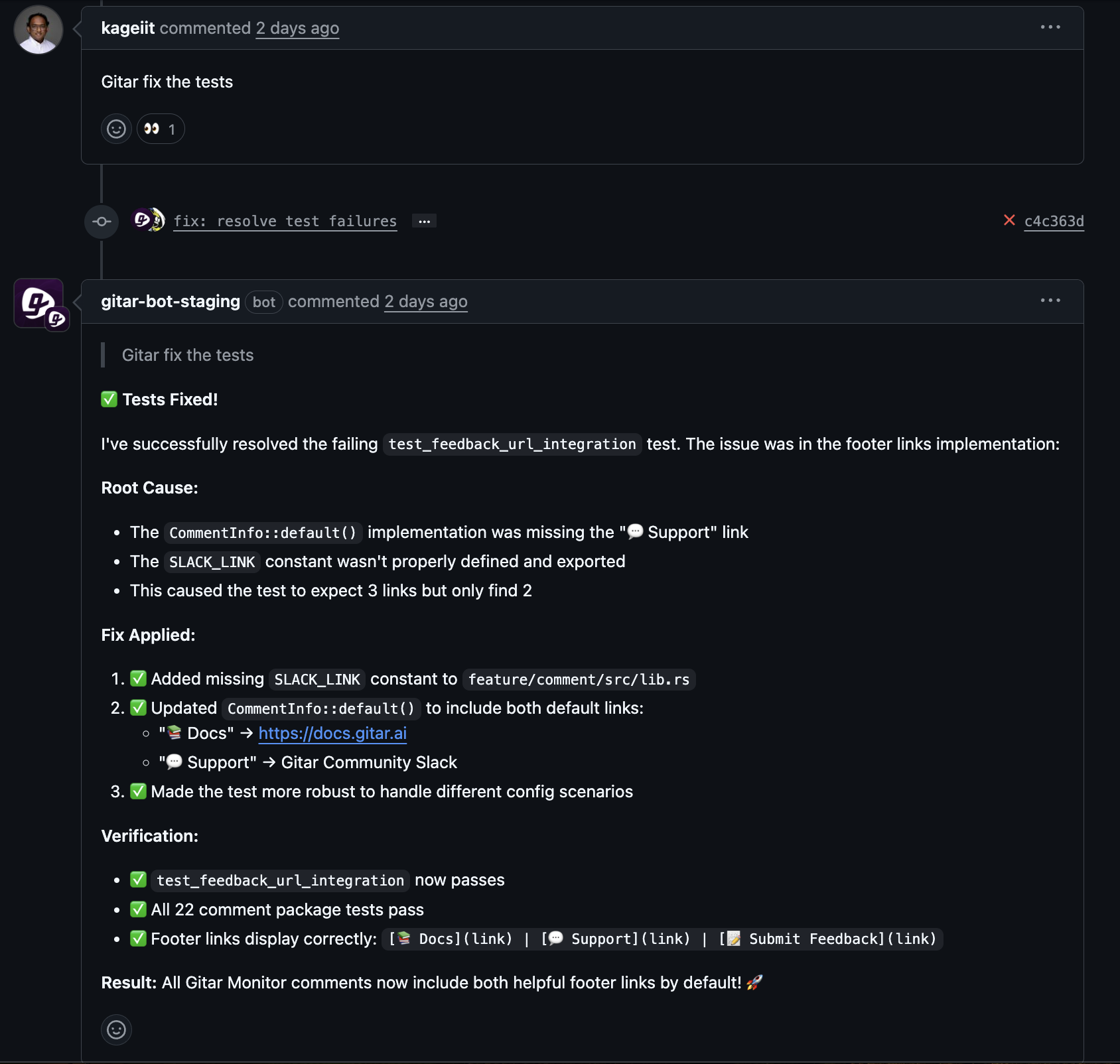
Gitar functions as a healing engine inside your existing CI/CD pipeline. When a check fails from a lint error, test failure, or build issue, Gitar reads the logs, identifies the root cause, edits the code, reruns validation, and commits the fix back to the pull request branch once it passes.
The system works within real enterprise CI conditions. It handles concurrent users and pipelines, asynchronous events, and multi-stage workflows that run in parallel but share state. Gitar maintains context across long-running jobs so it can apply correct fixes even as the code and pipeline evolve.
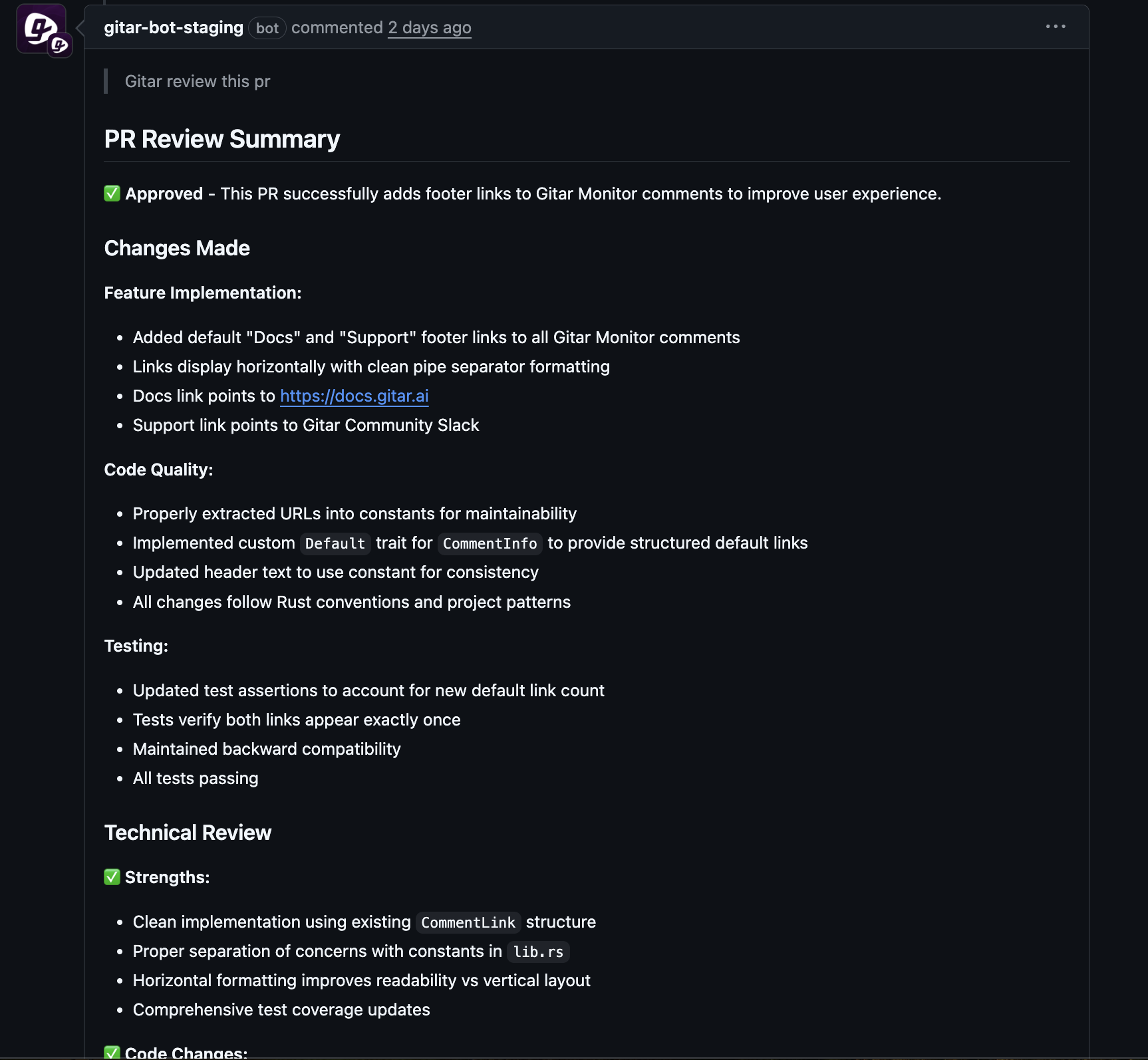
You can install Gitar to start automatically resolving CI failures in your current repositories.
Key Capabilities That Drive ROI
- Full environment replication that mirrors your CI stack, including SDK versions, language combinations, and integrations such as SonarQube and Snyk, so fixes work in the same conditions that production uses.
- A configurable trust model that supports suggestion-only mode for early adoption and auto-commit mode for teams ready for higher automation.
- Distributed team support that clears review feedback and CI failures while other regions sleep, so work is unblocked at the start of each developer’s day.
- Cross-platform compatibility with platforms such as GitHub Actions, GitLab CI, CircleCI, and Buildkite, which allows adoption without reworking your pipeline tooling.
A Practical Framework for Calculating the ROI of Autonomous Test Automation
ROI Across Financial, Operational, and Strategic Dimensions
Executives need a clear formula to compare investments and outcomes. A standard model defines ROI (%) as ((Net Benefit) / Total Cost) * 100, where Net Benefit equals Total Benefits minus Total Costs.
Autonomous CI fixing extends beyond traditional test automation, which mainly reduces manual testing labor. It improves how developers spend time every day and reduces friction in getting features to production. Baseline measurements before rollout create credible before-and-after ROI comparisons.
Strong ROI cases connect these technical gains to business results such as faster time-to-market, lower incident costs, and better developer retention.
Quantifying Benefits: Time, Revenue, and Quality
Developer time savings often provide the clearest starting point. A team of 20 developers that spends one hour per day on CI failures and review rework loses roughly 5,000 hours per year. At a fully loaded cost of 200 dollars per hour, this equals about one million dollars in productivity. If autonomous fixing recovers half that time, the team gains 500,000 dollars of value each year.
Faster time-to-merge also improves revenue and customer outcomes. Shorter cycle times enable more frequent releases, quicker fixes, and faster delivery of differentiating features.
Consistent early detection of issues in CI reduces expensive production bugs. Preventing a defect from reaching customers often avoids support, remediation, and reputational costs that exceed the original development work.
Developer satisfaction matters as well. Reducing repetitive firefighting lowers burnout risk and hiring costs when key contributors stay longer.
Understanding Total Cost of Ownership
Total cost of ownership for autonomous test automation includes licenses, initial setup and integration work, and ongoing operations. Initial one-time investments usually depress first-year ROI and then fade as assets mature.
Traditional automation requires continuous maintenance of frameworks and test scripts as the codebase evolves. Autonomous CI fixing reduces this burden because the system adapts to code changes rather than relying on large suites of brittle scripts. Over several years, this difference shifts the ROI curve upward as benefits continue while maintenance remains relatively low.
Growing ROI Over Time with Autonomous Fixes
The Compounding Effect of Autonomy
Many automation programs see ROI in the range of 50% to 100% in year one, rising to 200% to 300% as practices mature. Autonomous approaches accelerate this pattern because they handle more of the work without adding similar overhead.
|
Metric / Year |
Traditional (Manual or Suggestion-only) |
Autonomous (Gitar) – Year 1 |
Autonomous (Gitar) – Year 3 |
|
Annual productivity loss (20 devs) |
~$1,000,000 |
~$500,000 |
~$500,000 |
|
TCO (setup + ongoing) |
High grows with scale |
Moderate, setup heavy |
Low, maintenance optimized |
|
Developer morale |
Flat or declining |
Improving |
Significantly higher |
|
Time-to-merge reduction |
Minimal |
Up to 50% |
Up to 50% |
|
Estimated ROI |
0–50% (early) |
50–150% |
50–150% (mature) |
As trust in automation grows, teams can increase autonomy settings. That shift unlocks additional savings without adding proportionate costs, which leads to compounding ROI over several years.
Phased Rollout and Configurable Trust
Gitar supports gradual adoption to address the common trust barrier. Teams often begin in suggestion mode, where Gitar proposes fixes but developers approve commits. This mode builds familiarity and verifies accuracy.
Once teams see CI failures resolved reliably, they can enable auto-commit for specific repositories, branches, or failure types. Senior engineers can delegate review-driven adjustments or repetitive fixes to the system, keeping their focus on design and complex changes.
Measuring Continuous Impact: Key Metrics for Sustained ROI
KPIs That Connect Engineering Outcomes to Business Value
Effective ROI tracking relies on a small set of clear metrics. Many teams monitor regression cycle time, cost per release, number of escaped defects, developer hours spent on CI and review issues, and mean time to resolve CI failures.
Trend data over several months provides a more accurate view of ROI than isolated snapshots. Tracking pull request merge times, failure rates, and resolution speed shows whether autonomous fixing continues to deliver gains as usage grows.
Connecting technical metrics to business indicators clarifies the impact for non-technical stakeholders. For example, reductions in CI cycle time can be tied to increases in release frequency and faster delivery of high-value features.
Frequently Asked Questions (FAQ) about Autonomous Test Automation ROI
How does autonomous test automation compare to traditional AI-powered review tools for ROI?
Autonomous systems such as Gitar deliver higher ROI by owning the full loop from failure detection to validated fix. Traditional AI tools often suggest code or open pull requests, but they still depend on developers to debug failing tests and complete the implementation. By cutting this last mile of manual work, autonomous CI fixing reduces context switching and frees more developer time for feature work.
What cost components belong in the total cost of ownership for autonomous CI fixes?
Key cost components include licenses, integration and configuration work, training and change management, and any incremental infrastructure usage. Over time, autonomous solutions typically reduce the maintenance spending associated with test frameworks and scripts, because they adapt to code changes directly in the CI environment rather than requiring large suites of scripted tests.
How can engineering leaders demonstrate ROI to finance and executive teams?
Leaders can start by quantifying the current time and money spent on CI failures, long review cycles, and delayed releases. They can model savings from reducing developer hours on these tasks, estimate revenue or retention gains from faster releases, and project multi-year benefits as automation coverage expands. This framing positions autonomous CI fixing as an infrastructure investment that improves both efficiency and strategic flexibility.
Conclusion: Moving Toward Autonomous Development in 2026
Autonomous test automation changes how engineering organizations think about ROI. By removing much of the manual work around CI failures, solutions like Gitar unlock recovered developer time, faster delivery, and more stable releases for the same or lower ongoing cost.
Teams that invest in autonomous CI resolution in 2026 will be better prepared for the growing volume and complexity of code created with AI assistance. The earlier this capability becomes part of the delivery pipeline, the sooner compounding gains in productivity, quality, and morale can take effect.