
Written by: Ali-Reza Adl-Tabatabai, Founder and CEO, Gitar
Key Takeaways
- Automated unit testing has become the main constraint on release speed in 2026, especially as AI tools increase code volume.
- High-value unit tests focus on isolation, determinism, and readability, so they act as both quality checks and living documentation.
- CI/CD pipelines benefit from fast, targeted, and increasingly autonomous testing workflows that keep feedback loops short.
- AI and autonomous tools help teams manage large test suites by generating tests, prioritizing risk, and fixing common failures.
- Teams can reduce broken builds and reclaim developer time by using Gitar to automatically fix CI failures and keep tests passing.
The Strategic Imperative: Why Automated Unit Testing Best Practices Matter More Than Ever
Software development in 2026 runs on AI-assisted coding and dense release schedules. Code is easier to generate, but reliable validation now limits how fast teams can safely deploy. Organizations that invest in automated tests at multiple levels support frequent releases and rapid feedback, yet many teams struggle to test the growing volume of changes.
The bottleneck has shifted from writing code to validating and deploying it safely. Effective strategies move beyond simple coverage targets and focus on risk, feedback speed, and maintainability.
The financial impact is significant. For a typical 20-developer team, inefficient testing can cost about $1M each year in lost productivity. Earlier defect detection through unit tests reduces the cost of fixing bugs by catching them near the point of introduction. Teams that refine automated unit testing improve release frequency, code quality, and developer experience.
Install Gitar to automatically fix broken builds and keep your team focused on feature work.
Core Principles of Effective Automated Unit Testing
Effective automated unit testing relies on clear principles that keep tests reliable, fast, and easy to maintain at scale.
Isolation and Determinism: The Foundation of Reliable Tests
High-quality unit tests are isolated, deterministic, and independent, which ensures consistent results and reduces flakiness across environments. Each test should validate one behavior, avoid external systems, and always produce the same outcome.
Simple test logic, no randomness, and no hidden dependencies make parallel execution safe and allow CI pipelines to provide quick, trustworthy feedback.
Maintainability and Readability: Writing Tests for the Long Haul
Consistent naming and an Arrange, Act, Assert structure improve test readability and long-term maintainability. Descriptive names and one scenario per test clarify intent and speed up debugging.
Clear tests serve as living documentation. New engineers can understand expected behavior by reading tests, which reduces onboarding time and refactor risk.
Strategic Use of Test Doubles: Mocks, Stubs, and Fakes
Focused unit tests isolate business logic from external dependencies. Mocks, stubs, and fakes help remove databases, queues, and external APIs from the test path, which keeps tests fast and reliable.
Thoughtful use of mocks and stubs isolates units from infrastructure and external systems, so tests can run frequently without fragile environment setup.
Quality Over Quantity: Intelligent Coverage Strategies
High coverage alone does not guarantee value. Useful coverage strategies focus on high-risk paths, complex logic, and critical business flows instead of chasing 100 percent numbers.
Meaningful assertions, clear failure messages, and coverage in the right places give teams confidence to refactor and ship quickly.
Integrating Unit Testing into Modern CI/CD Pipelines
Modern CI/CD pipelines treat unit tests as a core quality gate rather than a simple checklist. Automated execution on each change enables early defect detection and continuous quality checks.
Tags, categories, and test suites let teams run different sets of tests on different triggers. Fast unit tests can run on every commit, while slower integration and regression suites run on pull requests or scheduled jobs.
Large systems benefit from change-based test selection, where only tests relevant to recent changes run on each commit. This approach keeps feedback loops short while the full suite still runs regularly for broader safety.
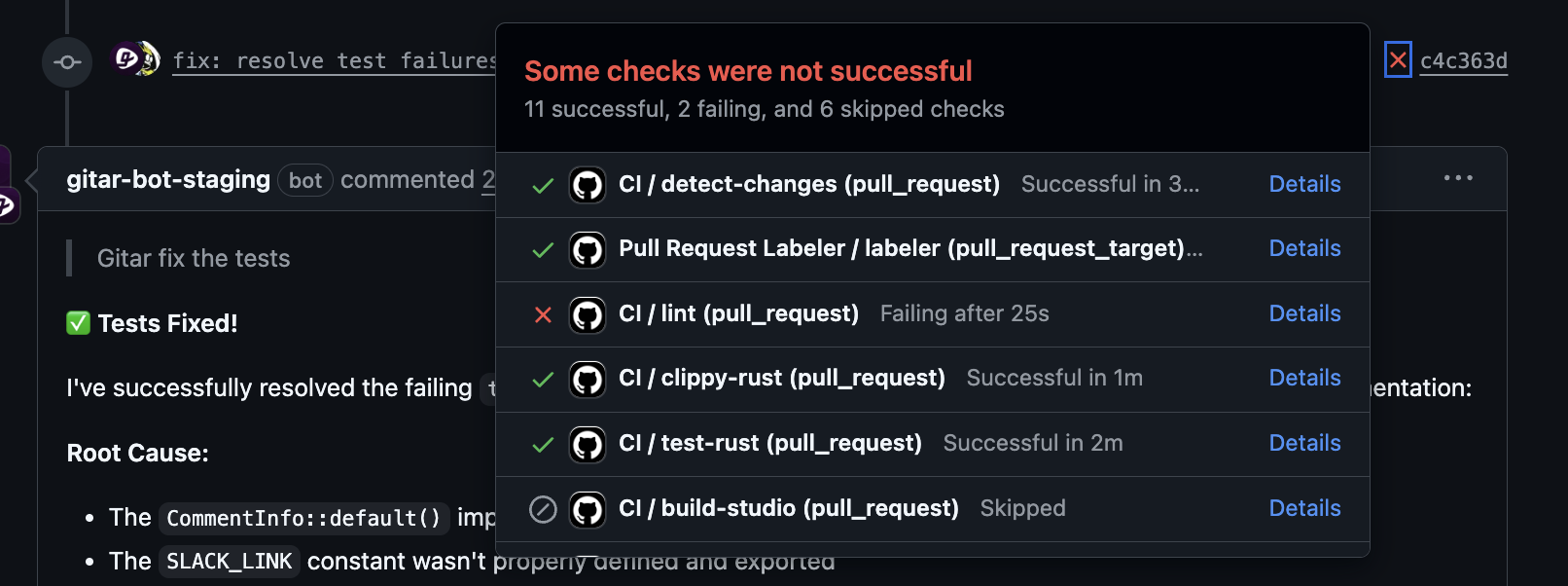
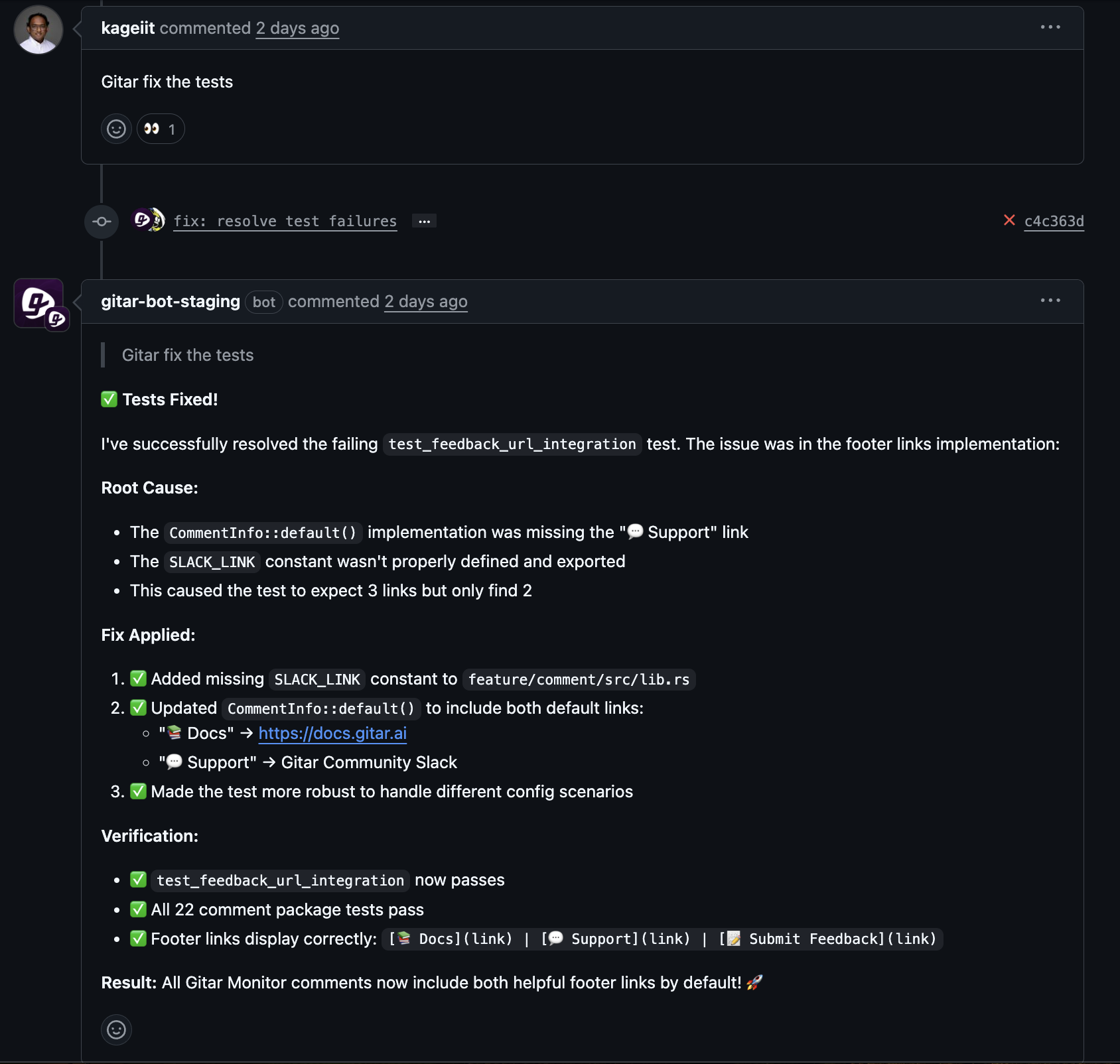
Many teams now adopt self-healing CI behavior. When unit tests fail due to straightforward issues such as assertion mismatches or outdated snapshots, autonomous tools like Gitar can propose or commit fixes, reducing manual triage and unblocking builds.
Advanced Strategies for Building a Culture of Quality
Strong automated unit testing practices grow from culture as much as tooling. Teams that treat tests as first-class assets sustain quality even under delivery pressure.
Clear ownership helps reduce flaky tests. Teams assign responsibility for triaging failures, fixing nondeterministic tests, and keeping environments stable, and they treat recurring test issues with the same seriousness as production incidents.
Shift-left testing embeds quality activities into development instead of deferring them to later QA phases. Unit testing practices also support test-driven development by encouraging incremental design and clean interfaces, even when teams only apply TDD to selected areas.
Leveraging AI and Automation for Unit Testing Excellence
AI now plays a practical role in how teams design, prioritize, and maintain unit tests. Code-aware models can suggest test cases, fill gaps in coverage, and propose assertions for complex edge cases.
AI and analytics guide test prioritization, risk prediction, and resource allocation, so the most valuable tests run first and most often. This focus is especially important for large monorepos and microservice architectures.
Autonomous systems such as Gitar add another layer of value by analyzing failing tests, identifying likely root causes, and applying targeted fixes directly in pull requests. This approach reduces context switching for developers and keeps CI signals clean.
Strategic Pitfalls in Automated Unit Testing for Experienced Teams
Experienced engineering organizations face specific testing challenges that appear only at scale.
The Coverage Obsession Trap
Teams that chase 100 percent coverage often add low-value tests that break frequently and slow refactors. Minimal, focused tests that use the simplest setup to prove each behavior stay more resilient to change and still offer strong protection.
Over-Engineering Test Infrastructure
Complex custom frameworks and heavy helper libraries can become another system to maintain. Shared builders and utilities should simplify test setup, reduce duplication, and stay easy to understand for new contributors.
Neglecting Test Performance at Scale
Slow test suites reduce how often developers run tests locally and extend CI cycle times. Teams avoid this by keeping unit tests fast, running them in parallel, and separating them from slower integration or end-to-end checks.
The Future is Autonomous: Elevating Unit Testing with Gitar
Autonomous CI support changes how teams experience testing. Traditional workflows require developers to stop feature work, debug failures, and rerun pipelines whenever tests break.
Gitar operates as an autonomous CI agent that detects, analyzes, and fixes common test failures such as simple assertion errors or outdated snapshots. The tool updates code, pushes commits, and reports back in the pull request, so developers stay focused on higher-value tasks.
This model helps teams sustain comprehensive test suites without turning maintenance into a burden. As test volume grows, Gitar keeps CI pipelines green and prevents broken builds from piling up.

Implementation Roadmap: Getting Started with Automated Unit Testing Best Practices
Successful adoption of automated unit testing works best as a phased rollout with clear goals at each stage.
Phase 1: Foundation and Assessment
Strong foundations start with an honest review of current tests and architecture. Code that is hard to unit test often needs refactoring toward clearer separation of concerns and better abstractions. Teams define conventions for naming, structure, and folder layout so tests stay organized as coverage grows.
Phase 2: Automation and Integration
The next step aligns tests with CI/CD. Teams select a robust test framework, run unit tests on every change, and add parallel execution where possible. Targeted suites and test impact analysis keep feedback fast, even as the number of tests increases.
Phase 3: Autonomous Healing
The final stage introduces autonomous fixing with tools like Gitar. Automated repair of common failures keeps pipelines healthy and prevents test debt from building up. Teams track metrics such as failure rate, mean time to fix, and developer satisfaction to refine their testing strategy.
Frequently Asked Questions
How do I convince my team to invest time in comprehensive unit testing when we’re under pressure to ship features quickly?
Position unit tests as a way to increase delivery speed, not slow it down. Time spent writing tests can offset many hours of debugging and hotfixes later. Simple metrics such as time-to-fix production bugs or regression frequency before and after test adoption help make the case, and Gitar can further reduce maintenance overhead by fixing common failures.
What’s the right balance between unit tests and integration tests, and how do I avoid over-testing?
Unit tests should cover core business logic, edge cases, and complex algorithms, while integration tests should focus on cross-service workflows and critical integrations. Avoid duplicating the same behavior at multiple levels. A balanced suite provides high confidence for important flows without running every possible combination in every layer.
How can we maintain test quality and prevent flaky tests as our codebase grows?
Stable tests depend on strict isolation, predictable data, and clear ownership. Teams remove shared state, avoid real external systems, and track flaky tests as first-class issues. Tooling such as Gitar helps by fixing simple failures quickly so teams can focus on deeper root causes.
What should we do when our test suite becomes too slow and starts hindering development velocity?
The response involves separating fast unit tests from slower suites, adding parallel execution, and using change-based test selection. Regular reviews identify redundant or low-value tests. Autonomous tools like Gitar then keep the remaining suite healthy by repairing failures that would otherwise add more delay.
How do we handle unit testing in legacy codebases that weren’t designed with testability in mind?
Incremental progress works best for legacy systems. Teams start by testing public interfaces and high-value flows, add characterization tests to document current behavior, and then introduce seams and abstractions as they touch code for new work. Automated assistance from tools like Gitar further reduces friction by resolving many test failures that appear during refactors.
Conclusion: Turning Unit Testing into a Sustainable Advantage
Automated unit testing in 2026 functions as a strategic capability, not just a quality checklist. Teams that align principles, culture, CI/CD, and automation create a feedback system that supports frequent, safe releases and confident refactoring.
Autonomous CI support with tools like Gitar closes the loop by keeping test suites healthy and builds green without constant human intervention. Engineering leaders who pair strong unit testing practices with autonomous fixing gain a durable advantage in both delivery speed and reliability.