
Key Takeaways
- PR workflows often block delivery because developers spend significant time fixing CI failures, reading logs, and waiting for reviews.
- Autonomous AI tools now move beyond suggestions and can apply, validate, and commit fixes to keep builds passing with less context switching.
- Gitar acts as a CI healing engine that clears lint, test, and build failures, and can act on review feedback directly in pull requests.
- A phased rollout and clear metrics help teams build trust in autonomous fixes while tracking impact on cycle time and developer focus.
- Teams that want practical automation for broken builds and slower PRs can install Gitar to add autonomous fixes into their PR workflows.
Why Traditional PR Workflows Challenge Modern Engineering Teams
Modern software development in 2026 moves quickly, but PR workflows often slow teams down. CI pipelines fail, logs feel hard to parse, and developers lose time restarting builds and chasing flaky tests. Each interruption forces a shift away from deep work.
Context switching has a strong cost. A 30-minute CI fix can consume an hour or more of productive time after factoring in lost focus and re-ramp. Across a team, this turns into a strategic drain that reduces delivery speed and affects roadmap commitments.
Developers now generate code faster with AI-assisted tools, so the main bottleneck sits in validation and merging. Pull requests wait in queues, CI reruns pile up, and small issues delay otherwise ready work. Teams that want higher throughput need to improve this stage of the lifecycle.
From Suggestions to Autonomous Healing in PR Workflows
PR optimization started with better CI/CD pipelines and basic automation. Many tools still act as suggestion engines: they surface warnings, propose fixes, or add comments, but they leave the actual changes and validation steps to developers.
This approach reduces some friction but still forces manual intervention and context switching. Developers must stop their current task, apply the suggestion, push a new commit, and wait again for CI to finish.
Autonomous healing engines take a different approach. These tools identify failures, generate fixes, apply them to the branch, and validate the result against CI. The workflow becomes more proactive because issues are resolved in the background rather than waiting in queues for manual attention.
Gitar: Autonomous AI Agent for PR Workflow Enhancement
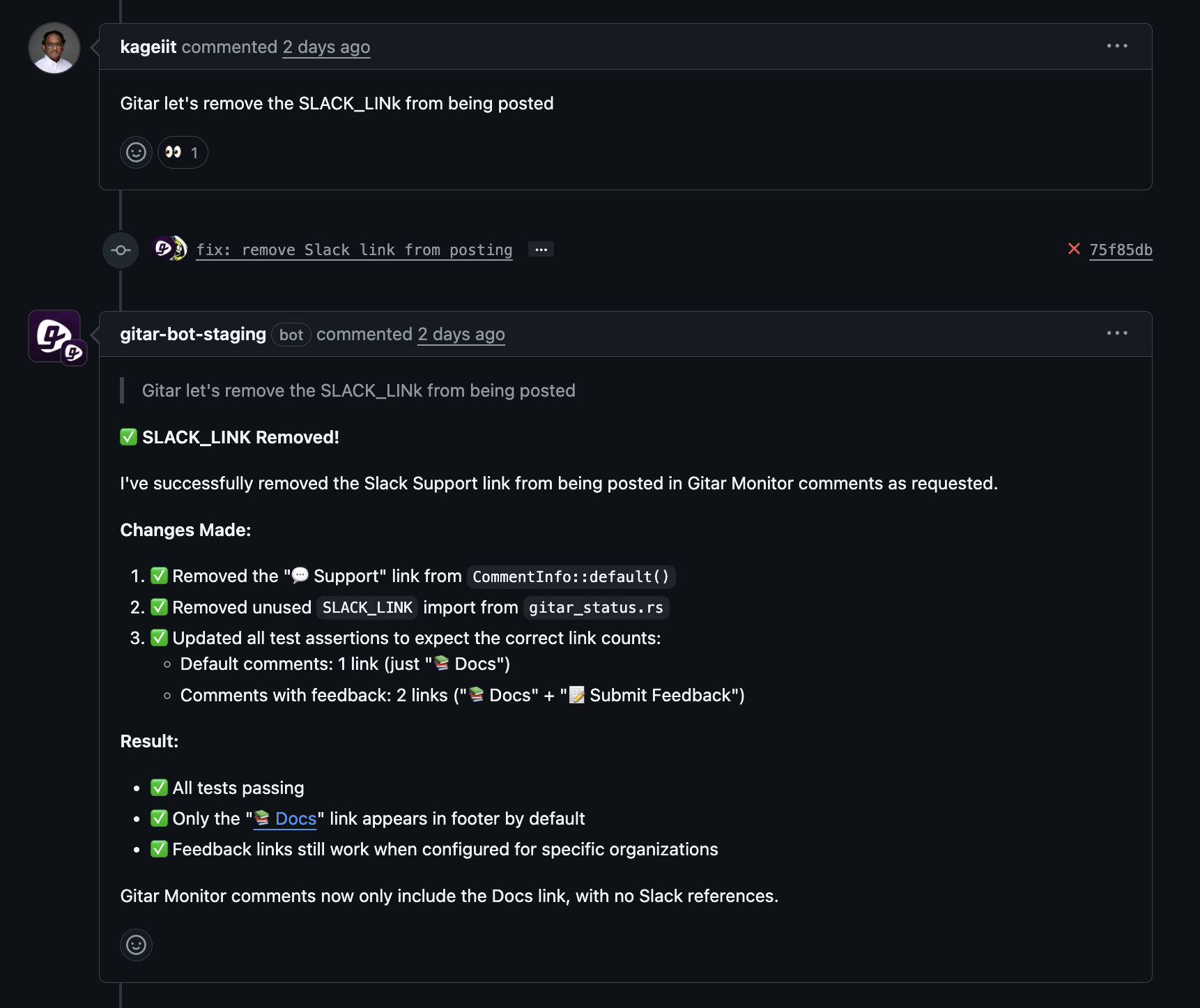
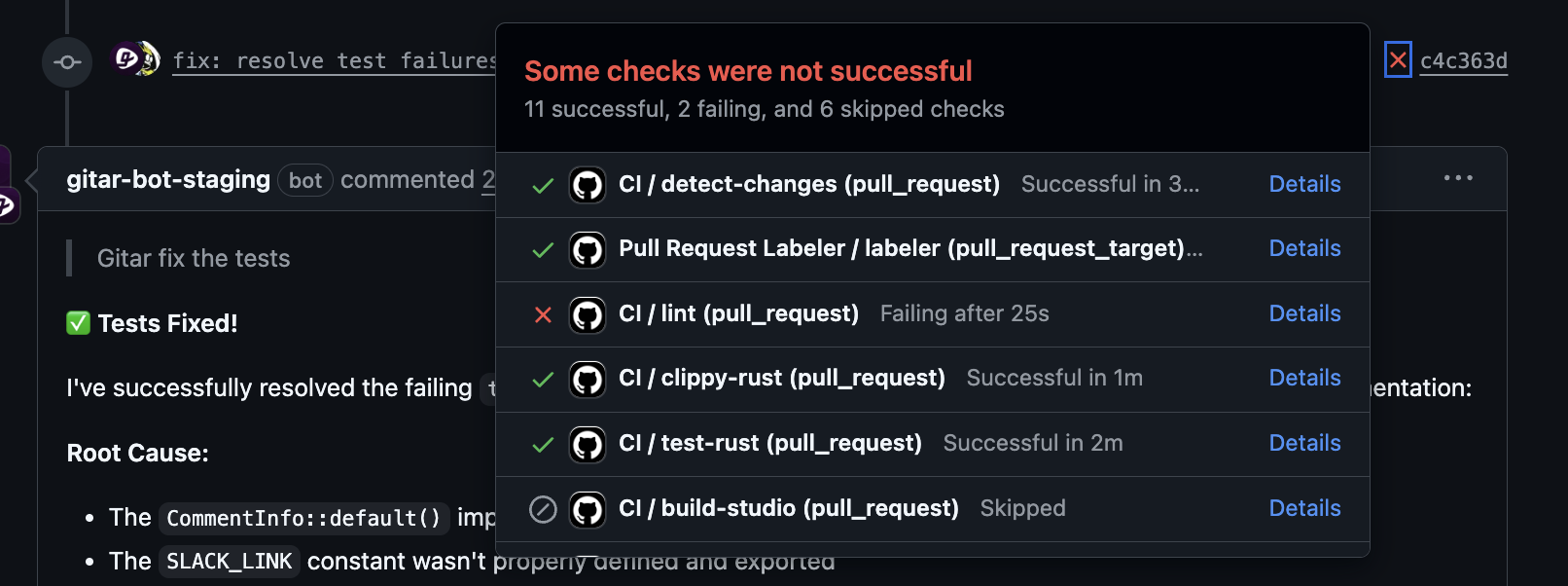
Gitar is an autonomous AI agent that focuses on broken builds and repetitive PR work. The system analyzes CI failures such as linting errors, test failures, or build issues, identifies the root cause, generates a fix, and commits it directly to the PR branch after validation.
This behavior turns CI into a self-healing process. Instead of spending hours across a week restarting builds and chasing down small issues, developers see passing checks with fewer interruptions. Reviewers can also tag Gitar in comments (for example, “@gitar review this PR”) to request an AI-generated review or to ask Gitar to implement specific changes.
Key Gitar Capabilities
- Autonomous CI fixes: Resolves linting, test, and build failures without extra developer work, then re-runs checks to confirm success.
- Review feedback implementation: Applies requested code changes from review comments and explains what changed in the PR.
- Reduced context switching: Handles background fixes so developers stay focused on design, architecture, and feature work.
- Support for distributed teams: Applies requested changes even when reviewers and authors work in different time zones.
- Configurable trust model: Starts in suggestion-only mode and can progress to auto-commit with clear rollback options.
Teams that want to reduce PR friction and repetitive CI work can install Gitar to add autonomous fixes into their existing workflows.
Integrating Autonomous AI Into Your Engineering Culture
Effective adoption of an autonomous agent requires both technical and cultural planning. Most teams benefit from a phased rollout that builds trust and keeps engineers in control.
The first phase usually relies on a conservative mode. Gitar posts proposed fixes or patch sets as suggestions, and developers approve or edit them. This pattern lets the team evaluate quality while staying confident that no unexpected commits will land.
After engineers gain confidence, teams can enable more automation. Gitar can auto-commit fixes once CI passes in a replicated environment that mirrors production dependencies, SDK versions, and security tools such as Snyk. This setup supports complex enterprise pipelines without requiring major structural changes.
The goal of this rollout is simple: convert your PR workflow from a recurring bottleneck into a predictable, low-friction path to merge.
Measuring Impact and Quantifying ROI
Engineering leaders can measure the impact of autonomous tools by tracking metrics around the PR lifecycle. Useful indicators include:
- Time from PR creation to merge.
- Number of CI failures and reruns per PR.
- Developer time spent on CI/debug tasks versus feature work.
- Review queue length and wait time for first review.
Costs scale quickly for even mid-sized teams. A 20-developer group can lose hundreds of thousands of dollars per year on time spent chasing CI failures, re-running builds, and handling minor review nits instead of building new capabilities.
Gitar reduces these losses by clearing failures and implementing straightforward review feedback with minimal human input. The result is fewer blocked branches, faster time-to-merge, and more consistent flow state for developers.
Automation also changes the role of human review. Engineers can focus on architectural concerns, security implications, and long-term maintainability instead of formatting issues or simple test fixes.
|
Feature/Aspect |
Gitar (Autonomous Healing Engine) |
Suggestion Engines |
Manual Workflow |
|
Problem resolution |
Finds issues, applies fixes, validates, and commits |
Suggests fixes that developers must apply and validate |
Requires manual diagnosis, fix, and commit |
|
Context switching |
Low, because work happens in the background |
Medium, because developers still re-run CI and commit |
High, with frequent interruptions |
|
Build validation |
Runs checks and confirms passing status |
Developer responsibility |
Developer responsibility |
|
Environment context |
Replicates the CI environment for accuracy |
Limited context |
Depends on the local environment |
Teams that want these gains can install Gitar and start automating fixes for broken builds.
Frequently Asked Questions About Autonomous AI Agents
Our team already uses AI code reviewers like CodeRabbit or Claude. How is Gitar different?
Tools like these provide code review suggestions, comments, and examples of better patterns. Gitar goes further by acting as a healing engine that edits code, commits changes, and validates results in CI. The system focuses on closing the loop from problem discovery to confirmed fix.
How can we trust automated fixes with a complex CI setup?
Gitar works against the same environment used by your pipelines, including language versions, dependencies, and integrations such as Snyk. Teams can start in suggestion-only mode so every fix receives human review. Every automated change is clearly labeled, explained, and can be reverted if needed.
Will an autonomous AI agent increase CI/CD costs or pipeline runtime?
Gitar is designed to reduce waste from repeated failures and retries. The goal is to fix most issues within one or two CI runs instead of many small attempts. Fewer broken runs and less manual re-triggering help control both runtime and CI budget.
How does Gitar handle conflicts or unintended changes?
Gitar operates within PR branches and commits changes under its own identity. Each commit includes an explanation so reviewers can see exactly what changed. Teams can require approvals for their commits, and any change can be rolled back if it conflicts with other work or causes side effects.
Can Gitar integrate with our existing tools and workflows?
Gitar connects to GitHub and GitLab and works with CI systems such as GitHub Actions, GitLab CI, CircleCI, and BuildKite. The agent supports common languages including Python, Go, JavaScript, TypeScript, Java, and Rust. It fits into existing approval rules and security checks rather than replacing them.
Conclusion: Improving Engineering Velocity With Autonomous AI
Developer productivity in 2026 depends on how efficiently teams move code from the branch to production. Autonomous tools like Gitar target the slowest part of this path by handling CI failures and straightforward review changes.
Gitar helps reduce context switching, shortens PR cycle times, and gives engineers more time for complex work that benefits customers. Teams that want to capture these advantages can install Gitar and add autonomous healing to their PR workflows.