
Key takeaways
- Autonomous agents now move CI/CD workflows beyond manual firefighting, reducing developer time spent on failing builds and code review friction.
- Self-healing pipelines rely on agents that understand logs, environments, and tests, then apply and validate fixes without constant human involvement.
- Engineering leaders should evaluate build-vs-buy, trust and control, and organizational readiness before adopting autonomous CI tooling.
- Gitar focuses on complex, real-world environments and integrates with existing CI platforms to handle both CI failures and code review updates.
- Teams can reduce build-related toil and improve delivery speed by using Gitar to automatically diagnose and fix failing builds and review feedback, available at gitar.ai/fix.
Why autonomous agents now matter for modern CI/CD pipelines
Failing builds and slow code reviews create a large and often hidden productivity cost. For a 20‑developer team, the time spent diagnosing CI failures and reworking pull requests can approach $1M per year in lost productivity when fully loaded hourly costs reach $200 per developer.
AI-assisted coding tools increase output, but they also generate more pull requests, more tests, and more chances for CI to break. Self-healing pipelines address this pressure by using agents that watch CI health, find root causes, and apply fixes that pass validation. These systems turn reactive recovery work into automated maintenance that protects developer focus.
Understanding autonomous agents for self-healing CI
Autonomous CI agents extend beyond static analysis or suggestion tools. They monitor pipelines, analyze logs, and propose concrete code changes, then run checks to confirm the fix.
Core capabilities typically include:
- Log and error analysis to identify the true source of a failing build
- Targeted code or configuration changes that address the identified issue
- Validation in CI environments to confirm that tests and checks succeed
- Automated commits or pull request updates with clear explanations and safe rollback options
This pattern reduces context switching, because engineers spend less time leaving current work to debug pipelines for older branches or pull requests.
How CI/CD automation evolved to autonomous solutions
From manual remediation to agent-driven workflows
Early CI/CD automation focused on scripts and templates that ran tests and deployments. When builds failed, developers still had to read logs, reason about the failure, and patch the code or configuration by hand.
Later, AI-powered tools added suggestions and summaries, especially during code review. These tools improved insight but still left developers responsible for implementing and validating fixes.
Autonomous agents now close that loop by taking action inside the pipeline. They monitor, propose, apply, and verify fixes, treating CI health as a continuous responsibility instead of an ad hoc task.
Comparing common approaches to CI failure handling
Manual work (status quo): When CI fails, developers pause current tasks, inspect logs, attempt a fix, and push new commits. Even simple fixes can consume 30 to 60 minutes once context switching is included.
AI code reviewers: Tools such as CodeRabbit or Linear add summaries and inline recommendations in pull requests. They highlight potential issues but do not apply or validate changes, so developers still shoulder the full remediation effort.
On-demand AI fixers: General-purpose models that developers manually prompt with logs offer one-off suggestions. They lack persistent context, deep environment awareness, and continuous monitoring across pipelines.
IDE-based coding assistants: Tools such as GitHub Copilot help during development and can draft code or pull requests. Their strength lies pre-commit, not in autonomously repairing failures once code reaches CI.
Gitar as an autonomous CI fixer for real-world environments
Gitar focuses on turning failing builds into passing builds with minimal engineer involvement. The system analyzes failures, proposes concrete changes, applies them under configurable trust rules, and confirms that CI is green before handing work back to the team.
The platform supports complex enterprise environments that depend on precise SDK versions, multiple language runtimes, and third-party tools on platforms such as GitHub Actions, GitLab CI, CircleCI, and BuildKite. Teams can start with suggestion-only modes, then gradually enable auto-commit in selected repositories while keeping rollbacks available. Install Gitar to automatically diagnose and fix failing builds in your existing pipelines.
Strategic considerations before adopting autonomous CI agents
Build vs. buy for agentic CI systems
In-house autonomous agents require a dedicated architecture that handles agent orchestration, CI context, logs, secrets, state, and concurrency across many users and pipelines. Teams must design for asynchronous events, evolving environments, and safe code application.
Most engineering organizations benefit more from adopting a proven product than investing months or years into building and maintaining their own agent framework on top of existing CI tools.
Change management and team readiness
Moving to autonomous CI operations changes how teams work. Engineers shift from manually fixing every failure to supervising an automated system, defining guardrails, and reviewing outcomes.
Successful adoption depends on clear communication about what the agent will do, which repositories it affects, and how developers can review or override its actions.
Trust, control, and autonomy levels
Engineering leaders need configurable autonomy. Conservative modes post changes as suggestions inside pull requests, letting developers accept or refine them. Higher-autonomy modes can commit directly once teams see consistent accuracy.
This progression builds trust while keeping human review available where needed, such as sensitive services or security-critical components.
Measuring ROI for autonomous CI fixes
Teams should measure impact using metrics such as:
- Reduced mean time to recovery for failing builds
- Higher deployment frequency and more reliable release trains
- Less engineer time spent on log reading and repetitive debugging
- Faster pull request merge times and fewer stale branches
Clear baselines and ongoing tracking make it easier to evaluate whether agent-driven fixes justify expansion across more repositories or services.
How Gitar implements autonomous fixes in complex CI environments
Environment-aware architecture for enterprise CI
Gitar replicates each repository’s environment, including specific JDK and SDK versions, multi-language builds, and integrations with tools such as SonarQube or Snyk. This context allows Gitar to propose and apply fixes that pass real organizational quality gates instead of relying on generic guesses.
Handling CI failures and code review feedback in one workflow
Gitar addresses both CI failures and review comments inside the same pull request flow. When reviewers leave instructions, Gitar interprets the feedback, updates files, and commits changes with a clear explanation.
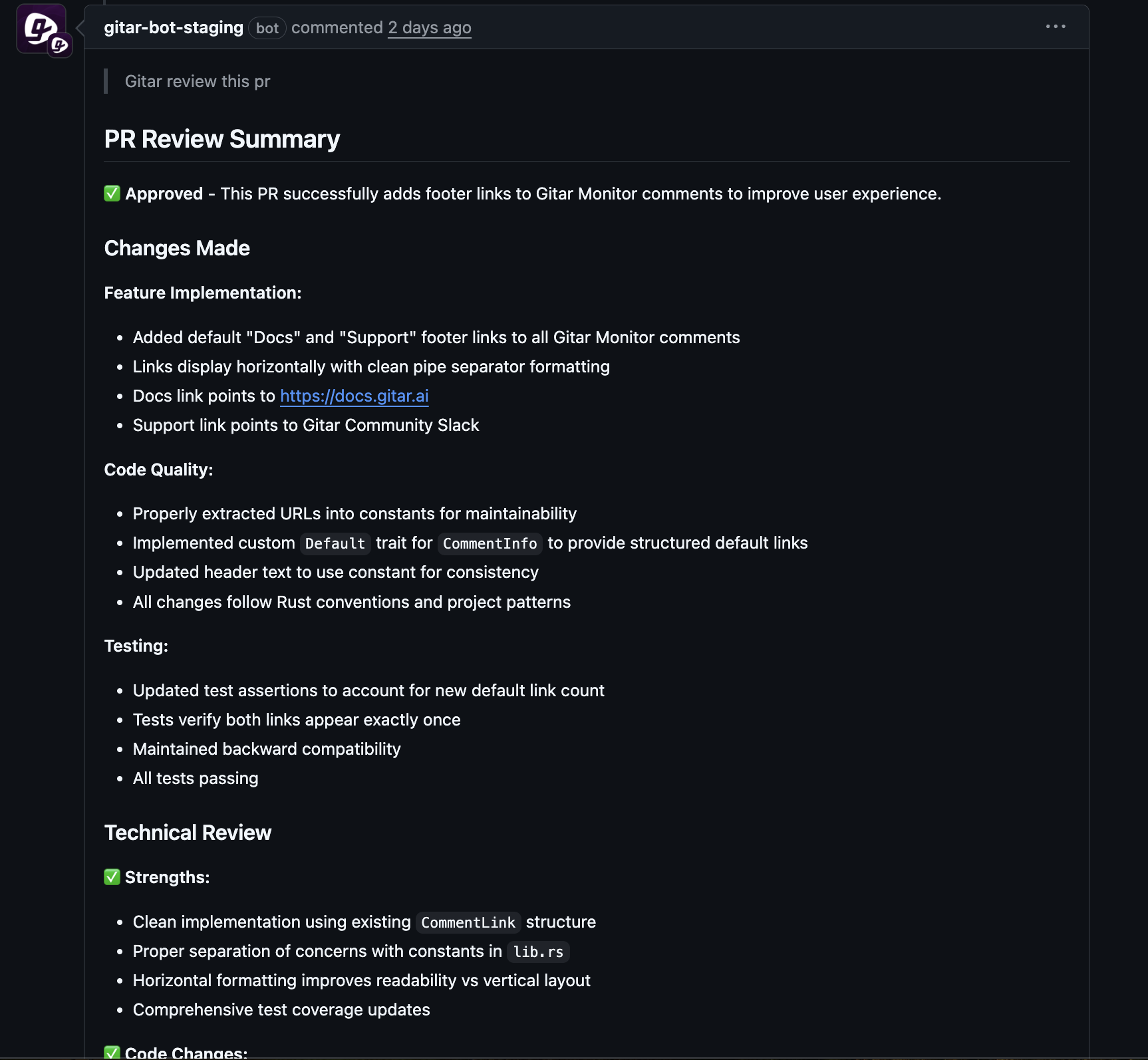
This loop avoids multi-day back-and-forth on distributed teams, because the agent can apply feedback and re-run checks shortly after comments appear.
Developer experience inside pull requests
Gitar interacts through familiar pull request comments and status updates. Developers see what the agent is working on, which fixes it proposed, and how those changes affect CI results.
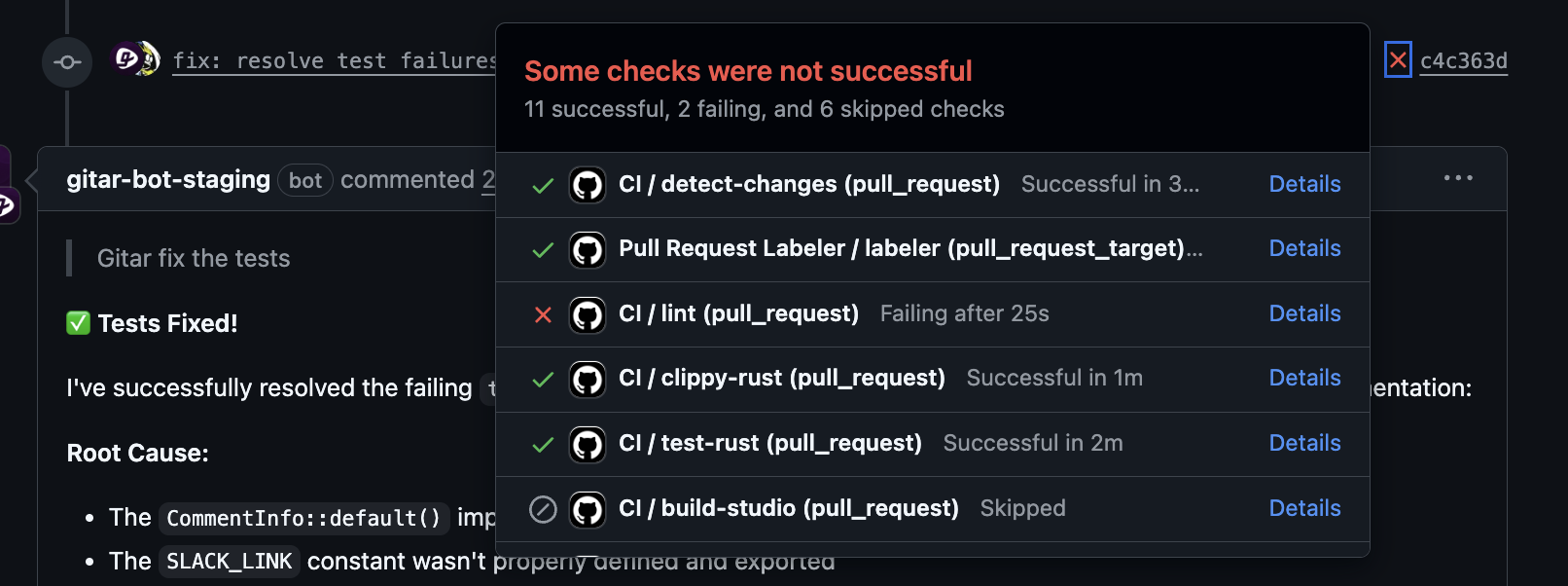
Developers can keep focus on feature work while Gitar works through CI issues in the background, then review a concise explanation of what changed.
Healing engines vs. suggestion engines
|
Feature |
Gitar (healing engine) |
Traditional AI reviewers |
On-demand AI fixers |
|
Fixes implemented |
Automatically, with validation |
Suggestions only |
Suggestions only |
|
Environment context |
Full, replicated environment |
Limited or none |
Limited or manual |
|
Platform support |
GitHub, GitLab, CircleCI, BuildKite |
Git provider only |
Often GitHub-specific |
|
Autonomy level |
Configurable, from suggestions to auto-commit |
Low, manual action required |
Medium, manual trigger required |
Implementation frameworks and common pitfalls
Readiness checklist for autonomous agents
Teams considering autonomous CI agents should confirm that:
- CI failures occur often enough to disrupt delivery timelines
- Developers report frustration with repeated, low-value debugging tasks
- Distributed teams experience review delays due to time zones
- Leadership supports automation that changes day-to-day workflows
Phased rollout strategies
Many organizations adopt a staged rollout:
- Start with suggestion-only mode on a small set of repositories
- Expand to auto-commit for low-risk services once trust builds
- Introduce more complex workflows, such as multi-step fixes, after early wins
Avoiding strategic mistakes
Common issues include relying only on suggestion tools that never close the loop, underestimating the need for clear change management, and deploying agents without metrics that show impact.
Engineering leaders should maintain human oversight, define success metrics from the start, and confirm that any chosen tool can reflect real enterprise environments rather than simplified demos. Install Gitar to reduce CI firefighting and focus engineers on higher-value work.
Frequently asked topics about autonomous CI agents
Compatibility with complex CI/CD environments
Gitar supports complex enterprise setups that include multiple SDKs, specific JDK versions, and third-party scanners such as SonarQube and Snyk. The system models these details so that fixes align with real pipelines and pass existing quality gates.
Building trust in automated code changes
Trust grows through transparent behavior and gradual autonomy. Gitar starts with suggestion-style changes that developers can review and merge with a click. After teams see consistent, validated fixes, they can enable auto-commit in selected repositories while retaining full history and rollback options.
Impact on time-to-market and engineering costs
Autonomous CI fixes reduce time spent on repetitive debugging and unplanned build work. Teams often see faster pull request merges, fewer blocked branches, and less time spent interpreting logs. For a mid-sized team, the reduction in CI-related toil can represent hundreds of hours per month, which improves delivery speed and lowers effective engineering costs.
Conclusion: Moving toward self-healing build pipelines in 2026
Autonomous agents for failing build fixes help engineering teams shift from manual recovery work to continuous, supervised automation. This change supports higher developer productivity, more predictable releases, and a better day-to-day experience for engineers.
Gitar focuses on practical, environment-aware automation that fits into existing CI/CD platforms and workflows. Teams that want to reduce CI firefighting and improve delivery speed can explore Gitar as a focused solution for autonomous build fixes. Request a demo at gitar.ai/fix to evaluate autonomous CI fixes in your own pipelines.