
Key Takeaways
- Manual CI and CD pipeline fixes in 2026 still consume a large share of engineering time, increase context switching, and slow delivery across version control systems.
- Automated approaches range from basic suggestion tools to autonomous healing engines, and differ in trust models, platform coverage, and environment awareness.
- Gitar functions as an autonomous healing engine that fixes failing pipelines and applies code review changes directly in Git-based workflows.
- Teams that adopt automated CI and CD fixes can reduce failure-related toil, reclaim developer time, and gain clearer insight into engineering productivity and costs.
- Engineering leaders can use Gitar to automatically repair broken pipelines and resolve review comments without adding manual overhead.
The Hidden Costs of Manual CI/CD Pipeline Fixes in Version Control
Manual CI and CD fixes create a significant hidden cost for modern software teams. Failures in systems like GitHub and GitLab often stem from flaky tests, misconfigured build scripts, and dependency conflicts that appear during merges and parallel development.
Context switching magnifies this cost. A developer who sees red checks on a pull request must pause feature work, parse logs, and reproduce issues locally. For a 20 person team, this pattern can approach seven figure annual productivity loss, with a large share recoverable through targeted automation.
Modern branching strategies and frequent merges increase failure rates, because configuration drift and integration complexity grow with each change. Teams that rely only on manual triage often struggle to keep pipelines stable as they scale.
Evaluating Options for Automated CI/CD Pipeline Fixes
Engineering leaders now face a wide set of tools that promise help with pipeline failures. Key evaluation factors include the level of automation, the ability to mirror real environments, platform support across major CI and version control systems, trust and review controls, and total cost of ownership.
Tools fall into two broad groups. Suggestion engines highlight likely root causes and propose fixes, but rely on developers to implement and validate changes. Healing engines apply, test, and validate fixes themselves, then surface updated pull requests that already pass CI checks. Teams that understand this distinction can select the right approach for their scale and risk tolerance.
Gitar as an Autonomous Healing Engine for CI/CD Pipeline Fixes
Gitar shifts CI troubleshooting from suggestions to autonomous action. The system analyzes failing pipelines, proposes specific changes, applies them in code, and commits updates back to the repository once checks pass.
Key capabilities include:
- End to end fixes that apply code changes and wait for green CI checks before updating pull requests
- Environment replication that models complex enterprise workflows, language runtimes, SDK versions, and third party tools
- Configurable trust modes that range from suggested patches requiring review to auto commit behavior with rollback options
- Support for GitHub, GitLab, GitHub Actions, GitLab CI, CircleCI, BuildKite, and other common CI platforms
- Assistance with code review that implements reviewer feedback, resolves comments, and keeps pull requests moving

Request access to Gitar to see autonomous CI and CD fixes in your own repositories.
Comparing Gitar to Other Approaches for Automated CI/CD Pipeline Fixes
Teams benefit from a clear view of how autonomous healing compares with common alternatives that focus on suggestions or manual workflows.
Manual CI/CD Debugging Workflows
Many teams still rely on manual investigation when pipelines fail. Developers stop feature work, open logs, reproduce errors locally, and push trial fixes until checks turn green. Short failures can expand into long interruptions that fragment focus and delay delivery. A healing engine reduces this pattern by handling routine failures without developer intervention.
AI Code Reviewers as Suggestion Engines
AI code reviewers such as CodeRabbit, Linear, and Ellipsis summarize pull requests and propose code edits. These systems help reviewers work faster, but they do not run pipelines or apply fixes automatically. Developers must still change code, rerun CI, and respond to any new failures that appear.
On Demand AI Fixers with Limited Context
On demand tools like Claude based fixers or GitHub actions run when triggered on a specific failure. They often operate within a single platform and within the constrained CI job environment. This setup can limit access to full project context and consume CI minutes without providing continuous monitoring across repositories and platforms.
IDE Based Coding Assistants with Pre Commit Focus
Coding assistants such as GitHub Copilot help generate code before commits. As code volume and pull requests grow, the main bottleneck often shifts to validation and merging. A post commit system like Gitar addresses this later stage by focusing on CI outcomes rather than code generation.
Single Platform Root Cause Analysis
GitLab Duo offers AI root cause analysis for failures that occur within GitLab pipelines. This provides guidance inside that ecosystem, but still expects developers to apply changes and ensure success. Organizations that operate across multiple CI and version control platforms often seek a more uniform layer for automated fixes.
Comparison Table for Automated CI/CD Pipeline Fixes
|
Feature / Solution |
Gitar (Healing Engine) |
AI Code Reviewers |
Manual Process |
|
Automation level |
Autonomous fix and validate |
Suggestions only |
Manual |
|
Version control integration |
Deep integration across pull request lifecycle |
Review comments only |
Not integrated |
|
CI pipeline validation |
Runs and validates full CI workflows |
No direct validation |
Manual validation |
|
Environment replication |
Enterprise level replication |
Not provided |
Not provided |
|
Platform compatibility |
Cross platform CI and VCS support |
Often tied to a single provider |
Dependent on human workflow |
|
Developer context switching |
Reduces or removes context switching |
Reduces review effort |
High context switching |
Maximizing ROI from Automated CI/CD Pipeline Fixes
Return on investment for automated CI fixes extends beyond feature lists. Teams must consider time saved in each failure cycle, reduction in unplanned work, and the effect on developer satisfaction.
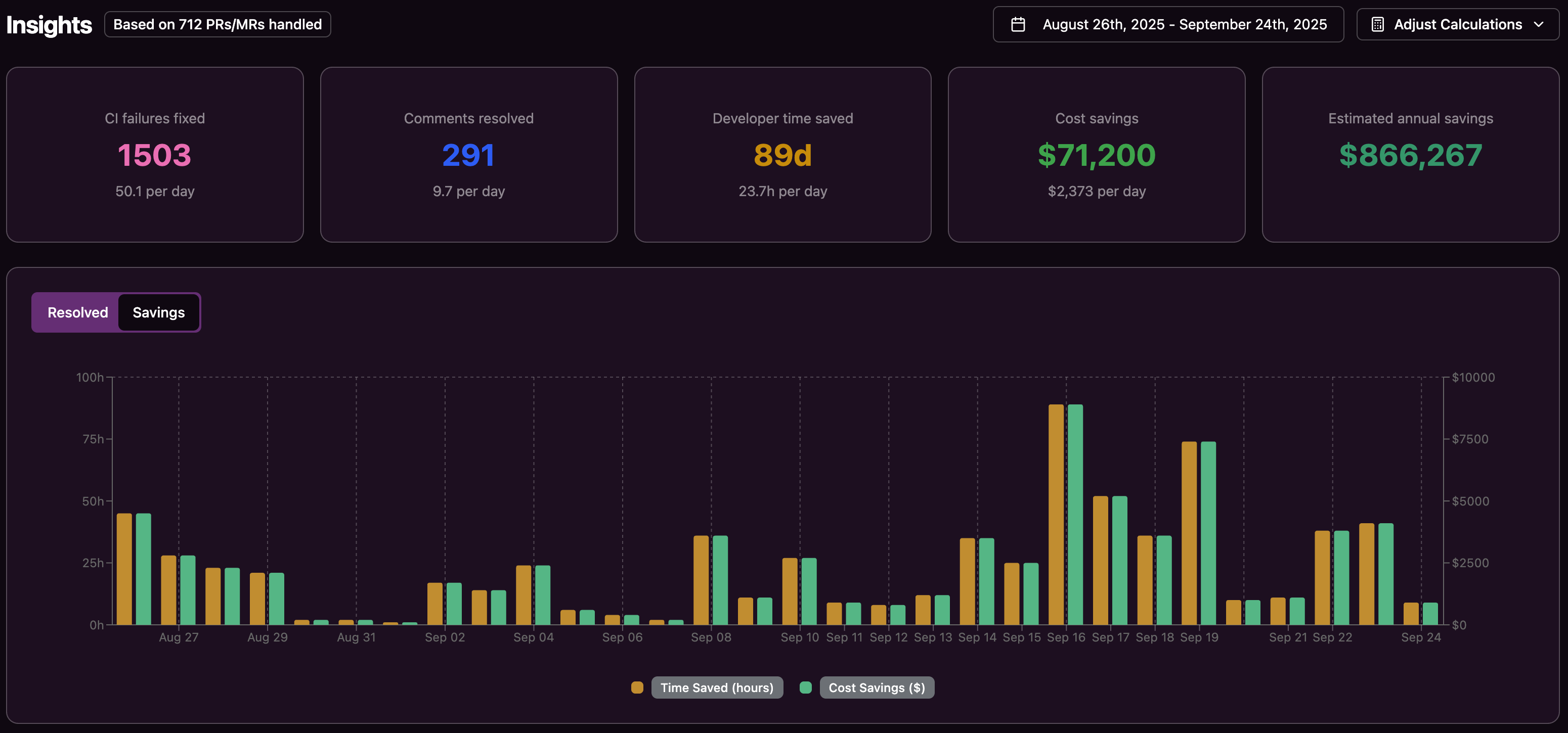
Even partial automation can reclaim substantial time. A mid sized team that cuts manual failure handling in half can recover hundreds of thousands of dollars in annual productivity, while also reducing burnout associated with repetitive debugging tasks. A healing engine that replicates real environments and manages fixes at scale can compound these gains over time.
Frequently Asked Questions About Automated CI/CD Pipeline Fixes
How Gitar handles complex enterprise CI environments
Gitar replicates end to end workflows that include specific JDK versions, multiple SDKs, and tools such as SonarQube and Snyk. This replication allows the system to propose and apply fixes that match the exact environment where failures occur, instead of relying on simplified local assumptions.
How Gitar integrates with version control and CI/CD platforms
Gitar connects to GitHub and GitLab repositories and works with CI platforms such as GitHub Actions, GitLab CI, CircleCI, and BuildKite. The system monitors pull requests, identifies failing runs, and applies updates directly in the same tools developers already use.
How teams manage trust in automated fixes
Teams can start with conservative settings that only suggest patches for review. Developers review these changes and merge them with a single click. After teams gain confidence, they can enable more automated modes that commit fixes directly while keeping rollback options available.
How Gitar addresses common CI failures
Gitar inspects logs to identify root causes for flaky tests, linting problems, dependency conflicts, and build errors. The system then edits code or configuration files, runs checks, and updates the pull request once pipelines pass.
How quickly teams see results from Gitar
Teams often observe value soon after installation. Early wins include automatic fixes for straightforward failures such as lint issues or missing dependencies. Over time, the system accumulates more context about the codebase and pipelines, which supports more complex automated fixes.
Conclusion: Advancing Engineering Velocity with Autonomous CI/CD Pipeline Fixes
Engineering organizations in 2026 increasingly rely on AI to support development work, and the pressure has shifted from writing code to validating and merging it safely. Manual CI fixes limit throughput and add unplanned work that competes with roadmap priorities.
An autonomous healing engine like Gitar helps teams move past suggestion only tools and reduce time spent on repetitive failure handling. This shift can improve engineering velocity, lower operational costs tied to failures, and support a more sustainable developer experience.
Request a Gitar demo to see automated CI/CD pipeline fixes running on your own pull requests.