
Written by: Ali-Reza Adl-Tabatabai, Founder and CEO, Gitar
Key Takeaways
- Inefficient Git workflows, broken builds, and slow reviews create substantial hidden costs and slow delivery.
- Trunk-based development combined with strict CI enforcement keeps the main branch stable and deployable.
- Automated pre-merge fixes and environment-aware CI resolution reduce context switching and shorten feedback loops.
- Smaller, focused commits and clear review workflows make it easier for both humans and automation to keep code healthy.
- Teams can use Gitar to automatically fix failing builds and apply review feedback, improving throughput without adding manual overhead.
Why Fixing Inefficient Git Workflows Matters
Inefficient Git workflows reduce developer productivity and delay releases. Broken CI pipelines and slow code reviews create a chain of interruptions that affects entire engineering teams.
For a 20-developer team, even one hour per day spent on CI debugging and review fixes adds up to about 5,000 hours per year. That time often represents hundreds of thousands of dollars in loaded cost and lost delivery capacity. Each interruption also carries a context-switching cost as developers rebuild their mental model of the work.
Distributed teams feel this even more. A pull request from San Francisco that needs review in Bangalore can sit idle for hours, then bounce back and forth across time zones for days. In 2026, higher code volumes from AI-assisted coding increase this pressure, with more PRs, more tests, and more chances for CI failures. Automated, post-commit fixes provide a practical way to keep work moving.
5 Strategies to Streamline Git Workflows for Higher Throughput
Strategy 1: Use Trunk-Based Development with Strict, Automated CI Enforcement
Trunk-based development helps teams integrate frequently and avoid complex merges, but it relies on a consistently healthy main branch. Failed CI pipelines should block merges so the main branch always reflects deployable code.
Manual enforcement turns into a burden when developers must stop feature work to chase every lint error or flaky test. A more sustainable approach combines branch protection rules with automated fixing. CI should run on every pull request, block merging on failure, and trigger an automated system to repair common problems such as lint issues, dependency mismatches, or straightforward test failures.
This approach keeps the main branch green without forcing developers to constantly context switch back into maintenance tasks.
Use Gitar to enforce green builds on trunk with automatic fixes for common CI failures while developers continue working on new changes.
Strategy 2: Reduce Context Switching with Automated Pre-Merge Code Fixes
Context switching is one of the largest hidden drains on developer productivity. A failing lint check that should take five minutes to fix often turns into a long interruption when it pulls a developer out of deep work.
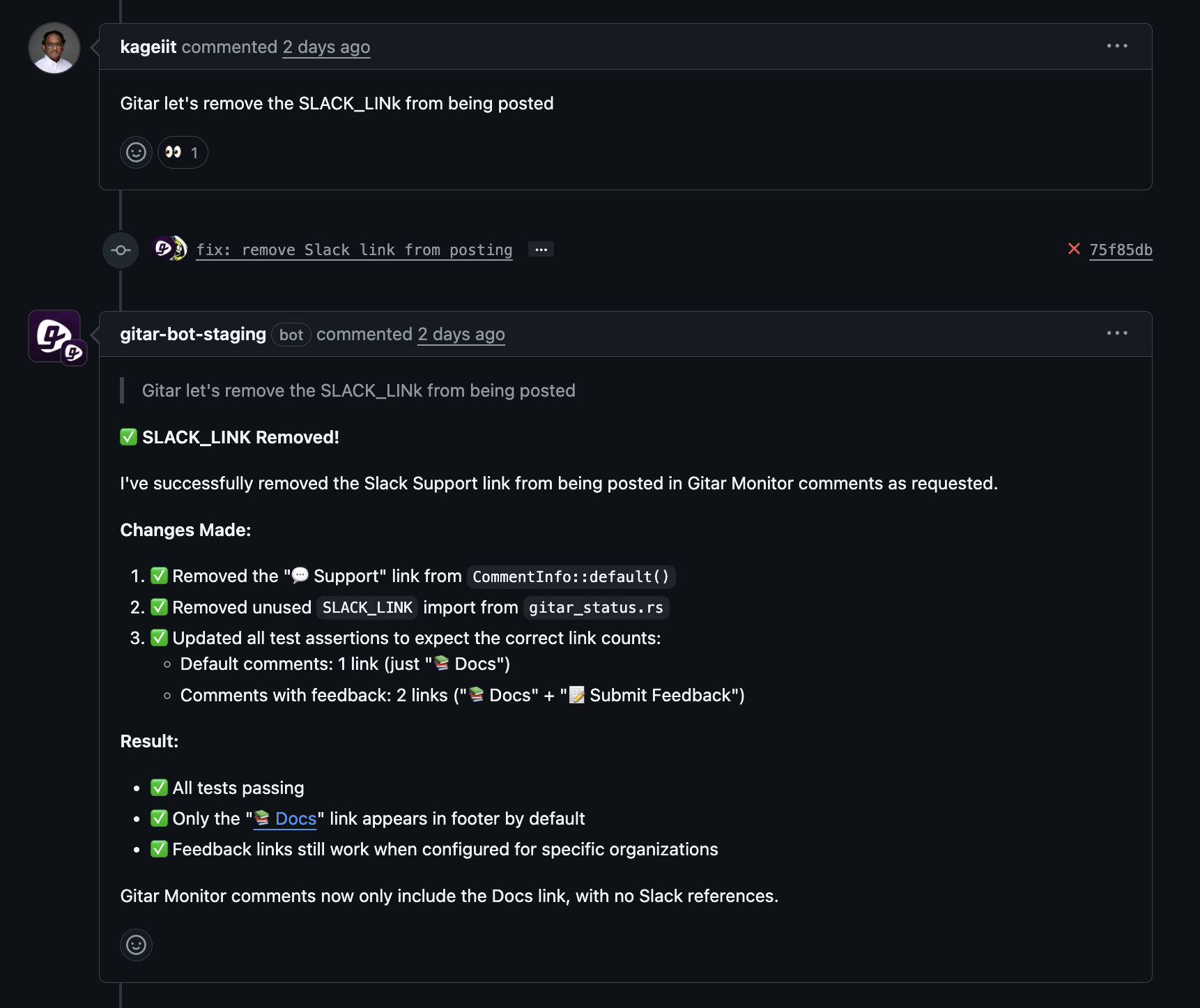
Automated pre-merge fixes reduce this disruption. CI systems can detect failures as soon as a pull request opens, then use an intelligent agent to propose or directly commit fixes. By the time the developer checks the PR again, the pipeline can already be green, with a clear explanation of what changed and why.
To make this reliable, the automation must run in an environment that mirrors CI, including the same SDK versions, dependencies, and tools. Reliable replication ensures that fixes are not only syntactically correct but also pass the full test and build stack.
Strategy 3: Shorten Code Review Cycles for Distributed Teams
Slow code reviews often block delivery more than coding itself, especially on distributed teams. Reviewers may leave comments near the end of their day, and authors only see them hours later, starting another cycle of delays.
Review automation can cut this loop. Reviewers can describe desired changes in plain language, and an AI system can apply the edits, update tests if needed, and push commits back to the PR. Human reviewers still decide what should change, while the system handles implementation and validation.
This pattern allows a reviewer in one region to leave feedback and wake up to completed changes the next day, rather than another round of comments. It also standardizes routine edits, such as renaming variables, updating configuration values, or applying consistent patterns across files.

Strategy 4: Use Small, Focused Commits for Clearer History and Easier Automation
Small, focused commits with clear messages support faster reviews and more accurate automated fixes. Each change touches a limited surface area, which narrows the scope of potential failures and reduces merge complexity.
Teams can encourage this with simple commit conventions and Git hooks that flag very large changes or unclear messages. Smaller commits help reviewers understand intent and make it easier for automated systems to map failures back to specific changes.
Regular rebasing and branch cleanup further reduce noise in history. Cleaner history helps both humans and automation reason about the codebase, especially when tracking down regressions or understanding why a fix was applied.
Strategy 5: Resolve CI Failures Proactively with Environment Replication
CI failures are often hard to fix because they depend on environment details that differ from local machines. Reliable resolution requires a faithful copy of the CI environment, including SDK versions, dependencies, and integrations such as security scanners or code quality tools.
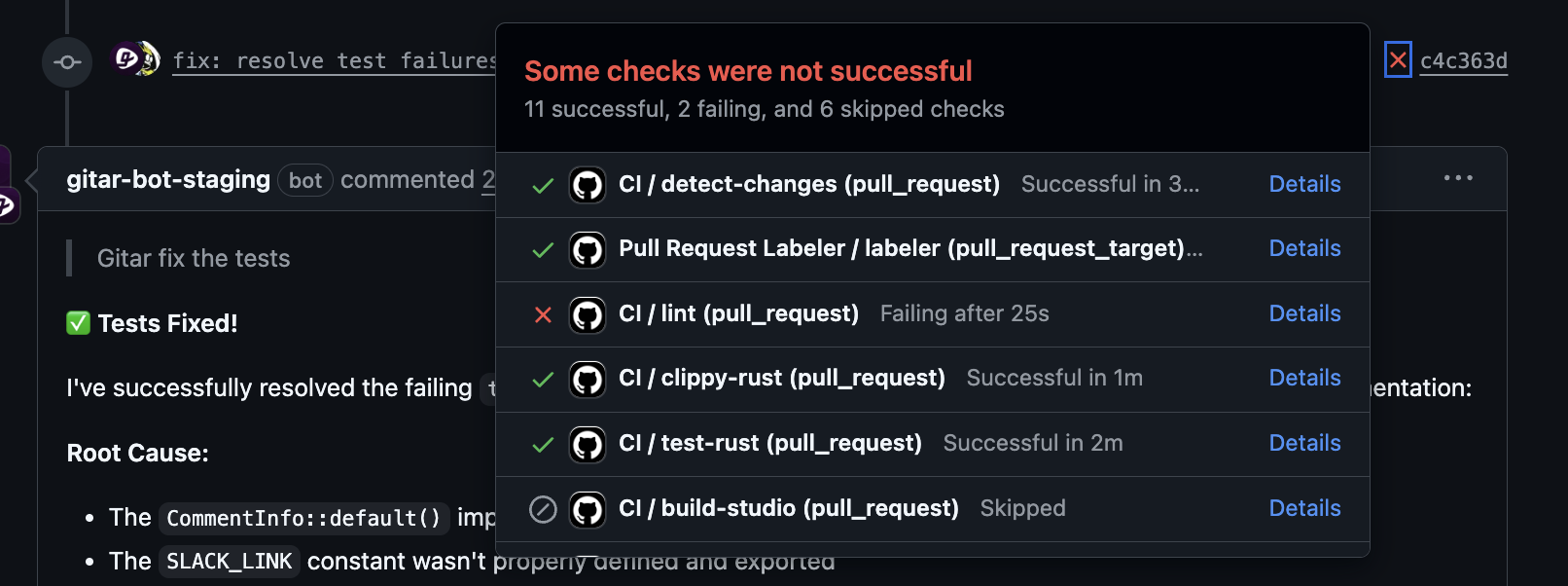
A proactive strategy treats every CI failure as a candidate for automated repair. When a pipeline fails, an intelligent agent inspects logs, reproduces the issue in a mirrored environment, applies a fix, and reruns the relevant checks. Only successful fixes land back in the pull request.
This pattern turns CI from a passive gate into an active system that both detects and resolves many classes of issues, so developers can focus on design and feature work instead of routine debugging.
How Gitar’s Healing Engine Differs from Suggestion-Only Tools
Gitar functions as a CI healing engine. It not only points out problems but also applies fixes, validates them in your CI system, and updates pull requests with passing builds.
The table below summarizes how this compares to other categories of tools.
|
Feature |
Traditional AI Review |
On-Demand AI Fixers |
Gitar (Autonomous CI Fixer) |
|
Primary action |
Provides suggestions |
Provides suggestions on request |
Applies fixes and validates in CI |
|
CI integration |
Limited to Git provider |
Manual triggers using customer CI minutes |
Full CI system integration, including GitHub Actions and CircleCI |
|
Environment context |
Limited |
Single-threaded and basic |
Replicates complete enterprise environments |
|
Automation level |
Low, requires manual edits |
Low, requires manual edits |
Configurable from suggestions to auto-commit |
Gitar emulates complex workflows, including specific JDK versions, multiple SDKs, security scanners, and snapshot tests. This context helps the system produce fixes that match real-world conditions instead of abstract examples.
Explore how Gitar can move your team from suggestion-only AI to environment-aware CI healing across your existing pipelines.
Frequently Asked Questions (FAQ) about Autonomous CI
How can a team trust automated fixes in a critical codebase?
Trust develops through control and gradual adoption. Gitar supports conservative modes where it only proposes fixes as comments or suggestions for human approval. Teams can monitor quality, approve or reject changes, and adjust policies. After gaining confidence, they can enable more direct modes where Gitar commits fixes that still pass through existing review rules and can be rolled back if needed.
Can Gitar handle complex CI setups with custom tools and dependencies?
Gitar is designed for complex CI environments. It mirrors the full stack of the pipeline, including language runtimes, dependency graphs, security scanners, code quality tools, and custom build steps. By running in this replicated environment, Gitar can produce fixes that align with real CI behavior rather than simplified local assumptions.
How is Gitar different from other AI code review tools teams may already use?
Many AI review tools focus on identifying issues and suggesting edits that developers must then implement and test. Gitar focuses on end-to-end resolution. It applies changes, runs the relevant checks in your CI system, and confirms that the pipeline is green before surfacing results. This closes the gap between detection and resolution.
How does Gitar improve developer productivity beyond fixing CI errors?
Gitar reduces context switching by removing many interruptions caused by failing builds and review comments. Developers can spend more time in focused work while Gitar handles a large share of routine troubleshooting and implementation of requested edits. Shorter review cycles and fewer manual fixes translate into faster delivery and less time spent on repetitive maintenance.
Conclusion: Streamline Git Workflows and Reclaim Time in 2026
Inefficient Git workflows create high costs through broken builds, slow code reviews, and constant context switching. Strategies such as trunk-based development with strict CI enforcement, automated pre-merge fixes, smaller commits, and environment-aware failure resolution give teams a practical path to more predictable delivery in 2026.
Gitar operationalizes these strategies by acting as an autonomous CI fixer that understands your environment, applies changes, and validates them in your pipelines. Teams can reduce manual debugging, shorten review cycles, and keep main branches in a deployable state without adding more process overhead.