
Written by: Ali-Reza Adl-Tabatabai, Founder and CEO, Gitar
Key Takeaways
- CI failures and code review delays create context switching, lost focus, and significant productivity loss for modern engineering teams.
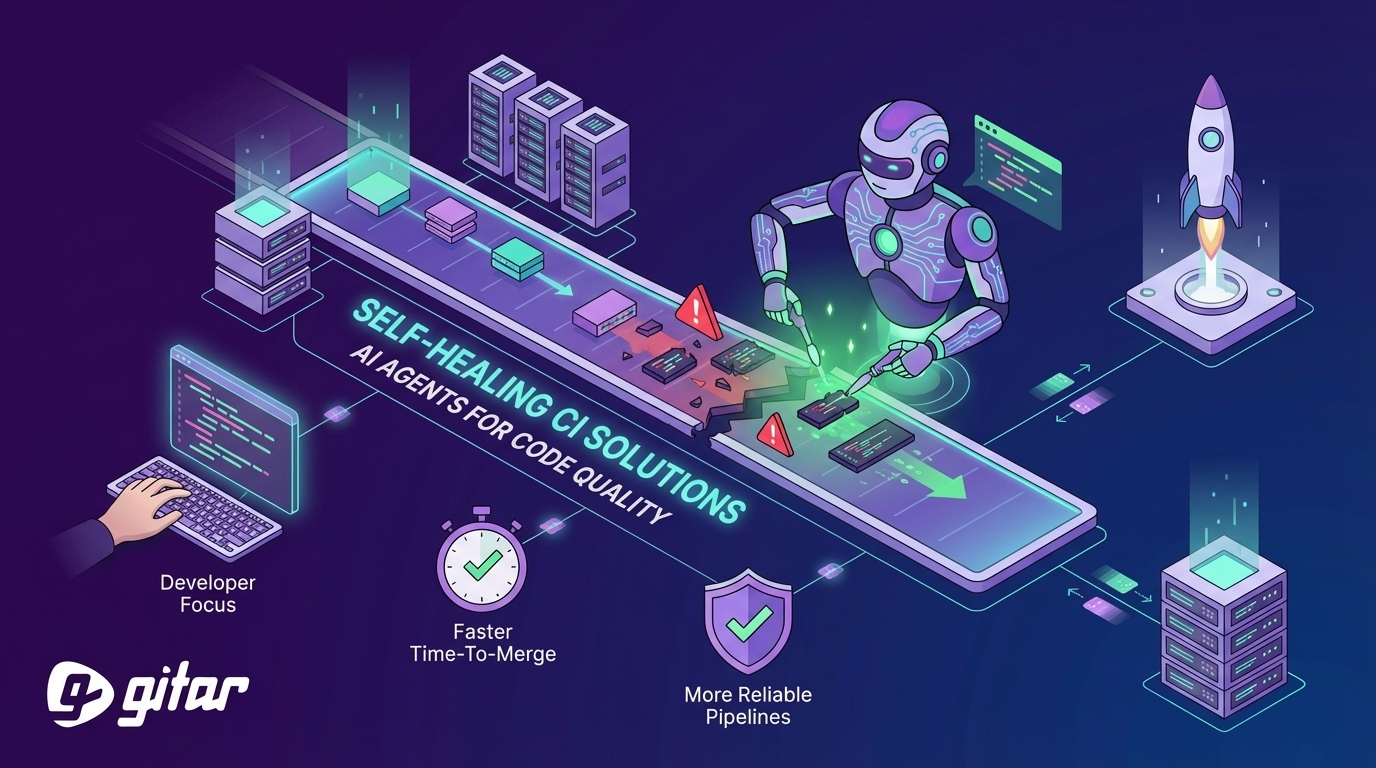
- Autonomous AI agents work inside CI/CD pipelines to analyze failures, generate fixes, and update pull requests without manual intervention.
- Healing engines like Gitar differ from suggestion tools by implementing and validating fixes, not just recommending changes.
- Teams that adopt AI agents see faster time-to-merge, fewer broken builds, better support for distributed work, and more reliable pipelines.
- Teams can start using Gitar in a controlled mode and scale to self-healing CI when ready. Get started with Gitar to automatically fix broken builds and speed up merges.
Why Traditional Code Quality Slows Modern DevOps Teams
Context Switching From CI Failures Drains Productivity
Many teams ship code frequently, yet CI failures disrupt focus and delay merges. A developer opens a pull request, starts a new task, then gets pulled back by a failing job. A five minute lint fix or flaky test often turns into an hour of reloading context and re-running pipelines.
Developers can lose up to 30% of their time to CI and review friction. On a 20 person team, that can reach about 5,000 hours and roughly one million dollars of annual productivity tied up in repetitive debugging and manual fixes.
More Code Now Means More Validation Bottlenecks
AI coding assistants help engineers write more code, yet this increase shifts the bottleneck to validation. More pull requests mean more tests, more policy checks, and more opportunities for CI failures. Generating code faster has limited value if validation and merge steps slow down release cycles.
Manual Interventions Increase Cost And Delay Delivery
Slow CI and review cycles affect more than developer happiness. Release delays affect revenue, customer experience, and competitiveness. Distributed teams feel this even more. A pull request opened in one time zone can sit overnight waiting on a fix or a minor change request in another.
Most AI review tools only add comments or suggested diffs. Developers still have to implement, run CI again, and wait for confirmation that the change is safe.
How Autonomous AI Agents Improve Code Quality
From Suggestions To Hands-Off Fixes
AI agents for code quality improvement focus on action rather than advice. These agents run within your CI/CD workflows, inspect failures, generate fixes, and push commits back to the branch. Developers keep shipping features while the agent handles routine breakages.
When a job fails, the agent reviews logs, identifies the root cause, proposes a change, applies it, and revalidates the pipeline. Typical use cases include lint violations, formatting issues, broken tests, dependency problems, and simple script errors.
How Gitar Enables Self-Healing CI
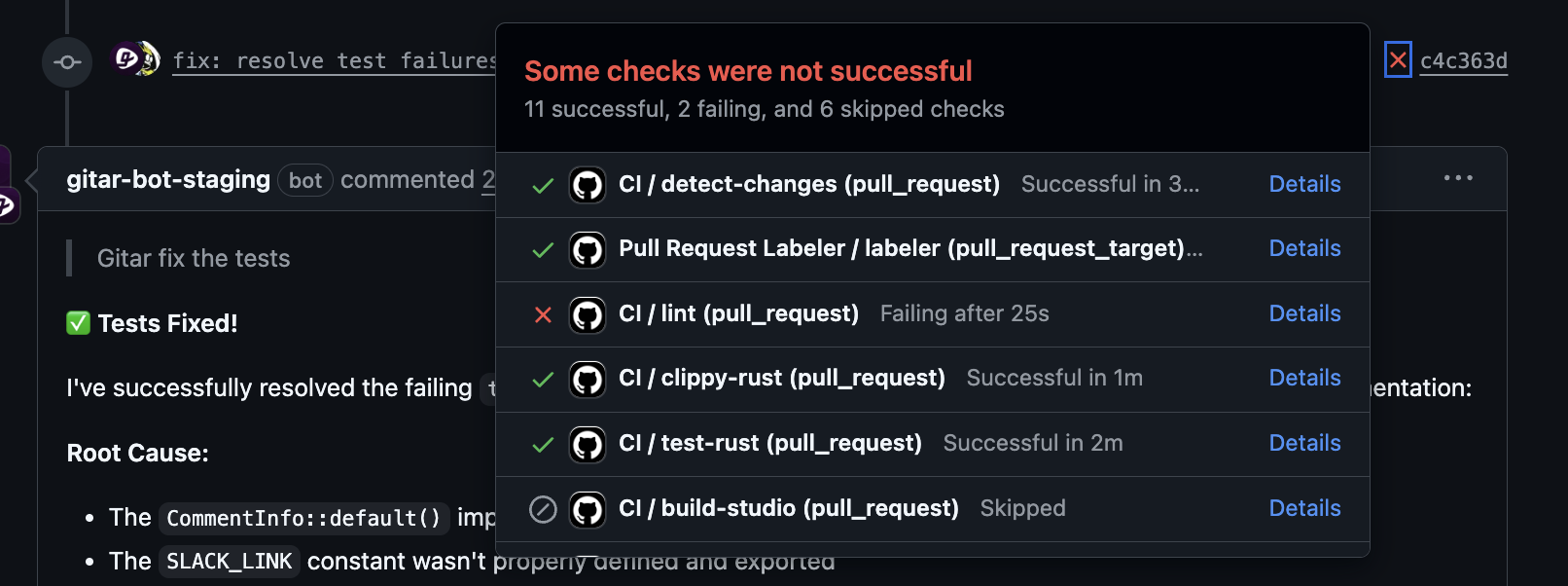
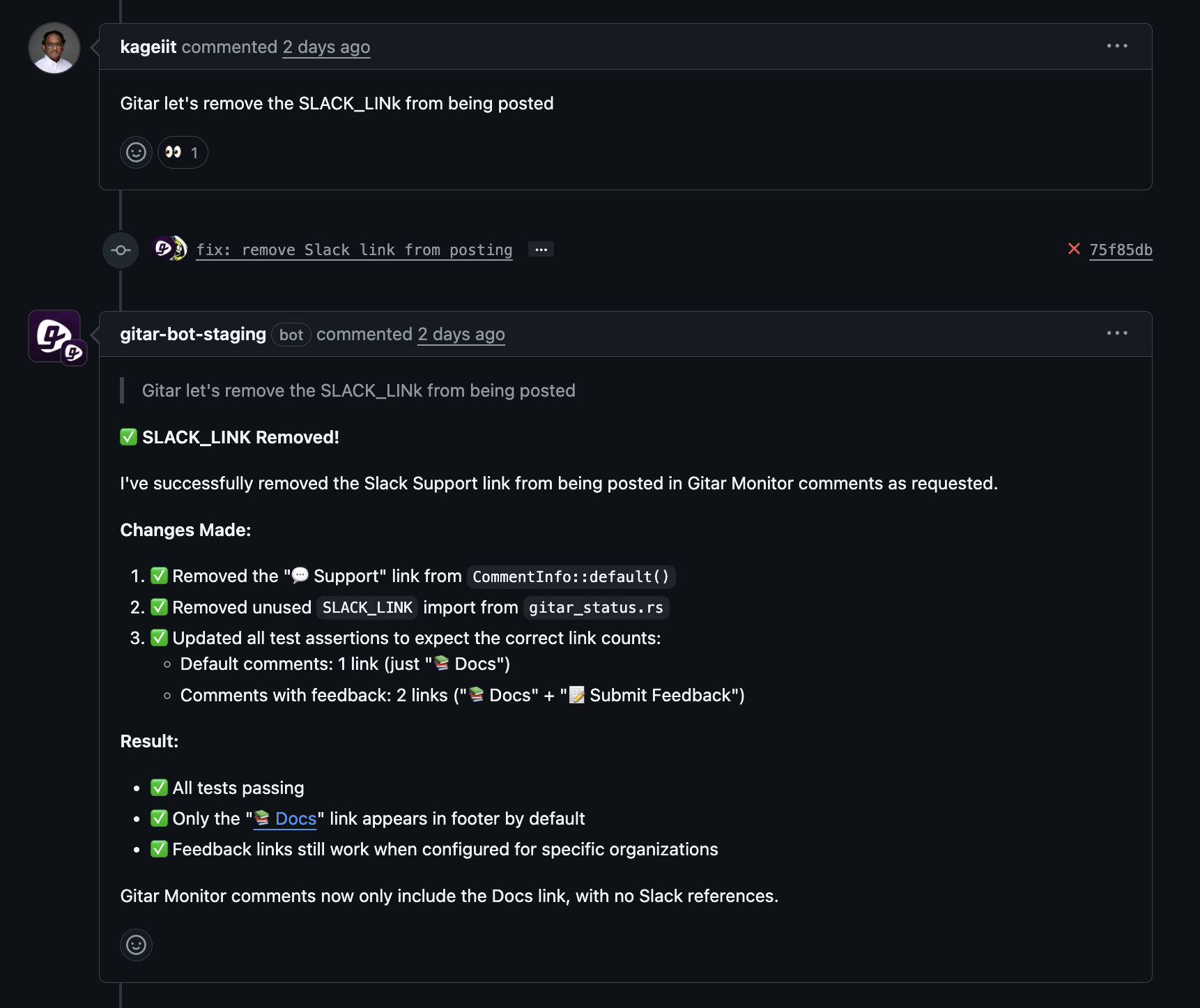
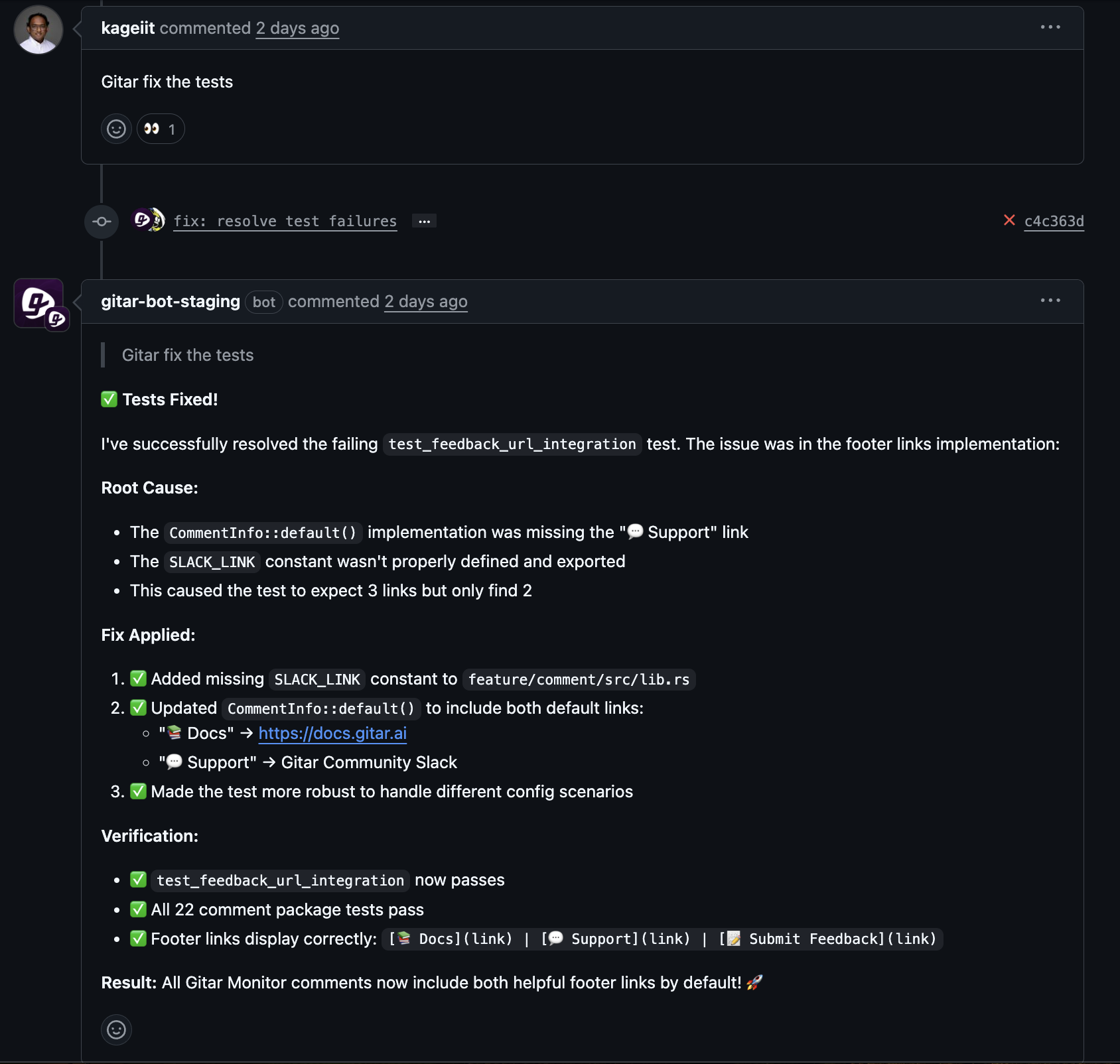
Gitar brings this autonomous model into everyday development. When a pull request fails CI or receives review feedback, Gitar detects the issue, analyzes it, and prepares a fix. The pull request updates with new commits and a clear explanation of what changed, so reviewers can focus on higher level feedback.
Install Gitar to automatically fix broken builds and keep your main branch green.
Gitar Capabilities That Improve Code Quality
- End-to-end fixing: Applies changes, re-runs CI, and only marks fixes complete when all checks pass.
- Environment awareness: Mirrors real workflows, including SDK versions, multi-language projects, and third party scans.
- Broad CI support: Works with GitHub Actions, GitLab CI, CircleCI, Buildkite, and other common platforms.
- Configurable trust levels: Starts in suggestion or approval modes and scales to fully autonomous commits with rollback controls.
- Review automation: Implements reviewer feedback, commits the changes, and posts comments explaining updates.
What You Gain From AI Agents For Code Quality
Developer Focus And Flow
Teams that adopt AI agents cut down on context switches. Developers see fewer red builds for routine issues and spend more time on design, architecture, and complex bugs. The agent handles recurring tasks like style fixes, snapshot updates, and simple assertion changes.
Faster Time-To-Merge And Releases
Autonomous fixes shorten review loops. Reviewers can leave specific comments for the agent, and by the time the original author returns, the requested changes and passing builds are already in place. This pattern is especially helpful for teams spread across several time zones.
Lower Operational Costs And Better Morale
For a 20 person team that spends about one hour per day on CI and review fixes, the productivity cost can approach one million dollars per year. Even partial automation can free a large share of that time while reducing frustration from repetitive work.
More Reliable CI/CD Pipelines
Self-healing behavior keeps pipelines healthy. Gitar watches for common failures, applies known-safe fixes, and escalates only the complex or ambiguous cases to humans. Over time, this reduces noise and keeps branches closer to releasable quality.
Healing Engines vs. Suggestion Engines
Many tools stop at suggestions. They point out issues and sometimes propose diffs, but leave implementation and validation to developers. Healing engines go further by handling the full loop from detection through validation.
|
Feature |
Traditional AI Reviewers |
Manual Debugging |
Gitar AI Agent |
|
Issue detection |
Yes |
Yes |
Yes |
|
Fix suggestions |
Yes |
No |
Yes |
|
Autonomous implementation |
No |
No |
Yes |
|
CI validation |
No |
Manual |
Yes |
Tools like CodeRabbit center on suggestions and analysis, so developers still have to apply changes and hope the next CI run passes. Gitar applies and validates fixes to keep builds green, which reduces manual rework.
Some teams experiment with general purpose models wired into CI. These setups can be powerful but often require custom integration, prompt design, and long term maintenance. Gitar delivers a focused, production ready fixing workflow without building that infrastructure in house.
Addressing Common Concerns About Autonomous Fixes
Objection: Existing AI Reviewers Already Help
AI reviewers improve visibility but still behave like suggestion engines. Gitar acts as a healing engine. It not only proposes changes, it applies them, runs CI, and reports back with passing results or clear failures.
Objection: Automated Commits Feel Risky
Gitar allows a gradual path to trust. Teams can begin in a suggestion or approval-required mode. As they see successful fixes, they can enable automatic commits for low risk cases, while keeping rollback options and strict controls for sensitive areas.
Objection: Our CI Setup Is Too Custom
Gitar is built for complex environments. It works with specific language versions, dependency graphs, and tools such as SonarQube or Snyk. This context helps the agent propose changes that respect existing checks and policies, even in large or regulated codebases.
Frequently Asked Questions
How do AI agents differ from standard CI tools?
Standard CI tools report failures and logs. AI agents like Gitar read those logs, infer likely causes, propose changes, apply them to a branch, and re-run jobs. CI becomes a closed loop system that not only detects issues but also attempts safe fixes.
What kinds of issues can Gitar fix automatically?
Gitar targets common CI breakages such as lint and formatting errors, simple failing tests, dependency and version conflicts, and straightforward script problems. It can also implement many reviewer comments, for example renaming functions, updating configuration, or adjusting log messages.
How does Gitar maintain quality while acting autonomously?
Gitar mirrors your CI environment, respects existing security and quality checks, and uses configurable trust levels. Teams can restrict autonomous changes to narrow categories and require human approval for anything outside those boundaries. Every action is logged for review.
What does the rollout process look like?
Most teams start by installing Gitar on a subset of repositories and enabling conservative settings. The agent first handles low risk fixes like formatting or basic test updates. As confidence grows, teams expand coverage and automation, including support for complex reviewer feedback and distributed workflows.
Conclusion: Moving Toward Autonomous Code Quality With Gitar
AI agents for code quality improvement give development teams a practical way to reduce CI noise, shorten review cycles, and protect focus. Routine fixes stop blocking progress, and pipelines trend toward a steady green state instead of frequent breakage.
Gitar supports this shift by acting as an autonomous CI fixing agent. It implements and validates changes rather than only suggesting them, and it adapts to both small teams and large, multi-platform environments.
Install Gitar to automatically fix broken builds and ship reliable code faster in 2026.