
Key Takeaways
- Automated CI/CD pipelines still create bottlenecks in 2026 through broken builds, flaky tests, and long review cycles.
- Manual CI debugging, context switching, and code review fixes consume large portions of developer time and increase burnout risk.
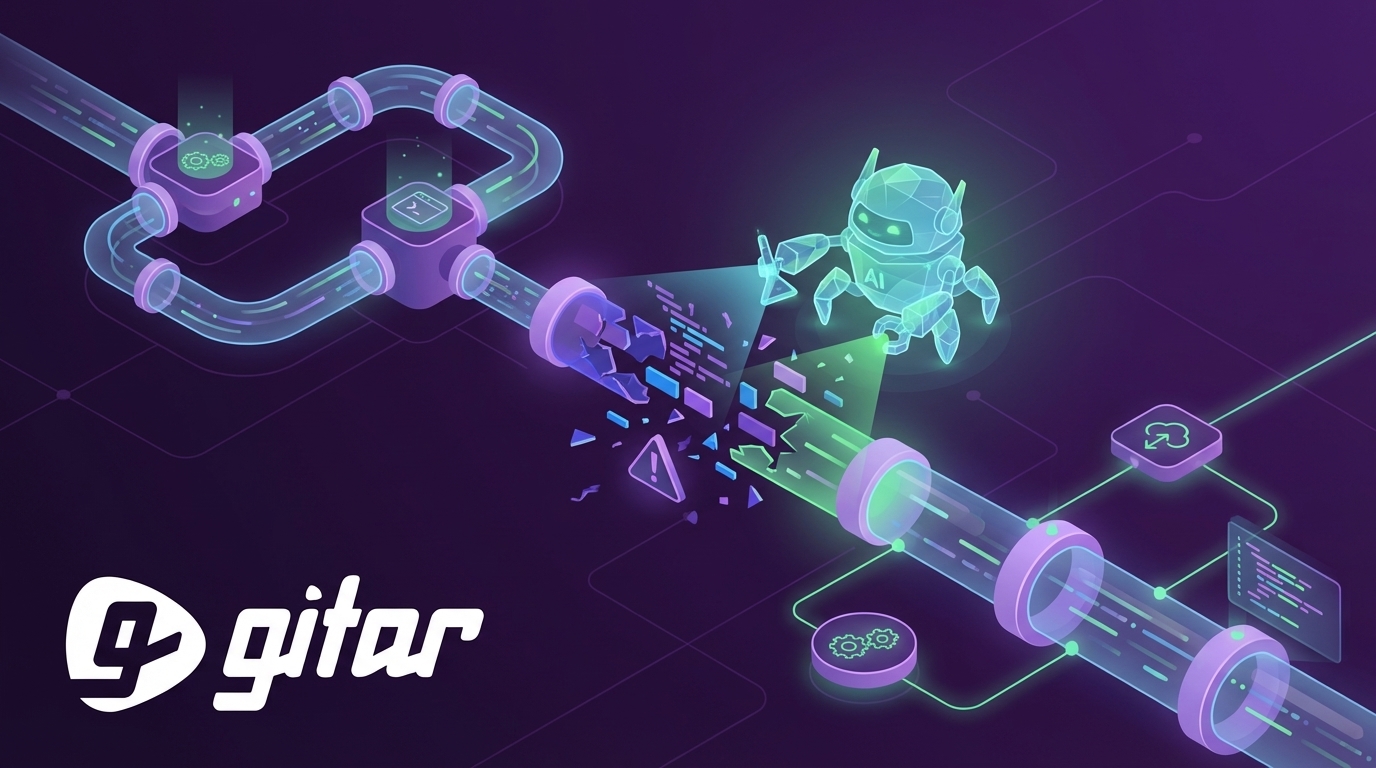
- Autonomous “healing” agents move beyond suggestions by diagnosing failures, applying fixes, and validating them directly in your pipeline.
- Gitar reduces CI toil, shortens time-to-merge, and supports complex, distributed teams through full-environment awareness and configurable trust controls.
- Teams that want self-healing automated software development pipelines in 2026 can start with Gitar at https://gitar.ai/fix.
The Problem: Why Your Automated Software Development Pipeline Is Still a Bottleneck in 2026
Many engineering teams entered 2026 with automated pipelines but still face slow feedback, frequent CI failures, and delayed releases. Automation around deployment exists, yet manual work in debugging and review remains a major drag on delivery speed.
Developer Time Lost to Manual Intervention
Developers spend over 17 hours per week on maintenance tasks, which can exceed 40,000 hours annually for a 50-person team. Some industry estimates place CI failures and code review rework at around 30 percent of a developer’s time. For a 20-person team, this can approach 1 million dollars in lost productivity each year.
The Cost of Context Switching and Broken Flow
Each time CI fails or review feedback arrives, developers must pause their current work, reload context, and then return to the feature later. A small lint fix or test adjustment might take only minutes to code, yet the surrounding context switching often costs close to an hour of real productivity. Repeated interruptions erode flow state and contribute to frustration and burnout.
Right-Shifted Bottlenecks from Faster Code Generation
Tools such as GitHub Copilot and Cursor help engineers write code faster. That extra code increases the number of pull requests, tests, and potential CI failures. The constraint no longer sits in writing code but in validating, fixing, and merging it safely.
Complex CI/CD Environments Increase Risk and Delay
Modern pipelines chain together many tools, environments, and checks. Tool integration issues, testing delays, and scalability problems often slow builds. Without robust automation around failure handling, these systems create longer build times, slower tests, and infrastructure queues, which raise cloud spend and extend feedback cycles.
How Autonomous AI Agents Improve Automated Software Development Pipelines
The rise of AI and machine learning inside CI/CD, highlighted as a key trend for 2026, is shifting pipelines from passive reporting to active remediation. AI-assisted pipelines increasingly use models to interpret logs, predict failures, and act on issues.
From Suggestion Engines to Healing Engines
Many AI tools flag problems or propose code changes but still rely on developers to implement and validate fixes. Healing engines differ by taking ownership of the full loop. They:
- Detect failures across CI jobs and tests.
- Analyze logs and code to identify likely root causes.
- Generate targeted fixes and update the branch.
- Re-run the relevant parts of the pipeline.
- Surface a green pull request or clearly explain what remains unresolved.
This pattern turns repetitive CI and review work into background automation instead of a series of manual tasks.
Self-Healing CI for Faster, More Reliable Pipelines
Self-healing CI agents monitor pipelines continuously, then apply and validate fixes while respecting existing quality gates. Predictive analytics, intelligent error handling, and reduced manual intervention make builds more reliable and shorten recovery time when something breaks.
Gitar: A Self-Healing AI Agent for Automated Software Development Pipelines
Gitar is an autonomous AI agent that focuses on CI failures and code review feedback. It runs inside your existing pipeline and repository, then applies and validates fixes so developers can stay focused on feature work.
Key capabilities that support modern teams
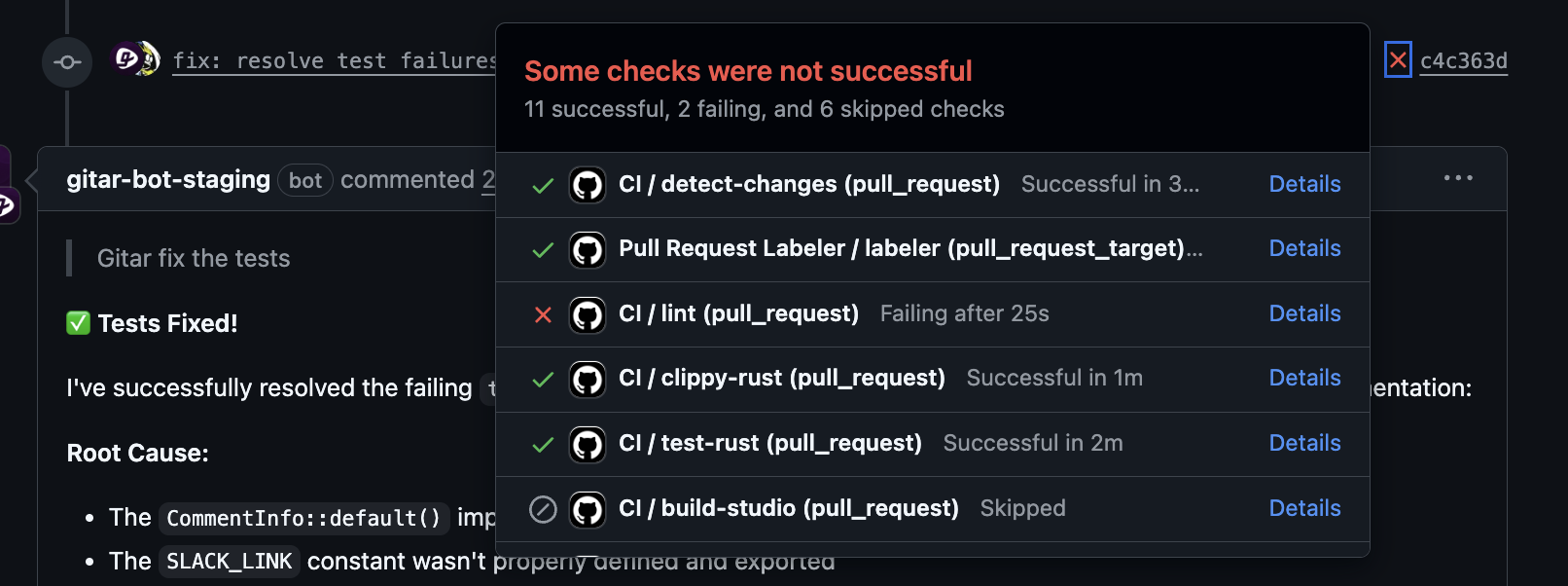
- End-to-end fixing. Gitar applies code changes, re-runs CI workflows, and only presents results once all required jobs pass.
- Full environment awareness. The agent reproduces complex enterprise workflows, including specific language runtimes, multi-SDK dependencies, security scanners such as SonarQube or Snyk, and snapshot testing.
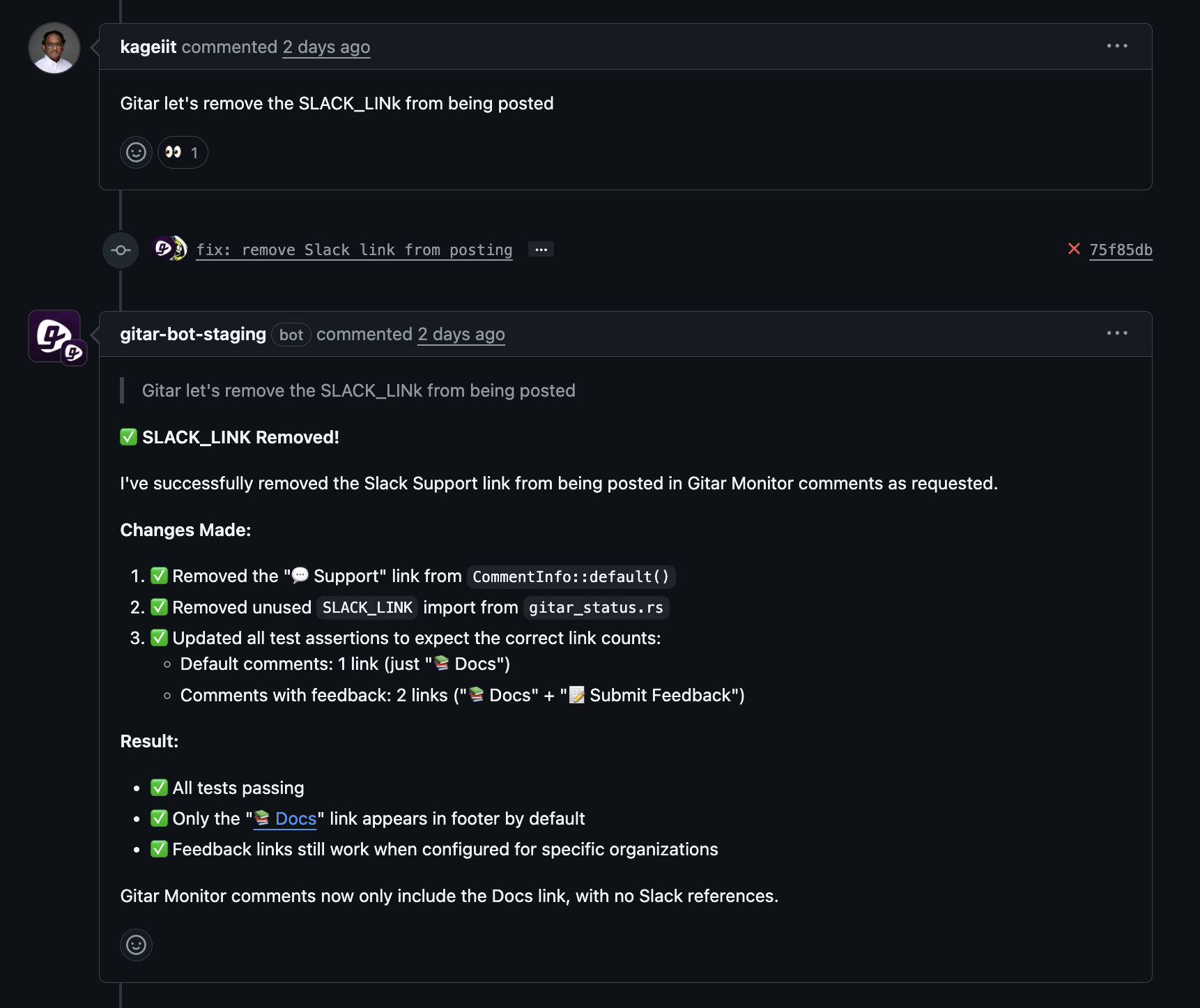
- Code review assistance. Gitar handles preliminary code review tasks and acts on reviewer comments by implementing requested updates and committing them with clear explanations.
- Configurable trust and control. Teams can start in a conservative mode where Gitar proposes patches for manual approval, then move toward auto-commit modes with rollback options as confidence increases.
- Cross-platform coverage. The agent integrates with platforms such as GitHub Actions, GitLab CI, CircleCI, and Buildkite, so teams can adopt it without reworking existing pipelines.
Teams can explore how Gitar fits into their existing automated software development pipeline here.
How Healing Engines Like Gitar Improve Developer Productivity
Reduced Context Switching and Developer Toil
Gitar addresses common failures such as lint errors, flaky tests, and configuration issues so developers stay in their current task longer. The agent handles the back-and-forth of editing code, pushing changes, and re-running pipelines, which turns what used to be many small interruptions into a single summarized update.
Faster Time-to-Merge and Ship Cycles
CI issues contribute to delayed projects for a large share of companies. By fixing failures quickly and implementing review feedback overnight or between time zones, Gitar shortens the path from first commit to merged code. Pull requests move forward even when original authors or reviewers are unavailable.
Lower Operational Costs and Clearer ROI
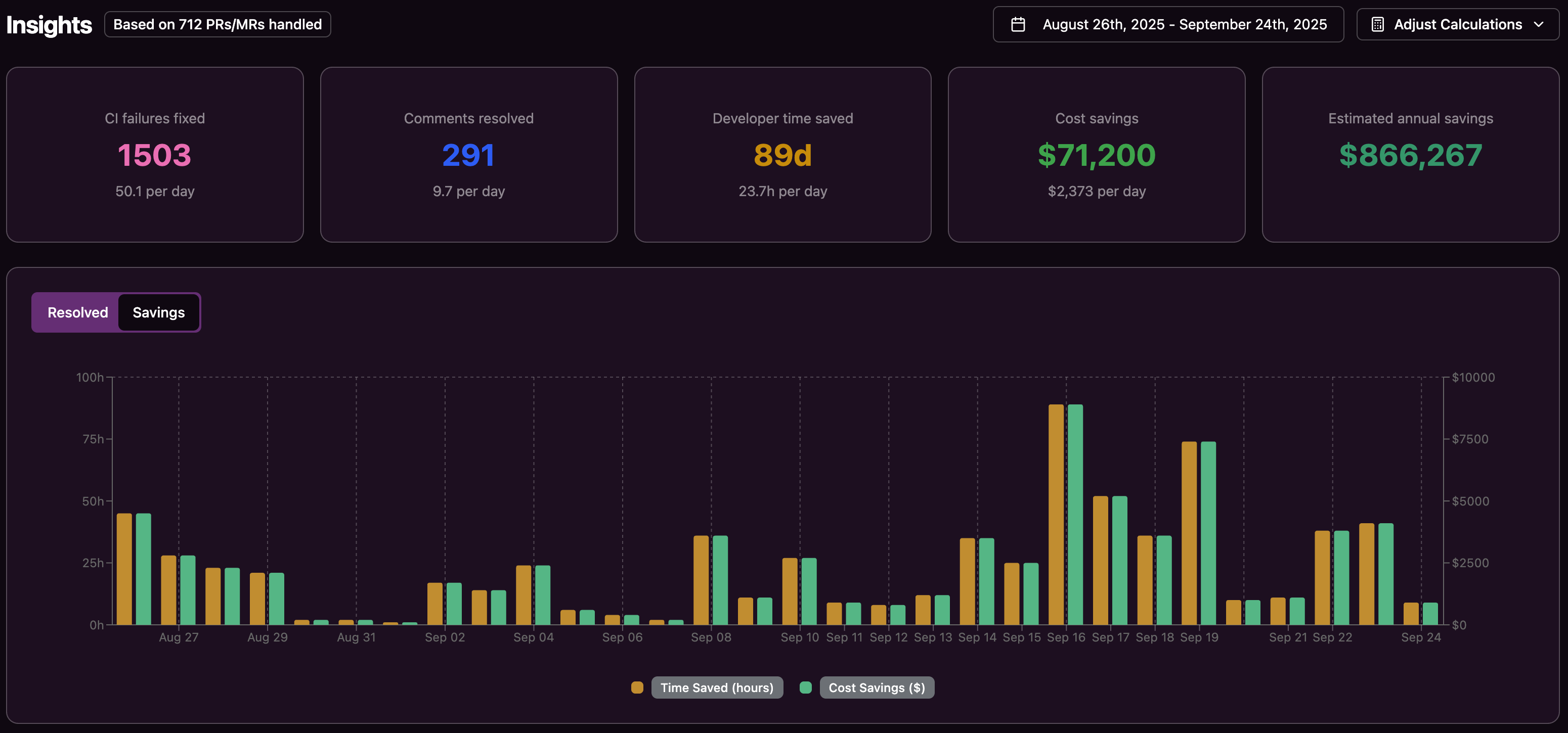
Time lost to CI failures and review friction carries a direct financial impact. For a 20-developer team, one hour per engineer per day tied up in pipeline issues can approach 1 million dollars in annual productivity loss. If Gitar halves that waste, the savings can reach hundreds of thousands of dollars per year, along with reduced spend from repeated failed CI runs.
Support for Distributed and Complex Teams
Distributed teams often wait a full day for code review responses. With Gitar, reviewers can leave high-level instructions, then allow the agent to make and validate changes. Pull requests arrive in the next workday already updated and passing CI. Because Gitar mirrors enterprise CI environments, its fixes respect the same constraints human developers face.
|
Aspect |
Gitar (healing engine) |
AI code reviewers |
Manual work |
|
Core action |
Applies, validates, and commits fixes autonomously |
Suggests changes that developers must apply |
Human diagnosis, fixing, and re-runs |
|
Environment awareness |
Recreates full enterprise CI context |
Focuses on code-level analysis |
Relies on human knowledge and memory |
|
Automation level |
Fully autonomous with configurable controls |
Assisted, but requires manual validation |
Entirely manual |
|
Productivity impact |
Large reduction in repetitive CI and review toil |
Faster reviews, but manual fix costs remain |
High effort and frequent delays |
Learn how Gitar can reduce bottlenecks in your automated software development pipeline.
Frequently Asked Questions About Automated Pipelines with AI Agents
How autonomous AI agents like Gitar ensure safe, trustworthy fixes
Gitar uses a configurable trust model. Teams can start with modes where the agent proposes patches for manual approval, then progress to auto-commit once they are comfortable with its behavior. Every fix runs through the full CI workflow before it is surfaced as ready, so only changes that pass existing checks reach reviewers or main branches.
How AI agents handle complex CI/CD pipelines with unique dependencies
Gitar is designed for complex setups. Its agents recreate the environment defined by your pipeline, including language versions, service dependencies, and third-party tools such as SonarQube and Snyk. This context allows Gitar to generate fixes that address the actual conditions your code must satisfy.
How Gitar differs from AI code reviewers and IDE assistants
AI code reviewers and IDE tools help write and refine code before it reaches the repository. They still require developers to apply fixes and re-run tests. Gitar operates after commits land, focusing on CI failures and review feedback. It edits code, triggers CI, and iterates until checks pass or it reaches clear limits, then provides a concise summary for humans.
How Gitar supports enterprise security and compliance
Gitar offers on-premise deployment options so source code and data can remain within enterprise boundaries. It works alongside existing security scanners and quality gates, ensuring all autonomous fixes meet the same compliance standards as human-written changes.
Conclusion: Moving Toward Self-Healing Automated Software Development Pipelines
CI failures, integration issues, and review backlogs keep many teams from realizing the full value of automated software development pipelines in 2026. Manual intervention remains common, which slows delivery and consumes expensive engineering time.
Self-healing agents such as Gitar address this gap by diagnosing pipeline failures, applying targeted fixes, and validating them directly in your CI/CD environment. Developers can spend more time on product work while the agent handles repetitive repair tasks in the background.