
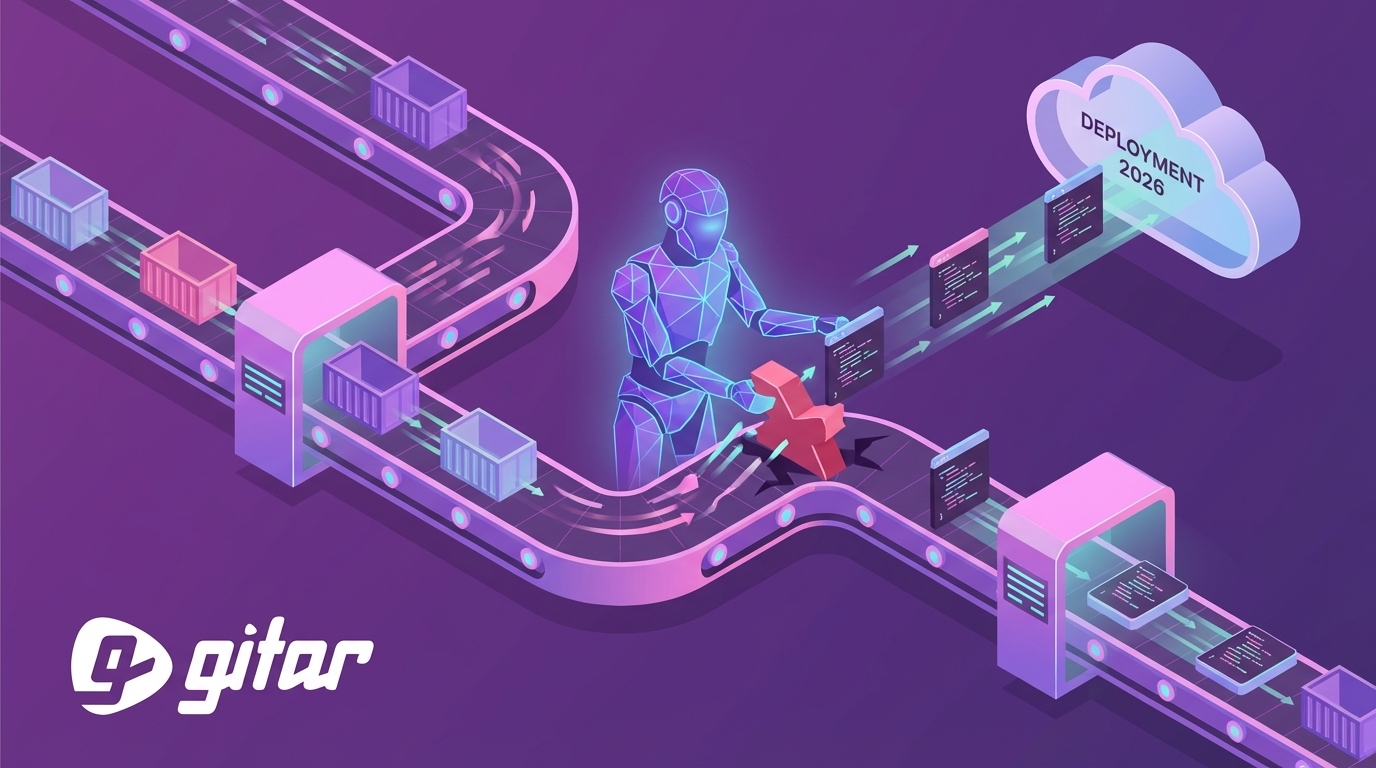
Key Takeaways
- Deployment frequency often stalls in CI/CD, where failed builds, slow tests, and manual reviews add hidden delays.
- Context switching during CI failures and code reviews erodes focus, which reduces effective development time for every engineer.
- AI agents in 2026 give teams a practical way to create self-healing CI pipelines that fix many issues without manual effort. This shift aligns with broader trends toward AI-driven pipelines.
- Gitar acts as an autonomous CI agent that reproduces your environment, applies fixes, and validates them against your full workflow before changes merge.
- Teams that want to reduce CI toil and speed up releases can install Gitar to automatically fix broken builds and unlock faster, more reliable deployment cycles.
The Problem: Why Your Deployment Frequency Is Stalling
The CI/CD Gauntlet
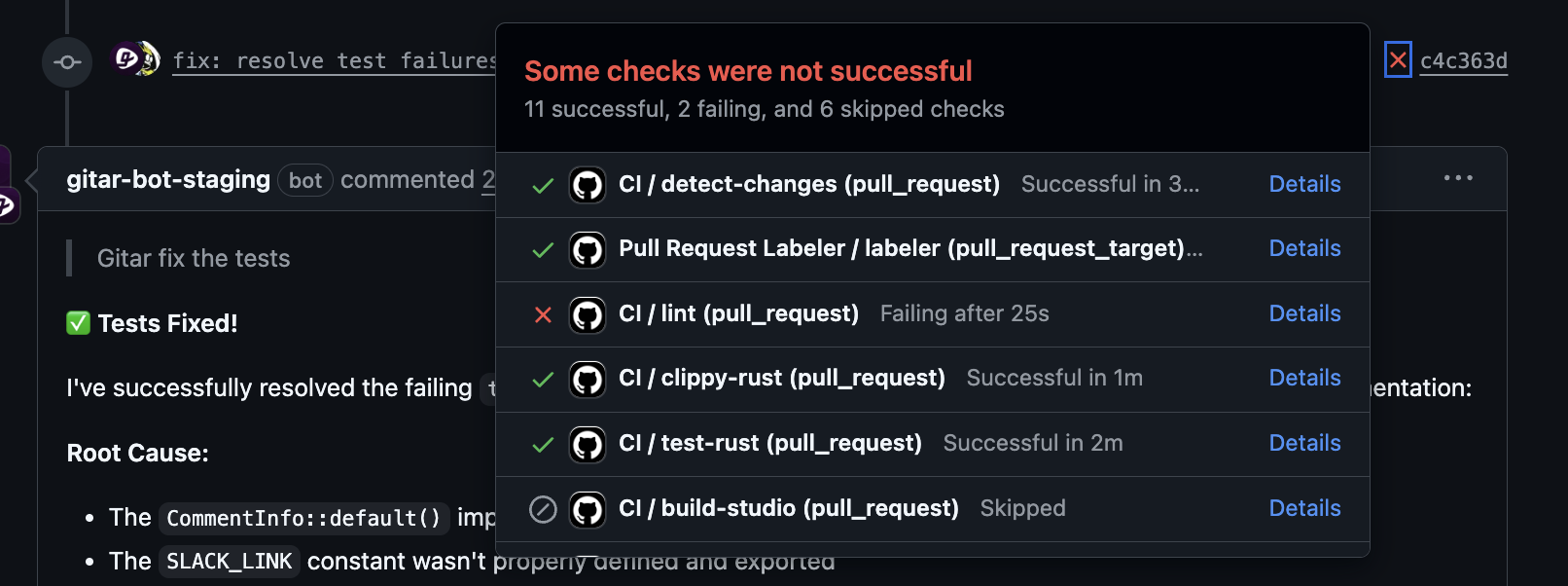
Most deployment delays start after code is written. A pull request looks ready, then CI turns red because of lint errors, flaky or failing tests, or missed dependencies. Each failure forces a loop of log inspection, local reproduction, fixes, and another full pipeline run.
Common CI/CD bottlenecks include slow builds, long-running tests, and queues caused by limited infrastructure. Work that should take minutes often stretches into hour-long interruptions that break concentration and delay merges.
The Cost of Context Switching
Developers rarely work on a single task while CI runs. They submit a PR, start another feature, then receive alerts about failures or review feedback. Each interruption forces them to reload context, which can double the effective time required to resolve even small issues.
Code Review as a Delay Point
Code review delays create additional friction, especially across time zones. A simple feedback cycle between San Francisco and Bangalore can expand from hours to days. Traditional AI review tools may highlight issues, but they still require developers to implement and verify every change.
The Right-Shifted Bottleneck
AI coding tools such as GitHub Copilot have increased output, which results in more pull requests and more tests that must pass. Some data indicates higher merge rates and healthier builds, yet the main constraint has shifted from writing code to validating and merging it efficiently. Many teams feel this as slow builds, unreliable tests, and manual deployments that reduce competitiveness.
Compounding Business Impact
These frictions add up. Warning signs include releases that take weeks, developers waiting on unstable environments, and late discovery of security issues. For a 20-person team spending even one hour per day on CI and review overhead, the annual productivity loss can reach hundreds of thousands of dollars.
The Solution: Improving Deployment Frequency with Gitar as an Autonomous AI Agent
AI and machine learning increasingly sit at the center of modern CI/CD. Current 2026 pipeline trends highlight deeper AI integration for decision-making and automation. Earlier 2025 guidance already described how AI can select tests, tune resource usage, and handle errors with less manual intervention.
Gitar extends this direction by acting as a CI healing engine. The system not only identifies failures, it also applies fixes, reruns checks in a replica of your CI environment, and keeps builds green without constant developer involvement.
Key Features of Gitar for Deployment Frequency
- End-to-end autonomous fixing, from error analysis to code changes, validation, and commits.
- Full environment replication for complex workflows, including language runtimes, dependencies, and tools such as SonarQube or Snyk.
- A configurable trust model that starts with suggested fixes and can progress to auto-commit as teams build confidence.
- Support for popular CI platforms, including GitHub Actions, GitLab CI, CircleCI, and Buildkite.
- An intelligent code review assistant that implements reviewer feedback directly in the pull request.
How Gitar Accelerates Deployment Cadence and Developer Velocity
Self-Healing CI for Common Failures
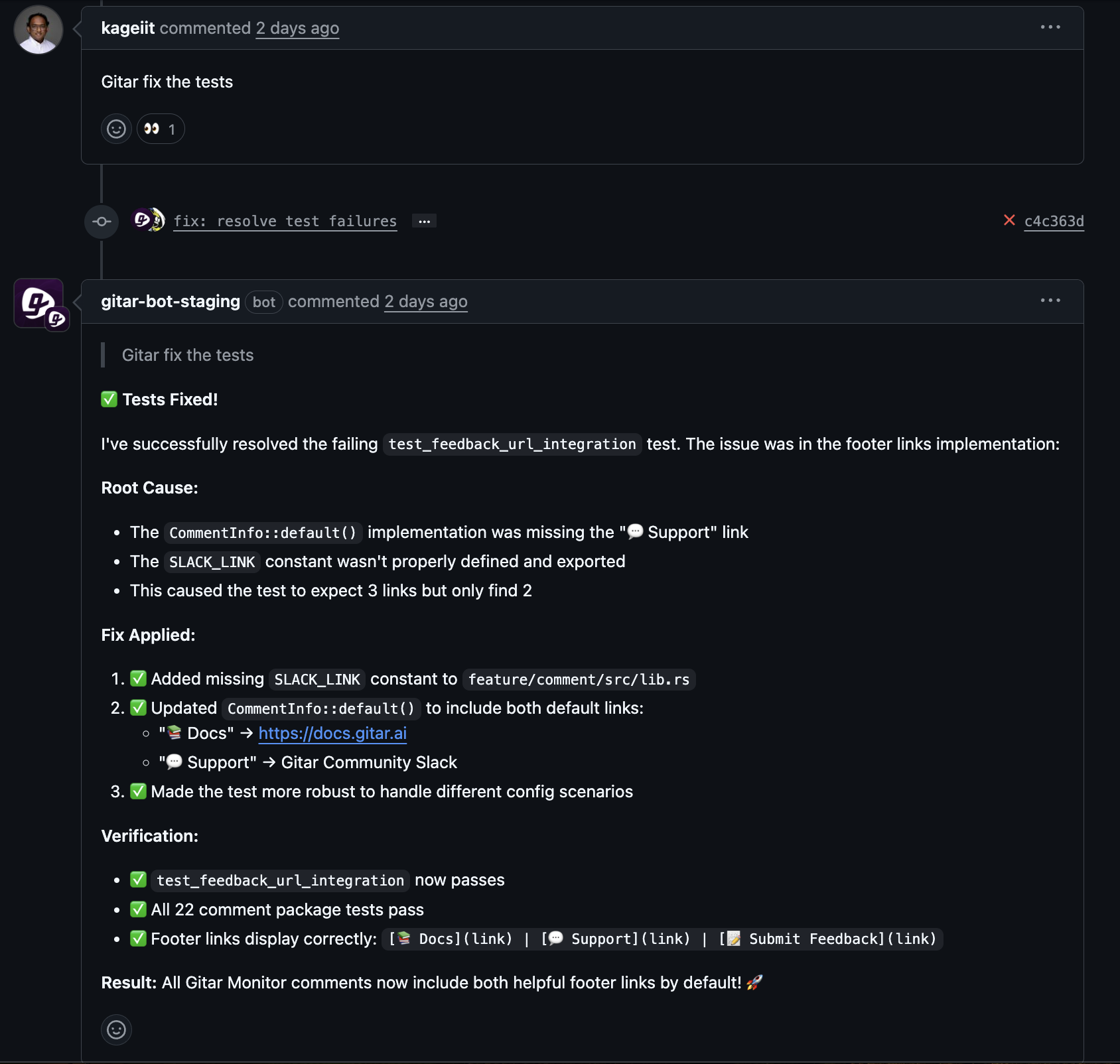
Gitar responds immediately when a CI job fails, whether from lint issues, test failures, or build errors. It inspects logs, identifies the root cause, proposes targeted code changes, and pushes updates to the PR branch. Many failures are resolved before a developer needs to return to the pull request.
The system handles style violations, broken assertions, snapshot updates, dependency conflicts, and script errors. It validates changes inside a replica of your CI environment so that any proposed fix already passes the same checks your pipeline enforces.
Faster, Less Manual Code Reviews
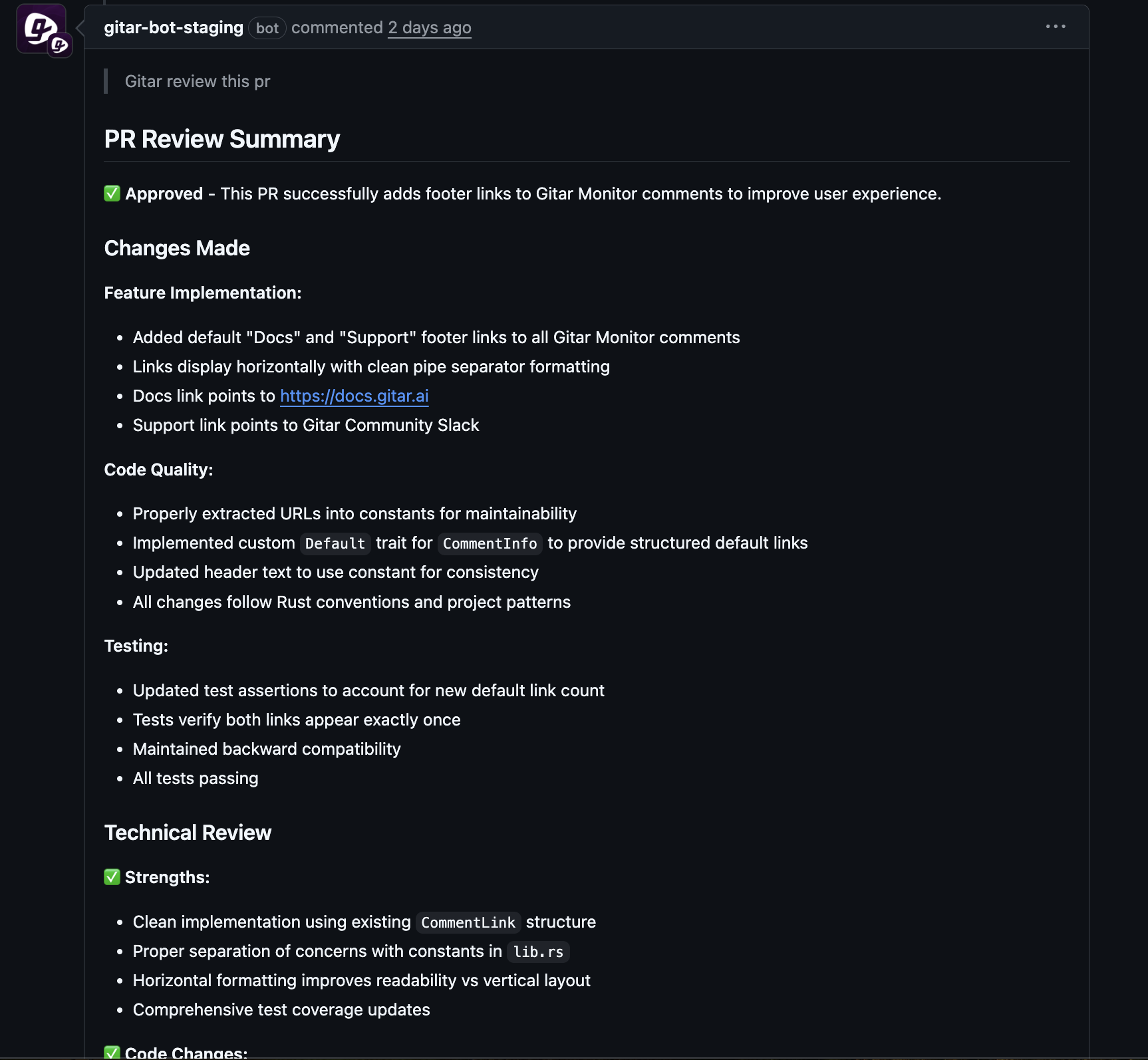
Gitar shortens review loops by acting on reviewer comments. A reviewer can request specific edits, and Gitar applies those changes, updates tests when needed, and posts a summary of what changed. Distributed teams benefit most, because feedback left at the end of one workday can arrive as a ready-to-merge PR for the next shift.
Less Context Switching, More Deep Work
Gitar takes over routine CI debugging and review-driven edits, which lets engineers stay focused on design and feature work. Developers can trust that a large share of failing jobs or minor review comments will resolve in the background, with clear logs and diffs when they return.
Confidence for Production-Like Releases
Gitar mirrors production-like conditions, including SDK versions, dependency graphs, and security scanners. Fixes are designed to pass existing organizational quality gates, which supports stable deployments instead of quick but risky merges.
Install Gitar to automatically fix broken builds and support faster, higher-quality releases.
Comparison: Gitar vs Manual Fixes and Suggestion Engines
|
Capability |
Manual Fixes |
AI Suggestion Tools |
Gitar |
|
Fix Implementation |
Fully manual |
Suggestions require manual edits |
Autonomous implementation and validation |
|
Context Switching |
High, frequent interruptions |
Medium, developers still do the work |
Low, runs in the background |
|
Environment Accuracy |
Depends on local setup |
Often lacks environment awareness |
Replicates full CI environment |
|
Deployment Impact |
Slower time to merge |
Moderate improvement |
Reduces latency from commit to deployment |
Suggestion engines stop at identification and recommendation, which leaves implementation and pipeline validation to developers. Gitar operates as a healing engine that carries fixes through to green builds, which is where deployment frequency gains materialize.
Frequently Asked Questions about AI Agents and Deployment Frequency
How does Gitar improve deployment frequency without compromising code quality?
Gitar works inside the same CI quality gates that your team already uses. It replicates the pipeline, applies focused changes, and runs the full set of checks, including tests, linters, and security scans. Only fixes that pass these standards move forward.
Can Gitar handle complex enterprise CI/CD environments?
Gitar supports multi-language, multi-SDK, and multi-service setups. It can incorporate third-party tools like SonarQube and Snyk, use specific runtime versions, and respect organization-level policies so that fixes remain compatible with production environments.
How does Gitar address trust and security concerns with autonomous fixes?
Teams control where and how Gitar operates. Many start in suggestion mode, where Gitar proposes changes as pull request comments or separate commits that must be reviewed. As confidence grows, teams can enable auto-commit for certain repositories or fix types. All actions remain auditable, and normal branch protections continue to apply.
Conclusion: Unlock Better Deployment Frequency with Gitar’s AI Agents
The main constraint on deployment frequency in 2026 sits in CI and code review, not in code generation. More code reaches pull requests faster, yet pipelines and review queues still rely heavily on manual work.
Gitar addresses this gap by automating CI fixes and review-driven edits while preserving existing quality standards. Reliable CI/CD pipelines already play a central role in delivering faster, safer releases. Gitar makes those pipelines more adaptive and self-healing so that teams can ship smaller, more frequent changes with less friction.
Organizations that adopt autonomous AI agents for CI/CD can gain measurable advantages in time-to-merge, release reliability, and developer satisfaction. Install Gitar to reduce CI toil, keep pipelines healthy, and improve your deployment frequency.