
CI build failures are a constant headache for developers. Hours spent digging through logs, switching between tasks, and fixing minor issues can grind productivity to a halt. While AI tools like GitHub Copilot speed up coding, CI failures remain a stubborn obstacle, slowing down merges and delaying releases. This article dives into the real cost of CI failures and shows how autonomous automation, or “self-healing CI,” offers a practical fix. With an AI agent like Gitar, you can automate diagnosis, resolution, and validation of CI issues, freeing up your team to focus on building, not debugging.
Why CI Build Failures Hurt So Much
The Real Price of Broken Builds
CI build failures cost more than just frustration. For a team of 20 developers, these interruptions and delays can add up to around $1 million each year in lost productivity. This figure includes time spent on debugging, the impact of delayed releases, and the toll on team morale.
Developers often spend up to 30% of their day tackling CI issues instead of coding new features. This slows down projects, pushes back deadlines, and traps teams in a loop of fixing rather than creating. Distributed teams face even bigger challenges, as time zone differences can stretch a quick fix into days of back-and-forth.
Over time, constant CI failures wear down morale. Developers hesitate to make changes, fearing another round of errors. This cautious approach stifles progress and builds up technical debt that becomes harder to address.
What Causes CI Failures Most Often?
Pinpointing the reasons behind CI failures helps in solving them. Common issues include flaky tests, poorly set up build scripts, dependency clashes, environment variable mismatches, and errors in YAML or configuration files. Small mistakes often create big slowdowns in development speed.
Flaky tests are especially tricky. These tests often fail due to timing problems or external dependencies, creating instability in shared CI setups. A test might work on a local machine but fail in CI because of differences in speed or resources, wasting time on false alarms.
Build setup errors add to the frustration. Mismatched tool versions or incorrect commands often cause builds to break, especially when CI and local environments don’t align. For instance, using Node.js 18 locally while CI runs Node.js 16 can trigger unexpected failures.
Dependency issues create another hurdle. Conflicts in complex projects can lead to inconsistent results across environments if versions aren’t locked down. With apps relying on numerous packages, a single mismatch can disrupt the entire build.
Simple human errors also play a big role. Typos in YAML files or unclear commit histories often break pipelines and go unnoticed until CI runs. One small slip can stop everything.
Certain changes are more likely to cause issues. Maintenance tasks like bug fixes or dependency updates tend to cause more CI failures than new features. This makes routine work riskier, discouraging necessary updates.
How Failures Disrupt Focus and Create Delays
The biggest hit from CI failures isn’t just the fix time, but the mental cost of switching tasks. When a developer moves on after a commit, only to get pulled back by a failed build, the interruption cuts deeper than the actual repair.
Switching tasks carries a heavy price, especially for complex work. It can take 20 to 30 minutes to refocus after a CI failure pulls you away from a feature design. A quick 5-minute fix for a lint error might end up costing an hour of lost momentum.
Environment differences make this worse. Slight mismatches in OS, dependencies, or variables often cause hard-to-diagnose CI failures. Without a way to replicate the issue locally, developers guess, commit, and wait for feedback, turning minutes into hours.
AI coding tools add another layer. While tools like GitHub Copilot speed up writing code, they also increase the volume of code, pull requests, and tests, which means more chances for CI failures. This shift highlights how inefficient CI processes can hold back gains from faster coding.
Want to stop losing time to CI failures? Install Gitar now to fix broken builds automatically and ship better software faster.
How Self-Healing CI Solves the Problem
Self-healing CI changes the game by treating failures as problems to solve automatically, not as interruptions for developers to handle. Instead of just flagging issues, this approach detects, diagnoses, and fixes them without manual effort.
Most CI failures follow recognizable patterns, like linting errors or dependency conflicts. These don’t need creative thinking, just consistent fixes. Self-healing CI applies these solutions systematically, saving time and reducing errors.
Effective self-healing goes beyond generating a fix. It understands the full context of the failure, applies the right solution, and checks that it works without creating new issues. This demands deep awareness of build environments and testing setups.
Building trust is also key. With options to start with suggested fixes and move to full automation over time, teams can adopt self-healing CI at their own pace, keeping control while reducing manual work.
Meet Gitar: Your AI Agent for Automated CI Fixes
Gitar takes CI automation to the next level. It’s not just about spotting failures; Gitar resolves them from start to finish. Unlike tools that only alert or suggest, Gitar owns the process, diagnosing issues, applying fixes, and validating results.

What Gitar Brings to Your Workflow
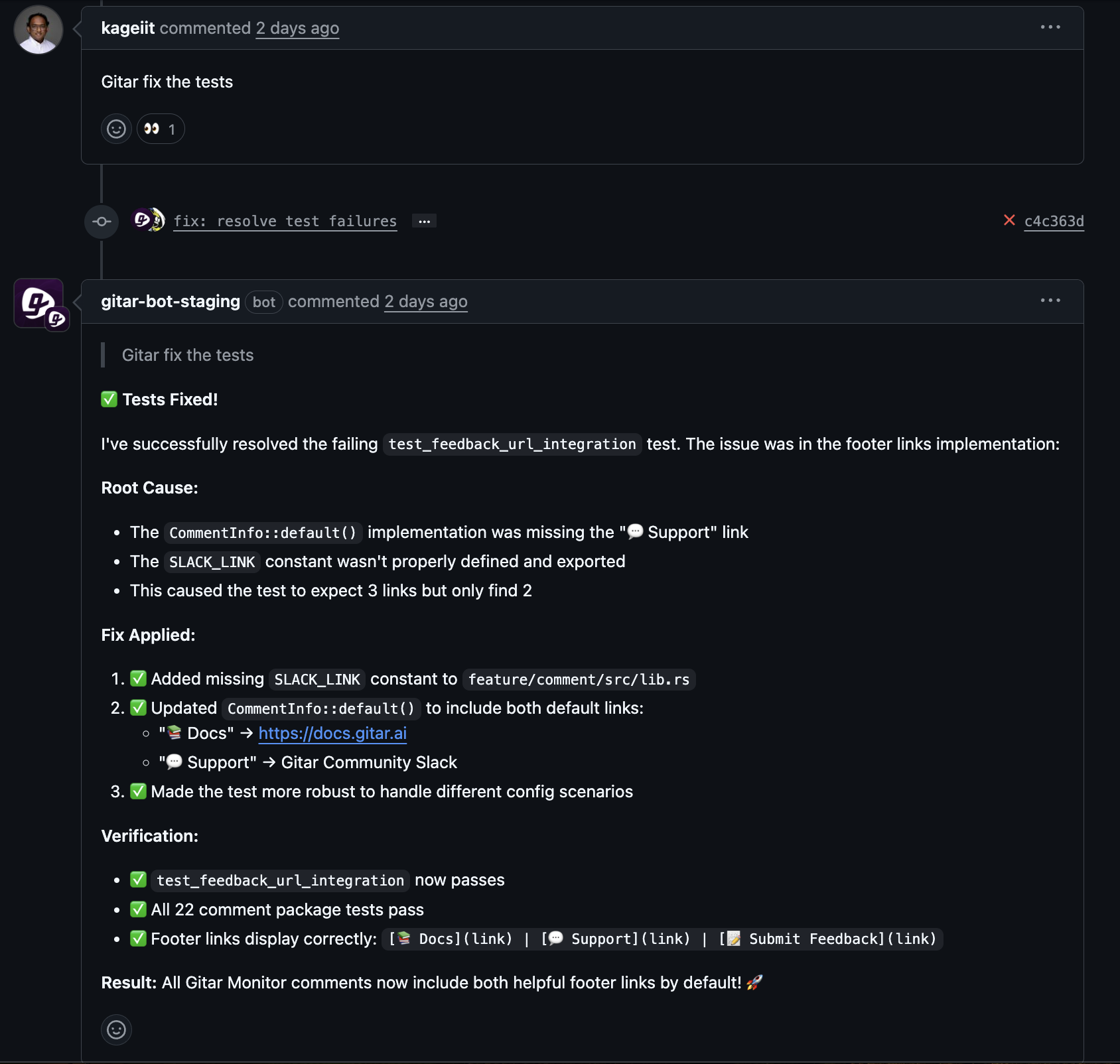
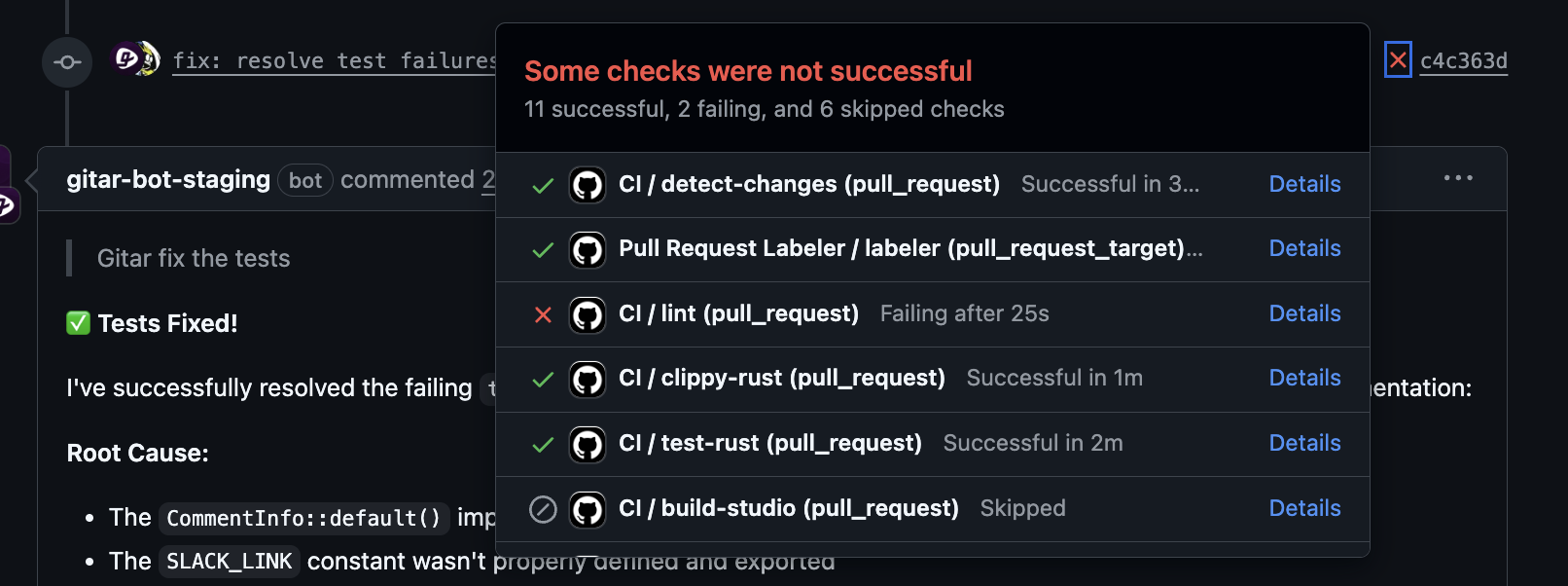
- Complete Fix Automation: Gitar doesn’t stop at pointing out issues. If a CI check fails due to a lint error or test issue, it analyzes logs, crafts the fix, applies it, and commits the change. Developers can focus elsewhere while Gitar handles routine problems.
- Accurate Environment Matching: Gitar mirrors complex CI setups. Environment mismatches often cause pipeline failures due to version differences. It replicates specific JDK versions, multi-SDK dependencies, and tools like SonarQube for reliable fixes.
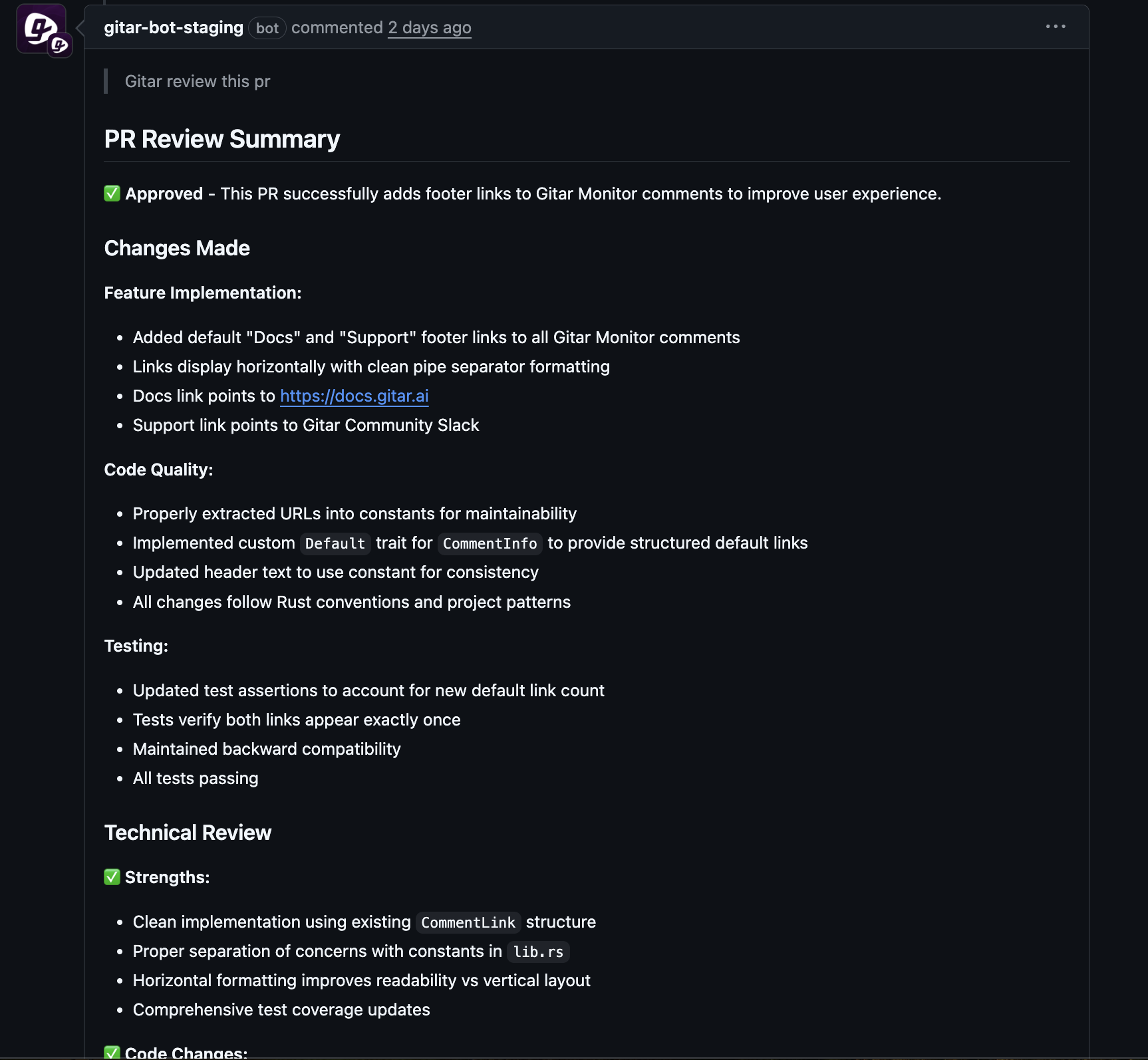
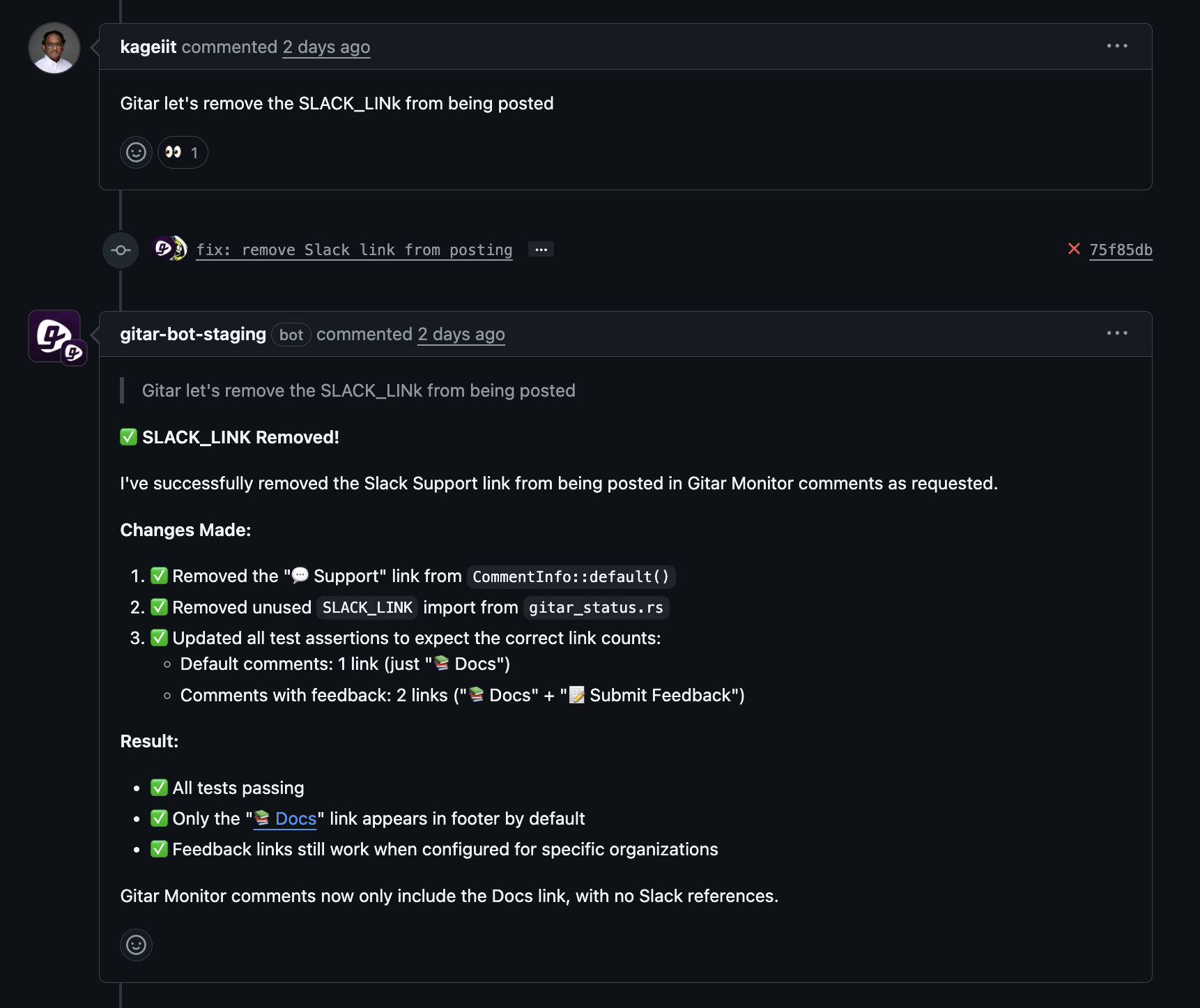
- Smart Code Review Help: Gitar also assists in reviews. Tag it with a request, like removing a feature from a PR, and it makes the change, commits it, and explains the update, saving time for reviewers.
- Flexible Automation Options: Start with suggestions that need approval, then move to direct commits as you build trust. Gitar adapts to your team’s comfort level with automation.
- Broad CI Platform Support: Gitar works with GitHub Actions, GitLab CI, CircleCI, BuildKite, and more. It fits into your existing setup without forcing changes.
Ready to turn your CI pipeline into a time-saver? Install Gitar now to fix broken builds automatically and ship better software faster.
Key Gains from Using Gitar for CI Automation
Keep Developers Focused and Productive
The biggest win with Gitar is cutting out interruptions that kill focus. When CI issues resolve themselves, developers stay in the zone, working on features instead of debugging small errors.
Gitar shifts the developer experience from constant fixes to active creation. No more wasting hours on error logs or minor tweaks. Push code with confidence, knowing Gitar handles linting, test updates, and setup issues. This frees up mental space for designing and solving real challenges.
Eliminating task-switching has a big impact. Staying focused on one project without jumping back to fix old commits means better code quality and faster delivery of new features.
Speed Up Merges and Deliver Faster
CI failures slow down the entire pipeline. A minor lint error can delay a critical fix for hours, especially across time zones. Gitar cuts through these delays with instant, verified fixes that keep things moving.
Routine maintenance benefits most from this speed. Tasks like updating dependencies or refactoring often fail more than new features. Gitar automates fixes for these, so teams can maintain code without long debugging sessions.
For distributed teams, Gitar removes time zone barriers. A reviewer in one region can request changes, and Gitar commits them before the developer in another region starts their day. This keeps reviews continuous, not stalled by schedules.
Say Goodbye to Environment Mismatch Issues
Environment differences are a major pain, often impossible to replicate locally. Failures frequently stem from outdated versions or missing dependencies in CI. Code works on your machine but crashes in CI for no clear reason.
Gitar solves this by fully matching the CI environment. Whether it’s specific Node.js versions or Docker setups, Gitar creates fixes that work in the exact context. This removes guesswork and frustration.
This also applies to enterprise tools. Even with Docker, environment mismatches persist without strict tools and practices. Gitar accounts for custom setups like SonarQube or Snyk, ensuring fixes fit your specific workflow.
Lower CI Costs and Ease Onboarding
CI failures burn through costly CI minutes with repeated runs and failed builds. Multiple cycles to fix a small error add up, especially with long test suites.
Gitar cuts this waste by getting fixes right the first time. It tests solutions against full CI workflows before committing, reducing trial-and-error. This saves CI resources and speeds up feedback.
New developers also benefit. Setting up matching CI environments can be tough for beginners, leading to failures that senior team members must fix. Gitar handles mismatches automatically, helping new hires contribute sooner without setup struggles.
How Gitar Stands Out from Other CI Fix Approaches
|
Feature |
Manual Debugging |
AI Suggestion Engines |
Gitar (Autonomous AI Agent) |
|
Issue Detection |
Manual log analysis |
Automated detection |
Automated detection |
|
Diagnosis |
Developer interpretation |
AI-generated insights |
AI-powered root cause analysis |
|
Fix Generation |
Manual code changes |
Suggested code snippets |
Complete, validated fixes |
|
Fix Validation |
Trial and error |
No validation |
Full CI workflow validation |
|
Environmental Context |
Limited to local setup |
Generic suggestions |
Full environment replication |
|
Automation Level |
Fully manual |
Suggestion-only |
Configurable autonomy |
|
Time Savings |
None |
Partial |
Comprehensive |
|
Developer Interruption |
High |
Medium |
Minimal to none |
|
Cross-Platform Support |
Depends on developer |
Limited |
Comprehensive |
Gitar goes beyond suggestions, acting as a full CI repair system. Tools like CodeRabbit offer helpful tips, but they leave the fixing and validating to developers. This means interruptions and guesswork still slow you down.
Gitar’s strength lies in understanding environments. Debugging environment-specific issues and flaky tests drags down release speed and morale. By matching the exact build context, Gitar ensures fixes work right away, cutting out wasted effort.
Ready to ditch suggestions for real automation? Install Gitar now to fix broken builds automatically and ship better software faster.
Common Questions About Gitar and CI Automation
How Does Gitar Handle Tricky CI Failures?
Gitar tackles CI failures head-on by analyzing logs to pinpoint causes, whether it’s a flaky test or dependency issue. It fixes test problems like outdated snapshots and resolves build conflicts. Unlike tools that only suggest, Gitar applies fixes, tests them in your full CI setup, and confirms everything passes, making debugging hands-free.
Can Gitar Manage Complex Enterprise CI Setups?
Gitar is built for enterprise complexity. It handles intricate CI environments with specific JDK versions, multi-language builds, and tools like SonarQube. By mirroring your exact setup, including dependencies and configurations, Gitar ensures fixes match your unique constraints for dependable results.
How Does Gitar Build Trust for Automated Fixes?
Trust matters with automation, so Gitar offers adjustable levels. Start in Conservative Mode, where fixes are suggestions for review. As confidence grows, switch to Aggressive Mode for direct commits with rollback options. This step-by-step approach keeps control in your hands while cutting down manual effort.
What Makes Gitar Different from Other AI Tools?
Gitar focuses on the post-commit phase, unlike tools like GitHub Copilot, which help during coding, or CodeRabbit, which aids reviews. It acts as a healing engine for CI failures, applying and validating fixes in your actual pipeline. This full ownership of fixes sets Gitar apart from suggestion-based tools.
Will Gitar Fit into Our Current CI Workflow?
Gitar integrates easily with your existing setup. It supports GitHub Actions, GitLab CI, CircleCI, BuildKite, and others as a repository app. It respects branch protection rules and review processes, working with complex or enterprise-specific tools through environment matching, requiring no changes to how you work.
Wrap-Up: Leave CI Failures Behind with Gitar
CI build failures drain productivity in software development. For a 20-developer team, lost time on debugging and waiting for reviews can cost $1 million yearly. This goes beyond frustration, impacting deadlines and outcomes.
The causes, from test failures to environment mismatches, are predictable. Yet, manual fixes or suggestion tools don’t close the gap between spotting a problem and solving it. Developers remain stuck in reactive loops, losing focus and delaying work.
Gitar changes this with self-healing CI. It diagnoses failures, applies verified fixes, and ensures builds pass without your input. This automation lifts the burden of CI issues, letting teams code instead of debug.
The advantages go further. Gitar preserves focus, speeds up merges, fixes environment headaches, and cuts CI costs. For distributed teams, its constant availability turns reviews into a smooth, ongoing process, ignoring time zone delays.
As AI speeds up coding, CI remains a hurdle. Adopting Gitar’s automation gives teams an edge, maintaining speed and improving satisfaction.
Ready to end CI struggles and boost your team’s output? Install Gitar now to fix broken builds automatically and ship better software faster. Autonomous CI is the future, and it starts here.