
Scripting languages power automation in modern development, managing repetitive tasks in CI/CD pipelines. Still, software engineers, engineering leaders, and DevOps professionals often deal with disruptions from failing builds and lengthy code reviews. This article dives into how AI-driven tools like Gitar take scripting further, creating self-healing CI systems that autonomously solve integration challenges and streamline software delivery.
Understanding the Cost of Manual CI/CD Fixes
How Context Switching Slows Developers Down
Constant interruptions from broken CI builds and manual code feedback drain developer productivity. Up to 30% of a developer’s time can be lost to these issues, turning focused coding sessions into fragmented cycles of fixing minor errors.
Picture this: you submit a pull request, expecting smooth progress, only to see CI failures pop up. A small linting error or a failing test forces you to dig through logs, make quick fixes, recommit, and wait for the pipeline to rerun. What could be a 30-minute fix often stretches into an hour due to the mental shift required to refocus afterward.
For developers, these interruptions disrupt flow state, the critical mindset for creative and effective work. Each CI failure pulls attention away from meaningful tasks, redirecting energy to repetitive debugging.
Delays in Project Delivery and Market Impact
CI failures don’t just frustrate individuals, they slow down entire teams. Around 60% of companies experience project delays due to pipeline issues, affecting their ability to deliver on time and stay competitive.
Engineering leaders see this impact clearly. When teams spend more time fixing builds than building features, progress stalls. Projects extend beyond planned timelines, often due to small, recurring integration hiccups rather than complex challenges. Frequent commits and smaller pull requests, while beneficial, multiply these opportunities for delays.
Distributed teams face even bigger hurdles. A developer in one time zone might wait days for feedback or fixes from a teammate halfway across the world. Standard processes, even with AI suggestions, still require manual steps, stretching simple reviews into prolonged exchanges.
Navigating Complexity in Enterprise Environments
Enterprise CI setups, with multi-SDK builds, specific dependencies, and security scans like SonarQube or Snyk, make manual debugging especially tough. These intricate systems challenge even seasoned developers to resolve issues quickly.
DevOps and platform engineers juggle maintaining these environments while supporting developers stuck on failures. As AI tools like GitHub Copilot speed up code writing, the volume of pull requests and tests grows, increasing the likelihood of CI issues in complex settings.
Traditional scripts automate routine tasks, but they often need manual updates or fixes when unexpected errors arise. This creates bottlenecks, with platform teams swamped by support requests and developers blocked on integration problems.
Solving Issues with AI-Driven Self-Healing CI
AI-powered automation goes beyond basic scripting by analyzing failures and creating solutions on the fly. Such systems use predictive analytics and smart error handling for proactive results, turning static scripts into adaptive, self-healing pipelines.
Unlike rigid scripts, AI systems understand context and failure patterns to apply relevant fixes. They improve efficiency by detecting errors, optimizing tests, and anticipating issues. This shift moves automation from simple rules to intelligent problem-solving.
Self-healing CI takes this further by not just spotting problems but fixing them autonomously. Instead of notifying developers to step in, these systems diagnose issues, implement changes, and verify results within the full pipeline, cutting out the manual debug cycle.
This approach tackles a core issue in development today: as AI speeds up coding, integration and validation become the bottleneck. Self-healing CI directly addresses this, ensuring smoother delivery with minimal human effort.
Install Gitar now to fix broken builds automatically and ship quality software faster.
Meet Gitar: Your AI Agent for CI Fixes
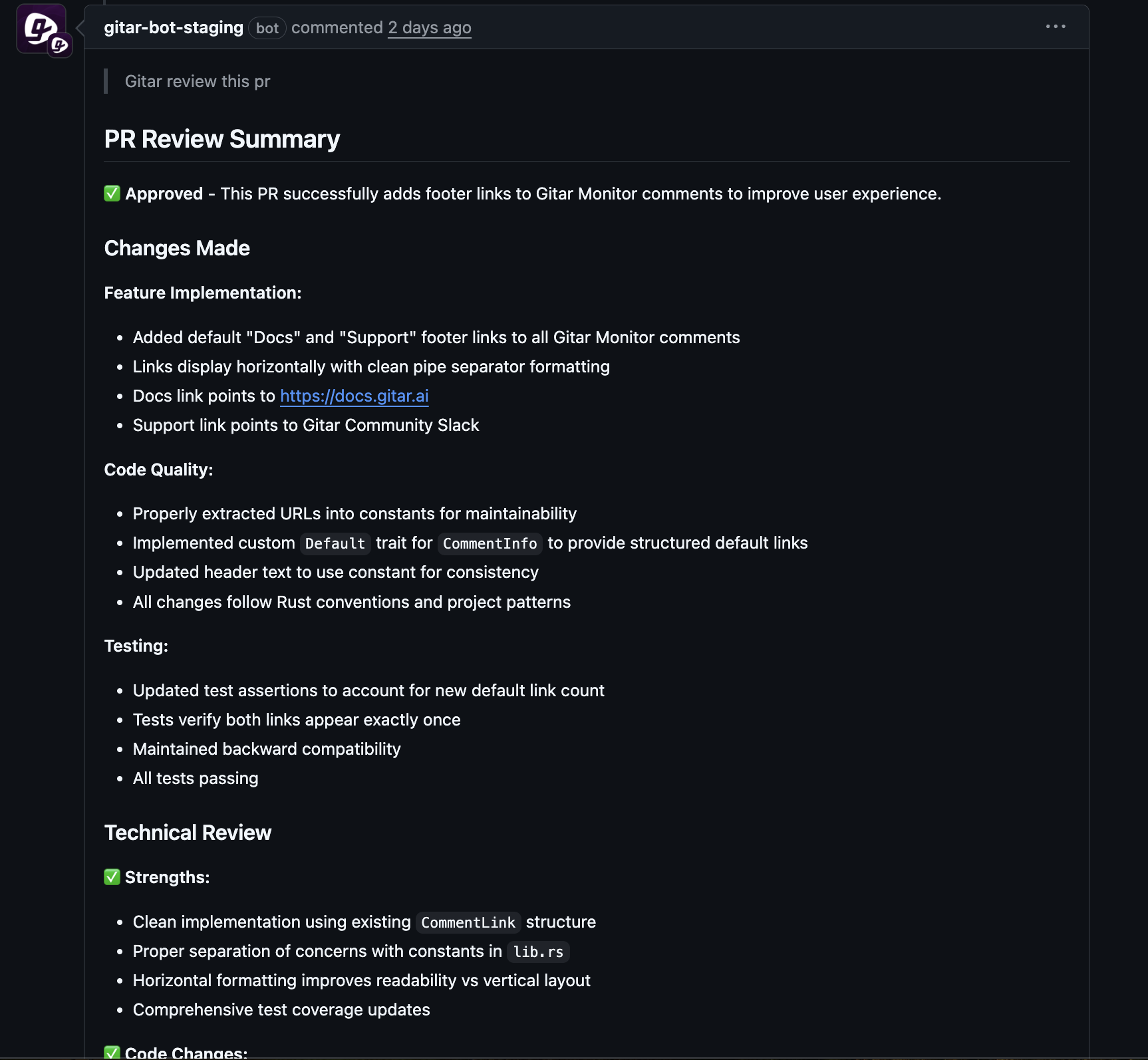
Gitar redefines CI/CD automation by acting as an independent fixer, not just a suggestion tool. It resolves CI failures and handles code feedback on its own, validating solutions across your full pipeline to deliver error-free builds without developer input.

Here’s what sets Gitar apart:
- Complete Fix Automation: Gitar applies and validates fixes across CI workflows, ensuring pull requests pass without manual intervention.
- Environment Accuracy: It mirrors complex enterprise setups, handling specific JDK versions, dependencies, and scans like SonarQube for reliable fixes.
- Smart Review Support: Reviewers can request Gitar’s input or leave comments for direct implementation, with clear change explanations.
- Customizable Control: Choose conservative mode for suggestions or aggressive mode for direct commits with rollback options as trust builds.
- Platform Flexibility: Gitar integrates with GitHub Actions, GitLab CI, CircleCI, BuildKite, and more, fitting into varied setups.
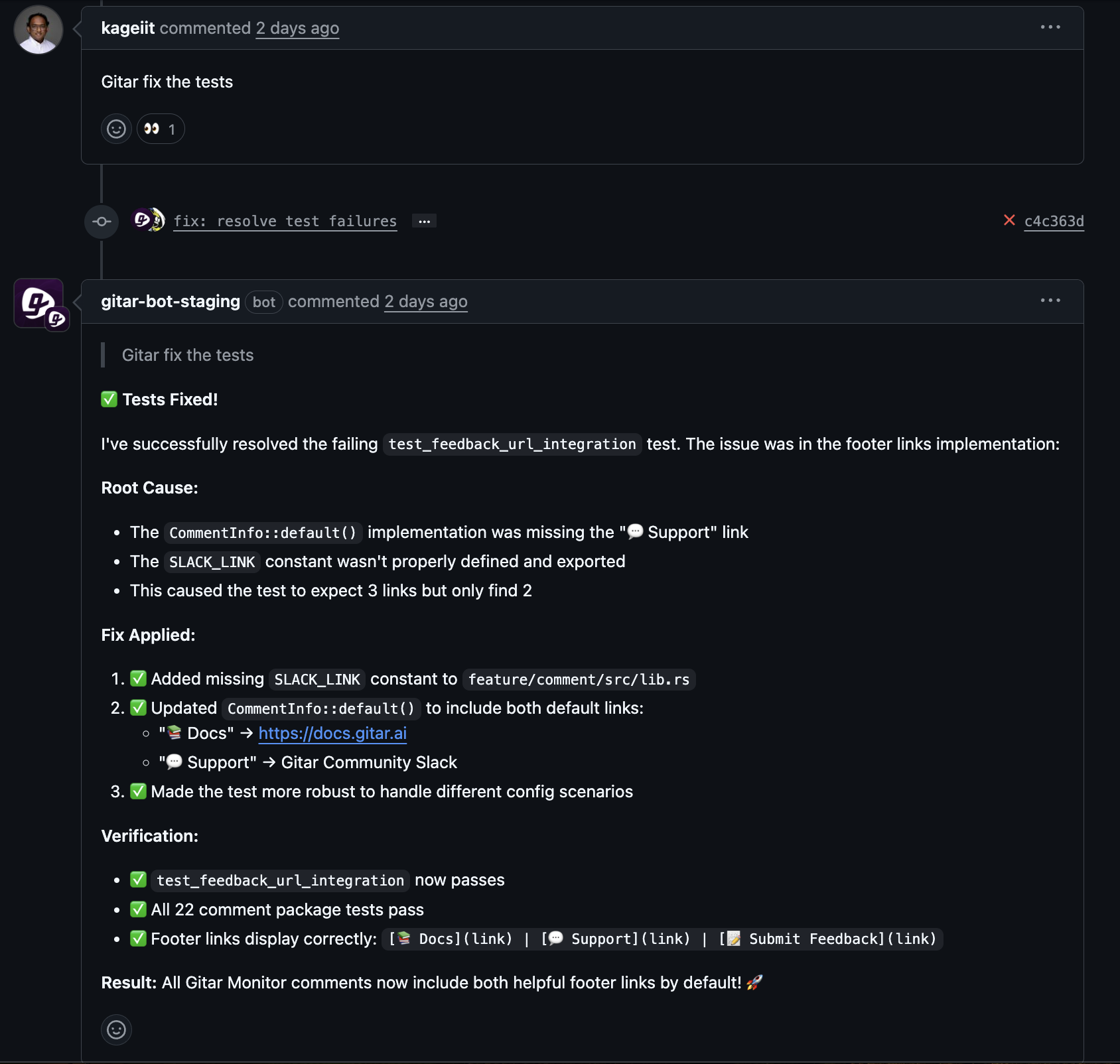
With Gitar, CI failures shift from frustrating roadblocks to automated background tasks. Seeing a linting error fixed and committed to your PR before you’re even aware of the issue highlights the value of true autonomy in integration.
Book a Gitar demo today to streamline your CI/CD process.
How Gitar Enhances Scripting for Seamless Fixes
Turning Scripts into Self-Healing Systems
Scripting languages allow teams to automate CI/CD stages from commit to deployment. They reduce errors and offer flexibility through pipeline-as-code approaches. Yet, scripts struggle with unexpected issues or changes needing manual tweaks.
Gitar steps in with AI to handle these gaps. While scripts manage standard tasks, Gitar addresses failures and unique cases by reasoning through problems and creating fixes. This blend of scripting for routine work and AI for exceptions minimizes human effort.
Fixes are tested across full test suites, ensuring issues are resolved efficiently without impacting developer focus.
Preserving Focus by Cutting Interruptions
Gitar keeps developers in their flow state by handling disruptions. It automatically resolves CI failures and feedback, letting developers stay focused on complex tasks.
Without automation, a failure notification forces developers to pause, debug, fix, and struggle to refocus. This mental shift wastes time beyond the actual fix. Gitar works silently, often resolving issues before developers notice, turning frustrating delays into seamless background processes.
For distributed teams, this autonomy eliminates delays caused by time zone differences. Issues get fixed regardless of when team members are active, keeping pull requests moving forward.
Speeding Up Merges for Quicker Delivery
Gitar boosts merge speed by ensuring clean builds and addressing feedback instantly. This shortens the cycle from submission to approval, helping teams deliver faster.
Standard workflows often involve multiple failure-fix loops, each consuming time and resources. Gitar cuts this down by validating fixes upfront, reducing back-and-forth. It also handles reviewer comments directly, preventing delays when the original coder isn’t available.
These efficiencies improve overall team speed, enabling quicker iterations and more responsive development cycles.
Handling Complex CI Setups with Precision
Enterprise environments challenge generic tools, but Gitar adapts to specific needs. It creates fixes tailored to unique setups, factoring in JDK versions, dependencies, and security scans.
This context awareness sets Gitar apart from broad AI tools lacking insight into specific CI constraints. Fixes account for build configurations and test dependencies, ensuring compatibility.
Gitar aligns with practices like GitOps for consistent deployments. These methods ensure reliability across infrastructure. For platform teams, this cuts support workload, freeing them for strategic tasks over constant troubleshooting.
Gitar vs. Suggestion Tools for Integration Fixes
|
Feature Category |
Manual Work (Status Quo) |
AI Code Reviewers (e.g., CodeRabbit) |
Gitar (Autonomous AI Agent) |
|
Problem Solved |
Time lost to manual debugging |
Code quality tips, basic error alerts |
Full resolution of CI failures and feedback |
|
Action Taken |
Manual search, coding, recommitting |
Inline tips, summaries |
Creates, applies, and verifies fixes |
|
CI Validation |
Manual reruns, uncertain results |
None, manual validation needed |
Full pipeline checks for successful builds |
|
Developer Flow Impact |
Heavy interruptions, major disruption |
Still needs manual steps, some disruption |
Minimal breaks, continuous focus |
|
Complexity Handling |
Relies on developer knowledge |
Limited CI context awareness |
Replicates full setups for solid fixes |
|
Time-to-Merge Impact |
Long delays |
Small gains, still manual delays |
Faster merges with automatic fixes |
|
Time Zone Optimization |
Increases delays for remote teams |
No effect on delays |
Cuts delays with async resolutions |
Gitar stands out by fully handling issues from detection to resolution. Unlike manual methods or suggestion tools that rely on human input, Gitar acts independently, shifting AI from a helper to a capable team member for integration tasks.
Install Gitar now to fix broken builds and deliver quality software faster.
Common Questions About Autonomous CI Fixes
How Does Gitar Differ from Other AI Review Tools?
Gitar functions as an independent fixer, not just a suggestion provider. Unlike tools offering tips for manual action, Gitar creates, applies, and validates fixes within your CI environment. It focuses on execution, ensuring solutions fit your specific setup.
While tools like GitHub Copilot assist during coding, Gitar works post-submission, tackling integration issues. It offers adjustable automation levels, starting with suggestions for trust-building before moving to full autonomy.
Can Gitar Manage Complex CI Environments?
Yes, Gitar is built for enterprise complexity. It replicates intricate setups, including specific SDKs, dependencies, and integrations like SonarQube or Snyk, ensuring fixes match your infrastructure.
It supports multiple CI platforms like GitHub Actions and GitLab CI, fitting diverse toolchains. This reduces support demands on platform teams, letting them focus on bigger improvements over constant fixes.
What Returns Can Teams Expect from Gitar?
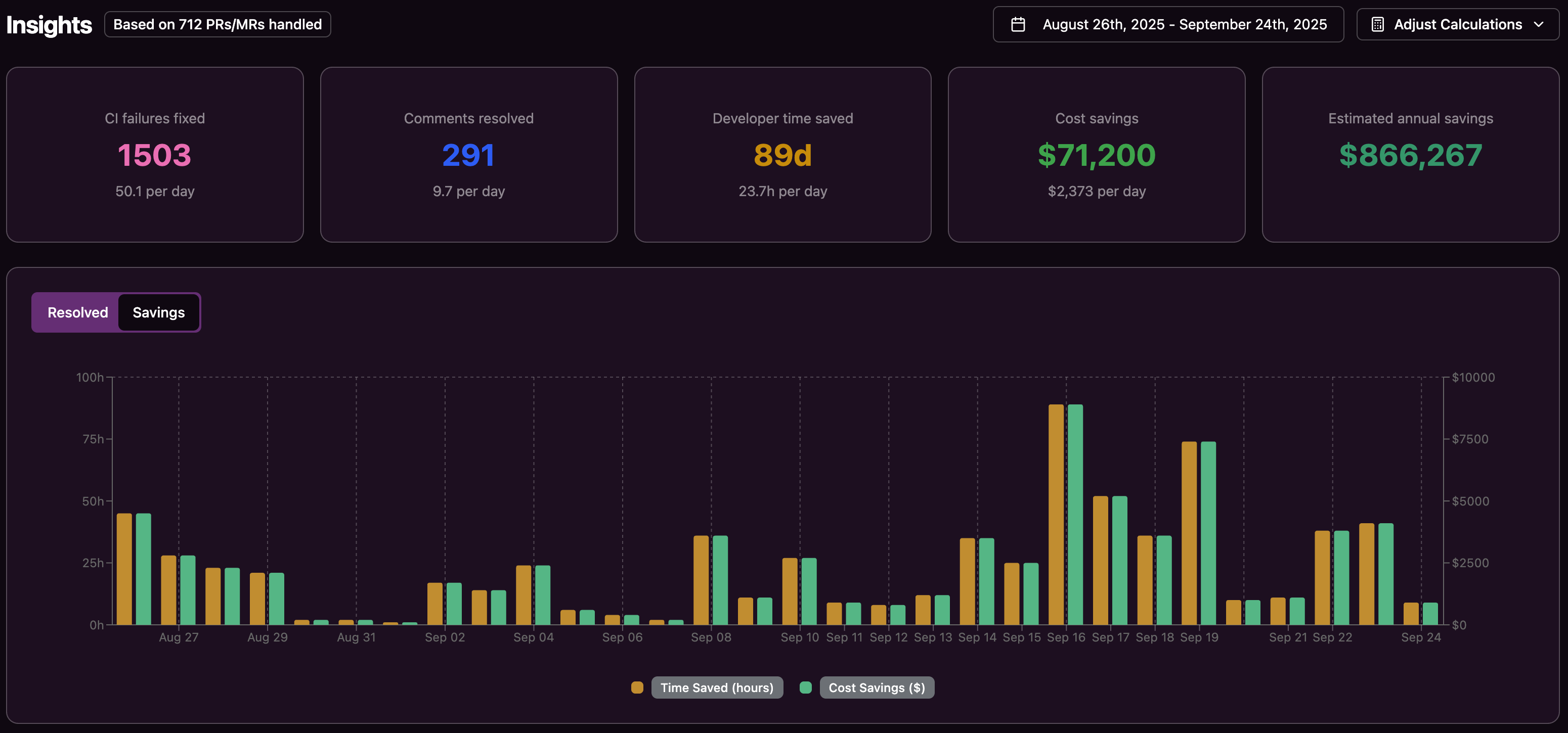
Gitar offers clear productivity gains. For a 20-developer team, CI and review issues might cost $1M yearly in lost time, based on one hour daily at $200 per hour. Gitar cuts this through automated fixes and reduced interruptions.
Additional benefits include faster merges, better morale, and quicker market delivery. For distributed teams, resolving time zone delays boosts overall speed and value.
How Does Gitar Ensure Fix Quality and Security?
Gitar maintains quality through strict validation and security measures. Fixes are tested against full CI workflows, passing all quality and security checks before application.
It integrates with existing security systems and offers audit trails for transparency. Teams can start with suggestion mode for oversight, scaling to autonomy with rollback options. On-premise deployment is available for strict security needs.
What if Gitar Introduces an Error?
Gitar includes safeguards to minimize errors. Fixes are validated in your CI environment beforehand, lowering risks. Rollback options allow quick reversal if issues arise.
Teams can begin with suggestion mode for full control, increasing automation as trust grows. Gitar targets common CI issues like linting errors, where risks are limited by existing safeguards.
Boost Productivity with Automated Integration
CI/CD bottlenecks don’t have to slow your team down. Scripting lays the groundwork for automation, but tools like Gitar push it further with intelligent, self-healing systems that address failures before they disrupt progress.
Shifting from manual fixes to automated solutions tackles key productivity hurdles. As AI coding speeds up, integration becomes the focus, and self-healing CI offers substantial relief. Gitar frees developers to focus on innovation while cutting merge times.
This isn’t just automation, it’s a new way to approach CI/CD. Developers stay in flow, and systems handle issues independently. For leaders, the benefits include faster delivery, reduced platform team workload, and a competitive edge.
Adopting autonomous fixes positions teams for better efficiency and satisfaction. The future of CI/CD is smarter automation, and early adopters will see the biggest gains in speed and output.
Ready to streamline your CI/CD pipeline? Request a Gitar demo today.