
Key Takeaways
- Autonomous test failure repair reduces time spent on CI breakages and repetitive debugging, which often consumes a large share of engineering capacity.
- Proactive CI fixes and automated code review feedback implementation shorten feedback loops and keep developers in a focused flow state.
- Full CI environment replication and configurable automation modes increase trust in AI-generated fixes while maintaining control and auditability.
- Organizations lower CI/CD compute costs and improve developer satisfaction by cutting repeated failed runs and manual rework.
- Teams can apply these strategies immediately by using Gitar to automatically fix CI failures and code review comments, available at https://gitar.ai/fix.
Why Autonomous Test Failure Repair Is Now Essential for Engineering Teams
Many engineering teams face an ongoing productivity drain from CI failures and review-related rework. Developers waste up to 30% of their time dealing with CI and code review issues, turning creative work into repetitive troubleshooting. That time loss also slows delivery, raises costs, and increases burnout risk.
The impact compounds quickly. For a 20-developer team, that waste can approach $1M per year in lost productivity. AI-assisted coding now produces more code and more pull requests, so validation, testing, and merging have become the new bottlenecks.
Context switching magnifies the cost. A five-minute lint fix often interrupts a deep work session, which can cost an hour of productive time. That interruption repeats multiple times a day across the team, reducing velocity and job satisfaction.
Teams that introduce autonomous test failure repair reduce these interruptions and keep developers focused on design and feature work instead of CI firefighting.
Gitar as an Autonomous CI Healing Engine for Faster Delivery
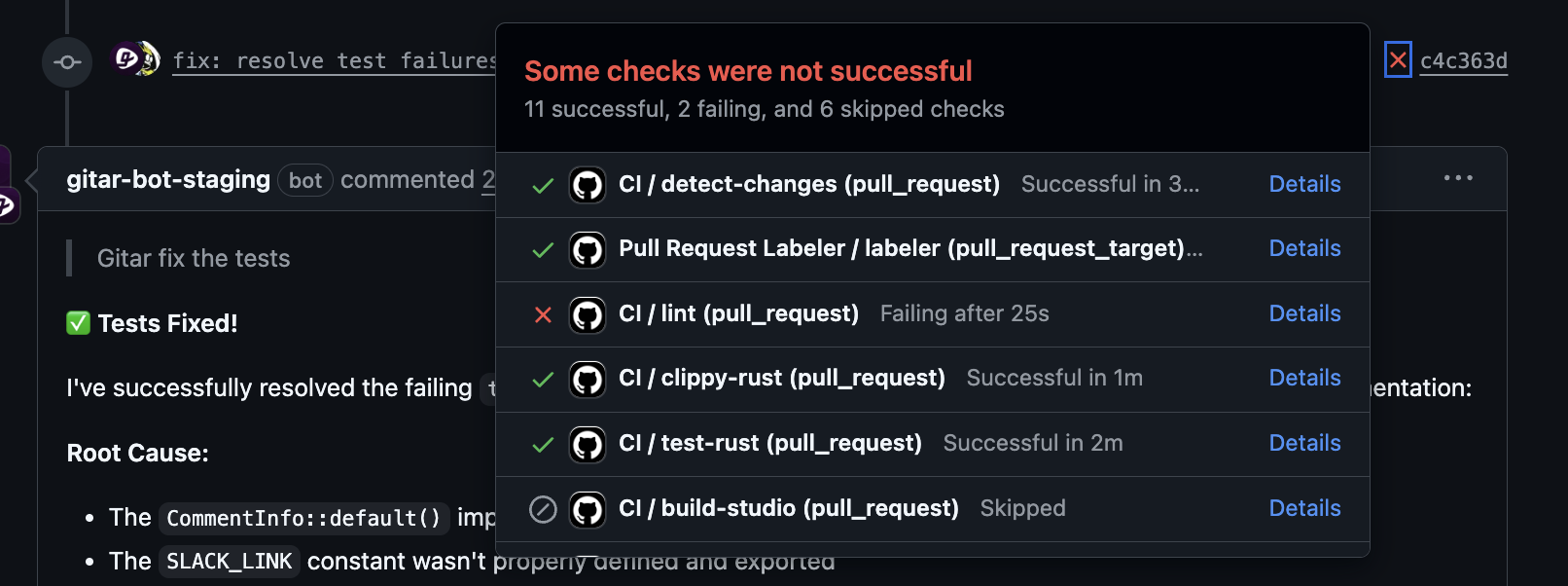
Gitar operates inside your CI/CD workflows as an autonomous fixing agent rather than a suggestion-only tool. When CI failures occur or reviewers leave comments, Gitar analyzes the issue, proposes a fix, validates it in the real CI environment, and, based on your settings, either suggests or commits the change.
Key capabilities include:
- End-to-end fixing: Applies and validates fixes, aiming for a green build before developers return to the pull request.
- Full environment replication: Handles complex enterprise CI setups, including multi-SDK builds and third-party tools.
- Configurable trust model: Supports modes that range from suggestion-only to direct auto-commit.
- AI agent context: Connects with local developer agents for richer understanding of code changes.
- Intelligent code review assistant: Implements review feedback so reviewers and authors avoid long back-and-forth cycles.
Teams can start using Gitar by connecting it to their CI system and configuring the desired level of automation at https://gitar.ai/fix.
5 Strategies for Leveraging Autonomous Test Failure Repair Tools
1. Eliminate Context Switching With Proactive CI Fixes
Reducing context switching is one of the fastest ways to improve developer productivity. Traditional workflows require developers to pause active tasks, parse CI logs, write fixes, and push new commits, which extends minor issues into long interruptions.
Autonomous repair tools detect and fix many CI failures before developers need to step in. Typical examples include:
- Lint and formatting violations
- Common unit or integration test failures
- Configuration and build script errors
Gitar observes CI failures, generates candidate fixes, validates them, and then commits them back to the pull request branch, based on your automation mode. Developers stay focused on their primary task while CI remains green more often, which improves flow and velocity.
2. Accelerate Pull Request Merge Times With Automated Feedback Implementation
Shorter review cycles lead directly to faster delivery. Manual implementation of review comments often introduces long pauses, especially across distant time zones, where a simple change request can delay a merge by days.
Autonomous tools interpret review comments and apply requested changes directly, then push a new commit that satisfies the feedback. Reviewers spend less time re-checking the same issues, and authors avoid repeated context shifts.
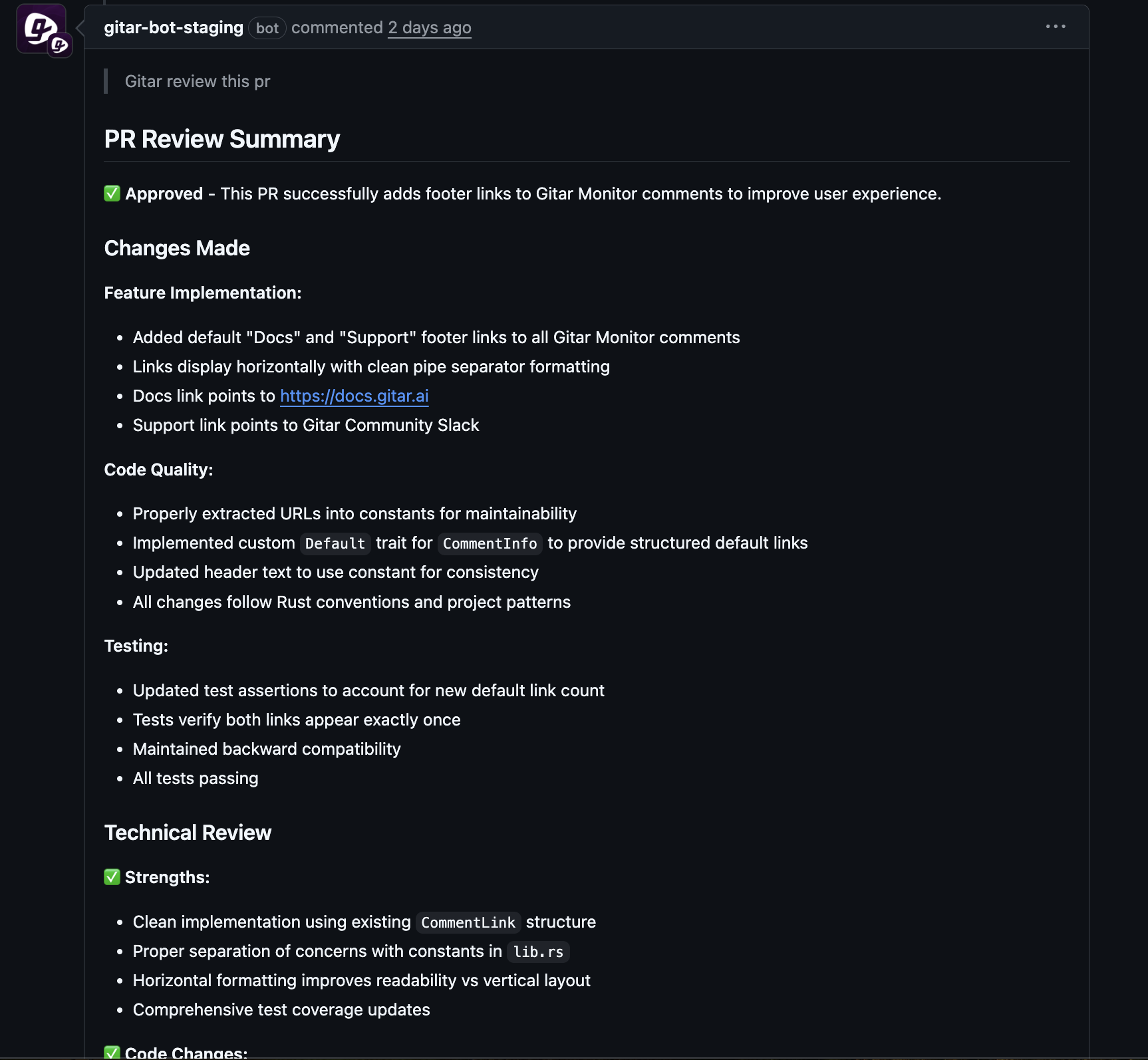
In Gitar, reviewers can leave a comment that starts with “Gitar,” then include either a review request or a specific change instruction. Gitar then updates the code and posts a clear explanation of what changed. Teams see fewer stalled pull requests and more predictable merge timelines.
3. Ensure Reliability With Full Environment Replication
Reliable autonomous fixes require accurate understanding of the real CI environment. Generic tools that ignore SDK versions, dependency trees, and third-party integrations often break in enterprise settings.
Infrastructure-based deployment keeps agents inside the organization’s existing CI and security perimeter. That approach lets tools operate with full context while respecting security and compliance controls.
Gitar follows this model and replicates complete workflows, including:
- Language and SDK versions such as specific JDK or Python releases
- Multi-SDK and multi-language builds
- Static analysis and security tools such as SonarQube or Snyk
This context makes fixes more reliable and reduces the risk of regressions or configuration drift.
4. Build Trust and Control With Configurable Automation Modes
Gradual rollout helps teams build confidence in autonomous repair. Many organizations start with low automation, then move to higher automation as they see successful fixes over time.
Best practices for autonomous remediation emphasize human review and clear audit trails for AI-generated changes. That approach lets teams keep control while gaining efficiency.
Gitar supports several modes so teams can match automation to their risk tolerance:
- Suggestion mode, where Gitar proposes changes for developers to review and accept.
- Hybrid mode, where low-risk issues are auto-fixed and higher-risk changes stay as suggestions.
- Auto-commit mode, where Gitar applies and verifies fixes directly for pre-approved scenarios.
Each change remains visible in version control history, so teams can audit and roll back when needed.
5. Optimize CI/CD Costs and Developer Resource Utilization
Lowering the number of failed CI runs and repeated debugging sessions reduces both compute costs and people costs. Every failed run consumes infrastructure resources and developer attention.
Autonomous repair tools cut this waste by:
- Resolving issues earlier in the pipeline
- Reducing the number of reruns needed to reach green
- Freeing senior engineers from routine fix work
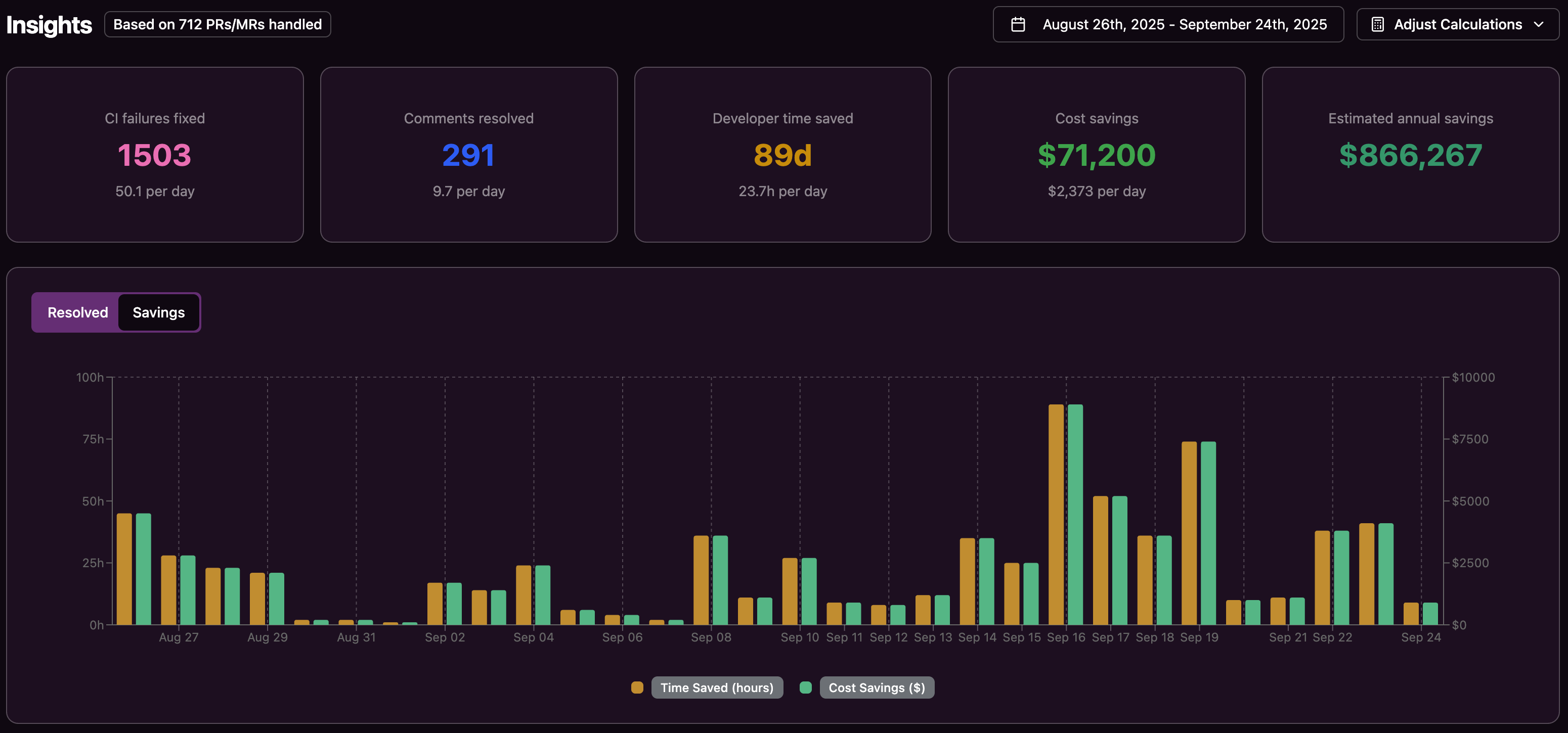
Gitar provides immediate, validated fixes that reduce the number of failed runs and the amount of manual rework. Teams often see lower CI-related spend and improved developer satisfaction when repetitive debugging decreases.
Comparison: Gitar vs. Traditional Approaches for Autonomous Test Failure Repair
|
Feature/Benefit |
Manual Debugging |
AI Code Reviewers |
Gitar |
|
Fix Application |
Developer must stop, debug, and fix manually |
Provides suggestions requiring manual implementation |
Automatically applies and validates fixes |
|
Environmental Awareness |
Limited to developer’s local setup |
Generic suggestions without CI context |
Full enterprise environment replication |
|
Autonomy Level |
Fully manual intervention required |
Suggestion-only, requires human action |
Configurable from suggestions to full automation |
|
Developer Interruption |
Constant context switching and flow disruption |
Review required for each suggestion |
Minimal interruption with validated fixes |
|
CI/CD Platform Support |
Manual process across all platforms |
Often limited to specific platforms |
Cross-platform: GitHub, GitLab, CircleCI, BuildKite |
|
Time-to-Merge Impact |
Significant delays from debugging cycles |
Moderate improvement with manual implementation |
Acceleration with autonomous fixes |
Frequently Asked Questions About Autonomous Test Failure Repair Tools
How can autonomous tools ensure the quality of AI-generated fixes?
Quality comes from verification in the real CI environment. Autonomous tools analyze the failure, propose a fix, apply the change in a safe context, and re-run relevant checks. Gitar replicates your CI environment, including dependencies and third-party tools, then keeps audit logs and supports rollbacks so teams can review and revert if needed.
Are autonomous CI fixing tools secure in enterprise environments?
Enterprise-grade tools run inside the existing CI and security perimeter. Gitar follows this pattern by integrating with current authentication, respecting repository permissions, and keeping code within the organization’s infrastructure. That design preserves existing security and compliance posture while adding automation.
What is the difference between an autonomous CI fixer and an IDE-based coding assistant?
IDE assistants such as GitHub Copilot focus on pre-commit code creation in the developer’s editor. Autonomous CI fixers like Gitar work post-commit, in remote repositories, and activate when pipelines fail or reviewers leave comments. Both tools are complementary, one accelerates authoring while the other ensures code passes quality gates.
How do autonomous tools handle complex, unique CI setups?
Advanced tools parse the CI configuration and reproduce it carefully. Gitar models SDK versions, multiple build jobs, dependency graphs, and external scanners, then tests candidate fixes within that environment. That approach helps ensure that fixes remain valid for the actual production-like workflow.
What ROI can organizations expect from autonomous test failure repair?
Organizations usually see value from reduced debugging time, fewer failed runs, and faster merges. A 20-developer team that previously spent an hour per day on CI issues can reclaim a large share of that time and convert it into feature work, which equates to significant annual savings. Additional gains come from lower compute usage and higher developer morale.
Conclusion: Reclaim Developer Time With Autonomous Test Failure Repair in 2026
Engineering leaders in 2026 face strong pressure to deliver more software with leaner teams. Time lost to CI failures and slow review loops acts as a hard cap on throughput.
Autonomous test failure repair addresses this constraint by reducing interruptions, shortening merge cycles, and lowering the number of failed runs. Gitar supports this shift with autonomous, validated fixes that fit into existing CI/CD pipelines and respect enterprise constraints.
Teams that apply the five strategies in this article can improve productivity, reduce operational friction, and create a better developer experience. Those ready to adopt autonomous CI fixing can start with Gitar at https://gitar.ai/fix.