Key Takeaways
- Test failures and code review rework consume significant engineering time, often costing mid-sized teams thousands of hours each year.
- Manual CI failure resolution increases context switching, slows feature delivery, and creates hidden operational costs that affect budget and timelines.
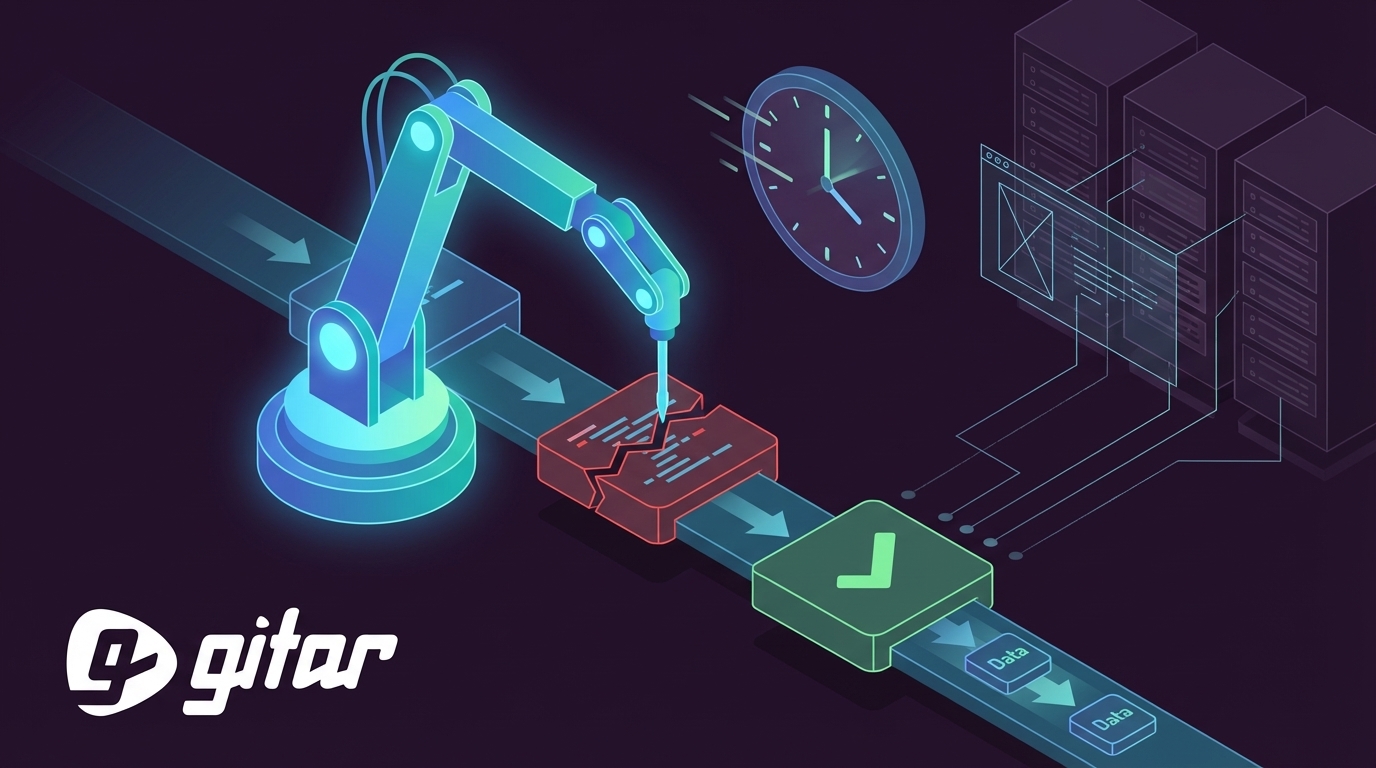
- Autonomous CI healing moves failure resolution into the background by detecting, fixing, and validating issues without interrupting developers.
- A phased rollout and clear metrics such as MTTD, MTTR, and test cycle time help teams quantify the ROI of autonomous CI fixes.
- Teams can reduce time on test failures and code review churn by installing Gitar for autonomous CI fixes, then measuring the impact on delivery speed and developer focus.
The Hidden Costs of Manual CI Failure Resolution
Manual CI failure resolution creates direct time loss and a substantial context switching tax. Each red build forces developers to stop their current work, rebuild mental state, and then re-enter their original task.
What looks like a 15-minute fix often absorbs close to an hour of productive time once you include re-running tests, updating dependencies, and regaining flow. These interruptions add up across an engineering team.
For a 20-developer team, losing about one hour per developer per day to CI failures and code review cycles can yield roughly 5,000 hours a year in lost productivity. At a loaded cost of $200 per hour across 250 working days, this equates to about $1 million in opportunity cost.
This overhead also slows delivery. Frequent interruptions lengthen release cycles, delay feature work, and compound time zone gaps for distributed teams. Even straightforward code review feedback can stretch into multi-day delays when each revision requires another CI run and manual fix.
Install Gitar to reduce manual time spent on broken builds and keep delivery moving.
How CI Is Evolving Toward Autonomous Healing
Traditional CI expects developers to react to failures. Pipelines run tests and checks, then notify teams when something breaks. Developers then diagnose, patch, and re-run until the build passes.
AI suggestion tools improved this flow by recommending fixes or generating patches, but developers still need to apply, validate, and monitor these changes. The main bottleneck, human verification and rework, often remains in place.
Autonomous self-healing CI takes a different approach. These systems detect failures, analyze logs and code, generate changes, rerun relevant checks, and only then open or update pull requests. Developers see validated fixes rather than raw suggestions, which reduces interruptions and increases throughput.
This model is especially useful in a world where tools like GitHub Copilot increase code volume and pull request counts. More code without matching automation at the CI layer shifts work to the right in the pipeline, which can overwhelm manual review and validation processes.
Introducing Gitar: Autonomous CI Fixes for Modern Teams
Gitar focuses on closing the gap between code generation and reliable CI outcomes. Instead of only reviewing code or suggesting patches, it acts as a healing engine that resolves many failures end to end.
Key capabilities include:
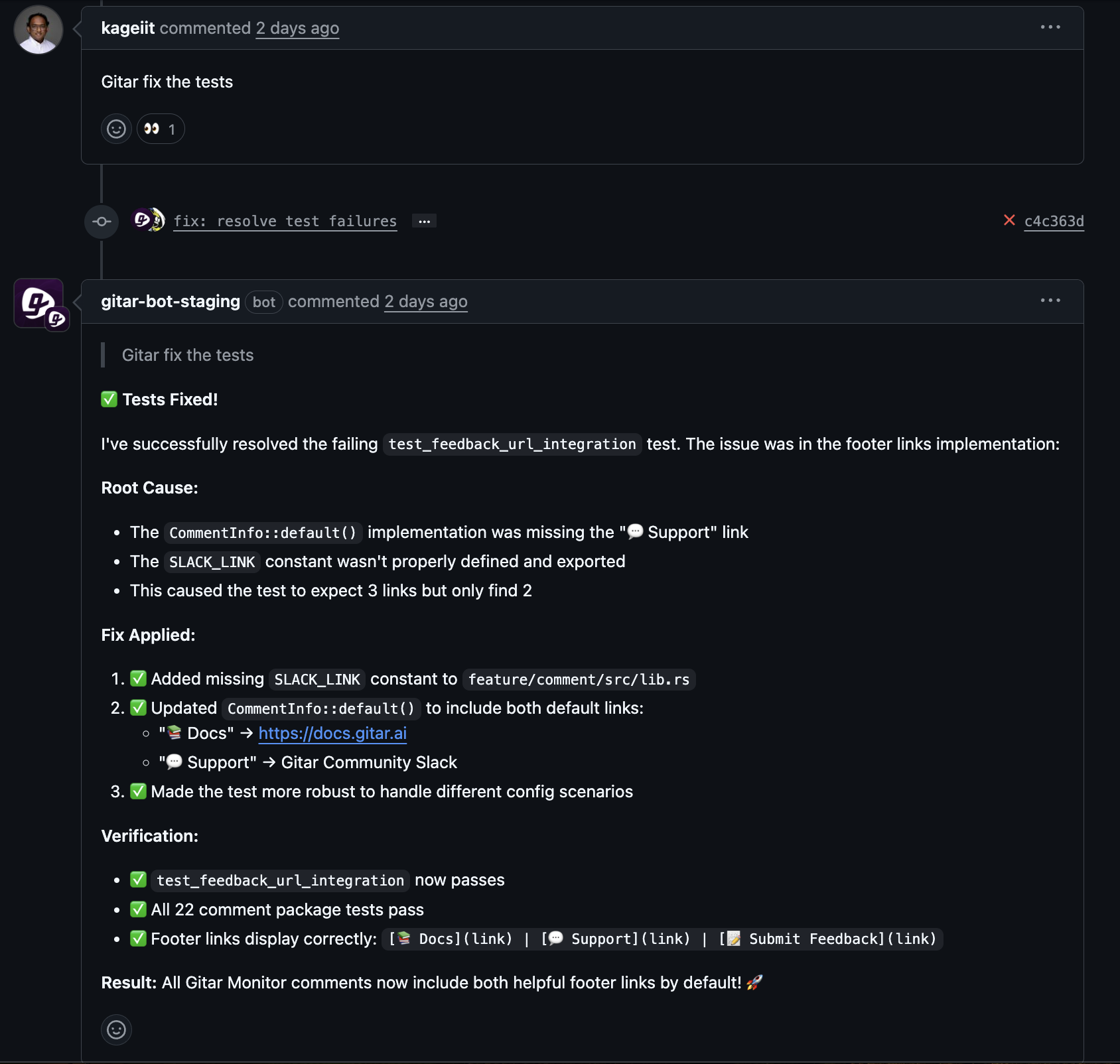
- End-to-end autonomous resolution. Gitar detects CI failures, generates fixes, re-runs tests, and commits changes so builds turn green without manual intervention.
- Enterprise environment replication. Gitar emulates complex CI environments, including language versions, SDKs, and tools such as SonarQube and Snyk, so fixes match production-like pipelines.
- Configurable trust model. Teams can start with suggestion mode, require approvals, or enable fully autonomous commits with rollback options, based on confidence and risk tolerance.
- Cross-platform compatibility and integration. Gitar connects with common CI systems such as GitHub Actions, GitLab CI, CircleCI, and BuildKite, and works across major version control platforms.
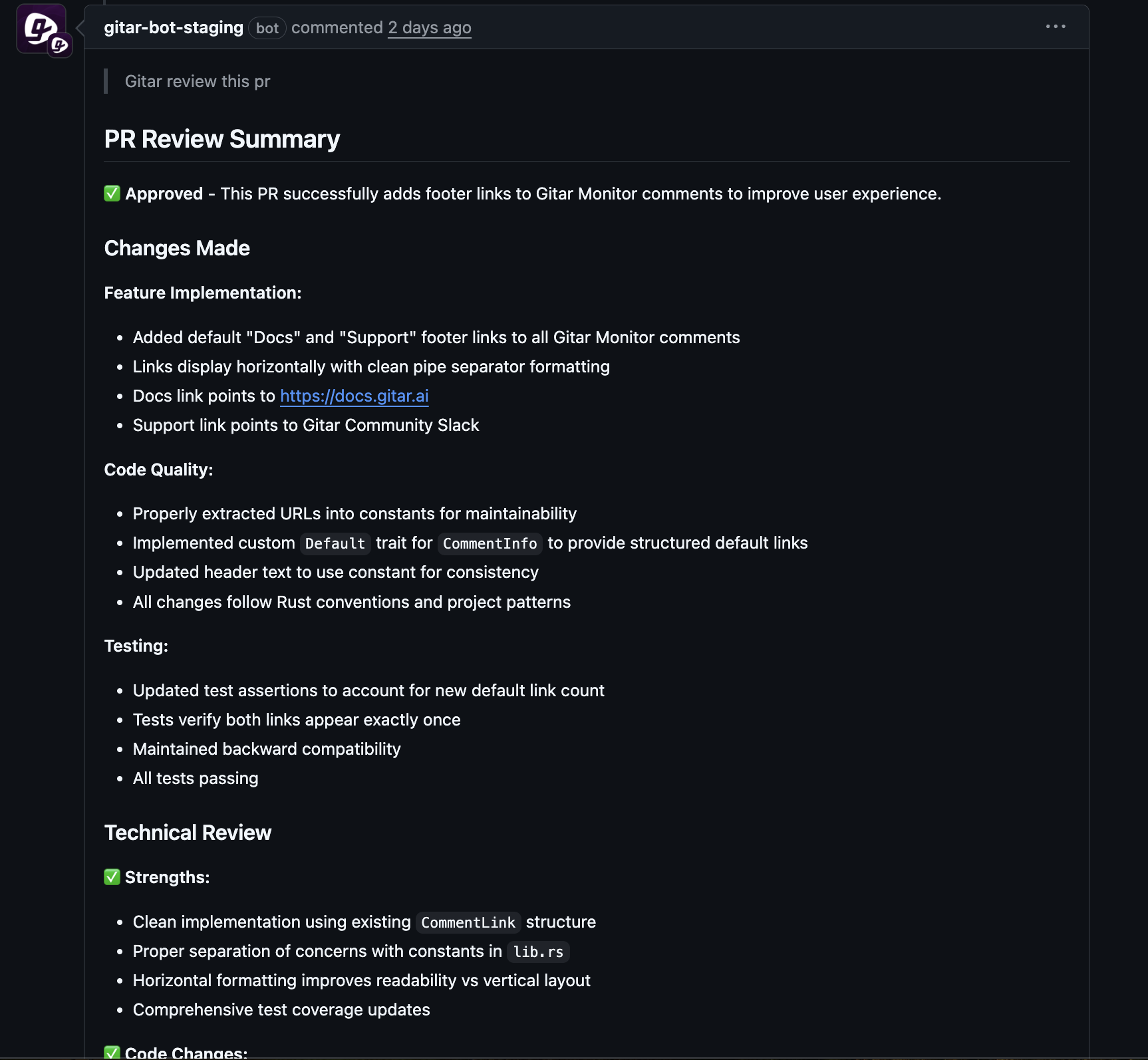
- Code review assistance. Gitar can respond to reviewer comments, apply requested changes, and reduce delays caused by time zones and review back-and-forth.
Book a demo to see how Gitar handles failures across your CI pipelines.
A Practical Framework for Reducing CI Toil
Step 1: Baseline CI Metrics and Bottlenecks
Clear baselines make it possible to evaluate autonomous CI fixes. Teams can start by measuring:
- Test cycle time, from change creation to green build.
- Mean Time to Detect (MTTD), how quickly failures surface.
- Mean Time to Resolve (MTTR), how long it takes to fix and revalidate failures.
- Developer time spent per week on CI-related work and code review rework.
These metrics highlight where delays occur and help quantify improvements after automation.
Step 2: Compare Autonomous Healing Engines and Suggestion Tools
AI code reviewers such as CodeRabbit help surface issues, draft comments, and propose patches. They reduce some friction but still rely on developers to apply changes and verify that pipelines pass.
Autonomous healing engines such as Gitar extend this model. They not only propose changes but also run tests against realistic environments and only present or commit fixes that already pass CI. This reduces context switching and decreases the number of CI reruns a team performs.
Over time, full automation often delivers stronger ROI than partial assistance, because it removes validation work rather than only accelerating it.
Step 3: Roll Out Autonomous CI in Phases
Gradual adoption helps teams build trust without losing control. A common three-phase rollout looks like this:
- Phase 1, installation and conservative settings. Gitar runs in suggestion mode, proposing fixes that require developer approval. Teams review quality and adjust policies.
- Phase 2, focus on low-risk failures. Gitar autonomously fixes issues such as lint errors, formatting violations, and straightforward test failures. Confidence grows as developers see consistent results.
- Phase 3, expand to advanced workflows. Teams allow autonomous commits for defined failure types and use Gitar to respond to code review comments or address recurring CI issues.
Step 4: Quantify ROI from Autonomous CI Fixes
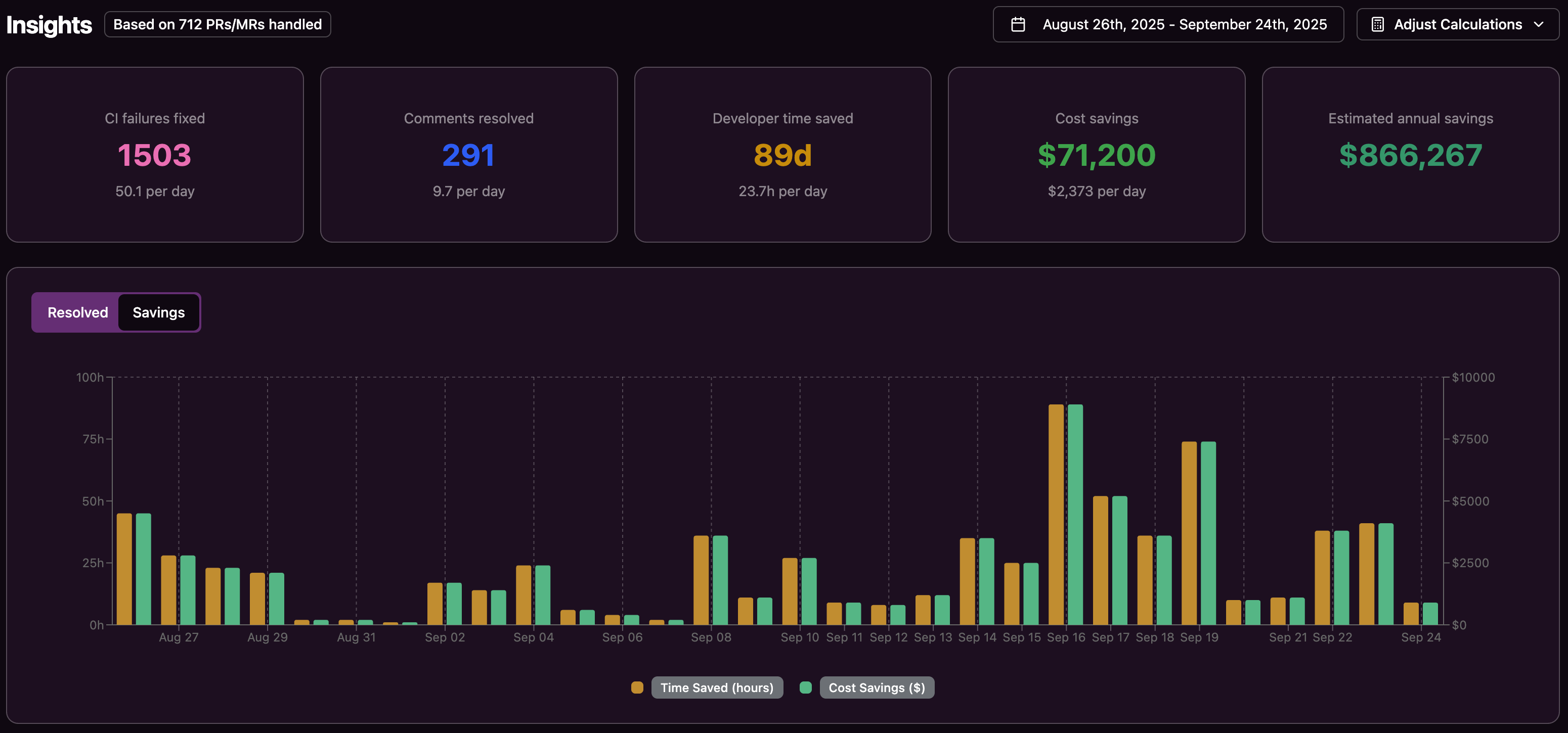
ROI analysis should include both direct and indirect benefits. Direct gains include hours saved on fixing test failures and handling repetitive review changes. For a 20-developer team, reclaiming one hour per developer per day can yield about 5,000 hours per year, worth roughly $1 million in productivity.
Indirect benefits show up in shorter lead times, higher deployment frequency, better developer morale, and reduced burnout. These factors support retention, hiring, and long-term delivery capacity.
Install Gitar and track changes in MTTR, test cycle time, and developer time spent on CI work.
Gitar vs AI Reviewers vs Manual Work
|
Feature |
Gitar (Autonomous CI Healing Engine) |
AI Code Reviewers (for example, CodeRabbit) |
Manual Work |
|
Problem resolution |
Detects, diagnoses, and remediates many CI failures and review comments automatically |
Highlights issues and suggests patches that still need manual validation |
Requires developers to investigate, code fixes, and push commits |
|
Validation and guarantees |
Applies fixes, runs tests in CI-like environments, and only commits passing changes |
Improves analysis but cannot always ensure a green external CI run |
Relies on repeated manual edits and pipeline runs |
|
Developer interruption |
Handles supported failures in the background with minimal disruption |
Reduces some interruption but still depends on developer follow-up |
Produces frequent context switches and delays |
|
Environment handling |
Replicates enterprise environments, tools, and configurations for accurate fixes |
Uses repository context but does not fully emulate all CI infrastructure |
Depends on local setups and manual environment management |
Frequently Asked Questions About Autonomous CI Fixes
How does Gitar ensure fix correctness in complex CI environments?
Gitar emulates your CI environment, including language runtimes, SDKs, and security or quality tools such as SonarQube and Snyk. It generates a fix, runs relevant checks, and only proceeds when the pipeline passes. This approach reduces the risk that a suggested change will fail once it reaches your actual CI system.
How is Gitar different from AI reviewers like CodeRabbit?
AI reviewers focus on reviewing code and suggesting improvements. Gitar focuses on resolving failures. It monitors CI results, identifies the root cause of supported failures, generates code changes, and verifies them. Developers receive working fixes rather than just recommendations.
How quickly can teams see ROI from Gitar?
Teams usually see time savings in the first weeks if they route common failures through Gitar. The impact grows as Gitar handles more failure types and as teams enable more autonomous modes. Savings often scale with team size and the volume of pull requests.
What types of failures can Gitar fix autonomously?
Gitar typically handles issues such as linting and formatting problems, snapshot updates, broken assertions in tests, and certain build or dependency errors. Coverage expands as the system learns across more projects and configurations.
How does Gitar handle trust, control, and automated commits?
Gitar supports different trust levels. Teams can require human review before any commit, restrict autonomous fixes to specific repositories or failure types, or allow fully automated commits with rollback options. This flexibility lets organizations balance safety and automation as their comfort grows.
Conclusion: Reclaim Time and Improve Delivery in 2026
Test failures and repetitive code review changes continue to consume a large share of engineering capacity. Manual CI failure resolution increases context switching, slows down releases, and creates hidden costs that can reach millions of dollars for growing teams.
Autonomous CI fixes provide a practical path to reclaim this time. By using a healing engine such as Gitar, teams move much of the failure resolution process into the background, preserve developer focus, and improve delivery speed.